
FILM-120 · Lesson 2 of 12 · 30 min
Pre-cinema and the invention of motion pictures
Cinema was not invented by one person in one moment. It emerged in the 1880s and 1890s from a long history of projected images, optical toys, photography, scientific motion studies and popular entertainment, combined with new mechanical and chemical technologies. This lesson traces that pre-history, explains how motion pictures create the impression of movement, and follows the competing inventors who turned moving photographs into a commercial medium by 1895 and 1896. It ends with Georges Méliès, the stage magician who showed that cinema could tell fantastic stories.
Projected images before film
People were projecting images long before photography. The camera obscura, a darkened room or box with a small hole that projects an inverted image of the outside world, was described by scholars in the ancient and medieval worlds and used by artists in the Renaissance. From the seventeenth century, the magic lantern projected painted glass slides onto a wall or screen using a lamp and lens. Travelling lanternists gave shows of landscapes, comic scenes and religious images, and by the late eighteenth century the phantasmagoria used lanterns on moving carriages, smoke and sound effects to stage ghost shows that terrified audiences.
Lantern shows already contained many elements of later cinema: a darkened room, a seated audience, a bright projected image, a showman who narrated, music, and sequences of images that told a story. Mechanical slides with moving parts, and dissolving views that blended one image into another, gave lanternists simple ways to suggest motion and the passing of time.
Optical toys and the illusion of motion
In the nineteenth century, scientists and toymakers produced devices that made drawings appear to move. They exploited the way human vision fuses a rapid series of slightly different still images into the impression of continuous motion.
- Thaumatrope (1820s): a disc with a different image on each side, such as a bird and a cage, which merge into one when the disc is spun.
- Phenakistiscope (1832–1833): a spinning slotted disc with a sequence of drawings; viewed in a mirror through the slots, the drawings appeared to move.
- Zoetrope (patented in the 1860s): a rotating drum with slits and a strip of drawings inside, which several people could watch at once.
- Praxinoscope (1877): Émile Reynaud replaced the slits with a ring of mirrors, giving a brighter, steadier image; from 1892 his Théâtre Optique projected long hand-painted strips for paying audiences in Paris.
These toys revealed two principles that cinema still depends on. First, the image must change in small steps. Second, each image must be seen briefly and then replaced, with a moment of darkness or blocking between images so they do not smear. The slits of the zoetrope do the same job as the shutter in a film projector.
The older textbook explanation, "persistence of vision", suggested that the eye holds an image like a fading stamp. Perception researchers now explain apparent motion mainly through the brain's processing of rapidly changing stimuli, sometimes called the phi phenomenon and beta movement, combined with flicker fusion: above a certain rate of flashing, light appears steady. The details are still studied, but the practical result is clear. Show slightly different images fast enough, with the flicker hidden, and viewers see motion.
Photography and motion studies
Photography arrived in 1839 with the daguerreotype and the paper processes of William Henry Fox Talbot. Early exposures took minutes, far too long to capture motion. By the 1870s, faster plates made short exposures possible. In 1878, in California, the photographer Eadweard Muybridge used a row of cameras triggered by threads to photograph a galloping horse, showing that all four hooves leave the ground at once. He later photographed thousands of sequences of people and animals moving, and projected some of them with a device he called the zoopraxiscope.
In France, the physiologist Étienne-Jules Marey developed a photographic gun in 1882 and then chronophotography, recording successive phases of movement on a single plate and later on a strip of film. Marey was interested in science, not entertainment, but his use of a moving strip of light-sensitive material pointed the way toward motion picture cameras.
Two more ingredients were needed: a flexible, transparent base to carry many images in sequence, and a mechanism to move it, stop it for each exposure and move it again. Flexible celluloid roll film, sold for still cameras by George Eastman's company in the late 1880s, supplied the first. The intermittent mechanism, adapted from sewing machines and clockwork, supplied the second.
Edison, Dickson and the Kinetoscope
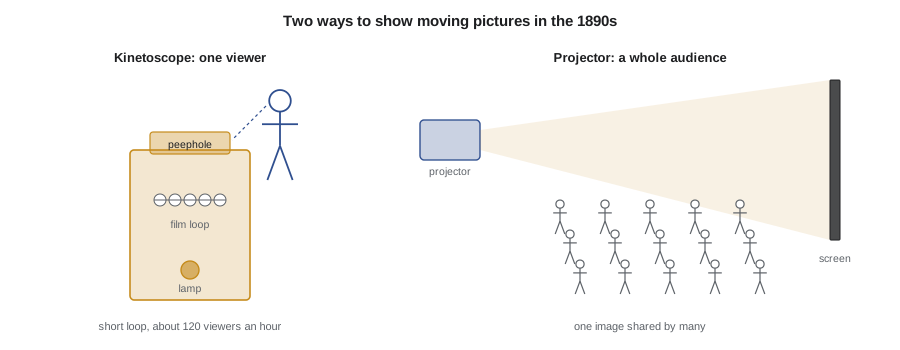
In the United States, Thomas Edison's laboratory in New Jersey pursued moving pictures as a companion to the phonograph. Most of the practical work was done by Edison's employee William Kennedy Laurie Dickson and his colleagues. By the early 1890s they had built the Kinetograph camera, which used 35 mm wide celluloid film with four perforations on each side of every frame, a format that became the international standard for more than a century. The Kinetoscope, a peephole viewer, showed a short loop of film to one viewer at a time.
The first commercial Kinetoscope parlour opened in New York in April 1894, and parlours soon spread to other cities and abroad. Films were made in the Black Maria, a tar-paper studio that rotated on a track to follow the sun. Subjects were short: vaudeville acts, strongmen, dancers, boxing matches, a man sneezing. Edison was slow to embrace projection, partly because he believed one viewer per machine would earn more money.
The Lumière brothers and projection
In France, Auguste and Louis Lumière, who ran a large photographic plate factory in Lyon, developed the Cinématographe, a lightweight hand-cranked machine that could act as camera, film printer and projector. On 28 December 1895 they held a paid public screening for an audience in a basement room of the Grand Café in Paris, often cited as the birth of cinema as a public entertainment. Their programme of short films, each lasting less than a minute, showed workers leaving the family factory, a baby being fed, a gardener tricked by a boy who steps on his hose, and similar everyday scenes.
The Cinématographe was portable, so Lumière operators were sent around the world to film and project. They recorded street scenes, ceremonies and landscapes, creating some of the earliest travel films and newsreels. Within months, projection spread across Europe and North America.
The Lumières were not alone. In Germany, the Skladanowsky brothers projected films in Berlin in November 1895 with their Bioscop. In the United States, Edison's company acquired the rights to a projector developed by Thomas Armat and C. Francis Jenkins and marketed it as the Vitascope, with a first New York theatrical screening in April 1896. Several other inventors in Britain and elsewhere were working on similar machines. Historians now speak of a cluster of inventions rather than a single invention.
Moving pictures reached Canada quickly. Projected films were shown in Montreal in June 1896, and in Ottawa that summer, where a Vitascope programme was presented at an amusement park. Within a few years, travelling exhibitors carried projectors to towns across the country, and Canadian scenes were among the subjects filmed by visiting operators.
How a film camera and projector work
The basic mechanism invented in the 1890s remained the heart of film cameras and projectors for a century. A strip of film is pulled down by a claw engaging the perforations, held still in the gate while the shutter opens for exposure or projection, and then moved again while the shutter closes. The intermittent movement turns continuous motion into a series of stills, and the shutter hides each movement so viewers see only stationary frames.
Early filmmakers cranked cameras and projectors by hand, so speeds varied. Silent films were commonly shot at about 16 to 18 frames per second in the early years, though speeds rose over the silent era and projectionists often ran films faster. When synchronized sound arrived, speed had to be fixed, and 24 frames per second became the standard. To reduce visible flicker at low frame rates, projector shutters were designed with two or three blades, flashing each frame two or three times.
Worked problem
Frames, feet and running time
Standard 35 mm film has 16 frames per foot. How many feet of film pass through a projector each minute at 16 frames per second and at 24 frames per second? How long would a 1,000-foot reel last at each speed?
Show solution
- At 16 frames per second: \( 16 \div 16 = 1 \) foot per second, so \( 60 \) feet per minute.
- At 24 frames per second: \( 24 \div 16 = 1.5 \) feet per second, so \( 90 \) feet per minute.
- Reel time at 16 fps: \( 1000 \div 60 \approx 16.7 \) minutes.
- Reel time at 24 fps: \( 1000 \div 90 \approx 11.1 \) minutes.
Answer: A 1,000-foot reel runs about 16.7 minutes at 16 fps but only about 11 minutes at 24 fps, which is why the faster sound speed used about 50 % more film for the same running time. It also explains why silent films projected at sound speed look sped up and jerky.
Actualities: the first films
Most of the earliest films were actualities: short, single-shot records of real events and everyday life. The camera was usually set up on a tripod and left running until the reel ran out. Subjects included trains arriving at stations, waves breaking, city traffic, parades, factory workers and famous people. Audiences were fascinated simply by seeing the world move on a screen, especially details such as leaves trembling or smoke drifting.
A well-known legend says that audiences at an early Lumière screening fled in terror as a train seemed to rush toward them. Historians are sceptical; there is little contemporary evidence for panic, and the story may have grown in later retellings. The legend survives because it expresses something true: the realism of moving photographs was astonishing to the first viewers.
Alongside actualities, early filmmakers staged comic scenes, re-enactments of news events, dances and magic tricks. The line between documentary and fiction was blurred from the start. Some early war films, for example, were re-enacted in fields or studios and sold as if they were real.
Georges Méliès and the cinema of attractions
Georges Méliès was a Paris stage magician who saw the Lumière programme in 1895 and soon began making films himself. He built a glass-walled studio and produced hundreds of short films between 1896 and the early 1910s. Méliès discovered and refined in-camera effects: stopping the camera to make objects appear or vanish (the substitution splice), multiple exposures, dissolves and painted sets. His most famous film, A Trip to the Moon (1902), sends a group of astronomers to the moon in a shell fired from a cannon; it ran about 14 minutes, long for its time, and was widely copied and pirated, especially in the United States.
Méliès's films were often hand-coloured frame by frame, and he staged scenes like theatre, facing the camera, with the frame as a proscenium arch. He built narrative through a series of tableaux rather than through editing within scenes. His business declined in the 1910s as longer, more narratively complex films took over, and much of his work was destroyed. Later rediscovered and celebrated, he is remembered as a pioneer of special effects and fantasy cinema.
The film historian Tom Gunning described early cinema as a cinema of attractions: films that addressed the audience directly and offered spectacle, surprise and display rather than absorbing them in a story. A magic trick, a speeding train or an exotic landscape was the point. This idea helps us see early films on their own terms rather than as clumsy attempts at later narrative cinema, and it suggests that spectacle has never left cinema. Today's effects blockbusters still offer attractions alongside story.
Patents, competition and the business of early film
From the start, motion pictures were a business shaped by patents and competition. In the United States, Edison's company sued rivals for infringing its patents, and in 1908 the leading companies formed the Motion Picture Patents Company, a trust that tried to control cameras, projectors and film stock. Independent producers resisted, and some moved production to California, partly for the climate and varied landscapes and partly to work far from the trust's base in the east. Federal courts ruled against the trust in 1915, and by then the independents were becoming the major studios of Hollywood.
| Year | Event | Place |
|---|---|---|
| 1878 | Muybridge photographs a galloping horse in sequence | California |
| 1882 | Marey builds his photographic gun | France |
| 1891–1893 | Edison and Dickson develop the Kinetograph and Kinetoscope | New Jersey |
| 1894 | First commercial Kinetoscope parlour opens | New York |
| 1895 | Skladanowsky brothers project films in Berlin; Lumière paid screening in Paris on 28 December | Germany and France |
| 1896 | Vitascope theatrical screening; projected films reach Canada | New York, Montreal and Ottawa |
| 1902 | Méliès releases A Trip to the Moon | France |
Worked problem
How much faster did screenings grow than single viewers?
A Kinetoscope showed a 20-second film to one person at a time and could serve about 120 viewers an hour if lines were full. A projector showed a 20-minute programme to an audience of 200, with 10 minutes between shows. How many viewers per hour could each serve?
Show solution
- Kinetoscope: about 120 viewers per hour, as stated.
- Projector cycle: \( 20 + 10 = 30 \) minutes, so 2 shows per hour.
- Projector viewers: \( 2 \times 200 = 400 \) per hour.
- Ratio: \( 400 \div 120 \approx 3.3 \).
Answer: Even with breaks, a single projector could serve more than three times as many viewers an hour as a peephole machine, and each viewer saw a whole programme rather than one short loop. This economic advantage helps explain why projection won.
Common mistakes
MistakeSaying one person invented cinema
InsteadDescribe a cluster of inventors and technologies that came together in the 1890s
MistakeAssuming silent films were meant to look sped up
InsteadRecognize that they were shot slower, often around 16 to 18 frames per second, and are distorted when run at sound speed
MistakeTreating early films as failed attempts at modern narrative
InsteadSee them as a cinema of attractions with their own aims
MistakeBelieving the train-panic legend as documented fact
InsteadTreat it as a later story with little contemporary evidence
MistakeThinking documentary and fiction were separate from the start
InsteadNote that early films mixed actualities, staged scenes and re-enactments
Summary and key terms
- Magic lanterns and optical toys anticipated cinema's darkened rooms, projected images and illusion of motion.
- Apparent motion depends on a rapid series of slightly different images with the flicker hidden by a shutter.
- Muybridge and Marey's motion studies and Eastman's celluloid roll film supplied key ingredients for motion pictures.
- Edison and Dickson's Kinetoscope (1894) used 35 mm perforated film but showed films to one viewer at a time.
- The Lumières' Cinématographe screening on 28 December 1895 is often cited as the birth of cinema as public projection.
- Méliès developed in-camera effects and fantasy narratives, and early films are often described as a cinema of attractions.
- Patents and trusts shaped the early American industry, and independents moving west helped create Hollywood.
- Magic lantern
- A device that projected painted glass slides using a lamp and lens
- Zoetrope
- A rotating slotted drum that animated a strip of drawings
- Chronophotography
- Marey's technique of photographing successive phases of movement
- Kinetoscope
- Edison's peephole viewer for showing films to one person at a time
- Cinématographe
- The Lumière brothers' camera, printer and projector
- Intermittent movement
- The mechanism that pulls film down one frame and holds it still for exposure or projection
- Actuality
- An early non-fiction film recording a real event or everyday scene
- Substitution splice
- Stopping the camera to replace or remove an object, making it seem to appear or vanish
- Cinema of attractions
- Early cinema's emphasis on spectacle and direct address rather than absorbing narrative
- Motion Picture Patents Company
- A trust formed in 1908 by leading American film companies to control patents and the industry
Practice problems
Work each problem on paper first, then reveal the answer to check.
What did the zoetrope's slits do?
Show answer
They briefly revealed each drawing and blocked the view between drawings, like a shutter.
What did Muybridge's 1878 photographs show?
Show answer
That all four hooves of a galloping horse leave the ground at once.
Why did the Kinetoscope lose out to projection?
Show answer
It served one viewer at a time, while a projector entertained a whole audience.
When and where did the Lumières hold their paid public screening?
Show answer
On 28 December 1895 at the Grand Café in Paris.
How many feet per minute does 35 mm film run at 24 fps?
Show answer
\( 24 \div 16 \times 60 = 90 \) feet per minute.
How long does a 400-foot reel last at 16 fps?
Show answer
\( 400 \div 60 \approx 6.7 \) minutes.
Name two effects Méliès used.
Show answer
Any two of: substitution splices, multiple exposures, dissolves, painted sets, colour added by hand.
What is an actuality?
Show answer
A short early film recording a real event or everyday scene.
Why did some American producers move to California in the 1910s?
Show answer
For the climate and landscapes, and to work far from the patent trust in the east.
What two ingredients did roll film and the intermittent mechanism supply?
Show answer
A flexible strip carrying many images and a way to move, stop and expose it frame by frame.
Lesson quiz · 5 questions
Score 60% or more to complete this lesson.
Create a free account to save your progress, take quizzes and earn a certificate.