
ELV-430 · Lesson 9 of 12 · 20 min
A troubleshooting method for elevators
While the Tillicum crew waited for the acceptance date, Lena sent Tamsin back to Route 7 for two weeks to cover Ray's callbacks. On her second morning, Seaview Medical car 2 shut down twice before nine o'clock with a door lock fault and then ran perfectly for the rest of the day, which is the kind of call that teaches more than any classroom. Troubleshooting is the part of the trade that the certification exam tests hardest and that mechanics are most proud of, and it is a skill with a method, not a talent. This lesson sets out the method; lessons 10 and 11 apply it to electrical and control faults and to mechanical faults, noise and ride quality.
Start with the complaint
Every callback starts with a report, and the report is evidence. Who saw the problem, what exactly happened, when, on which floor, in which direction, with how many people, and what did the car do next? A passenger who says the elevator dropped may mean the car fell, the car levelled down sharply, or the car stopped hard in an emergency stop; each points somewhere different. The building staff often know more than they put in the call: the car always does it in the morning, the car does it after the cleaners mop the lobby, the car started doing it after the new tenant moved in. Tamsin's first question at Seaview, before she opened any cabinet, was to the security guard who had called it in: what did the car do, and had it done it before? It had, he said, three times last week, always early.
The second source is the unit's own record. The maintenance control program's callback log shows whether this is new or a pattern, and what was done last time. The controller's fault log, which ELV-310 described, records the faults with their time, the car's position and state, and often the condition of the inputs at the moment of the fault. Seaview car 2's log showed five door lock faults in eight days, all between 6:40 and 8:55 in the morning, four of them at floors 1 and 2, and none after mid-morning. A pattern like that is half the diagnosis.
Make it safe, then look
Before investigating, the mechanic puts the unit in a safe state for the work: the car removed from service, passengers out, the controller in the mode the work needs, and lockout applied wherever the work exposes the mechanic to hazardous energy or movement. A fault that has stopped happening is no reason to skip this, and neither is a fault that seems to be in a harmless circuit: safety circuits are exactly where intermittent faults live. The first look is with the senses: smell for burning, listen for unusual sounds, look for water, broken parts, loose wires, scorch marks and anything disturbed since the last visit. A car that has been working well and suddenly faults has usually been changed by something, whether wear, weather, a person or another trade.
Understand the system, then divide it
A mechanic cannot find a fault in a system they do not understand. The second step is to work out, from the wiring diagram and the controller's documentation, what has to happen for the car to do what it failed to do, and therefore which parts could cause the symptom. For a door lock fault, the controller is saying that it expected the door lock circuit, the chain of hoistway door interlock contacts in series, to be closed, and found it open, or found it closed when it expected it open. The suspects are every interlock contact, every connection and wire in the chain, the controller input and anything that can open the circuit mechanically, such as a door that is pushed or a contact that is bumped.
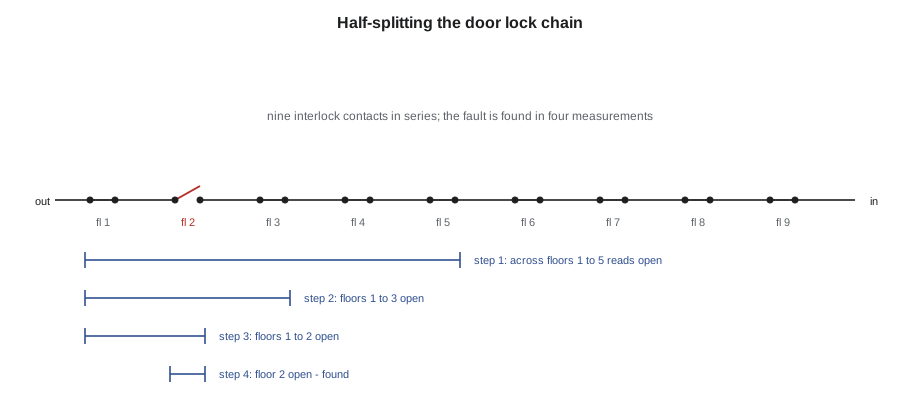
With the suspects listed, the fastest way to find the fault is usually to divide the system in half, test at the middle, and keep the half that contains the fault, then divide again. This is the half-split method. A chain of sixteen contacts can be searched in four measurements by halving, where testing each contact in turn could take sixteen. It works best on series circuits, such as the safety circuit and the door lock chain, and on signal paths with test points, and it depends on the measurement being reliable. When a fault is intermittent, the halving has to be done while the fault is present, or by watching several points at once with a recorder, which lesson 10 covers.
# Half-split search of a series chain against checking each device in turn
import math, random
random.seed(7)
def half_split(n, faulty):
    lo, hi, steps = 0, n - 1, 0           # the fault is somewhere in devices lo..hi
    while lo < hi:
        mid = (lo + hi) // 2
        steps += 1                        # measure across devices lo..mid
        if faulty <= mid:
            hi = mid
        else:
            lo = mid + 1
    return steps
for n in (8, 16, 32, 64):
    trials = [random.randrange(n) for _ in range(2000)]
    hs = sum(half_split(n, f) for f in trials) / len(trials)
    seq = sum(f + 1 for f in trials) / len(trials)
print(f"{n:3d} devices: half-split {hs:4.1f} measurements on average (at most {math.ceil(math.log2(n))}), one by one {seq:5.1f}")8 devices: half-split 3.0 measurements on average (at most 3), one by one 4.4 16 devices: half-split 4.0 measurements on average (at most 4), one by one 8.4 32 devices: half-split 5.0 measurements on average (at most 5), one by one 16.4 64 devices: half-split 6.0 measurements on average (at most 6), one by one 32.8
Form a hypothesis and test it
Measurements suggest a cause; a hypothesis states it in a way that can be tested. 'The floor 2 interlock contact opens when the car passes' can be tested by watching that contact with a meter or a recorder while the car runs past. 'Morning faults come from condensation on the floor 1 and 2 interlocks when the lobby doors open to cold air' can be tested by checking the contacts when the fault happens, by comparing the times with the building's door schedule and the outside temperature, and by heating or drying the contacts and seeing if the fault stops. A good hypothesis explains every fact, including the facts that seem odd, such as why the fault never happens after mid-morning. A hypothesis that explains some facts and ignores the others is a guess.
At Seaview, Tamsin half-split the door lock chain during the next morning's fault, which the guard helped her catch by calling the moment the car stopped. The open was between floors 1 and 2, and at the floor 2 interlock the contact's resistance was high and unstable. The contact was wet. The hospital had changed its entrance doors over the summer, and the new lobby doors stood open for long periods during the morning shift change, letting cold, damp air into the lobby and up the hoistway to the floor 2 entrance, which sat right above the lobby doors. As the building warmed through the morning, the condensation dried and the faults stopped. Every fact fitted.
Fix the cause, not the symptom
Replacing the floor 2 interlock contact would have stopped the faults for a while, but the cause was the cold air and the condensation, and the new contact would have corroded too. The fix had three parts. The floor 2 and floor 1 interlock contacts were cleaned and replaced with the sealed contacts the maker offered for damp locations; the hoistway door header at floor 2 was sealed where cold air leaked through; and Tamsin wrote to Seaview's facilities manager explaining the effect of the lobby doors and suggesting a closer or an air curtain, which the hospital later fitted. A useful habit is to ask why five times: the car stopped because the door lock circuit opened; it opened because the contact was wet; it was wet because cold air condensed on it; the air was cold because the lobby doors stood open; they stood open because of how the new doors were used at shift change. The fix belongs as far down that chain as the mechanic can reach, and the rest belongs in a written note to the people who can reach further.
Verify and record
A fix is not proven until the unit has run under the conditions that caused the fault. Seaview car 2 had to get through several cold mornings without a door lock fault before Tamsin closed the callback; she asked the guard to call if it stopped and checked the controller's fault log remotely each morning for two weeks. The record of the callback in the maintenance control program described the complaint, the pattern, the measurements, the cause, the fix and the follow-up, in enough detail that the next mechanic could use it. A callback record that says 'adjusted doors, OK' teaches nothing and hides the next fault.
# Callback record check: does the record answer the questions the next mechanic will ask?
record = {
    "complaint": "car shut down with door lock fault, mornings only",
    "pattern": "5 faults in 8 days, 06:40 to 08:55, floors 1 and 2",
    "measurements": "floor 2 interlock contact about 40 ohm and unstable during a fault",
    "cause": "condensation from cold lobby air on floor 2 and floor 1 interlock contacts",
    "fix": "sealed contacts fitted at floors 1 and 2, header sealed at floor 2",
    "follow-up": "fault log checked daily for 2 weeks; facilities told about the lobby doors",
}
needed = ["complaint", "pattern", "measurements", "cause", "fix", "follow-up"]
missing = [k for k in needed if not record.get(k)]
for k in needed:
    print(f"{k:12s}: {record.get(k, '')}")
print("complete record" if not missing else f"missing: {', '.join(missing)}")complaint : car shut down with door lock fault, mornings only pattern : 5 faults in 8 days, 06:40 to 08:55, floors 1 and 2 measurements: floor 2 interlock contact about 40 ohm and unstable during a fault cause : condensation from cold lobby air on floor 2 and floor 1 interlock contacts fix : sealed contacts fitted at floors 1 and 2, header sealed at floor 2 follow-up : fault log checked daily for 2 weeks; facilities told about the lobby doors complete record
Habits of good troubleshooters
Experienced mechanics share a handful of habits. They believe the evidence over their first idea, and change their minds when a measurement disagrees. They change one thing at a time, so that they know what fixed the fault. They put back anything they disturbed, and never leave a jumper or a bypass in a circuit, however sure they are of the fault. They are suspicious of coincidences, such as a fault that started the week another trade worked in the hoistway. They use the maker's documentation and the unit's own diagnostics before their memory. They call for help when they are stuck, because a second mechanic sees what the first has stopped seeing. And they record what they learned, because every unit has its own habits. Moira told Tamsin that the exam tests the method as much as the facts: a candidate who reads a fault scenario and jumps to a part is usually wrong, and one who works through the system usually finds the answer even on a type of equipment they have never seen.
Worked problem
A fault that is not where it appears
A car occasionally stops between floors with a safety circuit fault, always while going up, never going down. The safety circuit runs through switches in the pit, hoistway, car top and machine room. Where should the search start?
Show solution
- A fault tied to the direction of travel points to something that moves differently going up and going down.
- Switches operated by the car's motion, such as a slack rope switch, a car top switch rubbing a cam or a travelling cable conductor flexing at one point, are good suspects.
- The travelling cable bends at a different point as the car moves; going up, the loop rises toward the hitch.
- Watch the safety circuit at the controller with a recorder during up runs and half-split it while the fault is present.
Answer: Start with what moves with the car and changes with direction, such as the travelling cable and car-operated switches, and catch the fault in the act with a recorder.
Common mistakes
MistakeStarting with a part instead of the complaint.
InsteadGather the report, the callback log and the fault log first.
MistakeTesting devices one by one in a long chain.
InsteadHalf-split the chain to find the fault in a few measurements.
MistakeAccepting a hypothesis that leaves facts unexplained.
InsteadA good hypothesis explains every fact, including the odd ones.
MistakeReplacing the failed part and closing the call.
InsteadFix the cause, and report the parts of the cause you cannot fix.
MistakeRecording 'adjusted, OK'.
InsteadRecord the complaint, pattern, measurements, cause, fix and follow-up.
Summary and key terms
- The complaint, the callback log and the controller fault log are evidence; patterns in time, place and direction are half the diagnosis.
- Make the unit safe before investigating, then look with all the senses for change.
- Understand what must happen for the car to work, list the suspects and divide the system with half-split measurements.
- Form a hypothesis that explains every fact and test it, ideally while the fault is present.
- Fix the cause as far down the chain of whys as possible and report the rest.
- Verify under the conditions that caused the fault, then record enough for the next mechanic.
- Half-split method
- Testing at the middle of a system and keeping the half that contains the fault, repeatedly.
- Hypothesis
- A testable statement of the suspected cause of a fault.
- Intermittent fault
- A fault that comes and goes, often with conditions such as temperature or load.
- Root cause
- The underlying reason for a fault, as opposed to the part that failed.
- Fault log
- The controller’s record of faults with time, position and state.
- Five whys
- Asking why repeatedly to trace a fault back to its cause.
Practice problems
Work each problem on paper first, then reveal the answer to check.
Why ask the person who reported the fault what exactly happened?
Show answer
Different descriptions point to different causes, and they often know patterns.
How many measurements does a half-split take on a chain of 32 devices?
Show answer
At most five.
What makes a hypothesis good?
Show answer
It explains every fact and can be tested.
Why did replacing the floor 2 contact alone not fix the Seaview fault?
Show answer
The cause was condensation, which would corrode the new contact too.
When is a fix proven?
Show answer
When the unit has run under the conditions that caused the fault without it returning.
Lesson quiz · 5 questions
Score 60% or more to complete this lesson.
Create a free account to save your progress, take quizzes and earn a certificate.