
ELV-430 · Lesson 3 of 12 · 21 min
Code triggers and permits for alterations
ELV-410 ended with the permit for Tillicum car 1 issued and two conditions attached. That review was done from the inspector's side of the table. This lesson looks at the same rules from the side of the crew that has to build the job: how the code decides what an alteration brings with it, how to read those requirements before the drawings are drawn, how the permit process runs in practice, and what happens when the crew finds something on site that the permit did not cover. Moira Kessler, who had written the eleven findings, came to the shop one evening in the first week of the outage to go through them again with the crew, because, as she put it, a finding fixed on paper still has to be fixed in steel.
How alterations bring requirements
When equipment is altered, the code does not require the whole unit to be brought up to the current edition. Instead, Section 8.7 lists the common alterations one by one, for electric elevators, hydraulic elevators, escalators and the other equipment, and for each one it names the requirements of the current edition that must then be met, usually for the parts affected and sometimes for related safety features. Anything not listed for that alteration may stay as it was, as long as it was lawful when installed and is kept in safe condition. This is the principle ELV-410 lesson 11 described: an alteration pulls particular requirements forward, not the whole book. The authority adopts the edition and may add its own amendments or orders on top, so the first step is always to check which edition and amendments apply where the unit is, as finding 1 at Tillicum showed: the right reference was B44-16 with the BC amendments, not B44:19.
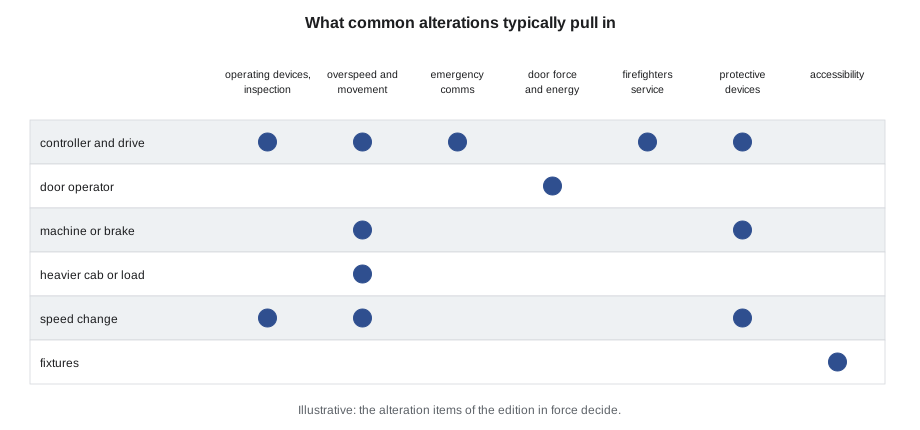
Some alterations bring more than they seem to. Replacing a relay controller with a microprocessor controller is more than a change of box, because the controller decides how the car moves, opens its doors and responds to its safety devices. The alteration item for a controller change typically pulls in the requirements for the controller itself, the operating devices and inspection operation (including a car top inspection station), the protection against ascending car overspeed and unintended car movement, emergency operation and signalling such as firefighters' service where it is fitted, the emergency communication system, the electrical protective devices and how they are wired, and the motor drive and its control. Changing the door operator pulls in the door closing force and kinetic energy limits and the reopening device. Changing the machine, the brake, the rated speed, the rated load, the travel or the type of operation each bring their own lists. Because the lists differ between editions, the crew works from the edition in force, not from memory or from the last job.
Reading the requirements before drawing
Priya's habit, which she passed on to Tamsin, was to make a requirements list before the first drawing. For each alteration in the scope she wrote down the requirements the edition pulls in, then for each requirement the equipment that would meet it, then for each piece of equipment what it needed from the building: power, space, wiring, a hole in a wall, a fire alarm connection. The list then became the backbone of the permit drawings and of the pretest checklist in lesson 8, so that nothing was designed without a reason or tested without a requirement behind it.
Three of the Tillicum requirements reached beyond the elevator contractor's own work, and they show why the list matters. The car lighting had to move to a separate circuit with its own disconnect, which meant an electrician working on the building's panel. Firefighters' service needed the fire alarm initiating devices in the lobby, the machine room and the hoistway connected to the new controller, which meant the fire alarm contractor and finding 10's test with the fire alarm technician present. And the machine room needed ventilation with a temperature sensor, which meant a hole through an exterior wall and a building permit separate from the elevator permit. Each of these was a separate trade with its own schedule, and Lena put them on the critical path chart from lesson 2.
# A requirements list for an alteration package (illustrative grouping; check the edition in force)
pulls = {
    "controller and drive": ["inspection operation and car top station", "ascending car overspeed and unintended movement",
                             "electrical protective devices", "emergency communication", "firefighters' service",
                             "motor drive and machine control"],
    "door operator": ["door force and kinetic energy limits", "reopening device"],
    "fixtures": ["accessibility of controls and signals"],
    "car lighting circuit": ["separate car lighting supply and disconnect"],
}
needs = {
    "firefighters' service": ("fire alarm contractor", "initiating devices wired to the controller"),
    "separate car lighting supply and disconnect": ("electrician", "new circuit from the building panel"),
    "ascending car overspeed and unintended movement": ("elevator crew", "rope gripper on the machine beams"),
    "emergency communication": ("telephone provider", "line or cellular unit in the machine room"),
}
scope = ["controller and drive", "door operator", "fixtures", "car lighting circuit"]
seen = set(); others = []
for alt in scope:
    for req in pulls[alt]:
        if req in seen:
            continue
        seen.add(req)
        who, what = needs.get(req, ("elevator crew", "in the elevator contract"))
        print(f"{alt:22s} -> {req:48s} [{who}]")
        if who != "elevator crew":
            others.append((who, what))
print(f"{len(seen)} requirements; other trades needed:")
for who, what in others:
print(f" {who}: {what}")controller and drive -> inspection operation and car top station [elevator crew] controller and drive -> ascending car overspeed and unintended movement [elevator crew] controller and drive -> electrical protective devices [elevator crew] controller and drive -> emergency communication [telephone provider] controller and drive -> firefighters' service [fire alarm contractor] controller and drive -> motor drive and machine control [elevator crew] door operator -> door force and kinetic energy limits [elevator crew] door operator -> reopening device [elevator crew] fixtures -> accessibility of controls and signals [elevator crew] car lighting circuit -> separate car lighting supply and disconnect [electrician] 10 requirements; other trades needed: telephone provider: line or cellular unit in the machine room fire alarm contractor: initiating devices wired to the controller electrician: new circuit from the building panel
The permit process in practice
In British Columbia, alterations to elevating devices need an installation permit from Technical Safety BC before the work starts, issued to a licensed contractor on an application that includes drawings, the alteration description and the code edition used; the work is then inspected and accepted before the unit returns to service. The authority can accept a variance where an existing condition cannot reasonably meet the requirement, with conditions; Tillicum's retractable pit ladder was accepted that way. The application, any variance requests and the authority's replies are part of the job file, and the crew carries a copy of the permit and its conditions on site.
Most permit problems come from three places: drawings that do not match what is built, work that goes beyond the permitted scope, and conditions that are forgotten. The first is handled by keeping the drawings current; when the crew changes a routing or a device location on site, the change is marked on the drawings that night. The second is handled by stopping: if the crew finds that more work is needed than the permit covers, such as a cracked machine beam or a hoistway door frame that has to be replaced, the work is described and the authority asked before it is done. The third is handled by putting the conditions on the pretest checklist, where they cannot be missed. Tillicum's two conditions were the car top guardrail and the variance for the retractable ladder, and both went onto the checklist on the first day.
When the site disagrees with the permit
Old buildings hide things. In the second week, Ray and Jonah removed the old hoistway wiring and found that the steel channel supporting the travelling cable hitch at mid-hoistway was cracked through at one bolt hole. It was not in the survey, because it had been hidden behind the old wiring trough. It was not in the permit, because nobody knew about it. Replacing a hitch support is normally a repair, but Ray did not decide that on his own. He photographed it, measured it, marked the car out of service in the job log for that area and called Priya, who called the consultant and wrote a short note to the authority describing the finding and the proposed replacement with a like-for-like channel. The reply came the next day: a repair, to be shown at the acceptance inspection. The point was not the answer but the process: a crew that changes the work without telling anyone can lose the inspector's trust for the rest of the job.
Other surprises are bigger. A machine beam found corroded, a rail bracket pulling out of a rotten concrete wall, an interlock of an unapproved type or an unrecorded earlier alteration can each change the permit. In each case the crew stops that part of the work, records the finding, informs the supervisor, and lets the supervisor, the owner and the authority decide. None of this means stopping the whole job; the controller wiring at Tillicum went on while the hitch channel question was answered.
Temporary operation during the work
A modernization takes a car through stages: the old system dismantled, the new one partly installed, the car run on temporary controls to set equipment and then on its new controller before every safety function is proven. During those stages the car must not carry the public, and many authorities allow its use by the crew only under the contractor's procedures, with the hoistway barricaded and the car's entrances locked. ELV-120 described construction use of new elevators; modernization temporary operation follows the same idea in an occupied building. The rules the crew followed at Tillicum were simple: the car carried crew and materials only, the lobby entrance was locked and signed, every jumper was logged in and out on a board in the machine room, and nobody rode the car without the safety circuit proven for the mode in use.
# Permit and inspection timeline for Tillicum car 1 (calendar days from application)
steps = [  # (step, days)
    ("application with drawings submitted", 0),
    ("authority questions answered", 21),
    ("permit issued with conditions", 38),
    ("controller delivered (long-lead order placed at approval)", 136),
    ("outage starts", 140),
    ("pretests complete", 200),
    ("acceptance inspection", 207),
]
prev = 0
for step, day in steps:
    print(f"day {day:4d}  (+{day - prev:3d})  {step}")
    prev = day
print(f"application to return to service: {steps[-1][1]} days, about {steps[-1][1] / 30.4:.1f} months")
print("the controller lead time, not the permit, set the start of the outage")day 0 (+ 0) application with drawings submitted day 21 (+ 21) authority questions answered day 38 (+ 17) permit issued with conditions day 136 (+ 98) controller delivered (long-lead order placed at approval) day 140 (+ 4) outage starts day 200 (+ 60) pretests complete day 207 (+ 7) acceptance inspection application to return to service: 207 days, about 6.8 months the controller lead time, not the permit, set the start of the outage
The timeline is a reminder that the paperwork is not the slow part of most modernizations. The permit took five or six weeks; the controller took fourteen weeks after approval; the outage took ten weeks. What the paperwork does is set the rules for everything that follows, and a crew that knows them works faster because it does not have to undo anything.
Worked problem
Is it inside the permit?
During a controller modernization, the owner asks the crew to also replace the cab's ceiling and wall panels with heavier stone, since the car is out of service anyway. The permit covers the controller, drive, doors and fixtures. What should the crew do?
Show solution
- A heavier cab changes the car weight, which affects the counterweight balance, traction, the rated load table and possibly the safety and buffer ratings.
- That makes it an alteration in its own right, not part of the permitted work.
- Tell the owner that it needs to be added to the scope and reviewed, and that the drive set-up depends on the final car weight.
- Do not install it until the supervisor and the authority have approved the change.
Answer: Treat the heavier cab as a new alteration: stop, explain the effect on balance and ratings, and get it added and approved before doing it.
Common mistakes
MistakeBringing the whole unit up to the latest edition by habit.
InsteadThe alteration items say what is pulled in; check the edition in force.
MistakeWorking from the last job's requirement list.
InsteadLists differ between editions and authorities; start from the code in force.
MistakeFixing a hidden defect without telling anyone.
InsteadRecord it, inform the supervisor and let the authority decide if it changes the permit.
MistakeForgetting the other trades a requirement needs.
InsteadList electrical, fire alarm, telephone and building work early and schedule it.
MistakeLeaving permit conditions to the end.
InsteadPut them on the pretest checklist on the first day.
Summary and key terms
- An alteration pulls particular requirements of the current edition forward, as Section 8.7 lists; it does not modernize everything.
- Controller changes reach far: inspection operation, overspeed and unintended movement protection, emergency operation and communication, protective devices and the drive.
- Make a requirements list before drawing: requirement, equipment, and what each needs from the building and other trades.
- The permit is issued to a licensed contractor; drawings stay current, scope changes go back to the authority and conditions go on the checklist.
- Hidden defects found on site are recorded and referred, not quietly fixed.
- During the work, the car carries only the crew under the contractor's temporary operation rules.
- Alteration item
- An entry in Section 8.7 naming a common alteration and the requirements it brings.
- Requirements list
- A list of what the alteration's code items require and what each needs from the building.
- Variance
- Permission from the authority to depart from a requirement, usually with conditions; some authorities call it a modification.
- Permit condition
- A requirement added by the authority when issuing a permit.
- Temporary operation
- Use of a car by the crew during the work, under the contractor’s procedures.
- Job file
- The permit, drawings, correspondence, test records and changes kept for the job.
Practice problems
Work each problem on paper first, then reveal the answer to check.
Does an alteration bring the whole unit up to the current edition?
Show answer
No; only the requirements listed for that alteration, for the affected parts and related features.
Name three trades besides the elevator crew a controller modernization may need.
Show answer
An electrician, the fire alarm contractor and the telephone provider, sometimes a builder.
What should a crew do on finding a cracked support not in the survey?
Show answer
Record it, stop that work, inform the supervisor and let the authority decide whether the permit changes.
Why put permit conditions on the pretest checklist?
Show answer
So they are not forgotten before acceptance.
What usually takes longer: the permit or the controller delivery?
Show answer
The controller delivery.
Lesson quiz · 5 questions
Score 60% or more to complete this lesson.
Create a free account to save your progress, take quizzes and earn a certificate.