
ELV-430 · Lesson 6 of 12 · 21 min
Door equipment and fixture upgrades
Doors cause more elevator callbacks and more passenger injuries than anything else, and on Tillicum car 1 they had caused nearly a third of the callbacks in the survey. The critical path in lesson 2 ran through the door work, and Lena had put two crews on it. This lesson covers the door and fixture part of a modernization: replacing the car door operator and the car door equipment, rebuilding the hoistway doors floor by floor, adjusting the new doors to the force, energy and timing limits, and replacing the hall and car fixtures and the emergency communication equipment. ELV-320 covered how doors and their protective devices work, and ELV-410 covered the code and accessibility requirements; here the subject is doing the work in an old building.
The car door operator
Tillicum's original operator was a DC motor with a resistor and cam arrangement: cams on the operator shaft switched resistors in and out to slow the door near the ends of its travel, and its speed and force depended on the adjustment of the cams, the condition of the resistors and the motor's brushes. The new operator was a closed-loop unit with a permanent-magnet motor, a belt drive to the car door and its own controller, which measured the door position with an encoder and drove the door along a programmed speed profile, detecting obstructions from the motor current. A closed-loop operator gives the same door motion every time, which is what makes it possible to set the closing speed close to the code's energy limit and still be sure it stays below it.
The operator and the car door hanger assembly were mounted on the car top with the car on inspection operation and the car top guardrail installed first, because the guardrail was a permit condition and the crew wanted it in place before anyone spent days working on the car top. The car door clutch, or vane, which engages the hoistway door rollers to open the hoistway door with the car door, was set to the dimensions the operator maker specified from the hoistway door rollers, with the running clearance checked at every floor once the hoistway doors were done.
Rebuilding the hoistway doors
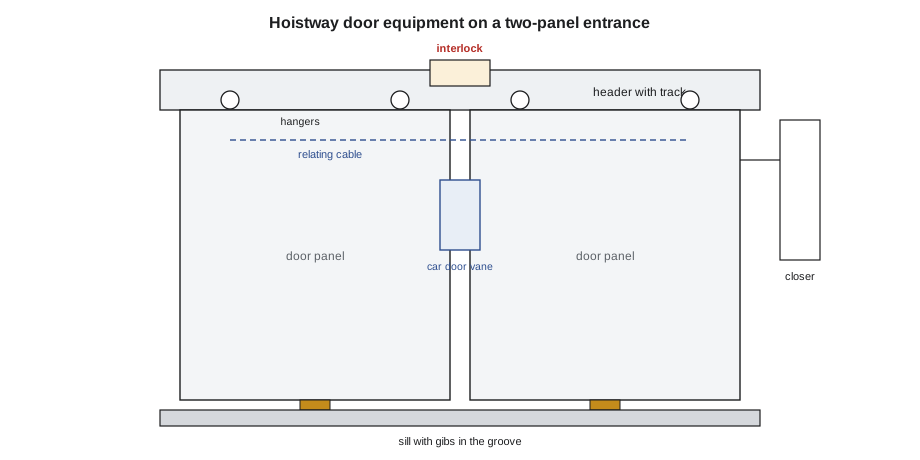
Each of Tillicum's nine hoistway entrances had a pair of centre-opening door panels on hangers running on a track, interlocked by a lock on the header, with a closer to shut them when the car leaves, gibs in the sill to guide the panel bottoms, and a fire rating that the panels and frame must keep. The scope replaced the hangers, tracks, interlocks, closers, gibs and the relating cables between the two panels, and kept the panels, frames and sills, which were sound. The work is repetitive and is done one floor at a time: the panels are taken down, the old equipment removed, the header cleaned and the new track set level and to the right height, the new hangers fitted, the panels rehung, the relating cable tensioned so the two panels meet in the middle, the gibs fitted, the closer set, and the interlock mounted and adjusted.
The interlock is the most important part of the entrance, because it is what stops the car moving unless the hoistway door is closed and locked, and stops the door being opened from the landing unless the car is there. The lock's engagement, the distance its hook or latch overlaps its keeper before the electrical contact makes, must be at least the minimum the interlock's maker and the code require, and each interlock is tested by trying to open the locked door by hand from the landing and by checking that the car cannot run with the door unlocked. Fire-rated entrances keep their rating only with listed hardware fitted as the listing allows, so the new hangers and interlocks were chosen from the door equipment maker's listed parts for those doors.
# Hoistway door rebuild schedule: one crew against two (working days)
floors = 9
days_per_floor = 1.0          # strip, set track, rehang, interlock, adjust
check_day = 1                   # final running check of all floors with the car
for crews in (1, 2):
    per_crew = -(-floors // crews)          # floors per crew, rounded up
    days = per_crew * days_per_floor + check_day
    print(f"{crews} crew(s): {per_crew} floors each, {days:.0f} working days for the hoistway doors")
print("with two crews the door work drops off the critical path by about four days")1 crew(s): 9 floors each, 10 working days for the hoistway doors 2 crew(s): 5 floors each, 6 working days for the hoistway doors with two crews the door work drops off the critical path by about four days
Setting closing force, energy and time
Closing doors must not hit a passenger hard enough to hurt them. The code limits the force needed to stop a closing door, measured at the middle third of its travel, and the kinetic energy of the closing door system, which depends on the mass of everything that moves (the car door panels, the hoistway door panels, hangers, relating parts and the operator's moving parts) and the speed. ELV-320 gave the limits: the stall force no more than 135 N (30 lbf), and the average kinetic energy no more than about 10 J (7.37 ft-lbf) with a working reopening device, lower without one. Because heavier doors carry more energy at the same speed, the closing speed is set from the door mass, and the minimum closing time over the measured opening follows from it.
# Closing speed and minimum closing time from kinetic energy (centre-opening, two panels each side)
mass = 140                 # kg, all moving door parts: car and hoistway panels, hangers, relating parts
opening = 1.07              # m, clear opening width
ke_limit = 10               # J, average closing energy limit with a reopening device
# for a centre-opening door, each panel set travels half the opening
travel = opening / 2
v_max = (2 * ke_limit / mass) ** 0.5
t_min = travel / v_max
print(f"moving mass {mass} kg, travel per side {travel:.2f} m")
print(f"highest average closing speed for {ke_limit} J: {v_max:.2f} m/s")
print(f"minimum closing time over the travel: {t_min:.1f} s")
set_time = 3.0
print(f"set closing time {set_time} s:", "ok" if set_time >= t_min else "too fast")moving mass 140 kg, travel per side 0.54 m highest average closing speed for 10 J: 0.38 m/s minimum closing time over the travel: 1.4 s set closing time 3.0 s: ok
The operator was then set up from its own menu: the door width learned by a slow learn run, the closing and opening speed profiles, the reversal sensitivity and the force limit. Tamsin measured the closing force with a calibrated force gauge at the middle of the travel on three floors, and the closing time over the measured distance with a stopwatch on every floor, because hoistway door panels are not all identical and a heavy or stiff panel can change the result. The door times that matter to passengers were set too: how long the doors stay open after a hall call is answered, which accessibility rules set from the distance a passenger must walk to reach the car, and how long they stay open after a car call.
The new full-height light curtain replaced the old mechanical safety edge, which had reopened the door only after it touched someone. The light curtain's emitters and receivers were mounted on the car door edges, wired to the operator, and checked across their full height with a test rod, including the bottom beams near the sill, because a curtain that misses a child's foot or a cane is not doing its job. The reopening device is part of the energy limit: with it working, the higher limit applies, and if it fails the operator must close only at the reduced energy or stop, depending on the design and the code edition, which the pretests in lesson 8 checked by blocking it.
Fixtures
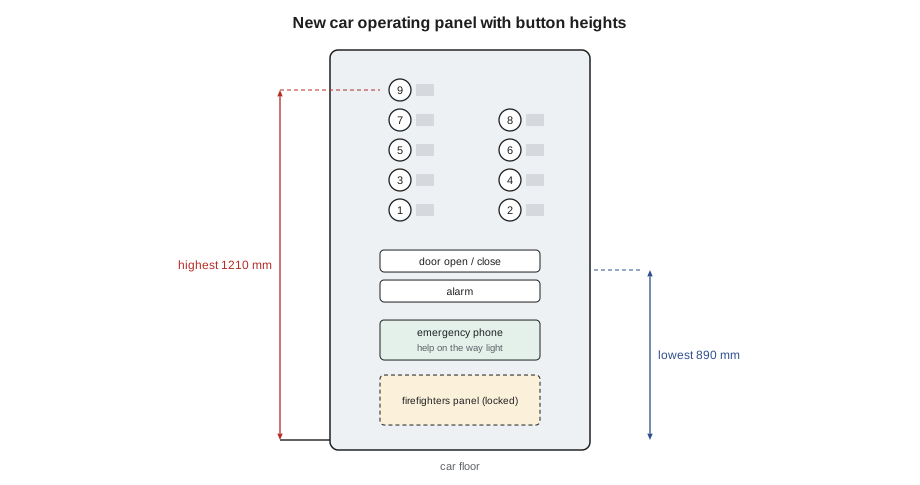
Fixtures are everything the passenger touches or sees: hall call stations, hall lanterns and position indicators, the car operating panel, the car position indicator and voice announcer, the emergency stop or alarm button, and the emergency communication device. On a modernization they are usually all replaced together, because new fixtures talk to the new controller over its serial links and because accessibility requirements apply to them. Accessible fixtures have raised characters and braille beside each button, buttons of a minimum size that light when pressed, the highest operable button within the reach height the accessibility rules set, hall lanterns visible from the waiting area with audible signals that sound once for up and twice for down, and an audible signal or voice announcement of the floor as the car stops. ELV-410's lesson 9 set out the requirements; on site, the crew's job is to mount the fixtures at the heights and positions the drawings show and check them with a tape measure before the inspector does.
# Fixture height check from the installed positions (centre line of the highest and lowest buttons)
max_reach = 1220       # highest operable button, mm above the floor
min_height = 380      # lowest button, mm above the floor
installed = {           # fixture: (highest button, lowest button), mm
    "car operating panel": (1210, 890),
    "lobby hall station": (1070, 1000),
    "floor 2 to 9 hall stations": (1070, 1000),
    "fire service key switch (lobby)": (1830, 1830),
}
for f, (hi, lo) in installed.items():
    ok = hi <= max_reach and lo >= min_height
print(f"{f:34s} highest {hi:>6} lowest {lo:>6} {'ok' if ok else 'MOVE'}")car operating panel highest 1210 lowest 890 ok lobby hall station highest 1070 lowest 1000 ok floor 2 to 9 hall stations highest 1070 lowest 1000 ok fire service key switch (lobby) highest 1830 lowest 1830 MOVE
The check flagged the firefighters' key switch in the lobby, which the drawing had placed at the height of the old switch. Firefighters' controls are not passenger controls, and their location is set by the firefighters' service requirements rather than by the passenger reach range, so Priya checked the requirement, confirmed the drawing was right and added a note so that the inspector would see why it was high. A check that flags something is still worth running, as long as someone reads the result.
Emergency communication
Tillicum car 1's old emergency phone was a handset in a cabinet behind a panel, with a bell button beside it. The new one was a hands-free unit in the car operating panel that dialled a monitored centre with one button press, identified the car's location to the person answering, and lit a sign telling the passenger that help was on the way. ELV-410 found that the communication requirements differed between the two sites. In British Columbia, under the edition adopted with its amendments, the requirement was for two-way voice communication with an indication that the call had been answered. The telephone line or cellular unit was the owner's to provide, and the unit was tested with the monitoring centre on the day of the pretests.
Old building, new holes
The fixture work raised the problem every modernization in an old building raises: the new fixtures did not match the old wall openings. The hall stations were smaller than the old ones, which left gaps in the plaster at every floor, and the hall lanterns were in a different place. Priya had measured the openings during the survey, so the scope included cover plates sized to hide the old openings at the hall stations, and the owner's contractor patched and painted the lantern openings. Small things like this decide how an owner remembers a modernization, and they are much cheaper to plan than to fix after the walls are finished.
Worked problem
A door that passes on one floor and fails on another
After the door rebuild, the closing time is 3.0 s on eight floors and 2.6 s on floor 6, with the same operator settings. What is likely, and what should be done?
Show solution
- The operator drives the car door the same way at every floor, so the difference comes from the hoistway door at floor 6.
- A shorter time suggests the floor 6 panels are lighter or freer; a stronger closer spring on that floor pulling the doors closed faster is a common cause.
- Check the closer setting, the panel weights and the relating cable at floor 6; compare with a floor that is right.
- Correct the hoistway door, then measure the closing time and force again at floor 6 and record it.
Answer: Find the difference in the floor 6 hoistway door, usually the closer, correct it and remeasure; never speed-correct the whole operator for one floor.
Common mistakes
MistakeWorking on the car top before the guardrail is in.
InsteadInstall permanent protection first when it is part of the scope.
MistakeSetting door speed by eye.
InsteadCalculate the minimum closing time from the moving mass and measure it on every floor.
MistakeUsing unlisted hardware on fire-rated entrances.
InsteadUse the listed parts allowed for those doors.
MistakeTesting a light curtain only at waist height.
InsteadTest across the full height, including near the sill.
MistakeForgetting the old wall openings.
InsteadMeasure them in the survey and plan cover plates or repairs.
Summary and key terms
- Doors cause most callbacks; closed-loop operators give repeatable motion close to the limits.
- Hoistway doors are rebuilt floor by floor; the interlock's engagement and function are checked at each.
- Closing force and kinetic energy are limited; the minimum closing time follows from the moving mass.
- Light curtains replace contact edges and are tested across their full height.
- Fixtures are replaced together and mounted to accessibility heights; firefighters' controls follow their own rules.
- Emergency communication requirements depend on the edition in force; test with the monitoring centre.
- Closed-loop door operator
- An operator that measures door position and controls its speed and force continuously.
- Interlock
- A device that keeps a hoistway door locked unless the car is there and prevents running unless it is locked.
- Relating cable
- The cable that ties the two panels of a centre-opening door together.
- Gib
- A guide on the bottom of a door panel running in the sill groove.
- Light curtain
- A row of light beams across the door opening that reopens the door if broken.
- Door vane
- The car door part that engages the hoistway door rollers to open the hoistway door.
Practice problems
Work each problem on paper first, then reveal the answer to check.
Why does a heavier door need a longer closing time?
Show answer
Kinetic energy rises with mass at the same speed, so the speed must be lower.
Where is the closing force measured?
Show answer
In the middle third of the door travel.
Why are the closing time and force checked on several floors?
Show answer
Hoistway door panels differ, and a heavy or stiff panel changes the result.
What do hall lanterns signal audibly?
Show answer
Once for up and twice for down.
Why was the lobby fire service switch above the passenger reach height?
Show answer
Firefighters' controls are located by firefighters' service rules, not the passenger reach range.
Lesson quiz · 5 questions
Score 60% or more to complete this lesson.
Create a free account to save your progress, take quizzes and earn a certificate.