
ELV-320 · Lesson 6 of 12 · 20 min
Door adjustment and maintenance
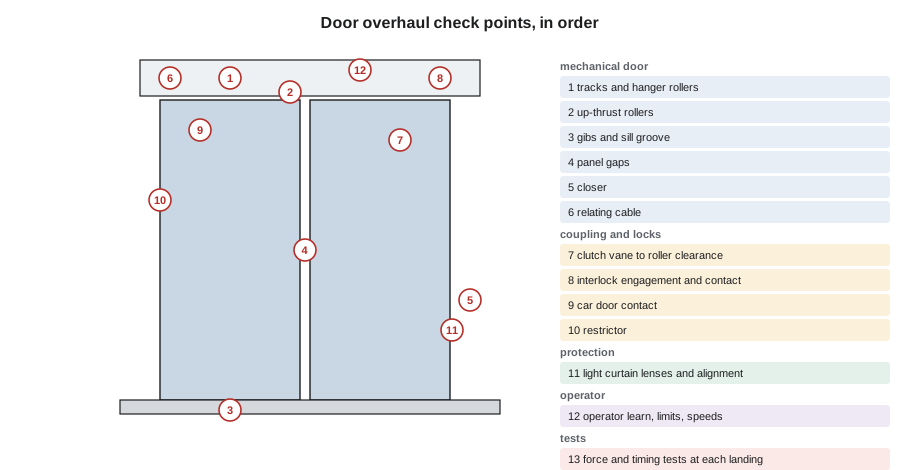
Priya's door overhauls follow the same order every time, and she made Tamsin write it on the inside cover of her field log: mechanical first, then the operator, then the protection, then the tests. "If you adjust the operator to suit a door that drags, you have hidden the problem until the next callback," she said. "Fix the door so it moves freely by hand, then make the operator move it properly, then prove the protection works, then measure." This lesson follows that order through a full door overhaul at Quayside car 4, and then looks at how door work fits into the maintenance control program and how door faults are recorded and trended.
Door work in the maintenance control program
Every elevator in service must have a written maintenance control program, required by Part 8 of the code, listing the maintenance tasks, how often they are done and how they are recorded. Doors take more of it than any other part of the elevator. Typical door tasks include examining and cleaning tracks, sills and gibs; checking hangers, rollers and up-thrust rollers; checking closers and relating cables; checking the clutch and its alignment with each landing's rollers; checking interlocks, contacts and restrictors; checking the reopening device; and checking closing force and timing. The intervals depend on how hard the doors work: a busy office car doing more than a thousand door cycles a day needs its doors examined far more often than a car in a small apartment building. The program must be available to the inspector and the owner, and the records must show what was done and found.
# Door cycles and roller wear: when will the hanger rollers need replacing? (illustrative)
cycles_per_day = {"Quayside car 4": 1400, "Larchmont": 420, "Tillicum car 1": 650, "Holloway car 1": 900}
roller_life = 2_500_000        # door cycles a hanger roller lasts in this service (maker's guide, illustrative)
cycles_done = {"Quayside car 4": 1_950_000, "Larchmont": 260_000, "Tillicum car 1": 2_300_000, "Holloway car 1": 800_000}
for car, per_day in cycles_per_day.items():
    left = roller_life - cycles_done[car]
    months = left / per_day / 30.4
    flag = "plan replacement now" if months < 6 else ""
print(f"{car:<16} {per_day:5d} cycles a day, about {months:5.1f} months of roller life left {flag}")Quayside car 4 1400 cycles a day, about 12.9 months of roller life left Larchmont 420 cycles a day, about 175.4 months of roller life left Tillicum car 1 650 cycles a day, about 10.1 months of roller life left Holloway car 1 900 cycles a day, about 62.1 months of roller life left
Quayside car 4 and Tillicum car 1 are both close to the end of their rollers' typical life, which is why car 4 was on the overhaul list. Door controllers on modern cars count cycles, and Northcrest copies the counts into its records at each visit so that wear parts are changed on a plan rather than after a failure.
Step 1: the mechanical door
With the car on inspection at the floor, the operator disconnected or the drive arm unhooked so the door can be moved by hand, and the hoistway protected, Priya began with the car door, then each hoistway door in turn. Each panel should move along its whole travel with an even, light push, without tight spots, noise or bounce. The checks are those of lesson 3: tracks clean and dry; hanger rollers free, round and quiet; up-thrust rollers at the maker's clearance; gibs complete, unworn and running freely in a clean sill; panels plumb and not rubbing the frame; relating cable tight and the panels arriving together; closers closing and locking the door from every position. On car 4, three hoistway doors had worn rollers with flat spots, one had a cracked gib and the floor 18 closer cable was frayed. All were replaced with the maker's listed parts.
Panel gaps are checked at the same time. The code limits the clearance between the panels and the frame and between panels when the doors are closed, so that a hand or object cannot be pushed through, with a small extra allowance for wear; panels that have sagged on worn hangers or been struck by carts often exceed it, and the fix is to reset the hangers or replace damaged panels. Sills are checked for damage and for the running clearance to the car sill.
Step 2: clutch, rollers and locks
Next comes the coupling between the car door and each hoistway door. The clutch vanes must pass each landing's interlock rollers with the right clearance when the car runs past, and grip them properly when the door opens. Too little clearance and the vanes strike the rollers in passing, which can open a lock in flight, as in lesson 4. Too much and the vanes miss the rollers or catch them late, so the hoistway door opens with a jerk or not at all. The clearance between the vanes and the rollers, and between the rollers and the car sill, is measured at every landing, and the maker gives the ranges. Interlocks are checked for engagement and contact sequence, car door contacts for operation, and the restrictor for its function outside the unlocking zone.
# Clutch vane to interlock roller clearance at each landing (maker's range, illustrative)
low, high = 6.0, 12.0
survey = {12: 9.0, 13: 8.5, 14: 4.5, 15: 9.5, 16: 13.5, 17: 8.0, 18: 9.0}
for floor, c in survey.items():
    if c < low:
        msg = "too close: vanes may strike rollers in passing"
    elif c > high:
        msg = "too far: vanes may miss or catch late"
    else:
        msg = "ok"
    print(f"floor {floor}: {c:5.1f} mm  {msg}")
bad = [f for f, c in survey.items() if not low <= c <= high]
print("adjust rollers at floors", bad)floor 12: 9.0 mm ok floor 13: 8.5 mm ok floor 14: 4.5 mm too close: vanes may strike rollers in passing floor 15: 9.5 mm ok floor 16: 13.5 mm too far: vanes may miss or catch late floor 17: 8.0 mm ok floor 18: 9.0 mm ok adjust rollers at floors [14, 16]
Floor 14 was too close, the same landing where car 3 had nuisance reversals in lesson 2 and where the cars share a lobby wall that was rebuilt last year. Floor 16 was too far. Both rollers were reset on their slotted mountings and the survey repeated. Priya noted that a pattern of clearances drifting at several floors would point to the car itself, from worn guide shoes or a car running off centre, rather than to the landings.
Step 3: the operator
Only when the mechanical door moves freely and the coupling is right is the operator adjusted. On a closed-loop operator like car 4's, the work is mostly done with the door controller's service menu: run the learn cycle so the operator measures the door's travel and load, check that the open and closed limits are where the door stops, check the speed, acceleration and slow-zone parameters against the maker's settings and the data plate's minimum closing time, and check the obstruction detection and force limit. On an older resistor-and-cam operator like Tillicum's, the order is to set the cams for the slowdown points first, then the resistor bands for speed, then the checking and closing, and to time the door after each step.
Two points matter on every operator. Separate landing profiles, which some operators allow, must not be used to make one floor's door faster than the data plate allows to cover a drag problem. And after any change, the operator's settings must be written into the records, because the next mechanic needs to know what the door was set to when it was right.
Step 4: the protection and the tests
The reopening device is checked last before the tests: light curtain lenses cleaned, strips aligned and secured, the curtain's own status lights or self-test checked, and the reopening response tested at several heights, including low near the sill, at each landing. Nudging operation is checked if it is enabled. Then come the tests that prove the work: closing force at several landings, closing time through the code zone against the data plate, and a full set of door cycles at each landing on automatic. Priya's own final test, from lesson 1, follows: ride the car, block the doors by hand and with a cart, and watch the doors at each floor from the lobby side.
# Door overhaul record summary: anything left open?
items = {"tracks, sills, gibs": "done", "hanger and up-thrust rollers": "done (3 landings rollers replaced)",
         "closers and relating cable": "done (floor 18 closer cable replaced)",
         "clutch to roller clearances": "done (floors 14 and 16 reset)", "interlocks and contacts": "done",
         "restrictor": "done", "light curtain": "done", "operator learn and settings": "done",
         "closing force": "done", "closing time vs data plate": "pending"}
open_items = [k for k, v in items.items() if not v.startswith("done")]
for k, v in items.items():
    print(f"{k:<30} {v}")
print("car may return to service" if not open_items else f"NOT READY: {', '.join(open_items)}")tracks, sills, gibs done hanger and up-thrust rollers done (3 landings rollers replaced) closers and relating cable done (floor 18 closer cable replaced) clutch to roller clearances done (floors 14 and 16 reset) interlocks and contacts done restrictor done light curtain done operator learn and settings done closing force done closing time vs data plate pending NOT READY: closing time vs data plate
The record ends with a clear statement of whether the car can return to service. Tamsin's first overhaul record had the timing test still pending; Priya sent her back to time the door at every landing before signing it off.
Common door faults and their causes
| Symptom | Common causes |
|---|---|
| Door slow at one landing | drag at that hoistway door: rollers, gibs, sill debris, closer, panel rubbing |
| Door slow at every landing | car door or operator: car door hangers, operator belt, operator settings |
| Door reverses with nothing in the way | dirty or misaligned light curtain; drag read as obstruction by a closed-loop operator |
| Door slams on closing | operator slow zone lost or too short; closer too strong; worn checking |
| Door stops just short of closed | weak closer; drag near closed position; interlock or car door contact out of adjustment |
| Hoistway door does not open with car door | clutch misaligned with rollers; interlock roller bent or binding |
| Lock opens in flight | vane striking a bent roller; loose contact bridge; loose wiring |
| Noise and rumble | flat-spotted hanger rollers, worn track, loose panels or hangers |
Faults are trended as well as fixed. Northcrest's callback records note the car, the landing and the cause, and Lena reviews them monthly. A landing that appears three times in a quarter gets an overhaul whether or not its parts look worn, and a car whose door callbacks rise steadily gets its door maintenance interval shortened in the maintenance control program.
Worked problem
A door that passes every test but still gets complaints
After car 4's overhaul, the doors pass the force and timing tests at every landing, but the building manager reports that residents still say the doors "close on them" in the lobby. What should Priya check?
Show solution
- The tests prove the doors meet the limits, but not that the dwell time suits the lobby. Check the controller's dwell for hall calls at the lobby and whether destination dispatch sends passengers to a car far across the lobby.
- Check the hall call notification time against the walking distance, as in lesson 2, using the longest walk in the lobby.
- Check the light curtain's approach detection, if fitted: residents walking toward the doors expect them to stay open.
- Lengthen the lobby dwell or enable approach detection within the code limits, and confirm with the building manager after a week.
Answer: The doors are safe; the complaint is about dwell time and notification at the lobby, which are controller settings.
Common mistakes
MistakeAdjusting the operator before freeing up the mechanical door.
InsteadFix drag first; the operator must move a free door.
MistakeUsing a landing profile to speed up one dragging door.
InsteadFind and fix the drag; never exceed the data plate time.
MistakeSurveying vane clearances at only the landing with the complaint.
InsteadSurvey every landing; a pattern can point to the car rather than the landings.
MistakeSigning off an overhaul with tests pending.
InsteadComplete every test, especially force and timing, before return to service.
MistakeFixing door callbacks one at a time without trending them.
InsteadRecord the car, landing and cause, and act on repeats.
Summary and key terms
- Doors take the largest share of the maintenance control program, with intervals set by how hard they work.
- Overhaul in order: mechanical door, clutch and locks, operator, protection, tests.
- Each landing's vane-to-roller clearance is surveyed; a pattern across floors points to the car.
- Operator adjustments follow the learn cycle and the maker's settings, within the data plate time.
- Force, timing and full-cycle tests prove the work before return to service.
- Door faults are recorded by car, landing and cause and trended to plan maintenance.
- Maintenance control program
- The written program required by the code listing maintenance tasks, intervals and records for each elevator.
- Door cycle
- One complete opening and closing of the doors.
- Learn cycle
- A routine in which a closed-loop operator measures the door travel and load.
- Vane-to-roller clearance
- The gap between the car door clutch vanes and a landing's interlock rollers as the car passes.
- Panel gap
- The clearance between door panels, or between a panel and the frame, when closed.
- Trend
- A pattern found by comparing records over time.
Practice problems
Work each problem on paper first, then reveal the answer to check.
What is the correct order for a door overhaul?
Show answer
Mechanical door, clutch and locks, operator, protection, then tests.
Why survey vane clearances at every landing?
Show answer
To catch landings out of range and to see whether a pattern points to the car itself.
What does Part 8 of the code require for door maintenance?
Show answer
A written maintenance control program with tasks, intervals and records.
A door is slow at every landing. Where do you look first?
Show answer
At the car door and the operator.
Why record door cycle counts?
Show answer
To plan replacement of wear parts such as hanger rollers before they fail.
Lesson quiz · 5 questions
Score 60% or more to complete this lesson.
Create a free account to save your progress, take quizzes and earn a certificate.