
ELV-320 · Lesson 1 of 12 · 21 min
Elevator doors and why they cause most incidents
Tamsin's third term at Northcrest began on a Monday with a call that had nothing to do with controllers. A resident at the Marlowe had been struck by a closing car door, not hurt, but angry enough to phone the building manager, who phoned Lena, who sent Tamsin and Priya Sandhu. Priya found the door's reopening edge sticking on one side, adjusted it, timed the door, and wrote it up. On the drive back she told Tamsin what the term would be about. "You spent last term learning how the controller decides to move the car. This term is about the parts that stop it from hurting anyone when something goes wrong: the doors and the devices that guard them, and the governor, safeties, limits and buffers that catch a car that is going where it should not. Most of the calls you will ever get are about doors. Most of the deaths in this trade happen at doors too."
This course covers those devices. It begins with doors, because they are the part of an elevator that the public touches every day and the part that fails most often. It then works through the safety devices that act on the car itself, from the governor and the safeties to the terminal stopping devices and buffers, and ends with the emergency devices used by firefighters and by passengers trapped in a car. ELV-310 covered how the controller runs firefighters' emergency operation; here the focus is the hardware: the switches, keys, signals, lights and communication equipment, and how they are tested.
Why doors matter so much
An elevator door is a machine that opens and closes several hundred times a day, in a busy building often more than a thousand, with people walking through it, pushing carts and luggage through it, leaning on it and kicking it. Its hangers, tracks, rollers and gibs wear; its sills fill with grit; its operator, linkages and clutch drift out of adjustment. Industry service records consistently show that doors account for the largest share of elevator callbacks, often around half of all calls, and Northcrest's own records are no different. A door that fails to close keeps the car out of service, and a door that closes badly can strike a passenger.
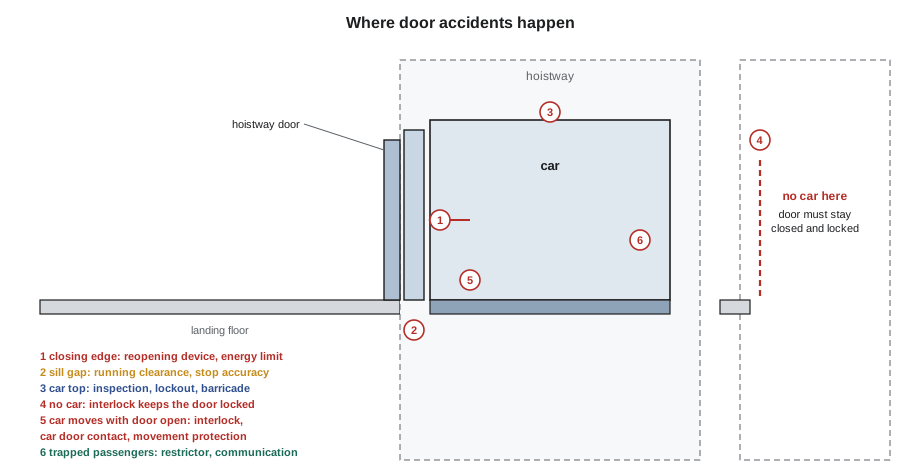
The far more serious danger is the hoistway door. Each landing has a door that must stay closed and locked whenever the car is not at that floor. If it can be opened without the car there, a person can step into an open hoistway and fall. If a car can move with a hoistway door open, a person half in and half out of the car can be caught between the car and the landing. These are the two classic fatal door accidents, and they are why the hoistway door interlock is one of the most important safety devices on an elevator. Mechanics are at risk too: falls into hoistways and being caught by a moving car while working at an open door are among the leading causes of death among elevator workers, often after a door circuit was jumpered or a door was propped open without the hoistway being protected.
| Hazard | How it happens | What prevents it |
|---|---|---|
| Fall into an open hoistway | A hoistway door opens with no car at the landing | Interlock locks the door; door is self-closing; access keys controlled |
| Shearing or crushing at the landing | The car moves with a door open and a person in the opening | Interlocks and car door contact in the safety circuit; unintended movement protection |
| Struck by a closing door | Door closes with too much speed or force, or the reopening device fails | Kinetic energy and force limits; reopening device; nudging rules |
| Trapped and self-evacuating | Passengers force the car door open between floors and climb out | Car door restrictor; emergency communication; trained rescue |
| Tripping at the sill | The car stops out of level with the landing | Levelling accuracy and relevelling; maintenance of stop accuracy |
| Mechanic struck by moving car | Working at an open hoistway door with the car on automatic | Lockout, inspection operation, barricades and a written procedure |
The door system at a glance
An elevator has two sets of doors. The car door, or car gate on some freight cars, travels with the car and is driven by the door operator mounted on the car top. The hoistway doors, one set at each landing, are mounted on the hoistway side of the landing entrance and have no motor of their own. When the car arrives at a floor, a clutch or vane on the car door engages rollers on the hoistway door, unlocks the interlock and drags the hoistway door open with the car door. When the car door closes, it pulls the hoistway door closed, and the hoistway door's own closer, a weight or spring, keeps it closed and locked once the car leaves. Lesson 3 describes these parts in detail, and lesson 4 explains the locks and contacts that prove the doors are closed.
Doors come in several arrangements. Single-speed doors have one panel that slides the full width. Two-speed doors have two panels on separate tracks, one moving twice as fast as the other, so they can open a wide entrance to one side; hospital cars like Holloway's use them for beds. Centre-opening doors split in the middle and are quickest for a given opening width, which is why passenger cars like Quayside's use them. Older freight cars and some cars in older buildings have vertically sliding doors or swing doors at the landings; the Marlowe still has two swing hoistway doors at its lower floors, with a sliding car door.
| Arrangement | Typical use | Points to watch |
|---|---|---|
| Single-speed side-opening | small cars, older residential | long travel per panel, slow for a wide opening |
| Two-speed side-opening | hospital, freight and service cars | relating cable or arms between panels; more parts to wear |
| Centre-opening single-speed | most passenger cars | two panels meet at the centre; reopening device on both edges |
| Two-speed centre-opening | large passenger and service cars | four panels; heavy doors need long closing times |
| Swing hoistway door with sliding car door | older buildings | manual door, closer and interlock need special attention |
| Vertical bi-parting | freight cars | door counterweights, astragals, constant-pressure closing |
The rules that govern doors and safety devices
The requirements for doors, interlocks, governors, safeties, terminal stopping devices, buffers and emergency devices are in the elevator code, CSA B44 in British Columbia, adopted under the Safety Standards Act and enforced by Technical Safety BC. The Canadian and US codes are published together as one harmonized document with country-specific clauses, and the clause numbers used in this course follow that shared numbering: section 2.11 covers hoistway doors, 2.12 hoistway door locking devices, 2.13 power operation of doors, 2.14 car enclosures and car doors, 2.17 car and counterweight safeties, 2.18 speed governors, 2.19 ascending car overspeed and unintended movement protection, 2.22 buffers, 2.25 terminal stopping devices and 2.27 emergency operation and signalling devices. The most recent combined edition is the 2025 edition; jurisdictions adopt editions on their own schedule, and a car must meet the edition in force when it was installed or last altered, plus any rules the jurisdiction applies to existing equipment.
Maintenance and testing requirements are in Part 8 of the code. Section 8.6 sets out the maintenance control program and the periodic tests. For governors, safeties, buffers and other safety devices, those tests come in two groups: tests done every year, called Category 1 tests in the code's US terminology and widely used in Canada too, and full-load, higher-speed tests done every five years, called Category 5 tests. Lesson 12 carries out a five-year test. The inspection guide ASME A17.2, used in both countries, describes how inspectors check each item, and Tamsin was told to keep a copy in the van.
How this course follows the work
The course follows Northcrest's jobs. At Quayside, the four-car centre-opening group, Tamsin will work with Priya on closed-loop door operators, light curtains, progressive safeties and oil buffers. At Tillicum, Ray Abernethy's old geared car 1 still has a DC door operator with resistors and cams, a flyball governor and spring buffers, and its modernization is on the horizon. Holloway's hospital cars have heavy two-speed doors and the most demanding fire service and emergency power arrangements on the route. Larchmont's machine-room-less car has its governor in the hoistway and a remote governor reset. The Marlowe has swing doors, and the Brackenridge escalators appear only briefly, because ELV-330 covers escalator devices.
# Door callbacks on Route 7 over one year (illustrative branch records)
calls = {"doors and door protection": 214, "stopping accuracy": 52,
         "controller and drive": 61, "hall and car fixtures": 48,
         "machine, brake and ropes": 23, "hydraulic power units": 31, "other": 37}
total = sum(calls.values())
for kind, n in sorted(calls.items(), key=lambda kv: -kv[1]):
    share = 100 * n / total
    print(f"{kind:<28} {n:4d}  {share:5.1f} %  " + "#" * round(share / 2))
print(f"{'total':<28} {total:4d}")doors and door protection 214 45.9 % ####################### controller and drive 61 13.1 % ####### stopping accuracy 52 11.2 % ###### hall and car fixtures 48 10.3 % ##### other 37 7.9 % #### hydraulic power units 31 6.7 % ### machine, brake and ropes 23 4.9 % ## total 466
Door problems are nearly half of Route 7's calls, which is in line with the industry pattern. Lena uses figures like these to decide where preventive maintenance time goes, and it is why Priya spends most of a maintenance visit on the doors.
Working safely at doors
Before any work at a hoistway door or on a car top, the hoistway must be made safe. Northcrest's procedure, built from the WorkSafeBC requirements Tamsin learned in ELV-110, has five parts. First, take the car off automatic operation, by inspection operation or by lockout at the mainline disconnect, depending on the task. Second, before opening a hoistway door with the access key, check where the car is; never step through an opened hoistway door without seeing the car top or the pit floor in front of you. Third, barricade an open hoistway door whenever you leave it, even for a minute, with a barricade that a person cannot walk through. Fourth, never jumper a door circuit to move a car; if the car must be moved with a door open, use the controller's inspection operation and the door bypass provisions the code and maker allow, with the hoistway protected. Fifth, before the car returns to service, prove that every door you touched closes, locks and stops the car when opened.
Priya added a sixth rule, which is hers rather than the code's: test the door the way a passenger will use it, at full speed, with the reopening device, before you leave. "The resident at the Marlowe is the person you are working for," she said. "Ride it, block it with your hand, push a cart through it. If you would not let your grandmother use it, it is not finished."
Worked problem
Choosing what to check first on a door complaint
A building manager at Tillicum reports that car 2's door "slams" on the third floor only. Priya asks Tamsin which part of the door system is most likely to be at fault and why.
Show solution
- The car door is the same at every floor, and the operator drives the car door. A fault that appears at only one floor points to something that is different at that floor.
- The hoistway door at floor 3 is the only thing that differs. Its hangers, closer, track, sill guide and clutch rollers belong to that landing.
- A tight track, a dragging gib, a broken closer spring or a misaligned clutch roller at floor 3 changes the load the operator sees, so the operator's motion profile no longer matches the door.
- So the first check is the floor 3 hoistway door: move it by hand with the car away and the hoistway protected, feel for drag, check the closer and the rollers, then watch the door close with the car at the floor.
Answer: Look first at the floor 3 hoistway door, because the problem appears at only one landing.
Common mistakes
MistakeTreating door complaints as minor nuisance calls.
InsteadDoors cause most callbacks and many serious injuries; every door complaint is a safety check.
MistakeOpening a hoistway door with the access key without knowing where the car is.
InsteadCheck the car's position first and look before stepping through.
MistakeLeaving an open hoistway door unattended for a moment.
InsteadBarricade it every time you leave it.
MistakeJumpering a door circuit to move a car.
InsteadUse inspection operation and the permitted bypass provisions with the hoistway protected; jumpered door circuits have killed mechanics and passengers.
MistakeAssuming the code edition is the latest one published.
InsteadUse the edition in force for that car and any jurisdiction rules for existing equipment.
Summary and key terms
- Doors cause the largest share of elevator callbacks and are where many serious passenger and mechanic accidents happen.
- The two classic fatal door accidents are a fall through a hoistway door with no car present and a car moving with a door open.
- The car door is power operated and drags the hoistway door through a clutch; the hoistway door closes and locks itself when the car leaves.
- Doors are single-speed, two-speed or centre-opening, sliding, swing or vertical, each with its own wear points.
- Code sections 2.11 to 2.14, 2.17 to 2.19, 2.22, 2.25 and 2.27 cover doors and safety devices; Part 8 covers maintenance and periodic tests.
- Safe door work means taking the car off automatic, knowing where the car is, barricading open doors, never jumpering and testing before return to service.
- Hoistway door
- The door at each landing that closes off the hoistway; it has no motor and is opened by the car door through a clutch.
- Car door
- The door on the car, driven by the door operator.
- Interlock
- A device that locks a hoistway door closed and proves it locked in the safety circuit.
- Two-speed door
- A door with two panels moving at different speeds on separate tracks to open a wide entrance to one side.
- Category 1 and Category 5 tests
- Periodic tests of safety devices, done every year and every five years.
- Callback
- An unscheduled service call made because equipment is not working properly.
Practice problems
Work each problem on paper first, then reveal the answer to check.
Name the two classic fatal door accidents.
Show answer
A fall through a hoistway door opened with no car at the landing, and a person caught when a car moves with a door open.
What opens the hoistway door when the car arrives at a floor?
Show answer
The car door's clutch or vane engages the hoistway door rollers, unlocks the interlock and drags the door open.
Why are centre-opening doors used on most passenger cars?
Show answer
Each panel travels only half the opening width, so they open and close a given entrance fastest.
Which part of the code sets maintenance and periodic test requirements?
Show answer
Part 8, especially section 8.6.
A door problem appears at only one landing. Where do you look first?
Show answer
At that landing's hoistway door and its hangers, track, closer, sill guide and clutch rollers.
Lesson quiz · 5 questions
Score 60% or more to complete this lesson.
Create a free account to save your progress, take quizzes and earn a certificate.