
ELV-320 · Lesson 5 of 12 · 20 min
Door protection: edges, light curtains and kinetic energy
The Marlowe complaint that opened lesson 1 was a door protection failure: the car door's reopening edge stuck, so the door kept closing when it touched the resident's shoulder. A power-closed door is a moving mass, and the code limits how much energy and force it can have when it strikes someone, and requires a device that reopens it when something is in the way. This lesson covers those limits and devices: the closing force limit, the kinetic energy limits that set how fast a door may close, the reopening devices from mechanical edges to light curtains, and how the reopening device, nudging and firefighters' operation interact. It ends with the door data plate, which every mechanic who adjusts a door must read.
Why limit energy and force
A door that closes slowly but pushes hard can pin a person; a door that closes lightly but fast can strike hard. The code therefore limits both. The force needed to stop a closing door must not be more than 135 N (30 lbf), measured at the leading edge with the door stopped between one-third and two-thirds of its travel. And the kinetic energy of the closing door, which depends on the mass of everything moving with it and on its speed, must stay within limits. These rules apply to horizontally sliding, power-closed doors on passenger cars; freight doors and vertically sliding doors have their own rules, often constant-pressure closing so that the door closes only while an attendant holds a button.
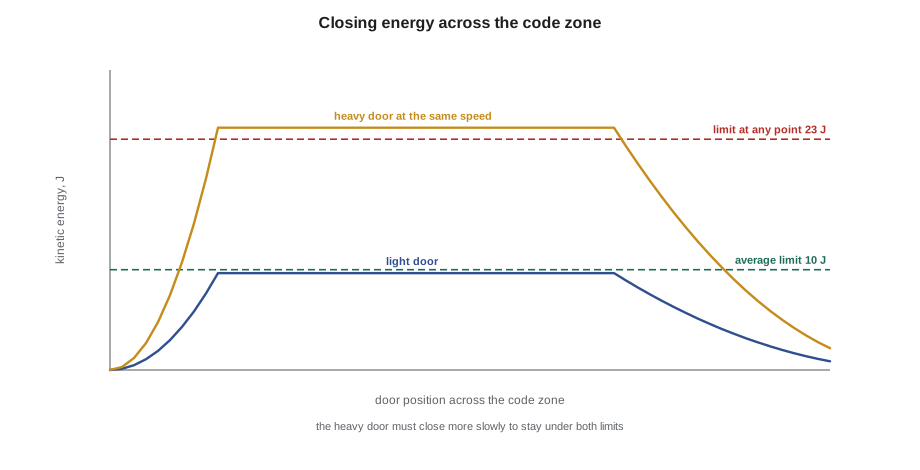
The kinetic energy limits come in two pairs. With an operative reopening device, the average kinetic energy over the code zone, the main part of the door's travel, must not exceed 10 J (7.37 ft-lbf), and the energy at any point must not exceed 23 J (17 ft-lbf). Without a reopening device, or when it is inoperative, as during nudging or firefighters' operation, the limits are much lower: an average of 3.5 J (2.5 ft-lbf) and 8 J (6 ft-lbf) at any point. The code zone is defined in the code as the door's travel less short distances at its start and end, and the maker uses it to set the minimum closing time.
| Limit | With an operative reopening device | Without one, or with it inoperative |
|---|---|---|
| Average kinetic energy over the code zone | 10 J (7.37 ft-lbf) | 3.5 J (2.5 ft-lbf) |
| Kinetic energy at any point in the code zone | 23 J (17 ft-lbf) | 8 J (6 ft-lbf) |
| Force to prevent closing | 135 N (30 lbf), measured between one-third and two-thirds of travel | same |
From energy to minimum closing time
Kinetic energy is one half of mass times speed squared. For a single panel or a centre-opening door, every moving part moves at the same speed, so the mass is simply the total of the car door panels, the hoistway door panels, hangers, clutch and linkage moving with them. For a two-speed door, the slow panels move at half the speed of the fast ones, so they count for only one quarter as much at the fast panel's speed. Turning the average energy limit around gives the highest average speed allowed, and dividing the code zone distance by it gives the minimum average closing time. That time is printed on the door's data plate, and the door must never close faster.
# Minimum closing time from the average kinetic energy limit
import math
E_avg = 10.0                     # average limit with an operative reopening device, J
cases = {
    # name: (fast-moving mass, slow-moving mass, code zone distance)
    "Quayside centre-opening": (140.0, 0.0, 0.45),
    "Holloway two-speed bed car": (112.0, 96.0, 1.27),
}
for name, (m_fast, m_slow, d) in cases.items():
    m_eff = m_fast + m_slow / 4          # slow panels move at half speed
    v_max = math.sqrt(2 * E_avg / m_eff)
    t_min = d / v_max
print(f"{name:<28} effective mass {m_eff:6.1f} kg -> max average speed {v_max:4.2f} m/s -> minimum time {t_min:4.1f} s")Quayside centre-opening effective mass 140.0 kg -> max average speed 0.38 m/s -> minimum time 1.2 s Holloway two-speed bed car effective mass 136.0 kg -> max average speed 0.38 m/s -> minimum time 3.3 s
For Quayside, the mass is both halves of the car door and the hoistway door with their hangers, and the code zone is the travel of one panel less the end allowances. Holloway's bed car doors are heavier and travel much farther, so their minimum closing time is more than twice as long. The maker's data plate on each car door operator states the minimum time for that door; Northcrest's figures above come from the door masses on the data plates and are a cross-check, not a replacement. On the US calculation, pounds are converted to slugs by dividing by the acceleration of gravity so that the energy comes out in foot-pounds.
The data plate matters because doors change. A building that replaces its hoistway door panels with heavier fire-rated panels, or adds stainless cladding to the car doors, adds mass, and the old minimum closing time is no longer safe. Any change to the door mass needs a new calculation and a new data plate, and the door must be retimed.
Measuring force and timing a door
The closing force test uses a force gauge and follows the inspection guide: with the car at a floor, start the doors closing, stop them partway, between one-third and two-thirds of travel, place the gauge against the leading edge, let the door push against the gauge only, and slowly back the gauge off until the door just begins to move; the reading at that point is the closing force. The timing test measures how long the door takes to travel through the code zone, usually with a stopwatch from marks on the sill or with the door controller's own measurement, and compares it with the data plate. Both tests are part of the periodic maintenance and inspection, and both must be repeated after any adjustment of the operator.
# Door closing force and timing, Quayside car 2 (one row per landing tested)
f_limit = 135                 # N
t_min = 1.3                  # minimum closing time on the data plate, s
tests = [(1, 98, 2.6), (8, 104, 2.7), (14, 101, 1.2), (22, 142, 2.6)]
for floor, force, t in tests:
    notes = []
    if force > f_limit:
        notes.append("force too high")
    if t < t_min:
        notes.append("closes faster than data plate")
print(f"floor {floor:2d}: force {force:5.1f} N, time {t:.1f} s -> {'ok' if not notes else ', '.join(notes)}")floor 1: force 98.0 N, time 2.6 s -> ok floor 8: force 104.0 N, time 2.7 s -> ok floor 14: force 101.0 N, time 1.2 s -> closes faster than data plate floor 22: force 142.0 N, time 2.6 s -> force too high
Two landings failed. At floor 14 the door closed faster than the data plate allows, because the operator had been given a separate, faster profile for that landing during a previous callback; the profile was reset. At floor 22 the force was too high, because the hoistway door's closer had been replaced with a stronger one; the correct closer was fitted. Each landing has its own hoistway door, so each must be checked.
Reopening devices
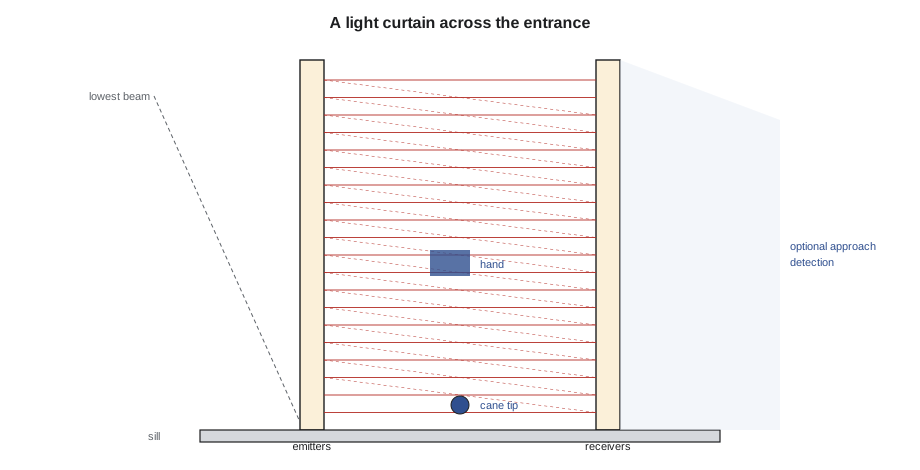
A reopening device detects a person or object in the path of the closing doors and makes them stop and reopen. The oldest type is the mechanical safety edge: a hinged or sliding strip along the leading edge of the car door that is pushed back on contact and operates a switch. A safety edge works only by touching, so a person is struck before the door reverses, though lightly. Next came photo eyes, one or two light beams across the entrance at fixed heights, which detect without contact but only at those heights. Most cars now use light curtains, an array of infrared emitters on one edge and receivers on the other, typically dozens of beams crossing the entrance diagonally from near the sill to above head height, so that an object anywhere in the opening interrupts several beams. Some systems add detection in front of the door, so the doors reopen for someone approaching rather than only someone in the opening.
# Light curtain coverage: largest gap between detection lines over the height
emitters = 40             # beams per strip
bottom, top = 20, 1800     # height of lowest and highest beam above the sill, mm
spacing = (top - bottom) / (emitters - 1)
print(f"straight beams every {spacing:.0f} mm from {bottom} to {top} mm")
print(f"crossing diagonals roughly halve the effective gap -> about {spacing / 2:.0f} mm")
print(f"gap below the lowest beam: {bottom} mm (a foot or cane tip lower than this is not seen)")straight beams every 46 mm from 20 to 1800 mm crossing diagonals roughly halve the effective gap -> about 23 mm gap below the lowest beam: 20 mm (a foot or cane tip lower than this is not seen)
A light curtain has a lowest beam a short distance above the sill, and a passenger's foot or cane tip below that line is not seen, which is why a closing door can still touch a foot. The maker's figure for the lowest beam is part of the specification, and dirty lenses or a strip mounted crooked can create blind spots higher up. Quayside's curtains report their own health to the door controller, and the controller holds the doors open and logs a fault if a curtain fails.
Nudging, fire service and the inoperative reopening device
The lower energy limits apply whenever the reopening device is not working. That happens in three situations. During nudging, the controller deliberately ignores the light curtain after the doors have been held open too long and closes the doors slowly with a buzzer. During firefighters' emergency operation, smoke or flame can make light curtains and photo eyes see obstructions that are not there, so the code makes smoke-sensitive reopening devices inoperative during Phase I recall and Phase II, and the doors close at reduced speed or only by constant pressure on the door close button. And when a reopening device has failed, the controller may allow the doors to close at the lower energy rather than leave the car with its doors open. In all three cases, the closing speed must drop so that the average energy stays within 3.5 J (2.5 ft-lbf), which for a typical passenger door means closing in roughly twice the normal time or longer. Where the door has a mechanical edge as well as a light curtain, the edge usually stays active.
Worked problem
Retiming Holloway's doors after new panels
Holloway's facilities group replaced the car 1 car door panels with new stainless panels, adding 14 kg (31 lb) to the fast-moving mass. What must Northcrest do before the car returns to service?
Show solution
- The door's kinetic energy at a given speed has risen with the added mass, so the old minimum closing time may now be too short.
- Recalculate the effective moving mass, including the extra mass on the fast panel and the slow panel's share, and the new minimum closing time from the average energy limit and the code zone distance, using the maker's method.
- Retime the operator so that the door closes no faster than the new minimum, at every landing, and check the force limit.
- Fit a new data plate with the new mass and minimum closing time, and record the change in the maintenance control program.
Answer: Recalculate, retime, retest force and replace the data plate; a heavier door must close more slowly.
Common mistakes
MistakeSpeeding up a slow door without checking its data plate.
InsteadThe data plate's minimum closing time is the limit; find and fix the drag instead.
MistakeIgnoring door mass changes such as new cladding or panels.
InsteadAny change in moving mass needs a new minimum closing time and data plate.
MistakeTesting closing force at only one landing.
InsteadEach landing's hoistway door and closer affect force and timing; test them all.
MistakeLeaving light curtain lenses dirty or strips crooked.
InsteadDirt and misalignment create blind spots; clean and align them on every visit.
MistakeLetting nudging close the door at normal speed.
InsteadWith the reopening device ignored, the lower energy limits apply.
Summary and key terms
- The force to stop a closing door must not exceed 135 N (30 lbf), measured between one-third and two-thirds of travel.
- Average kinetic energy is limited to 10 J (7.37 ft-lbf) with an operative reopening device and 3.5 J (2.5 ft-lbf) without one, with higher limits at any single point.
- The minimum closing time follows from the moving mass, the energy limit and the code zone distance, and is on the data plate.
- Reopening devices range from mechanical edges to photo eyes and light curtains with dozens of crossing beams.
- Nudging, fire service and a failed reopening device all require the lower energy limits.
- Any change in door mass requires a new calculation, retiming and a new data plate.
- Kinetic energy
- One half of mass times speed squared; the energy a moving door delivers when it strikes something.
- Code zone
- The part of the door travel, defined by the code, over which closing energy is measured.
- Reopening device
- A device that detects an obstruction and makes the closing doors stop and reopen.
- Light curtain
- An array of infrared beams across the entrance used as a reopening device.
- Safety edge
- A mechanical strip on the door edge that operates a switch on contact.
- Door data plate
- The plate on the operator stating the door mass and minimum closing time.
Practice problems
Work each problem on paper first, then reveal the answer to check.
How is closing force measured?
Show answer
With the door stopped between one-third and two-thirds of travel, a gauge is held against the leading edge and slowly backed off until the door just moves; the reading is the force.
Why do slow panels of a two-speed door count as one quarter of their mass?
Show answer
They move at half the fast panels' speed, and energy goes with speed squared.
What average energy applies during nudging?
Show answer
3.5 J (2.5 ft-lbf).
Why are light curtains made inoperative on fire service?
Show answer
Smoke or flame can make them see false obstructions and hold the doors open.
New heavier door panels are fitted. What changes?
Show answer
The minimum closing time increases; the door must be recalculated, retimed and given a new data plate.
Lesson quiz · 5 questions
Score 60% or more to complete this lesson.
Create a free account to save your progress, take quizzes and earn a certificate.