
ELV-320 · Lesson 3 of 12 · 21 min
Car doors, hoistway doors and hangers
Ray Abernethy's rule for door work is short: "The operator gets blamed, the hangers are guilty." Most door problems that look like operator problems turn out to be mechanical: a worn hanger roller, a loose track, a gib dragging in a sill full of grit, a broken closer, a relating cable stretched out of adjustment. This lesson goes through the parts of car and hoistway doors, how they hang and move, what wears and how to check it. Tamsin spent two days of it at Holloway, where the hospital's two-speed doors had just had their annual overhaul, and two more at Tillicum and the Marlowe.
Panels, frames and entrances
A landing entrance is an assembly: a steel frame (jambs and header) fixed into the hoistway wall, a sill at the floor, a header above that carries the door track and hangers, and the door panels themselves. The hoistway side of the entrance forms part of the hoistway's fire separation, so the hoistway door assembly is a fire-rated, tested and labelled product, and its parts, including panels, gibs, hangers and frame, must be replaced only with parts that keep the rating. A mechanic who drills a panel for a new fixture, replaces a gib with an unlisted part or removes a label can void the rating. The fire rating is checked on inspection, and Lena had a story about a building where every door label had been painted over and the owner had to have the entrances recertified.
Car doors are lighter, because they are not part of the fire separation. They hang from the door operator's track on the car top, and their bottoms run in the car sill with gibs. A car door has an electric contact, called the car door contact or car gate switch, that proves the car door is closed before the car can run; lesson 4 covers it with the interlocks.
Hangers, tracks and up-thrust rollers
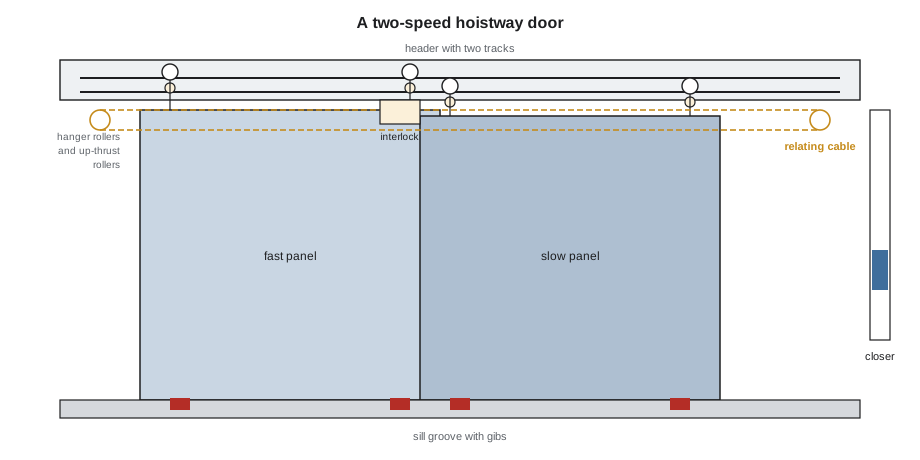
Each door panel hangs from a hanger: a steel plate bolted to the top of the panel, with two or more rollers that run on a track along the header. The rollers are usually steel or polymer-covered on sealed bearings. Below each main roller, or on the same plate, is an up-thrust roller, often on an eccentric so it can be adjusted, that runs just under the track and stops the hanger from lifting off if the panel is pushed or lifted. The up-thrust rollers must be set with a small clearance under the track: close enough to stop the panel jumping the track, but not touching, or they drag and wear. Hanger rollers wear flat spots, which make a door noisy and jerky, and their bearings fail; tracks wear grooves and collect dirt and must be clean and dry, since oil collects grit. The maker gives the up-thrust clearance; typical figures are well under a millimetre or a few hundredths of an inch.
# Hanger check record: up-thrust roller clearance (maker's range, illustrative)
low, high = 0.3, 0.8          # allowed clearance under the track, mm
readings = {"car door, left hanger": 0.5, "car door, right hanger": 0.4,
            "floor 1 hoistway, fast panel": 1.6, "floor 1 hoistway, slow panel": 0.6,
            "floor 2 hoistway, fast panel": 0.2, "floor 2 hoistway, slow panel": 0.7}
for part, gap in readings.items():
    if gap < low:
        verdict = "too tight: roller drags, reset eccentric"
    elif gap > high:
        verdict = "too loose: panel can lift, reset eccentric"
    else:
        verdict = "ok"
print(f"{part:<30} {gap:5.2f} mm {verdict}")car door, left hanger 0.50 mm ok car door, right hanger 0.40 mm ok floor 1 hoistway, fast panel 1.60 mm too loose: panel can lift, reset eccentric floor 1 hoistway, slow panel 0.60 mm ok floor 2 hoistway, fast panel 0.20 mm too tight: roller drags, reset eccentric floor 2 hoistway, slow panel 0.70 mm ok
At Holloway the floor 1 fast panel's up-thrust roller had a clearance about twice the maker's limit after a cart had struck the panel and bent the eccentric's mounting; a hard push could have lifted the panel off its track. The floor 2 fast panel was set too tight and its roller had worn a polished stripe on the track. Both were reset and recorded.
Gibs, sills and panel retainers
The bottom of each panel is guided by gibs, usually two per panel, that run in a groove in the sill. Gibs keep the panel in line and stop it swinging into the hoistway or the car. They wear, crack and fall out, and a panel with a missing gib can be pushed out of the sill groove into the hoistway. Many codes and jurisdictions now require hoistway door panels to have fire-resistant gibs or separate retainers, so that a panel stays in place even if a gib melts in a fire or breaks when struck; older doors are commonly retrofitted with them. Sills must be clean: grit, stones and debris in the groove make the doors drag and are the first thing to clear on any sticking door.
The gap between the car sill and the landing sill, the running clearance, is set by the code to a narrow range so that a foot or a cane cannot drop into it: at least 13 mm and at most 32 mm (1/2 to 1-1/4 in). Car guide shoe wear, rail misalignment and a car sitting off centre can all change it. Checking the running clearance at each floor is part of a door overhaul.
# Running clearance between car sill and landing sill at each floor
low, high = 13, 32       # code range, mm
gaps = {1: 24, 2: 25, 3: 34, 4: 23}   # measured at the centre of the entrance
for floor, g in gaps.items():
    ok = low <= g <= high
print(f"floor {floor}: {g:5.2f} mm -> {'within range' if ok else 'OUT OF RANGE, check car guides and sill alignment'}")floor 1: 24.00 mm -> within range floor 2: 25.00 mm -> within range floor 3: 34.00 mm -> OUT OF RANGE, check car guides and sill alignment floor 4: 23.00 mm -> within range
Holloway car 2's floor 3 gap was just over the limit. The landing sill had settled at that floor when the hospital replaced its lobby floor; the sill was reset, not the car, because the car's gaps at other floors were consistent.
Closers: making the hoistway door close itself
A hoistway door must close and lock by itself whenever the car leaves the landing, even if someone has pushed it partly open. The closer provides the force. Two types are common. A weight closer hangs a weight on a cable or chain over a pulley in a tube or channel at the strike jamb, so the weight always pulls the door closed. A spring closer uses a coil spring, sometimes in a drum (called a spirator on some makes), wound so it pulls the door closed. Weight closers give a nearly constant force; spring closers give more force when the door is open than when it is nearly closed. Either way, the closer must be strong enough to close the door from any position and pull the interlock into its locked position, and not so strong that it slams the door or overloads the operator. A broken closer cable or spring is a serious defect: the door may stay open with no car at the landing.
Ray's test for a closer is simple, done with the car away from the floor and the hoistway protected: open the hoistway door by hand to several positions and let go. It must close fully and lock from every position, without slamming. Then hold it nearly closed and let go: it must still lock. A door that stops a few centimetres short is a door that someone will push open.
Relating cables and two-speed doors
On two-speed doors, the two panels on each side must move together in a fixed ratio, the fast panel twice the speed of the slow one, so that they reach the open and closed positions together. The relating mechanism is a cable, or on some makes a chain or arms, running over pulleys in the header and fixed to both panels. The operator drives only one panel; the relating cable drives the other. A stretched or slipped relating cable lets the panels get out of step, so the slow panel lags, the panels hit their stops at different times, and the door may not close fully. On centre-opening hoistway doors, a similar cable or a belt makes the two halves move together in opposite directions.
# Two-speed door: panel travel and speed
opening = 1370         # clear opening width, mm
overlap = 30         # overlap between panels when open, mm
t_close = 4.6         # closing time, s
fast_travel = opening + overlap
slow_travel = fast_travel / 2
print(f"fast panel travels {fast_travel:.0f} mm, average speed {fast_travel / t_close:.0f} mm/s")
print(f"slow panel travels {slow_travel:.0f} mm, average speed {slow_travel / t_close:.0f} mm/s")
print("both must arrive together; a lagging slow panel means the relating cable has slipped or stretched")fast panel travels 1400 mm, average speed 304 mm/s slow panel travels 700 mm, average speed 152 mm/s both must arrive together; a lagging slow panel means the relating cable has slipped or stretched
Holloway's bed cars have 1,370 mm (54 in) two-speed doors, and the fast panel travels twice as far as the slow one in the same time. Lesson 5 returns to these doors, because their large moving mass is why they have the longest minimum closing times on Route 7.
Swing doors and older entrances
The Marlowe's two lower landings still have manually opened swing hoistway doors with a sliding car door. A passenger opens the swing door by hand once the car is at the floor and the door is unlocked, and a closer, usually a hydraulic door closer like a building door's, pulls it shut. The interlock on a swing door must be designed for it: the door may be unlocked only when the car is at the landing, and the car may not run until the door is closed and locked. A weak closer or a sticking latch on a swing door is particularly dangerous because a passenger may let go of a door that has not latched. Northcrest checks the Marlowe's swing door closers and latches on every visit.
Worked problem
Doors that close but do not lock
At Tillicum car 1, the floor 5 hoistway door closes when the car leaves but sometimes stops a few millimetres short, and the interlock does not make. The car shuts down on a door lock fault until someone pushes the door. What should Ray and Tamsin check?
Show solution
- The closer provides the last part of the closing force. Check it first: a weakened spring, a stretched cable or a weight that has been shortened.
- Check for drag that the closer cannot overcome near the closed position: a gib dragging in a dirty sill, an up-thrust roller set tight, a bent panel touching the frame.
- Check the interlock: a lock hook or roller out of adjustment may need more force to engage than the closer provides.
- After the repair, test from several open positions, including nearly closed, and confirm the door closes and locks every time.
Answer: The cause lies in the closer, drag near the closed position or interlock adjustment at floor 5; the test is that the door locks from every position.
Damaged panels and carts
Most hoistway door damage on Route 7 comes from carts, dollies and furniture striking the panels during moves, and the damage is not always obvious. A panel that has been struck may look straight but have a bent hanger plate, a cracked gib or a sill guide pushed out of line, and it may run normally for weeks before it jams. Ray's habit after any reported moving day in a building is to walk every landing with the car on inspection, push each hoistway door panel firmly toward the hoistway at its bottom corners, and look for movement, cracked gibs and fresh marks on the sill. Northcrest also recommends that buildings require movers to book the car, hang protective pads in the car and fit sill protection, which costs far less than a panel replacement.
Common mistakes
MistakeOiling door tracks and sills.
InsteadKeep them clean and dry; oil holds grit and makes drag worse.
MistakeReplacing a hoistway door gib or panel part with whatever fits.
InsteadUse listed parts that keep the door's fire rating.
MistakeSetting up-thrust rollers hard against the track to quieten a door.
InsteadSet the maker's clearance; a tight roller drags and wears the track.
MistakeBlaming the operator for a door that is slow at one landing.
InsteadCheck that landing's hangers, closer, gibs and relating cable first.
MistakeAccepting a hoistway door that closes but stops short of locking.
InsteadThe door must close and lock from every position; fix the closer, drag or lock.
Summary and key terms
- Hoistway door assemblies are fire-rated and labelled; replacement parts must keep the rating.
- Panels hang from hanger rollers on a track, with up-thrust rollers set just under the track to stop the panel lifting.
- Gibs in the sill guide the panel bottoms; fire-resistant gibs or retainers keep panels in place.
- The running clearance between car and landing sills is held to a narrow code range.
- Closers make hoistway doors close and lock themselves; they must work from every position.
- Relating cables keep two-speed and centre-opening panels in step; a slipped cable makes panels arrive at different times.
- Hanger
- The plate and rollers at the top of a door panel that carry it on the track.
- Up-thrust roller
- An adjustable roller just below the track that stops a hanger lifting off.
- Gib
- A guide fixed to the bottom of a door panel that runs in the sill groove.
- Closer
- The weight or spring that closes a hoistway door when the car leaves.
- Relating cable
- The cable linking door panels so they move together in a fixed ratio.
- Running clearance
- The gap between the car sill and the landing sill.
Practice problems
Work each problem on paper first, then reveal the answer to check.
Why must hoistway door parts be replaced with listed parts?
Show answer
The assembly is fire rated, and unlisted parts can void the rating.
What does an up-thrust roller do?
Show answer
It stops the hanger and panel lifting off the track if the door is pushed or lifted.
What is the running clearance range between car sill and landing sill?
Show answer
At least 13 mm and at most 32 mm.
How do you test a hoistway door closer?
Show answer
With the car away and the hoistway protected, release the door from several positions, including nearly closed; it must close and lock every time without slamming.
On a two-speed door, the slow panel reaches its stop after the fast panel. What is the likely cause?
Show answer
The relating cable has stretched or slipped.
Lesson quiz · 5 questions
Score 60% or more to complete this lesson.
Create a free account to save your progress, take quizzes and earn a certificate.