
ELV-320 · Lesson 12 of 12 · 23 min
Capstone: a safety device test and a door entrapment call
The capstone for this term was two pieces of work in the same week, and Lena chose them deliberately. The first was planned months ahead: Quayside car 2's five-year tests of its governor, safeties, buffers and emergency brake, with the inspector present. The second was not planned at all: a door entrapment call at Larchmont at seven in the evening on the Thursday. "One is the most controlled job we do and the other is the least," Lena told Tamsin. "You need to be good at both, and they use the same knowledge." This lesson follows both jobs from start to finish and ends with Tamsin's write-ups, which became part of her apprenticeship record.
Part 1: planning the five-year tests
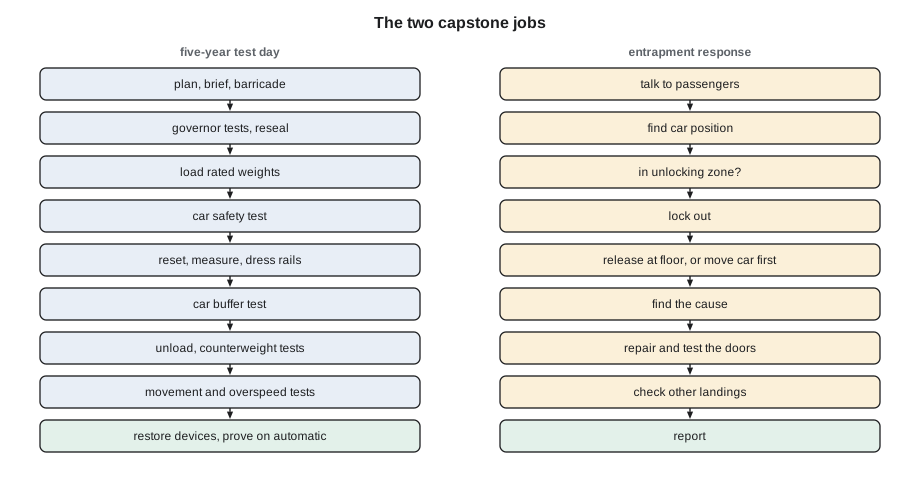
Five-year tests are full-load, rated-speed tests of the devices that stop a runaway car, so they are planned in writing. Priya's plan for Quayside car 2 had five parts. First, the scope: governor tripping and switch speeds and pull-through, car safety test with rated load at rated speed, counterweight safety test, car and counterweight oil buffer tests at the speed allowed by the emergency terminal speed limiting system, and the unintended movement and ascending overspeed tests by the maker's procedure. Second, the logistics: test weights for the rated load 1,600 kg (3,500 lb), delivered and moved in the car on a Sunday morning when the building's traffic is lowest, with the other three cars in service for residents; barricades at the car 2 entrances; the inspector booked. Third, the method: the maker's procedures for each test, set up through the service tool so that the safety board's supervision is suspended only for the device under test and restored afterward. Fourth, the hazards: working on a car top near moving equipment, the weights, the high-speed tests, and the possibility of a device failing to act, each with its control in the job hazard analysis. Fifth, the return to service: every device restored, every bypass removed, the car run on automatic through every floor, and the test record signed.
# Five-year test day plan for Quayside car 2: sequence and time
steps = [("barricade, lockout, job hazard analysis briefing", 30),
         ("governor: rope off, speed test with test drive, pull-through, reseal", 75),
         ("load test weights into car", 40),
         ("car safety test: rated load, rated speed, governor tripped", 35),
         ("raise off safeties, reset switch, measure marks, dress rails", 45),
         ("car buffer test at limited speed, check return and oil", 30),
         ("unload weights", 35),
         ("counterweight safety and buffer tests, car empty", 50),
         ("unintended movement and ascending overspeed tests by maker's procedure", 40),
         ("restore all devices, end service tool tests, remove bypasses", 25),
         ("run every floor on automatic, door checks, sign the record", 30)]
t = 0
for name, minutes in steps:
    print(f"{t // 60:2d}:{t % 60:02d}  +{minutes:3d} min  {name}")
    t += minutes
print(f"total about {t / 60:.1f} hours, starting 07:00 -> finished by about {7 + t // 60}:{t % 60:02d}")0:00 + 30 min barricade, lockout, job hazard analysis briefing 0:30 + 75 min governor: rope off, speed test with test drive, pull-through, reseal 1:45 + 40 min load test weights into car 2:25 + 35 min car safety test: rated load, rated speed, governor tripped 3:00 + 45 min raise off safeties, reset switch, measure marks, dress rails 3:45 + 30 min car buffer test at limited speed, check return and oil 4:15 + 35 min unload weights 4:50 + 50 min counterweight safety and buffer tests, car empty 5:40 + 40 min unintended movement and ascending overspeed tests by maker's procedure 6:20 + 25 min restore all devices, end service tool tests, remove bypasses 6:45 + 30 min run every floor on automatic, door checks, sign the record total about 7.2 hours, starting 07:00 -> finished by about 14:15
The plan came to about seven and a half hours, and Priya booked the whole day. The order matters: the governor is tested before the safeties because the safety test uses the governor's trip, the car tests are done with the weights in, and the counterweight tests with the car empty, so the weights are moved only once.
Part 1: the test day
The governor tests came first. With the governor rope lifted off the sheave and a test drive turning the sheave, the tripping speed came in at 3.05 m/s (600 ft/min), within the code range for the car's rated speed, and the overspeed switch, adjusted in lesson 7, opened below its maximum. Three pull-through readings averaged within the maker's range. The governor was resealed.
With the rated load in the car, the car was run down from the top at rated speed and the governor tripped by hand at the governor, from the machine space, on Priya's radio call. The car stopped smoothly. The marks on the rails measured 1.22 m and 1.18 m, close together, so the platform was level within the limit, and the stopping distance was within the maker's range for the tripping speed. The car was raised off the safeties on inspection, the safety switch reset, and Tamsin dressed the rail marks with a stone. The car buffer test at the speed the terminal speed limiting system allows followed: the plunger returned in well under the time allowed and the oil level was correct. After the weights were unloaded, the counterweight safety and buffer tests were done with the car empty; the counterweight buffer's oil was found slightly low, the same finding as in lesson 10's record, and was topped up with the specified oil and a small seep at the plunger seal noted for repair.
# Quayside car 2 five-year results against their criteria
results = [
    ("governor trip speed", 3.05, 2.88, 3.18, "m/s"),
    ("governor switch speed", 2.8, 0, 2.86, "m/s"),
    ("pull-through average", 2480, 2200, 2900, "N"),
    ("car safety stopping distance", 1.22, 0.8, 1.6, "m"),
    ("platform tilt", 2.1, 0, 3.0, "%"),
    ("car buffer return time", 41, 0, 90, "s"),
    ("unintended movement stop", 260, 0, 1220, "mm"),
]
fails = 0
for name, value, lo, hi, unit in results:
    ok = lo <= value <= hi
    fails += not ok
    print(f"{name:<30} {value:>8} {unit:<7} (allowed {lo} to {hi}) {'pass' if ok else 'FAIL'}")
print("all tests passed" if fails == 0 else f"{fails} test(s) failed: car stays out of service")governor trip speed 3.05 m/s (allowed 2.88 to 3.18) pass governor switch speed 2.8 m/s (allowed 0 to 2.86) pass pull-through average 2480 N (allowed 2200 to 2900) pass car safety stopping distance 1.22 m (allowed 0.8 to 1.6) pass platform tilt 2.1 % (allowed 0 to 3.0) pass car buffer return time 41 s (allowed 0 to 90) pass unintended movement stop 260 mm (allowed 0 to 1220) pass all tests passed
The stopping-distance range and the tilt limit in the record are the maker's figures for this car and safety, taken from the test procedure, and the inspector checked them against the code table. Every result passed. The unintended movement test, run through the service tool with the doors open at floor 1, stopped the car a small fraction of the code distance from the floor. The inspector witnessed the safety and buffer tests and signed the record; the test tag in the machine space was updated.
Returning the car to service took longer than Tamsin expected. Priya ended each service tool test so that the safety board restored its supervision, checked the controller showed no bypasses active, ran the car to both terminals on inspection to prove the final limits and normal terminal devices, then put it on automatic and rode every floor, checking the doors at each landing. Only then were the barricades removed.
Part 2: the entrapment call
At 18:52 on the Thursday, the monitoring centre took an emergency call from Larchmont's car: two residents and a dog, moving a bookcase, were stopped in the car near floor 5 with the doors closed. The centre identified the car, now that its device had been fixed in lesson 11, kept talking to the passengers, confirmed nobody was hurt or unwell and called Northcrest's after-hours line. Tamsin was on call with Ray as her backup and reached the building at 19:24. She spoke to the passengers through the building's in-building communication, told them who she was and what would happen, and asked them not to try to open the doors. Then she followed Northcrest's entrapment procedure.
# Entrapment response timeline (times from the monitoring centre and Tamsin's log)
events = [("18:52", "call received, car identified, passengers reassured"),
          ("18:55", "Northcrest after-hours line called"),
          ("19:24", "mechanic on site, talks to passengers"),
          ("19:31", "car position found: 180 mm above floor 5, in unlocking zone"),
          ("19:36", "mainline locked out, hoistway door unlocked with tool, barricade up"),
          ("19:39", "car door opened by hand, passengers out over the sill with help"),
          ("19:55", "cause found: floor 5 hoistway door panel out of its sill groove")]
def minutes(t):
    h, m = map(int, t.split(":")); return h * 60 + m
start = minutes(events[0][0])
for t, what in events:
    print(f"{t}  (+{minutes(t) - start:2d} min)  {what}")
print(f"passengers out {minutes('19:39') - start} min after their call")18:52 (+ 0 min) call received, car identified, passengers reassured 18:55 (+ 3 min) Northcrest after-hours line called 19:24 (+32 min) mechanic on site, talks to passengers 19:31 (+39 min) car position found: 180 mm above floor 5, in unlocking zone 19:36 (+44 min) mainline locked out, hoistway door unlocked with tool, barricade up 19:39 (+47 min) car door opened by hand, passengers out over the sill with help 19:55 (+63 min) cause found: floor 5 hoistway door panel out of its sill groove passengers out 47 min after their call
The car's position decided the method. The controller showed the car stopped about 180 mm above floor 5, inside the unlocking zone, with the door circuit open. Because the car was in the zone, the passengers could be released at floor 5 without moving the car. Tamsin locked out the mainline disconnect, so that the car could not move during the rescue, opened the floor 5 hoistway door with the unlocking tool from the landing, set up a barricade, and opened the car door by hand; the restrictor allowed it because the car was in the zone. The step down from the car sill to the landing was small, and she helped the residents, the dog and finally the bookcase out. Had the car been outside the zone, the procedure would have been to move it to a floor first, by the maker's rescue operation, not to open the doors between floors.
Part 2: finding and fixing the cause
With the passengers out and the car locked out, Tamsin looked for the cause. The floor 5 hoistway door's leading panel had a cracked gib, and the bottom of the panel had been pushed out of the sill groove toward the hoistway, probably by the bookcase or a cart earlier in the day. As the car arrived at floor 5 and its door began to open, the clutch picked up the displaced panel's interlock rollers out of line; the hoistway door jammed partway, the car door closed again on the controller's door-close retry, and when the controller tried to relevel with the door circuit not proving locked, it shut the car down. The car had stopped in the door zone, as it should, and the restrictor and interlock had kept the passengers from opening the doors themselves.
The repair followed lesson 3 and lesson 6. With the car moved to floor 6 on inspection and the floor 5 entrance barricaded, Tamsin and Ray, who had arrived by then, replaced both gibs on the panel with listed fire-resistant gibs, refitted the panel in the sill, checked the hangers and up-thrust rollers, checked the panel gaps, checked the interlock engagement and contact sequence and the clutch vane clearance at floor 5, and checked the floor 5 closer. Then they ran the tests: door closing force and time at floor 5 against the data plate, the door from every position by hand with the car away, the interlock opened by the unlocking tool to prove the car would not run, and twenty door cycles on automatic. The car returned to service at 21:40.
# Entrapment report checklist: is anything missing before it is filed?
report = {"time of call and of release": True, "car and landing": True, "passengers and condition": True,
          "car position and rescue method": True, "cause found": True, "parts replaced": True,
          "tests after repair": True, "reported to the regulator if required": True,
          "follow-up: cart damage and other landings checked": False}
missing = [k for k, v in report.items() if not v]
print("report complete" if not missing else "complete before filing: " + "; ".join(missing))complete before filing: follow-up: cart damage and other landings checked
Tamsin's report was missing one item: she had not yet checked the other landings for similar damage. The next morning she and Priya surveyed every Larchmont landing's gibs and sills and found a second cracked gib at floor 3, which was replaced. Lena added a note to the building's file and wrote to the building manager suggesting a rule for moving furniture, with door protection pads, booked through the manager. Technical Safety BC reporting rules depend on whether anyone is injured and on the type of incident; Lena checked them and filed what was required.
Tamsin's write-up
Tamsin's apprenticeship write-up compared the two jobs. The five-year test proved, under control, that the devices of lessons 7 to 10 would stop the car in the failures they are designed for. The entrapment showed the door devices of lessons 3 to 5 doing their job in a real failure: the interlock and car door contact stopped the car from moving with a door not locked, the car stopped in the door zone, and the restrictor kept the passengers from opening the car door themselves, while the emergency communication of lesson 11 kept them informed. Her conclusion, which Priya underlined, was that in both jobs the work was only finished when every device was proven by test after the work was done.
Worked problem
What if the car had been between floors?
Suppose Larchmont's car had stopped 1.6 m (5 ft 3 in) above floor 5, well outside the unlocking zone, with the same fault. How would the rescue have differed?
Show solution
- The car is outside the unlocking zone, so the restrictor stops the car door opening more than a small amount from inside, and the passengers must not be taken out between floors.
- Keep talking to the passengers and tell them to stay in the car, away from the doors.
- Move the car to a floor using the method the maker provides for this machine-room-less car, typically the rescue operation from the controller cabinet at the top landing, which uses controlled brake release or the drive on emergency power with the car on inspection. With the door circuit open, any movement must be done under the maker's procedure and the branch's rescue rules, with the hoistway doors protected.
- Once the car is in the unlocking zone at a floor, lock out and release the passengers as before.
Answer: Move the car to a floor by the maker's rescue method first; never release passengers between floors.
Common mistakes
MistakeTreating a five-year test as finished when the last device passes.
InsteadIt is finished when every device is restored, every bypass removed and the car proven on automatic.
MistakeReleasing trapped passengers before locking out the car.
InsteadLock out first so the car cannot move during the rescue.
MistakeOpening doors to release passengers with the car outside the unlocking zone.
InsteadMove the car to a floor by the maker's method first.
MistakeFixing the landing where the fault occurred and stopping there.
InsteadCheck the other landings for the same damage.
MistakeLeaving the report without the regulator check.
InsteadConfirm the reporting rules for the incident and file what is required.
Summary and key terms
- Five-year tests are planned in writing: scope, logistics, method, hazards and return to service.
- Governor tests come before safety tests; car tests are done with rated load, counterweight tests with the car empty.
- Results are compared with the maker's figures and the code, witnessed and recorded, and the car is restored and proven before service.
- An entrapment response starts with communication, finds the car's position and chooses the rescue method from it.
- Passengers are released only with the car locked out and in the unlocking zone; otherwise the car is moved to a floor first.
- The cause is found and fixed, the doors tested, other landings checked and the incident reported as required.
- Five-year test
- The full-load, rated-speed test of governors, safeties and buffers required every five years.
- Test weights
- Certified weights used to load a car to its rated load for testing.
- Entrapment
- Passengers trapped in a stopped car.
- Rescue operation
- The maker's provision for moving a car to a floor to release passengers.
- Return to service
- The checks and tests that prove a car is safe for public use after work.
- Follow-up
- Checking for the same fault elsewhere and preventing it recurring.
Practice problems
Work each problem on paper first, then reveal the answer to check.
Why is the governor tested before the car safety?
Show answer
The safety test uses the governor's trip, so the governor must be proven first.
Why are the counterweight tests done with the car empty?
Show answer
The empty car makes the counterweight heavier than the car, which is the condition for those tests, and the weights are moved only once.
In an entrapment, what decides the rescue method?
Show answer
Whether the car is in the unlocking zone at a floor or outside it.
What must be done before opening the hoistway door to release passengers?
Show answer
Lock out the car so it cannot move, and be ready to barricade the opening.
What follow-up did the Larchmont call need?
Show answer
Checking the other landings for similar gib and sill damage, preventing furniture damage, and reporting as required.
Lesson quiz · 5 questions
Score 60% or more to complete this lesson.
Create a free account to save your progress, take quizzes and earn a certificate.