
ELV-220 · Lesson 9 of 12 · 21 min
Rupture valves, overspeed and safety devices
Ray told Tamsin about the worst hydraulic failure he had seen. Years before, in another city, a rubber hose between a power unit and a jack had burst while a car was coming down with a full load. The car had no rupture valve, and with the hose open, the oil in the jack rushed out as fast as the broken hose would let it. The car dropped faster and faster until it hit the buffers in the pit. Nobody was killed, but two passengers were badly hurt. "Everything we are adding at Holloway is there because of failures like that," he said. "The rupture valve, the safety bulkhead, the protected cylinder. A hydraulic car sits on a column of oil. Every device in this lesson is about what happens if that oil escapes."
What can go wrong
A hydraulic car is held up by the oil trapped in the jack, the piping and the valve. If that oil escapes quickly, the car falls. The main ways it can escape are a burst hose or pipe, a split fitting, a cracked valve body, a failed cylinder wall or bottom, or a valve that opens fully and stays open. Slower losses, from leaking packing, seepage past the check valve or a weeping fitting, let the car sink gradually, which is a different hazard covered in Lesson 10. Other failures cause the car to rise too far, as when a valve sticks closed on an up run, or press the system to too high a pressure, as when a car is overloaded or the shut-off valve is closed with the pump running.
The code deals with each failure by a combination of strength, so that parts are unlikely to fail, and devices that act if they do. The rest of this lesson takes the devices one at a time.
The pressure relief valve
The relief valve, in the power unit's valve block, is a spring-loaded valve that opens when the pump pressure reaches its setting and passes the pump's full flow back to the tank, so that the pressure cannot rise further. It protects the pump, the piping, the jack and the cylinder against overpressure from an overloaded car, a jammed car, a car driven up into its stop ring at the top of its travel, or a closed shut-off valve. The code limits its setting to a range above the working pressure, high enough not to open in normal service, and not more than a set percentage of the working pressure, so that the system's parts, designed with that pressure in mind, are never overstressed. The setting is tested and sealed, as Lesson 10 describes.
The check valve
The check valve in the valve block lets oil flow from the pump to the jack but not back. When the pump stops, it closes and holds the car. If a power unit pipe or the pump fails upstream of it, it prevents the car from falling. But it cannot protect against a break between the valve and the jack, which is why a rupture valve is needed at the jack itself.
The manual shut-off valve
The code requires a manual shut-off valve in the line between the power unit and the jack, near the power unit, so that the jack can be isolated for work on the valve or power unit and for tests. It is a quarter-turn ball valve or a gate valve, with a handle that shows whether it is open or closed. With it closed and the car landed on its stops or blocking, the power unit can be opened without draining the jack. Ray checks that it is fully open before returning a car to service, because a part-closed shut-off valve restricts flow, heats the oil, slows the car and can confuse the valve's control.
Rupture valves
A rupture valve is a flow-sensing valve mounted at the jack inlet, between the jack and the piping. In normal service, oil flows freely through it in both directions. If the flow out of the jack exceeds a set value, as it would if a pipe or hose burst and the oil rushed out, the valve snaps shut and traps the oil in the jack, stopping the car. Most rupture valves are spring-loaded poppet valves: the flow out of the jack passes through an orifice and the pressure difference across it pushes against a spring; when the flow, and so the pressure difference, exceeds the setting, the force overcomes the spring and the poppet closes. Once closed, it stays closed until the line is repaired and the pressure on the line side is restored, which lets it reopen, or until it is reset as the manufacturer describes.
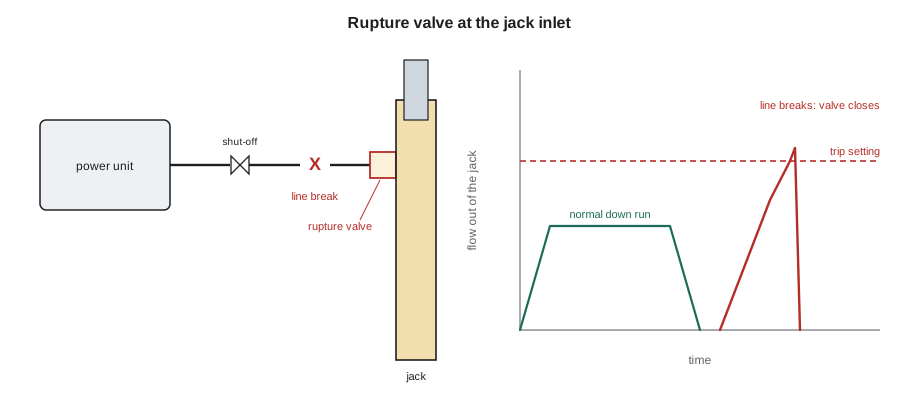
The trip setting must be above the highest normal down flow, including a fully loaded car descending with hot oil, so that the valve does not close in normal service, and low enough that the car is stopped before it gains dangerous speed after a break. The code limits the speed at which the valve must close in terms of the rated down speed, and limits the deceleration when it does. The manufacturer's data sheet gives the setting for each valve size and car, and the adjustment is sealed after the test. On new installations such as Holloway car 2, the code requires a rupture valve or an equivalent overspeed device on in-ground and other jacks.
The trip flow is the plunger area times the car speed at which the valve should close. The second equation estimates how far the car moves while it stops after the valve closes, at a deceleration a. With a trip speed a modest amount above rated down speed and a deceleration below the code limit, the stopping distance is small.
# Rupture valve trip setting check for Holloway car 2 (illustrative values)
import math
area = math.pi * 0.150 ** 2 / 4            # m2
v_rated = 0.50                            # rated down speed, m/s
hot_loaded_down = 1.10 * v_rated         # down speed with rated load and hot oil, observed at commissioning
v_trip = v_rated + 0.30                  # trip speed: rated plus a margin, within the code limit, m/s
a = 9.81                                  # deceleration when the valve closes, m/s2
q_trip = area * v_trip * 60000
q_norm = area * hot_loaded_down * 60000
print(f"highest normal down flow {q_norm:.0f} L/min, trip flow {q_trip:.0f} L/min")
print(f"margin above the highest normal flow: {100 * (q_trip / q_norm - 1):.0f} %")
v_si = v_trip
s = v_si ** 2 / (2 * a )
print(f"stopping distance after closing about {s * 1000:.0f} mm at {a} m/s2")highest normal down flow 583 L/min, trip flow 848 L/min margin above the highest normal flow: 45 % stopping distance after closing about 33 mm at 9.81 m/s2
The margin between normal down flow and trip flow is why the commissioning tests include a fully loaded down run with warm oil: if the car's normal down speed is close to the trip, the rupture valve will close during ordinary service and trap passengers. Equally, a rupture valve set too high would let the car reach a dangerous speed before it acted.
Testing a rupture valve means making it close. Methods depend on the valve and the manufacturer: opening a test bypass in the line to simulate a break, using the valve's own test feature, or running the car down with the down valve opened beyond its normal setting so that the flow rises above the trip. The test is done with the car carrying the load the code specifies, and with people out of the car. The car must stop within the limits, and the valve must hold.
Overspeed valves and plunger grippers
Other devices give similar protection. Some installations use an overspeed valve that senses car speed rather than flow. Some, especially where an existing cylinder could fail at the bottom, use a plunger gripper: a clamp mounted on the cylinder head or pit that grips the plunger and stops the car if it overspeeds downward, sensed by a governor or speed sensor. The gripper protects against a cylinder failure below the gripper, which a rupture valve at the inlet cannot do, because the oil would escape from the cylinder itself. For that reason grippers are one of the accepted ways of protecting existing single-bottom cylinders. Each device has its own annual or periodic test, set by the code and the manufacturer.
Hoses and piping
The line from the power unit to the jack is made of steel pipe or tube, with a flexible hose in some installations to isolate noise and vibration or to connect to a moving part. Pipes, fittings and hoses must be rated for the pressures in the system, with large safety factors, and the code sets requirements for the hose's rating, marking and testing. Hoses age: the rubber hardens and cracks, the reinforcement corrodes and the crimped fittings loosen. Older installations had hose replacement intervals; many jurisdictions now require a rupture valve or overspeed protection on cars with flexible hoses. Hoses are inspected for bulges, cracks, abrasion, kinks and weeping at the fittings, and they are pressure tested with the system.
Pipe runs are supported at regular intervals with clamps that allow for expansion, and protected where they pass through walls or floors. Buried pipes between the machine room and the hoistway are a special concern, because a leak there is hidden; new installations avoid them or put them in a sleeve or trench where leaks can be seen.
Devices at the ends of travel
A hydraulic car's travel is limited at the top by the plunger's stop ring, which bottoms against the cylinder head, and by normal and final terminal stopping devices that stop the car electrically before it reaches the stop ring. Driving the plunger against its stop ring at full speed would shock the system and push the pressure up to the relief setting, so the controller slows the car at the top terminal and the final limit cuts the pump if the car goes too far. At the bottom, the car is stopped by its normal terminal stopping device and, if it overtravels, by buffers or bumpers in the pit. Roped hydraulics also have the safety gear, governor and slack rope device described in Lesson 7.
Low oil protection, motor thermal protection, phase protection and the anti-creep or re-levelling operation complete the list. Each is tested at the intervals the code sets, and each test result goes in the maintenance records, which the inspector reviews.
Worked problem
Why a rupture valve might trip in normal service
A week after a new valve was fitted at the Marlowe, the car stopped suddenly halfway down with a full load on a hot afternoon, and the passengers were trapped until Ray arrived. The line was intact. The car had a rupture valve at the jack. What probably happened, and what is the fix?
Show solution
- The line was not broken, so the rupture valve closed on normal flow: the down flow on that run exceeded its trip setting.
- A full load and hot oil both raise the down speed through a valve: the heavier car pushes oil faster, and thin oil passes the valve more easily.
- The new control valve's down speed was set on an empty car with cool oil, so with full load and hot oil the car ran faster than the old valve had allowed.
- Ray resets the rupture valve as the manufacturer describes, lowers the car to the floor and releases the passengers.
- The fix is to readjust the down speed with rated load and warm oil, so that the highest normal down flow is well below the rupture valve's trip, then retest; the rupture valve's setting is not raised.
Answer: The valve was doing its job; the down speed adjustment was wrong. Down speed is checked with rated load and warm oil.
Common mistakes
MistakeRaising a rupture valve's setting to stop nuisance trips.
InsteadCorrect the down speed; the trip setting protects against a falling car.
MistakeThinking the check valve protects against a broken line to the jack.
InsteadOnly a device at the jack, such as a rupture valve, can trap the oil in the jack.
MistakeReturning a car to service with the shut-off valve part closed.
InsteadCheck that it is fully open before leaving.
MistakeIgnoring a weeping hose fitting.
InsteadWeeping fittings and bulging hoses are signs of failure; replace them.
MistakeDriving the plunger into its stop ring to find the top of travel.
InsteadTerminal stopping devices should stop the car before the stop ring is reached.
Summary and key terms
- A hydraulic car is held by trapped oil; protection is about what happens if that oil escapes or is overpressured.
- The relief valve limits pressure; the check valve holds the car against failures upstream of the valve.
- A rupture valve at the jack inlet closes when the down flow exceeds its setting, stopping a car after a line break.
- Trip settings must clear the highest normal down flow, with full load and warm oil, and stay within code limits.
- Plunger grippers and overspeed valves give overspeed protection, including for cylinder failures.
- Hoses, pipes, terminal stopping devices, buffers and low oil protection complete the system; each is inspected and tested.
- Relief valve
- A spring-loaded valve that limits the pump pressure by returning flow to the tank.
- Rupture valve
- A flow-sensing valve at the jack inlet that closes if the down flow exceeds a set value.
- Overspeed valve
- A valve that closes when the car exceeds a set down speed.
- Plunger gripper
- A clamp that grips the plunger to stop a car overspeeding downward.
- Manual shut-off valve
- A hand-operated valve that isolates the jack from the power unit.
- Stop ring
- A ring on the plunger that limits its travel out of the cylinder.
- Trip flow
- The flow at which a rupture valve closes.
Practice problems
Work each problem on paper first, then reveal the answer to check.
Why must a rupture valve be mounted at the jack rather than in the power unit?
Show answer
So that it can trap the oil in the jack when the line between the power unit and the jack breaks.
Why are down speed checks made with rated load and warm oil?
Show answer
These conditions give the highest normal down flow, which must stay below the rupture valve's trip.
What failure can a plunger gripper protect against that a rupture valve cannot?
Show answer
A failure of the cylinder itself, such as a cylinder bottom failure.
A car trips its rupture valve; the line is intact. Should the setting be raised?
Show answer
No; find out why the down flow was high and correct the down speed adjustment.
What does the relief valve protect against?
Show answer
Excessive pressure from overload, a jammed or overtravelled car, or a closed shut-off valve.
Lesson quiz · 5 questions
Score 60% or more to complete this lesson.
Create a free account to save your progress, take quizzes and earn a certificate.