
ELV-220 · Lesson 8 of 12 · 22 min
Hydraulic elevator controls and starters
The new controller for Holloway car 2 came pre-wired from the factory in a tall cabinet, with a soft starter for the pump motor in its lower half and a microprocessor board, relays and terminal strips above. Priya spent an evening class on its drawings. A hydraulic controller, she explained, does most of what a traction controller does: it answers calls, picks the direction, runs the doors and keeps the car safe. But it does not control a hoist motor and brake. It controls a pump motor that only runs for up travel and a set of valve solenoids that run both directions. "Learn the sequence of an up run and a down run," she said, "and you can follow any hydraulic controller, relay or computer."
What the controller does
A hydraulic elevator controller has these main jobs:
- Register hall and car calls and decide which direction to travel, using the car position from the landing system.
- For up travel, start the pump motor through its starter, then energize the up valve solenoids in sequence; for down travel, energize the down valve solenoids. Slow down and stop at the floor from landing system signals.
- Run the doors, and prevent the car from moving unless the doors and locks are closed, except in the levelling zone with the doors open under the code's conditions.
- Monitor the safety circuit, the motor's thermal protection, phase loss and reversal, the pump run timer and the oil temperature, and stop or remove the car from service when any of them trips.
- Re-level the car if it drifts away from floor level while parked.
- Provide emergency operations: fire service recall and in-car operation, and emergency lowering on loss of power where required.
The sequence of an up run
Every up run follows the same steps, whether the controller uses relays or software. The car is at a floor with the doors closed and the safety circuit made. The controller has a call above the car and selects up. It closes the motor starter; on a wye-delta starter, it closes the wye contactor first. The motor accelerates, pumping oil through the open bypass back to the tank, so the car does not move. After a short delay, long enough for the motor to reach speed or, on a wye-delta starter, after the transition to delta, the controller energizes the up valve solenoids. The valve begins to close its bypass, the pressure rises to the value needed to lift the car, the check valve opens and the car accelerates up. At the slowdown point for the destination floor, the controller drops the up fast solenoid; the valve slows the car to levelling speed. At floor level, the landing system's stop signal drops the levelling solenoid; the bypass opens fully, the check valve closes and holds the car, and the controller stops the motor a moment later. The doors open.
A down run is simpler, because the pump does not run. With a call below, the controller energizes the down valve solenoids. The lowering valve opens, oil flows from the jack back to the tank, and the car accelerates down. At the slowdown point, one solenoid drops and the car slows to levelling speed; at floor level, the last drops, the lowering valve closes and the car stops.
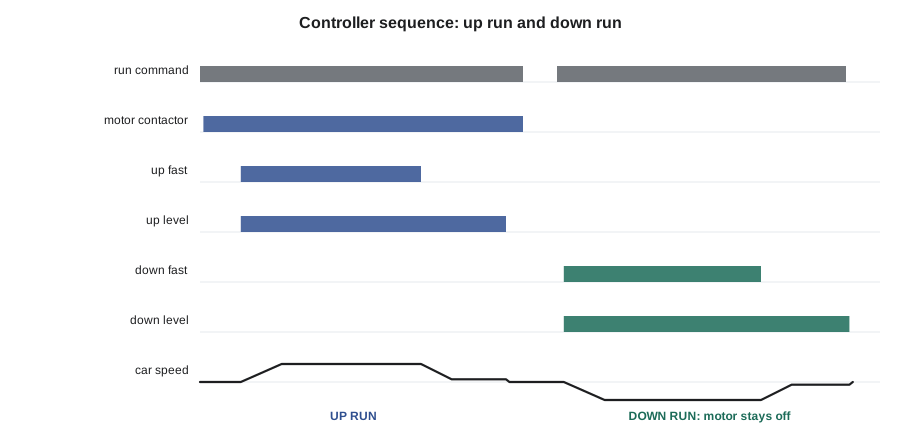
# Up and down run sequence on a hydraulic controller (simplified, times in seconds)
up_run = [
    (0.0, "run up", "call above, doors locked, safety circuit made: run up selected"),
    (0.1, "motor on", "starter closes; the pump runs through the open bypass"),
    (1.2, "up fast + up level", "after the start delay the valve closes the bypass; car accelerates"),
    (6.5, "up fast off", "slowdown point reached; car slows to low speed"),
    (9.0, "up level off", "floor level reached; bypass opens, check valve holds the car"),
    (9.5, "motor off", "motor stops after a short run-on; doors open"),
]
down_run = [
    (0.0, "run down", "call below: down selected; the motor stays off"),
    (0.2, "down fast + down level", "lowering valve opens; car accelerates down"),
    (6.0, "down fast off", "slowdown point; car slows to low speed"),
    (8.6, "down level off", "floor level; lowering valve closes and the car stops"),
]
for name, steps in (("UP RUN", up_run), ("DOWN RUN", down_run)):
    print(name)
    for t, event, why in steps:
        print(f"  {t:5.1f} s  {event:<27} {why}")
motor_time = up_run[-1][0] - up_run[1][0]
print(f"pump motor runs {motor_time:.1f} s per up run between two floors")UP RUN
0.0 s run up call above, doors locked, safety circuit made: run up selected
0.1 s motor on starter closes; the pump runs through the open bypass
1.2 s up fast + up level after the start delay the valve closes the bypass; car accelerates
6.5 s up fast off slowdown point reached; car slows to low speed
9.0 s up level off floor level reached; bypass opens, check valve holds the car
9.5 s motor off motor stops after a short run-on; doors open
DOWN RUN
0.0 s run down call below: down selected; the motor stays off
0.2 s down fast + down level lowering valve opens; car accelerates down
6.0 s down fast off slowdown point; car slows to low speed
8.6 s down level off floor level; lowering valve closes and the car stops
pump motor runs 9.4 s per up run between two floorsThe delay between motor start and up solenoids matters. Too short, and the valve tries to lift the car before the motor is up to speed, causing a slow, labouring start and high current. Too long, and passengers wait for the car to move. The run-on after the stop lets the bypass open fully before the motor stops, so the stop is smooth.
Starting the pump motor
A pump motor started directly across the line, with full voltage applied at once, draws a locked-rotor current of five to seven times its full-load current for the second or two it takes to reach speed. For Holloway's 30 kW (40 hp) motors, with a full-load current of 38 A at 600 V (47 A at 480 V), that is about 250 A (300 A) at each start, many times an hour. The building supply dips, lights may flicker, and the motor and starter contacts are stressed. Because a hydraulic pump motor starts unloaded with the bypass open, it can be started with reduced voltage, which reduces the current.
- Across-the-line (direct-on-line) starters close one contactor and apply full voltage. They are simple and give full starting torque but the highest current. They are found on small units and older cars like the Marlowe.
- Wye-delta starters connect the motor's windings in wye for starting, which applies about 58 percent of the line voltage to each winding and cuts the starting current and torque to about a third, then switch to delta after a timed interval. The motor must have six leads brought out. In an open-transition starter, the motor is briefly disconnected during the switch, which causes a current spike; closed-transition starters avoid it with a resistor bank. A wrong transition time, or a failed timer, is a common cause of starting trouble.
- Solid-state soft starters use thyristors to ramp the voltage up over a few seconds, so the current rises smoothly and is limited to a set value, often around three times full-load current. Many also provide motor overload protection, phase loss and reversal detection and a bypass contactor that takes over once the motor is at speed, so the thyristors do not run hot. The new Holloway units use soft starters.
- Variable-frequency drives on the pump motor, used on some modern power units, start the motor at low frequency and vary its speed during the run. The valve then does less throttling, which saves energy and heats the oil less, and the drive can shape the up run directly.
# Starting current of the Holloway pump motor by starter type (illustrative)
fla = 38.0                      # full-load current at 600 V
locked = 6.5 * fla               # locked-rotor current, direct on line
starters = [
    ("across the line", locked, 1.00),
    ("wye-delta (open transition)", locked / 3, 1 / 3),
    ("soft starter, 3 x FLA limit", 3.0 * fla, (3.0 * fla / locked) ** 2),
]
for name, amps, torque in starters:
    print(f"{name:<29} starting current about {amps:4.0f} A, starting torque about {100 * torque:3.0f} % of full-voltage value")
print("a pump that starts against an open bypass needs little starting torque, so all three can start it")across the line starting current about 247 A, starting torque about 100 % of full-voltage value wye-delta (open transition) starting current about 82 A, starting torque about 33 % of full-voltage value soft starter, 3 x FLA limit starting current about 114 A, starting torque about 21 % of full-voltage value a pump that starts against an open bypass needs little starting torque, so all three can start it
Phase loss and phase reversal
A three-phase motor will run backwards if two of its supply lines are swapped, and a screw pump turning backwards does not pump; it may run noisily, draw oil the wrong way or damage itself. A phase swap can happen when the utility or an electrician works on the building supply. A motor that loses one phase, single-phasing, will not start and overheats if it is left trying. The code requires protection that prevents the car from starting if a phase is lost or reversed. Older controllers use a phase monitor relay; soft starters and electronic controllers usually include it. When a car will not run after an electrical shutdown in the building, Ray's first check is the phase monitor's indicator.
Protecting the motor and the oil
The starter's overload protection, set from the motor's nameplate current, opens the motor circuit if the current stays too high for too long. Many submersible motors also have thermal sensors embedded in the windings, wired to the controller, which stop the car at the next landing and hold it there until the windings cool. The pump run timer, the low oil protection described in Lesson 4, stops the motor if an up run takes too long and lowers the car to the bottom landing. An oil temperature sensor may hold the car out of service if the oil is too hot, or switch on the cooler or heater. Each of these protections leaves a trace: an indicator on the controller, a fault code in the event log, or a tripped relay. Reading them before resetting is how the mechanic learns what happened.
Emergency lowering and fire service
When the building loses power, a hydraulic car stops wherever it is, possibly between floors. Because lowering needs only an open valve, many hydraulic cars have a battery lowering device, which on loss of power lowers the car at levelling speed to the lowest landing, or the next landing below, and opens the doors so passengers can leave. In many jurisdictions, this or an emergency power supply is required on new installations. The device has its own battery, which must be tested and replaced on schedule, and its operation is part of the periodic tests.
On fire alarm, fire service Phase I recall brings the car to the designated landing, opens its doors and takes it out of normal service, so firefighters can use it under Phase II in-car control. Hydraulic cars are recalled like traction cars. Because a hydraulic's machine room is often next to the hoistway at the bottom, the designated and alternate landings and the machine room's smoke detection are coordinated so that the car does not travel to a floor where smoke could enter the hoistway.
Manual lowering is the last resort. The valve has a manual lowering screw or button that opens a small lowering path. With power off and the car between floors, a mechanic can lower the car slowly to a landing by opening it, under the controlled rescue procedure set by the company and the code. Tamsin practised it with Ray on the Marlowe car during a scheduled shutdown, with the car empty, a mechanic at the landing to watch the car approach, and radio contact between them.
Re-levelling
A parked hydraulic car slowly sinks as oil leaks past the check valve, the lowering valve and the packing, and it may also rise or fall a little as the oil cools or warms, or as a heavy load enters or leaves the car. The controller watches the landing system. If the car drifts beyond a set distance below floor level, it starts the pump and runs the up levelling solenoid to bring the car back; if it is above floor level, it opens the down levelling solenoid. The doors may be open during re-levelling, within the code's limits. Frequent re-levelling is a symptom, and Lesson 10 shows how to measure the leak behind it.
Worked problem
A car that will not go up after a power outage
After a utility outage at Dunmore Square, the car runs down normally but will not go up. The motor hums briefly and the controller shows a fault. Down travel uses only the valve. What should Tamsin check first?
Show solution
- The car runs down, so the safety circuit, doors and down valve circuit are working.
- The fault occurs when the motor starts, and the outage was on the utility side, so a supply problem is likely.
- She checks the phase monitor's indicator and the soft starter's fault display: it shows phase reversal.
- She measures the three line voltages, which are present and balanced, then uses a phase rotation meter on the incoming supply and confirms the rotation has changed.
- She reports to Ray and the building manager. The electrician who worked on the main switchboard during the outage swaps two incoming lines back, rather than the elevator's leads being changed.
Answer: The phase protection did its job; the fix was at the building supply, and the motor was never run backwards.
Common mistakes
MistakeSwapping two motor leads to clear a phase reversal fault.
InsteadFind out why the rotation changed; correct it at the supply where it changed.
MistakeSetting the up solenoid delay as short as possible.
InsteadThe motor must be up to speed, or transitioned, before the valve loads it.
MistakeResetting a thermal or pump run timer trip without investigating.
InsteadRead the fault, find the cause, then reset.
MistakeLeaving the battery lowering device untested.
InsteadIts battery and operation are tested on schedule.
MistakeForgetting that the motor does not run on a down trip.
InsteadA car that will go up but not down has a valve or down circuit fault, not a pump fault.
Summary and key terms
- A hydraulic controller runs a pump motor for up travel and valve solenoids for both directions.
- An up run: motor starts with the bypass open, up solenoids after a delay, fast solenoid drops at slowdown, levelling solenoid at the floor, motor stops.
- A down run uses only the down solenoids; the pump stays off.
- Reduced-voltage starters, wye-delta and soft starters, cut the starting current; drives can also vary pump speed.
- Phase loss and reversal protection, overloads, winding thermals, pump run timers and oil temperature sensors protect the system.
- Battery lowering, fire service recall, manual lowering and re-levelling are part of every hydraulic controller's duties.
- Starter
- The equipment that connects and protects the pump motor.
- Wye-delta starter
- A starter that starts the motor in wye at reduced current, then switches to delta.
- Soft starter
- A solid-state starter that ramps the motor voltage to limit starting current.
- Phase monitor
- A device that detects loss or reversal of a supply phase.
- Battery lowering device
- A device that lowers a hydraulic car to a landing on loss of power.
- Re-levelling
- Automatic correction of the car's position when it drifts away from floor level.
- Start delay
- The time between motor start and energizing the up valve solenoids.
Practice problems
Work each problem on paper first, then reveal the answer to check.
Why does a hydraulic controller start the motor before energizing the up valve?
Show answer
So the motor reaches speed unloaded through the open bypass before the valve loads it.
A wye-delta starter cuts starting current to about what fraction of across-the-line current?
Show answer
About one third.
A car goes up normally but will not go down. Is the pump motor likely to be the cause?
Show answer
No; down travel does not use the motor. Check the down solenoids and their circuit, the shut-off valve and the lowering valve.
What does a battery lowering device do on loss of power?
Show answer
Lowers the car at slow speed to a landing, usually the lowest or next below, and opens the doors.
Why must phase reversal be prevented on a screw pump motor?
Show answer
A reversed screw pump does not pump and may be damaged.
Lesson quiz · 5 questions
Score 60% or more to complete this lesson.
Create a free account to save your progress, take quizzes and earn a certificate.