
ELV-220 · Lesson 1 of 12 · 22 min
Hydraulic elevator types and applications
Tamsin Iwasaki's second year at Northcrest Elevator began in a hospital basement. The modernization at Holloway Memorial Hospital, which she first saw as a first-year apprentice when Ray Abernethy replaced the control valve on car 1, had moved on to car 2: a new power unit, a new controller, new valves and, most expensive of all, a new jack in a new protected cylinder to replace the single-bottom cylinder that had sat in the ground since the 1980s. Lena Ostrander, the field superintendent, put Tamsin on the job with Ray for the whole term. "Half the elevators on Route 7 are hydraulics," Ray told her on the first morning. "If you understand this one, you understand most of the low-rise buildings in the city." This course follows that job and the hydraulic cars on Route 7 from the principles of pressure and flow to the tests that prove a hydraulic elevator safe.
A hydraulic elevator moves its car by pumping oil into a cylinder. The oil pushes a ram, called the plunger or piston, out of the cylinder, and the plunger lifts the car. To lower the car, a valve lets oil flow back from the cylinder to the tank and the weight of the car pushes the plunger down. There is no counterweight and, in the simplest form, no ropes, no machine above the hoistway and no traction sheave. The pump runs only when the car goes up; going down, gravity does the work and the valve controls the speed. That simplicity is why hydraulics dominate low-rise buildings: they are cheap to install, the machine room can be anywhere near the bottom of the hoistway, and the building does not have to carry the load of a machine at the top.
A short history
Hydraulic elevators are older than electric ones. In the nineteenth century, many buildings had elevators driven by water under pressure from the city mains or from a rooftop tank, either pushing a long plunger directly or pulling ropes through a hydraulic machine. When electric traction elevators arrived at the end of the century, they took over taller buildings, because a direct plunger had to be as long as the rise and water systems were hard to control. The modern oil-hydraulic elevator, with an electric motor driving a pump and a valve controlling the flow, became common after the Second World War. Since then, valves have gone from simple mechanical designs to electronically controlled ones, starters from direct-on-line to soft starters and drives, and cylinders from bare steel in the ground to protected cylinders and holeless designs that do not need a hole at all.
The four main types
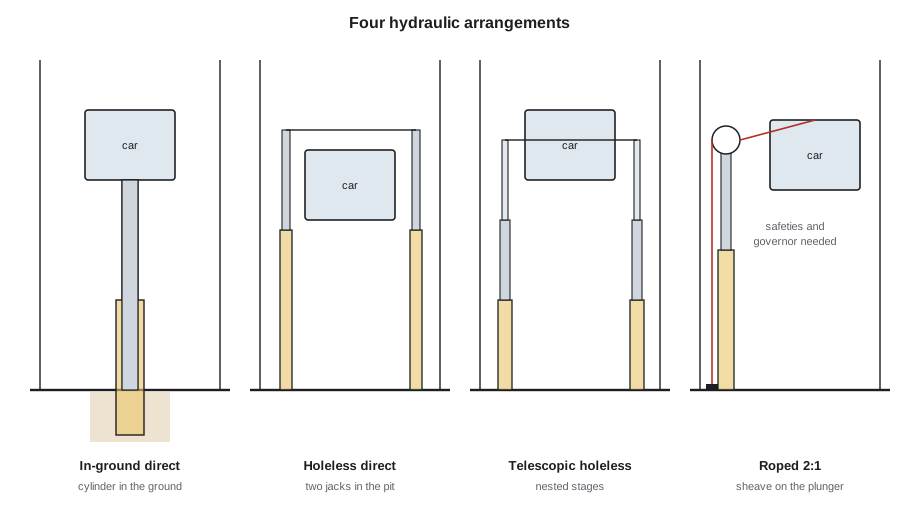
Every hydraulic elevator Tamsin will work on is one of a few arrangements, and the arrangement decides where the jack is, how much rise the car can have and what can go wrong.
- Direct-acting in-ground (holed) hydraulic. A single-stage plunger is fixed under the car platform and the cylinder sits in a drilled hole below the pit, as deep as the travel plus the bottom clearance. Holloway's cars and the Marlowe Apartments car on Route 7 are this type. The plunger supports the car directly, so the car does not need safety gear, and the ride is smooth because the jack pushes straight up under the centre of the car.
- Holeless direct-acting hydraulic. One or two jacks stand in the pit beside the car, with their plungers fixed to the car frame. No hole is drilled, so there is no buried cylinder to corrode or leak into the soil. The rise is limited by the length of jack that fits between the pit floor and the car with the car at the bottom landing, typically one or two floors with a single-stage jack.
- Telescopic holeless hydraulic. Two or three nested stages extend one after another, so a short jack can give a longer stroke. The Ashgrove Clinic, a two-storey medical building added to Route 7 this year, has a twin-post telescopic holeless car.
- Roped hydraulic. A jack in the hoistway carries a sheave at the top of its plunger; ropes from a hitch in the pit pass over the sheave to the car. Each metre of plunger travel moves the car two metres, so a jack half the length of the travel serves the full rise. Because the car is hung on ropes, it needs safety gear and a governor like a traction car. Dunmore Square, a four-storey office building on Route 7, has a roped hydraulic.
Where hydraulics are used
Hydraulic elevators are used where the rise is low and the traffic moderate: two to six stops, a rise up to roughly 18 m (60 ft), and speeds usually between 0.25 and 0.75 m/s (50 and 150 ft/min), with a few faster units. Typical buildings are low-rise offices, apartments, schools, clinics, parking structures and stores. Hydraulics are also the natural choice for heavy freight, because the jack can carry large loads without a counterweight, and for buildings where a machine room at the top is impossible. Above about six stops, the jack gets very long, the energy use and heating of the oil climb, and traction machines, especially machine-room-less gearless ones like those at Quayside Tower, become the better choice.
| Type | Typical rise | Needs a hole | Needs safeties | Example on Route 7 |
|---|---|---|---|---|
| In-ground direct-acting | up to about 18 m (60 ft) | yes | no | Holloway, Marlowe |
| Holeless direct-acting | one or two floors | no | no | (none) |
| Telescopic holeless | two to four floors | no | no | Ashgrove Clinic |
| Roped hydraulic (2:1) | up to about 18 m (60 ft) | no | yes | Dunmore Square |
The parts of a hydraulic elevator
Whatever its arrangement, a hydraulic elevator has the same chain of parts, and the course takes them in order. The power unit sits in the machine room: a steel tank of hydraulic oil, a pump driven by an electric motor (usually submerged in the oil on modern units), a control valve block that directs the flow, a manual shut-off valve, a muffler or silencer to quiet the pulses from the pump, and often an oil heater and cooler. A pipe or hose carries oil from the power unit to the jack. The jack is the cylinder and plunger, with a packing or seal at the top of the cylinder that stops oil escaping around the plunger. Safety devices include the pressure relief valve in the power unit, a rupture valve at the jack on newer installations, low-oil protection and, on roped units, the safety gear and governor. The controller, with its starter for the pump motor, runs the whole system from the hall and car calls, and a landing system tells it where the car is.
Ray summed up the system for Tamsin in a sentence she wrote on the first page of her second-year log: the motor makes flow, the load makes pressure, and the valve decides where the oil goes. Most problems with a hydraulic elevator are problems with one of those three things.
Strengths and weaknesses
The strengths of a hydraulic elevator are real. It is cheap to build for low rises. The machine room can be at the bottom of the building, or next to the hoistway on any floor near the bottom, and does not need a heavy structure above the hoistway. The car sits on the jack, so a power failure leaves it supported, and lowering it to the floor in an emergency only needs a valve to open, which a battery lowering system can do automatically. Hydraulics carry heavy loads well, and an in-ground car does not need safety gear.
The weaknesses matter just as much. A hydraulic elevator uses more energy than a counterweighted traction elevator, because the pump must lift the whole weight of the car and plunger every trip, and all that energy is turned into heat in the oil on the way down. The oil gets hot in busy service, and its viscosity changes with temperature, so the ride varies from a cold morning to a hot afternoon. Buried cylinders can corrode and leak oil into the soil, and the oldest single-bottom cylinders can fail catastrophically. Hydraulic oil is flammable and a spill is an environmental problem. And a hydraulic car can creep down slowly as oil leaks past seals and valves, so the controller must re-level it.
# Energy for one up trip: hydraulic car versus a counterweighted traction car (illustrative)
g = 9.81
travel = 12.0                 # rise, m
car_and_sling = 2300        # kg
plunger = 700               # kg (moves with the car on a direct-acting jack)
load = 1000                   # passengers in the car, kg
eta_hyd = 0.60               # pump, motor and valve overall efficiency, up direction
eta_trac = 0.80              # traction machine and roping
overbalance = 0.45           # a traction counterweight balances the car plus 45 % of rated load
rated = 2000
lift_mass = car_and_sling + plunger + load
e_hyd = lift_mass * g * travel / eta_hyd
unbalance = load - overbalance * rated     # traction: only the unbalance is lifted
e_trac = max(unbalance, 0) * g * travel / eta_trac
print(f"hydraulic: lifts {lift_mass:,.0f} kg, energy about {e_hyd / 1000:,.0f} kJ per up trip")
print(f"traction:  lifts an unbalance of {unbalance:,.0f} kg, energy about {e_trac / 1000:,.0f} kJ per up trip")
heat = (car_and_sling + plunger + load) * g * travel
print(f"on the way down the hydraulic valve turns about {heat / 1000:,.0f} kJ of potential energy into heat in the oil")hydraulic: lifts 4,000 kg, energy about 785 kJ per up trip traction: lifts an unbalance of 100 kg, energy about 15 kJ per up trip on the way down the hydraulic valve turns about 471 kJ of potential energy into heat in the oil
The comparison is not fair to the hydraulic in every respect, because a traction car spends energy too on a light car going down and a heavy car coming up, and modern traction drives recover energy by regenerating. But it shows why hydraulics are reserved for low rises: every trip lifts the whole car, and every descent dumps that energy as heat. Lesson 3 returns to the heat and how a power unit gets rid of it.
Codes, regulators and the people involved
Hydraulic elevators are covered by the same code as traction elevators, CSA B44, the Safety Code for Elevators and Escalators, which is published jointly with ASME A17.1 and adopted in British Columbia under the Safety Standards Act and the Elevating Devices Safety Regulation. The code has a part for hydraulic elevators, with requirements for jacks and cylinders, valves, piping, pressure relief, protection against overspeed and the tests that must be done. The regulator is Technical Safety BC, which issues operating permits, registers contractors and licenses mechanics. Each modernization at Holloway needs a permit before work starts, and the car cannot return to service until it passes an acceptance inspection.
Several older rules apply specifically to hydraulics. Cylinders installed in the ground before the code required a double bottom or safety bulkhead, called single-bottom cylinders, have a history of sudden failures when corrosion lets the bottom separate from the cylinder wall, dropping the car. Technical Safety BC issued a safety order requiring owners of in-ground hydraulic elevators with single-bottom cylinders to bring them into compliance, by replacement or approved protection, by October 2015. Holloway car 2 has an approved interim measure, but the owner has chosen replacement as part of the modernization, which is why a drilling rig will be in the building for a week in Lesson 6.
The Holloway car 2 job
The numbers for Holloway car 2 are the same as car 1, because the two cars were built together. The car and its sling, the frame that holds the platform to the plunger, weigh 2,300 kg (5,000 lb). The plunger, a steel tube 150 mm (6 in) in diameter, weighs 700 kg (1,500 lb) over its length. The rated load is 2,000 kg (4,500 lb), enough for a hospital stretcher, its attendants and a portable monitor. The car travels 12 m (40 ft) between four stops at a rated speed of 0.50 m/s (100 ft/min). These numbers will appear again and again in the course: they set the oil pressure, the pump flow, the motor size, the oil volume and the tests.
Lena gave Tamsin a one-page scope of work to read before the first site meeting. It listed the modernization in the order the work would happen: remove car 2 from service with a hospital-approved outage plan, install infection control barriers around the machine room and pit, remove the old power unit and controller, drill a new hole beside the old one, install a new protected cylinder and plunger, install the new power unit with a soft starter, a rupture valve at the jack, new piping and a new controller, then adjust, test and present the car for acceptance. Car 1 would carry all the hospital's traffic between the emergency department and the imaging floor while car 2 was out, so the schedule had no slack.
Worked problem
Travel time on a hydraulic car
Holloway car 2 travels 12 m (40 ft) at 0.50 m/s (100 ft/min). Allowing about 2 s to accelerate and 3 s to slow down and level, how long does a trip from the bottom to the top landing take, from start to stop?
Show solution
- At rated speed the full travel would take 12 / 0.50 = 24 s (40 / 100 × 60 = 24 s).
- Accelerating and slowing down at the ends cover part of the distance at less than full speed; a simple allowance is to add about half the acceleration and slowdown times: 0.5 × (2 + 3) = 2.5 s.
- Total trip time is about 24 + 2.5 = 26.5 s, plus door times at each end.
Answer: About 27 s from start to stop, which is why a four-stop hospital hydraulic feels slow beside a traction car.
Common mistakes
MistakeThinking a hydraulic elevator has a counterweight.
InsteadMost have none; the pump lifts the whole car and plunger every trip.
MistakeAssuming the pump runs in both directions.
InsteadThe pump runs only for up travel; the car descends by gravity through the valve.
MistakeTreating every hydraulic as an in-ground car.
InsteadHoleless, telescopic and roped hydraulics have different parts and different hazards.
MistakeForgetting that roped hydraulics need safety gear.
InsteadA car hung on ropes needs safeties and a governor like a traction car.
MistakeIgnoring the age of a buried cylinder.
InsteadSingle-bottom cylinders can fail suddenly; their status is checked on every older in-ground car.
Summary and key terms
- A hydraulic elevator lifts its car by pumping oil into a jack and lowers it by letting oil return through a valve.
- The main types are in-ground direct-acting, holeless, telescopic holeless and roped hydraulic.
- Hydraulics suit low rises, moderate speeds and heavy loads, and need no machine at the top of the hoistway.
- Every trip lifts the whole car and plunger, and every descent turns that energy into heat in the oil.
- The power unit, piping, jack, safety devices and controller form a chain: the motor makes flow, the load makes pressure, the valve directs the oil.
- Single-bottom cylinders are a known hazard and must be replaced or protected under the rules that apply.
- Jack
- The cylinder and plunger that lift the car.
- Plunger
- The ram that extends from the cylinder and supports the car; also called the piston.
- Power unit
- The tank, pump, motor and control valve that supply and control the oil.
- Holeless hydraulic
- A hydraulic elevator whose jacks stand in the pit, with no drilled hole.
- Roped hydraulic
- A hydraulic elevator in which a sheave on the plunger moves the car through ropes, usually 2:1.
- Single-bottom cylinder
- An older buried cylinder with only one bottom plate, prone to sudden failure.
- Sling
- The frame that carries the car platform and connects it to the plunger or ropes.
Practice problems
Work each problem on paper first, then reveal the answer to check.
Why does a roped hydraulic need safety gear when an in-ground hydraulic does not?
Show answer
Its car hangs on ropes that could fail, while the in-ground car sits directly on the plunger.
Name two reasons hydraulics are uncommon above six stops.
Show answer
The jack becomes very long and the energy use and oil heating grow with the rise.
What does the pump do when the car travels down?
Show answer
Nothing; it is stopped, and the car descends by gravity through the down valve.
Holloway car 2 travels 12 m (40 ft) at 0.25 m/s (50 ft/min) on inspection speed. How long does the full travel take at that speed?
Show answer
12 / 0.25 = 48 s (40 / 50 × 60 = 48 s).
Why is the oil in a busy hydraulic elevator hotter than in a quiet one?
Show answer
Each descent converts the car's potential energy to heat in the oil, so more trips mean more heat.
Lesson quiz · 5 questions
Score 60% or more to complete this lesson.
Create a free account to save your progress, take quizzes and earn a certificate.