
ELV-130 · Lesson 9 of 12 · 17 min
Rigging the car frame and platform
The car of a traction elevator is built in the hoistway, part by part, from the bottom up. The car frame, also called the car sling, is a rectangular steel frame: the safety plank at the bottom, carrying the safety gear that grips the rails; two uprights called stiles; and the crosshead at the top, which on the Quayside cars carries the car sheaves for the two-to-one roping. The platform sits inside the frame on the plank, and the cab is built on the platform later. Each of these parts is heavy, each has to be lifted into a narrow space between two rails, and each has to be fastened to the others square and plumb before the car can be hung on its ropes. This lesson follows the frame and platform for Quayside car 2 from the bottom landing to the point where the car is ready for roping.
The parts and their weights
The packing list for car 2 gives the weights of the frame parts, which Tamsin checked against the manufacturer's drawing before planning any lift. The crosshead with its sheave assembly is the heaviest single frame part and the one that has to go highest, so it governs the rigging. The platform is heavier but goes in at the bottom landing, across the sill, and is lifted only a short distance.
| Part | Weight | Lifted to | Lifting points |
|---|---|---|---|
| Safety plank with safeties | 220 kg (480 lb) | Car-building platform, just above the bottom landing | Two lifting holes in the plank channels |
| Stile (each of two) | 55 kg (120 lb) | Stood up on the plank | Top bolt holes, with a shackle |
| Crosshead with car sheaves | 210 kg (460 lb) | Top of the stiles, about 3.2 m (10.5 ft) above the plank | Two lifting lugs on the crosshead channels |
| Platform | 380 kg (840 lb) | Onto the plank, inside the stiles | Four lifting points at the platform corners |
The car frame and platform together weigh a little over 900 kg (2,000 lb), and the finished car with its cab, doors and equipment about 1,500 kg (3,300 lb). Neither of those totals is ever lifted on this job, because the car is built in place on its building platform and then hung from its ropes. That is typical: the rigging plan for a car is a set of small lifts, each planned, rather than one big one.
The lifting arrangement at the bottom
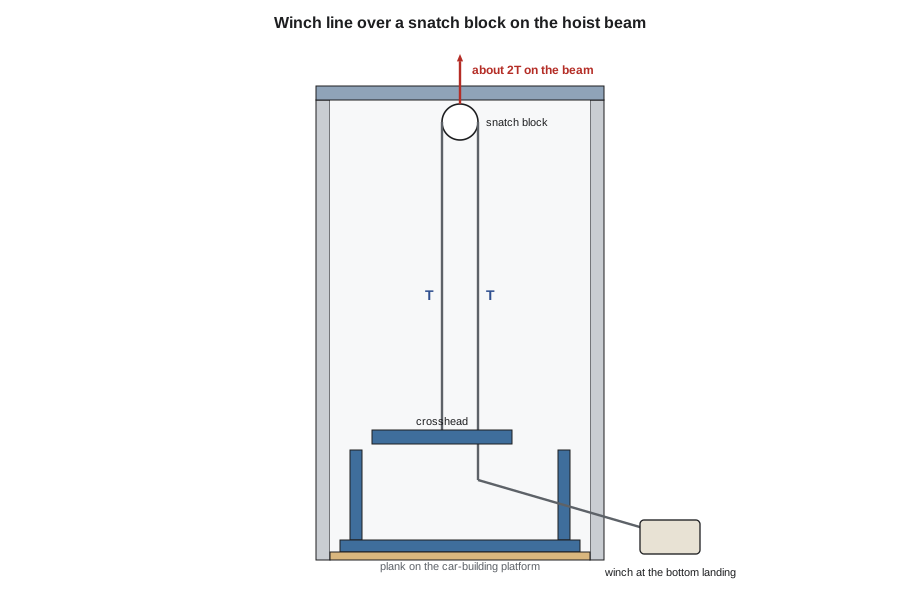
The hoist beam is at the top of a 90 m (300 ft) hoistway, and the car is built at the bottom. A chain hoist cannot reach that far. Northcrest's method for building a car low in a tall hoistway uses a construction winch: a powered winch anchored at the bottom landing, whose wire rope runs up the hoistway, over a snatch block hung from the hoist beam, and back down to the load. The winch is a rated hoisting machine with its own brake, limit and controls, inspected like any hoist, and its rope is protected from rubbing on the sill and the brackets by rollers and guards.
The snatch block on the hoist beam is the part apprentices most often get wrong. A block with a rope passing over it carries the pull of both rope parts. If the two parts hang parallel, one down to the load and one down to the winch, the block carries twice the rope tension. If the rope turns through a smaller angle, the block carries less. The load on the block, and therefore on the hoist beam, is found from the angle between the two rope parts.
Here T is the rope tension and θ the angle between the two rope parts at the block. With the parts parallel, θ is zero and the block carries 2T. With the parts at 90 degrees to each other, it carries about 1.41T. The winch anchor at the bottom carries the rope tension in the direction of the rope, so it is a rated anchor too.
# Winch line over a snatch block on the hoist beam: block and beam load
import math
beam_rating = 2000            # hoist beam rating (kg)
block_rating = 1000          # snatch block rating (kg)
for part, w in (("safety plank", 220), ("crosshead with sheaves", 210), ("platform (one end)", 190)):
    rigging = 20          # bridle, shackles and the winch hook (kg)
    T = (w + rigging) * 1.04  # rope tension including friction at the block (illustrative 4 %)
    for theta in (0, 30):        # angle between the rope parts at the block (degrees)
        F = 2 * T * math.cos(math.radians(theta / 2))
        ok = F <= beam_rating and F <= block_rating
print(f"{part:<24} theta {theta:>2}: rope {T:5.0f} kg, block {F:5.0f} kg {'ok' if ok else 'NOT OK'}")safety plank theta 0: rope 250 kg, block 499 kg ok safety plank theta 30: rope 250 kg, block 482 kg ok crosshead with sheaves theta 0: rope 239 kg, block 478 kg ok crosshead with sheaves theta 30: rope 239 kg, block 462 kg ok platform (one end) theta 0: rope 218 kg, block 437 kg ok platform (one end) theta 30: rope 218 kg, block 422 kg ok
Each lift puts roughly twice its weight on the block and the beam. The beam has plenty of capacity, but the snatch block chosen for the winch line is the limiting part, and it is within its rating for every lift with a good margin. If the platform were lifted whole on the winch line, rather than one end at a time as the next section describes, the block would be close to its rating, and the plan would need a larger block. Tamsin noted in her log that the crosshead, which weighs about a third as much as the machine, puts two thirds as much load on the hoist beam as the machine lift did, because of the block. A rigger who checked the beam against the weight of the part alone would be wrong by a factor of two.
Setting the plank and stiles
The safety plank comes in first, through the bottom landing on a dolly, and is lifted onto the car-building platform. It is set on the platform at the position the layout gives relative to the rails, with its safety jaws open and clear of the rails, and levelled with shims. The plank is the foundation of the car: every part above it is squared from it, so it is checked for level in both directions and centred between the rails before anything else goes on.
The stiles are lifted on end, one at a time, with the winch line and a shackle through the top bolt holes, and a tag line on the bottom. Each is stood up beside its rail, lowered onto the plank, and bolted with the bolts started by hand before the line is slackened. A stile standing on the plank but not bolted is held by the line until its bolts are in. When both stiles are up, each is braced temporarily to the rail with a clamp, so that the crosshead can be lifted between them.
Lifting the crosshead
The crosshead is lifted from its two lugs with a short two-leg bridle, adjusted so that it hangs level, because it has to drop between the stiles and onto their tops with its bolt holes lined up at both ends at once. It goes up horizontally between the rails with very little clearance, which is the reason the tag lines matter: one at each end, held from the landing above, keep it from turning. When it is above the stiles, it is lowered slowly until its holes are just above the stile holes, lined up with drift pins, and lowered onto the stiles. The bolts are started at both ends before the winch line is slackened.
This is the moment in the car build when people are closest to a suspended load. The two mechanics fitting the bolts are on a rated platform or scaffold beside the frame, tied off, with their hands on the drift pins and the bolts but never between the crosshead and the stile tops. The winch operator lowers only on Ray's signal, in short movements, and stops at once on 'hold'. Nobody is in the pit.
The platform
The platform is the floor of the car, a steel frame with a plywood or composite deck, and on Quayside it is too wide to tilt through the frame once the stiles are up. It is brought in across the bottom landing sill on skates and lowered onto the plank inside the stiles. Because it is heavy and has to move horizontally into the hoistway, it is the one part of the car build where a load is transferred from the landing in the way Lesson 7 described: the platform is rolled onto a bridge of timbers over the sill, lifted at the hoistway end by the winch line on a bridle to two corners while the landing end stays on its skates, and walked forward until it is over the plank. Then the landing end is picked up by a chain hoist on a temporary beam across the entrance head, and both ends are lowered together onto the plank.
Lifting one end at a time means each lift carries only part of the weight, which keeps the snatch block well within its rating. It also means the platform is tilted while one end is lifted, so its centre of gravity, which is near its middle, moves toward the lower end, and the share at each end changes. The share is checked at the steepest tilt, and the skates at the landing end are chocked so that the platform cannot roll as its other end lifts.
Squaring and plumbing the frame
When the plank, stiles, crosshead and platform are bolted together, the frame is squared and plumbed before the bolts are torqued. Square is checked by measuring the two diagonals of the frame, from the top of one stile to the bottom of the other, which must be equal within the manufacturer's tolerance; a frame that is not square will make the car run crooked on the rails. Plumb is checked on each stile against the rail face with a level or a plumb line. The platform is checked for level in both directions, because the car will level to the landings from it. Any correction is made by loosening bolts and adjusting the frame with a lever hoist or a jack, never by hammering the frame into line, and the bolts are then torqued in the sequence the manual gives.
The guide shoes or roller guides are fitted to the top and bottom of the frame and adjusted to the rails, and the safeties are adjusted to their clearances. At that stage the car frame is fully guided by the rails, which is the condition the manufacturer usually requires before the car is roped.
Supporting the car before roping
Until its ropes are on and tensioned, the car rests on the car-building platform. It is never left hanging from the winch line or a hoist, even for a short time, and its support is checked before anyone works on it or under it. Some manufacturers allow the car to be supported on its safeties, set by hand onto the rails, as a second support during the build. That is done only with the manufacturer's procedure, and only after the safeties are adjusted, because a safety that is not correctly set can slip.
Once the ropes are installed in ELV-230's work, the car takes its weight on the ropes, the counterweight is free of its blocking, and the car-building platform can be removed. Removing it is a rigging task too: its timbers and steel supports come out one at a time, lowered to the pit, with nobody under the car while it happens and the car held on its brake.
Common mistakes
MistakeAssuming the hoist beam carries only the weight of the part on the winch line.
InsteadA snatch block with parallel rope parts puts twice the rope tension on the beam.
MistakeSlackening the line before a stile's bolts are started.
InsteadHold each part on the line until its bolts are in.
MistakeLining up crosshead bolt holes with fingers.
InsteadUse drift pins, with hands clear of the gap.
MistakeLifting the whole platform on the winch line to save time.
InsteadLift one end at a time within the block rating, with the other end chocked.
MistakeHammering an out-of-square frame into line.
InsteadLoosen the bolts, adjust with a lever hoist or jack, then torque in sequence.
Summary and key terms
- The car frame and platform are built in place on a car-building platform as a series of small planned lifts.
- A winch line over a snatch block on the hoist beam reaches the bottom of a tall hoistway.
- A snatch block carries 2T cos(θ/2), about twice the rope tension when the parts are parallel.
- The plank is set level and centred first; the stiles and crosshead are lifted on lines and bolted before the line is slackened.
- The platform comes in from the landing one end at a time, with the other end chocked.
- The frame is squared by its diagonals, plumbed to the rails, and supported on the building platform until it is roped.
- Car frame (car sling)
- The steel frame of plank, stiles and crosshead that carries the car platform and cab.
- Safety plank
- The bottom member of the car frame, which carries the safety gear.
- Crosshead
- The top member of the car frame.
- Stile
- One of the two upright members of the car frame.
- Snatch block
- A single-sheave block that changes the direction of a rope, often opening at the side to take the rope.
- Construction winch
- A powered drum hoist used during installation to lift loads up the hoistway.
Practice problems
Work each problem on paper first, then reveal the answer to check.
A winch rope carries 250 kg and passes over a snatch block with the two parts parallel. What does the block carry?
Show answer
500 kg.
The same rope turns through a 90-degree angle between parts at the block. What does the block carry?
Show answer
2 × 250 × cos 45° = 354 kg.
Why is the safety plank levelled and centred before anything else is fitted?
Show answer
Every other part of the car is squared from it.
How is a car frame checked for square?
Show answer
By measuring its two diagonals, which must be equal within tolerance.
Lesson quiz · 5 questions
Score 60% or more to complete this lesson.
Create a free account to save your progress, take quizzes and earn a certificate.