
ELV-130 · Lesson 10 of 12 · 17 min
Rigging the counterweight
The counterweight is the heaviest assembly in a traction elevator, and the one that is never lifted whole. It is built in the hoistway from a frame and a stack of fillers, each light enough to handle, until it weighs as much as the car plus part of the rated load. At Quayside, the finished counterweight for car 2 is 2,220 kg (4,875 lb): a 340 kg (750 lb) frame and sixty-odd cast iron fillers of 30 kg (66 lb) each, as ELV-120 calculated. Rigging the counterweight is therefore not one lift but a series of jobs: lifting and setting the frame, building and checking its support, loading the fillers safely, and above all managing the balance between car and counterweight as both are built, so that nothing moves when it should not.
The counterweight frame
The frame is a tall, narrow steel assembly: two uprights, a bottom member that carries the fillers and the buffer striker plate, a top member with the rope hitch or sheave, guide shoes top and bottom, and tie rods or retainers that hold the fillers in place. At Quayside it is about 3.6 m (12 ft) tall and runs on the counterweight rails beside the car. Like a stile, it is lifted on end. It comes in through the bottom landing, is stood up and lowered into the counterweight space between its rails on the winch line through the snatch block, and is set on its blocking in the pit.
A tall frame on end has a high centre of gravity and a narrow base, which makes it unstable until it is guided by its rails. The frame is therefore lifted from its top lifting point, which keeps it hanging below its centre of gravity, with a tag line on the bottom, and it is lowered into the rails so that its guide shoes engage before it is set down. Until the shoes are on the rails and the frame is resting on its blocking, it stays on the line. A counterweight frame standing in the pit on blocking but not yet guided can fall over, and in a narrow counterweight space there is nowhere for a person to get out of its way.
The blocking
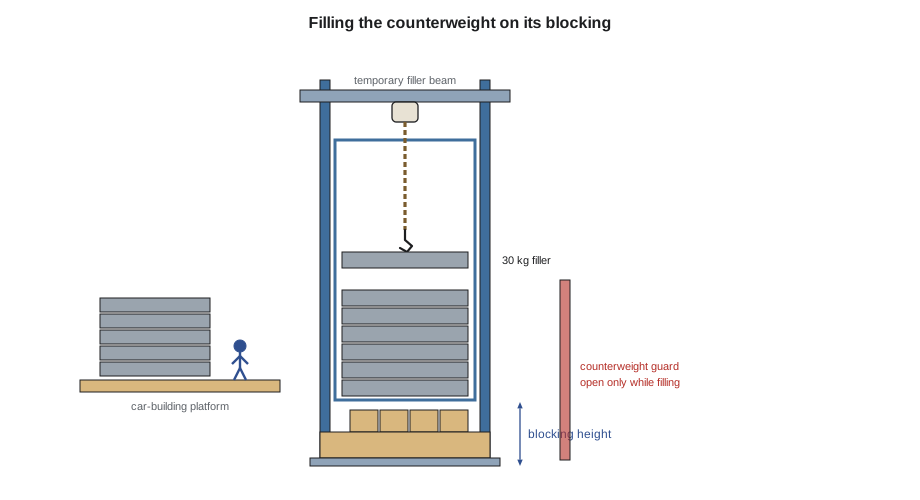
The blocking under the counterweight is a structural support of a planned height. Its height comes from the layout: with the car at the top landing and the ropes installed, the counterweight must be at the height where its buffer runby is correct. Setting the blocking to that height means that when the ropes are installed with the car at the top, the counterweight takes its load onto the ropes in the right place. At Quayside the blocking is a crib of matched hardwood timbers on a steel base plate in the pit, built as Lesson 7 described, with a steel cap plate under the counterweight's buffer striker. It is checked for its height, its bearing and its stability before the frame is set on it.
The blocking carries the frame and every filler loaded into it until the ropes take the weight, so it is designed for the full counterweight, not just the frame. It is never built up from scrap timber, mixed sizes or pieces of rail, and it is never shimmed with loose material that could squeeze out. Once the counterweight is on its ropes and the car is running, the blocking is removed from the pit, and a counterweight on its ropes with blocking still underneath is a hazard in itself, because the counterweight will land on it with the car at the top.
Loading the fillers
Fillers are cast iron or steel plates that slide into the frame between the uprights and stack on the bottom member, held down by the retainers. Each one at Quayside weighs 30 kg (66 lb), which is a manageable weight for a single lift by one person in a good posture but not for dozens of lifts while reaching into a narrow frame over an open pit. Northcrest's rule is that fillers over 23 kg (51 lb) are not lifted by hand into a frame. They are lowered in with a small chain hoist and a filler hook or clamp made for the filler's lifting slot, with the hoist hung from a rated point directly above the frame.
At Quayside, the rated point is a short temporary filler beam across the counterweight space at the second floor, bearing in two pockets in the hoistway walls that the general contractor formed for the purpose, with a beam clamp and a 500 kg (1/2 ton) chain hoist on it. One mechanic stands on the car-building platform beside the frame and hooks each filler from the stack; the other, also on the platform and tied off, guides it into the frame with a hand on the filler's top edge and lowers it on the hoist. Hands come off the filler before it lands on the one below, because the gap between two fillers is a pinch point that closes completely.
The counterweight guard in the pit, the screen that stops a person in the pit from walking under a descending counterweight, is opened only while the fillers are loaded and closed again at the end of each shift. The fillers are counted as they go in and recorded on the counterweight card, with the stage of the build, because the number in the frame is what controls the balance.
Managing the balance
The counterweight is built to balance the finished car plus a fraction of its rated load, the overbalance, which at Quayside is 45 percent. During installation, the car is never finished: at first it is a bare frame and platform, then it has a cab, then doors, then the equipment and finishes. If the counterweight were filled to its final weight while the car was still a bare frame, the counterweight would be heavier than the car by well over a tonne, and when the brake was released the counterweight would drive the car up. The manufacturer's procedure therefore fills the counterweight in stages, matching it to the car as it is built.
Here W_car is the car's weight at that stage, L the rated load, and q the overbalance fraction. During construction, the manufacturer usually calls for the counterweight to be close to the car's current weight, with a small difference in a set direction, so that the machine and its brake hold the system easily and the car does not run away in either direction when the brake is lifted for a test. The final fill and the balance test, in which the motor current is compared with the car going up and down with a known load, come at the end of the installation and are part of ELV-230.
# Counterweight fill plan for car 2: fillers by stage and the lifting work
import math
frame, filler = 340, 30          # (kg)
rated_load, q = 1600, 0.45          # rated load and overbalance fraction
stages = [  # (stage, car weight at that stage in kg, target = car only or final)
    ("frame and platform, roping", 920, "match"),
    ("cab and doors fitted", 1350, "match"),
    ("finished car, final fill", 1500, "final"),
]
in_frame = 0
for name, car, target in stages:
    want = car if target == "match" else car + q * rated_load
    n = (want - frame) / filler
    full = math.floor(n)
    half = target == "final" and n - full >= 0.5
    new = full - in_frame
    in_frame = full
    cwt = frame + full * filler + (filler / 2 if half else 0)
    print(f"{name:<28} car {car:>5} kg -> cwt {cwt:>6.0f} kg: {full} fillers{' + 1 half' if half else ''} ({new} added)")
lifts = in_frame + 1
print(f"total filler lifts: {lifts}, {lifts * filler:,} kg lowered into the frame by hoist")frame and platform, roping car 920 kg -> cwt 910 kg: 19 fillers (19 added) cab and doors fitted car 1350 kg -> cwt 1330 kg: 33 fillers (14 added) finished car, final fill car 1500 kg -> cwt 2215 kg: 62 fillers + 1 half (29 added) total filler lifts: 63, 1,890 kg lowered into the frame by hoist
The plan loads the counterweight in three steps: about a third of the fillers when the car is a frame and platform ready for roping, more when the cab and doors are on, and the rest at the end, which matches the final count from ELV-120. Each step is done only after the car's weight at that stage is known, from the packing list weights of everything fitted. The total, sixty-odd lifts of a heavy casting, is the reason the fillers go in on a hoist: by hand, that is nearly two tonnes of iron lifted and lowered at arm's length over a pit.
The stage fill also makes the system safer when the brake is lifted. With the car and counterweight close in weight, the force the brake has to hold is small, and if the machine is moved by hand for an adjustment, the car moves slowly and stops when it is released. A badly out-of-balance system moves on its own as soon as the brake is lifted. Lena's branch rule is that nobody lifts a brake during installation without first checking the counterweight card against the car's stage.
Roping and taking the counterweight off its blocking
When the ropes are installed, which is ELV-230's subject, the car is at or near the top landing on its building supports or a temporary arrangement, the counterweight is on its blocking at the bottom, and the ropes are cut and fastened to length so that they are just tight with both resting. The load comes onto the ropes when the car is lowered off its supports with the machine, or when the counterweight is lifted off its blocking by the car moving down. From that moment, the car and counterweight hang from the ropes and balance each other through the machine sheave, and both supports can be removed.
Taking the weight onto the ropes is a planned step with the mechanic in charge present, the hoistway clear, and the pit empty. The blocking is removed only after the counterweight has been lifted clear of it and the car is held on the brake, and it is lowered out of the pit piece by piece. Until the car runs on its own controls, any movement of the car is done with the machine under the control of a qualified mechanic, with the counterweight's position watched at the pit.
Rigging a counterweight on a modernization
On a modernization or a major repair, a counterweight that is already roped may have to be supported so that the ropes or the machine can be changed. The counterweight is landed on its buffer, or on blocking placed on the buffer support, with the car at the top of the hoistway. If the work means removing fillers, for example to change the frame or to rebalance for a new, lighter car, each filler is removed from the top of the stack with the hoist, and the car side is supported first, because removing weight from the counterweight changes the balance. On the Tillicum car 2 job, the counterweight will be landed on blocking in the pit with the car at the top on its safeties before the old machine's ropes come off, and that sequence is in the lift plan in Lesson 12.
Old counterweights hold surprises. Fillers may be different weights from different eras, concrete fillers may be cracked, and the tie rods may be corroded. Each filler removed from an old counterweight is weighed or measured, and the retainers are inspected before the counterweight is moved.
Common mistakes
MistakeSetting a counterweight frame on blocking before its guide shoes are on the rails.
InsteadKeep it on the line until it is guided and resting on its blocking.
MistakeBuilding blocking from scrap timber and rail offcuts.
InsteadUse a designed crib of matched timbers at the planned height.
MistakeLifting heavy fillers by hand into the frame.
InsteadLower them on a hoist with a filler hook from a rated point above the frame.
MistakeFilling the counterweight to its final weight before the cab is on.
InsteadFill in stages to match the car's weight at each stage.
MistakeLifting the brake without checking the counterweight card.
InsteadConfirm the fill against the car's stage first.
Summary and key terms
- The counterweight is built in place from a frame and fillers and is never lifted whole.
- The frame is lifted from its top, guided into its rails and set on blocking of planned height.
- The blocking carries the full counterweight until roping and is built as a proper crib.
- Fillers are lowered on a hoist with a filler hook; hands come off before they land.
- The counterweight is filled in stages to match the car, toward W_car + qL at the end.
- Taking the weight onto the ropes and removing the blocking are planned steps with the pit empty.
- Counterweight frame
- The steel frame that holds the fillers and runs on the counterweight rails.
- Filler
- A cast iron or steel plate stacked in the counterweight frame to make up its weight.
- Overbalance
- The fraction of the rated load added to the car weight to set the counterweight.
- Counterweight blocking
- A designed support under the counterweight before roping or during repairs.
- Counterweight guard
- A screen in the pit that keeps people out of the path of the counterweight.
- Counterweight card
- A record of the fillers in the frame at each stage of the build.
Practice problems
Work each problem on paper first, then reveal the answer to check.
A car weighs 1,500 kg, the rated load is 1,600 kg and the overbalance is 45 percent. What should the counterweight weigh?
Show answer
1,500 + 0.45 × 1,600 = 2,220 kg.
With a 340 kg frame and 30 kg fillers, how many fillers match a 920 kg car?
Show answer
(920 − 340) / 30 = 19.3, so 19 fillers.
Why are fillers lowered on a hoist rather than lifted by hand?
Show answer
Dozens of heavy lifts at arm's length over a pit are a serious strain and drop hazard.
Why must the counterweight not be filled to its final weight while the car is a bare frame?
Show answer
It would be far heavier than the car and would drive the car up when the brake was lifted.
Lesson quiz · 5 questions
Score 60% or more to complete this lesson.
Create a free account to save your progress, take quizzes and earn a certificate.