
ELV-130 · Lesson 6 of 12 · 18 min
Hoist beams, rigging points and anchors
The third of Ray's five questions is what the load will hang from. A hoist rated for 2,000 kg (2 tons), a sling rated for twice that, and a load that is well within both still fail if the point at the top gives way. Rigging points are where elevator jobs are most tempted to improvise, because the hoistway is full of solid-looking steel: rail brackets, rails, building beams, sprinkler mains, conduit, the car crosshead and the counterweight frame. Almost none of it is designed to carry a lifting load. This lesson covers the purpose-built rigging points on an elevator job, how a building beam or column can be used when an engineer says so, how temporary rigging beams are checked, and how rigging anchors and fall protection anchors are kept apart.
The hoist beam
Most new hoistways are built with a hoist beam, or a lifting hook cast into the overhead slab, at the top of each hoistway. It is provided by the building, usually as part of the general contractor's scope, at a position and capacity shown on the elevator layout, because the elevator contractor needs it to lift the machine, the car frame parts and the counterweight during installation, and the maintenance contractor will need it later to replace a machine or sheave. On a machine-room job, the hoist beam is in the machine room ceiling above the machine, often with a trolley so that equipment can be moved from the trap door to its position.
A hoist beam is marked with its rated capacity, and the rating applies to a vertical load at the point or along the length the marking describes. Before the first lift, the crew checks that the beam is installed as the layout shows: the right section, the right position, bearing properly on its supports, with its bolts or welds complete, and with the capacity marking in place. At Quayside, the car 2 hoist beam was installed when the roof slab was cast, with a marked capacity of 2,000 kg (4,400 lb), and Lena had the general contractor's engineer's letter confirming the design load in the job file before the machine lift was planned.
The rating of a hoist beam already includes the design factor its engineer applied, so the load hung from it, including the hoist and rigging, must not exceed the marked rating. A lift that would need more than the rating needs an engineer's approval in writing, not a judgement on the day. WorkSafeBC requires that a structure used to support a hoist be capable of supporting the load, which in practice means a designed and marked point or an engineer's confirmation.
What is not a rigging point
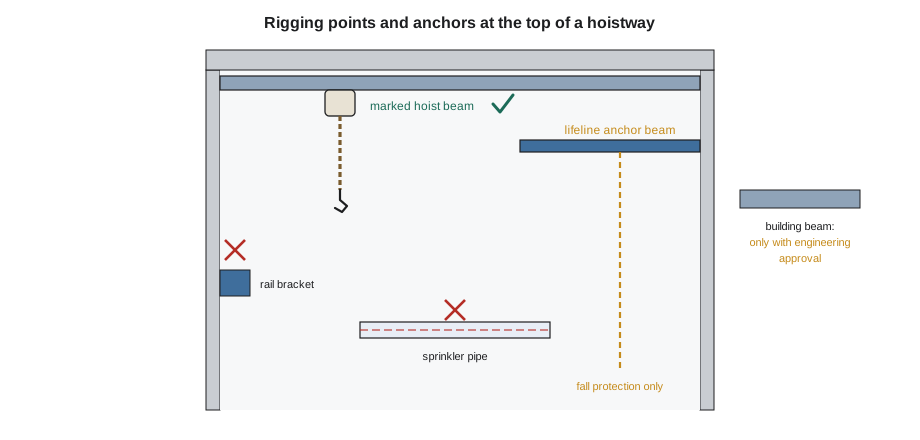
The things that most often get used as rigging points in elevator work, and must not be, are worth listing. Rail brackets are designed for the guiding forces of the car and counterweight and the loads of a safety application, spread along many brackets; one bracket carrying a hoisted load in the wrong direction can tear its anchors out of the wall. The rails themselves are designed for bending between brackets, not for a load hung from a single point. Building pipes, sprinkler mains, conduits, cable tray and ductwork are not structural. Scaffolds and temporary platforms are designed for people and small materials, not lifting. The machine support beams and hitch beams of an MRL elevator are designed for the finished elevator loads, and using them for a lifting load during installation is permitted only where the manufacturer or engineer says so. And the car crosshead and the counterweight frame are rigging points only for the lifts the manufacturer designed them for.
| Item | Rigging point? | Why |
|---|---|---|
| Marked hoist beam or overhead lifting hook | Yes, up to its rating | Designed and marked for lifting |
| Rail bracket | No | Designed for guiding loads spread over many brackets |
| Guide rail | No, except with a designed rail clamp where the manufacturer allows | Designed for bending between brackets |
| Building beam or column | Only with engineering approval | Capacity and connection unknown to the rigger |
| Pipe, conduit, duct, cable tray | Never | Not structural |
| Scaffold or work platform | Never, unless designed for it | Designed for people and light materials |
| MRL machine support or hitch beam | Only where the manufacturer permits | Designed for the finished elevator loads |
Ray tells a story from early in his career. A mechanic on another crew hung a chain hoist from a rail bracket to lift a sheave the last few centimetres into place. The bracket held the sheave, and then held it a little crooked, and then let go of one of its anchors. Nobody was hurt because nobody was below, which was luck. The bracket had to be replaced, the rail realigned and the anchor holes re-drilled, which cost two days. The point of the story, Ray says, is that it held at first.
Using building structure
On modernizations and in machine rooms, there is often no hoist beam where one is needed, and the obvious candidate is a building beam. A steel beam can carry a lifting load if it has the capacity and if the load goes into it in a way it can take. Neither is something the rigger can judge by eye. The beam may already be carrying a floor, a roof or equipment, its connections may be designed for gravity loads only, and a load hung from its bottom flange off-centre twists the beam. So a building beam is used only when the building owner's engineer, or an engineer engaged by Northcrest, has checked it and confirmed the load and the attachment method in writing.
Concrete structure is used through designed anchors: cast-in lifting inserts placed for the purpose, or post-installed anchors designed and installed for a lifting load, which is a demanding use because the load is a direct pull. Anchors installed for rail brackets or other equipment are not used as rigging points. A sling choked around a concrete column, with softeners at every corner, is a common method for a horizontal pull on a skating move, but again only where the column's capacity for that load has been confirmed.
Roofs are a special case. On the Tillicum Building, the crane will land the new machine on the penthouse roof and lift the old one away, and the question of whether the roof can carry the machine, the crane's outrigger loads on the street below, and the rigging for the move into the penthouse all go to an engineer before the lift plan is written. Lesson 12 follows that lift.
Separate rigging and fall protection anchors
A fall protection anchor is designed to stop a falling person, which means it must hold the arrest force with a large margin, 22 kN (5,000 lb) per person for an anchor that is not engineered, or twice the maximum arrest force for one that is. A rigging point carries a lifting load. The two are kept separate because a failure of one must not cause a failure of the other. If a load and a worker's lifeline hang from the same beam and the beam fails under the load, the worker goes with it. At Quayside, the hoist beam and the lifeline anchor beam are separate beams, and the job hazard analysis says so. The hoist beam is never used as a fall protection anchor and the lifeline beam never carries a hoist, even for a light lift.
Temporary rigging beams
When there is no suitable point, a temporary beam is set up for the job: a steel beam spanning across a hoistway opening at the top landing, across a trap door, or between two walls of a machine room, with its ends bearing on the structure. Northcrest keeps a few short steel beams for this purpose, each marked with its section, length and a rated capacity at its centre for the spans it is used on, which an engineer determined. A temporary beam is set level and square, bears fully on its supports with timber or steel bearing plates so that it does not crush the edges of the concrete, is fixed or stopped so that it cannot slide or roll off, and is loaded only at the point for which it is rated.
The engineer's check on a temporary beam looks at the bending stress at the load point, the deflection, the bearing at each end, the stability of the beam against twisting, and the capacity of the structure the ends bear on. The bending check is the one most easily understood, and it shows why span matters so much. For a simply supported beam with a single load P at mid-span L, the largest bending moment is under the load.
Here S is the beam's section modulus, a property of its shape found in steel tables. The stress must be below the allowable bending stress for the steel and the way the beam is braced. The load P includes the hoist, the rigging and an allowance for the dynamic effect of starting and stopping the hoist. The code below checks two of Northcrest's temporary beams across the top landing opening of a Route 7 hoistway, for a lift on the Marlowe Apartments job. The section properties and the allowable stress are illustrative, and the real check is the engineer's.
# Temporary beam across a landing opening: bending and deflection (illustrative)
P_load = 900          # load + hoist + rigging (kg)
dyn = 1.15            # allowance for starting and stopping a hand hoist (illustrative)
span = 2.4            # clear span between bearings (m)
E = 200000               # modulus of elasticity (MPa)
allow = 150          # allowable bending stress, laterally braced (MPa) - illustrative
beams = {             # name: (section modulus mm3, moment of inertia mm4)
    "C100x8 channel": (27.1e3, 1.60e6),
    "W150x18": (120e3, 9.2e6),
}
P = P_load * dyn * 9.81                       # force in N
M = P * span / 4
for name, (S, I) in beams.items():
    stress = M / S * 1000
    defl = P * span ** 3 / (48 * E * I) * 1e9
    ok = stress <= allow and defl <= span * 1000 / 360
print(f"{name}: stress {stress:.0f} MPa (allow {allow}), deflection {defl:.1f} mm (limit {span * 1000 / 360:.1f}) -> {'ok' if ok else 'NOT OK'}")C100x8 channel: stress 225 MPa (allow 150), deflection 9.1 mm (limit 6.7) -> NOT OK W150x18: stress 51 MPa (allow 150), deflection 1.6 mm (limit 6.7) -> ok
The light channel, which someone had brought from the branch because it was easy to carry, is overstressed at this span and deflects more than the limit. The wide-flange beam passes with a large margin, and its deflection is small. Doubling the span would double the moment and multiply the deflection by eight, which is why each of Northcrest's temporary beams has its rating marked for specific spans, and why a beam that was fine across one opening cannot be assumed fine across a wider one. The bearings, the twisting stability of the beam and the slab edge under each bearing are checked as well, and those are where an unbraced temporary beam usually fails first.
Rigging points on the equipment
The equipment itself provides lifting points: lugs welded to a machine bedplate, tapped holes for eyebolts or hoist rings, lifting eyes on a controller cabinet, slots in the car frame stiles, and holes in the counterweight frame for a lifting shackle. These are designed by the manufacturer for lifting that part alone, in the way the manual describes. A machine's lifting lugs are for the machine, not for the machine with the counterweight hung from it; the car frame's lifting points are for the bare frame, not the frame with its platform and cab. Using an equipment lifting point for anything else needs the manufacturer's confirmation. The manual also says which points not to use: many machines carry a label warning that a motor eyebolt is for lifting the motor alone and not the whole machine.
Checking a rigging point before use
Before a lift, the rigger confirms that the point is a designated rigging point, reads its marking, compares the rating with the total load including the hoist and rigging, and looks at it: the beam straight and seated, the bolts and welds sound, no cracks or distortion, the clamp or trolley correct for the flange, and nothing in the way of the hoist hanging freely. If the marking is missing or illegible, the point is not used until its capacity is confirmed. If the load is close to the rating, the lift is treated as a critical lift under the branch policy, which Lesson 12 explains.
Common mistakes
MistakeHanging a hoist from a rail bracket for a short lift.
InsteadRail brackets are never rigging points; use the hoist beam or a designed point.
MistakeUsing a building beam because it looks heavy.
InsteadUse building structure only with an engineer's written confirmation.
MistakeHanging a lifeline and a hoist from the same beam.
InsteadKeep fall protection anchors and rigging points separate.
MistakeMoving a temporary beam to a wider opening without checking it.
InsteadRatings are for specific spans; the moment grows with span and deflection with its cube.
MistakeLifting the whole machine from the motor eyebolt.
InsteadUse only the lifting points the manual names for that load.
Summary and key terms
- The hoist beam or overhead hook is provided by the building to a capacity on the layout and is marked.
- Rail brackets, rails, pipes, conduit, scaffolds and finished elevator supports are not rigging points.
- Building beams, columns and concrete are used only with engineering confirmation and designed attachments.
- Rigging points and fall protection anchors are always separate.
- Temporary beams are rated for specific spans and checked for bending, deflection, bearing and stability.
- Equipment lifting points are for the part alone, used as the manufacturer's manual describes.
- Hoist beam
- A beam at the top of a hoistway or in a machine room, designed and marked for lifting.
- Rigging point
- A designated, rated attachment for a hoist or rigging.
- Temporary rigging beam
- A rated steel beam set across an opening to provide a lifting point for a job.
- Section modulus
- A property of a beam section that relates bending moment to bending stress.
- Bearing plate
- A plate or timber under the end of a beam that spreads its load onto the support.
- Fall protection anchor
- An anchor designed to hold the arrest force of a falling worker.
Practice problems
Work each problem on paper first, then reveal the answer to check.
A temporary beam spans 2.0 m with a 10 kN load at mid-span. What is the maximum moment?
Show answer
10 × 2.0 / 4 = 5 kN·m.
If the span of a beam carrying a mid-span load doubles, what happens to the moment and the deflection?
Show answer
The moment doubles and the deflection increases eight times.
Why are the hoist beam and the lifeline anchor beam separate at Quayside?
Show answer
So that a failure of the rigging point cannot take the worker's fall protection with it.
A machine room beam has no marking. Can it be used for a lift?
Show answer
Not until an engineer has confirmed its capacity and the attachment method in writing.
Lesson quiz · 5 questions
Score 60% or more to complete this lesson.
Create a free account to save your progress, take quizzes and earn a certificate.