
ELV-130 · Lesson 1 of 12 · 22 min
Rigging hazards and the lift team
Almost everything in an elevator is heavy, and almost all of it has to be lifted into a place that was not built for lifting. A gearless machine goes to the very top of a hoistway that is open for its full height below. A car crosshead is raised between two rails with a few centimetres to spare on each side. Counterweight fillers go into a frame one at a time over an open pit. An escalator truss comes into a mall through a loading dock and across a finished floor. None of this is crane work in the usual sense, and most of it is done by the elevator crew with chain hoists, lever hoists, slings and shackles. That is why rigging is a core skill of the trade, and why it gets a whole course of its own after the introduction in ELV-110.
This course follows Tamsin Iwasaki into her second year at Northcrest Elevator. The rails for Quayside Tower car 2 are set, the counterweight frame and car sling are next, and the machine has to go to the top of the hoistway. On Route 7, the Tillicum Building is about to have the machine on car 2 replaced, which will mean a crane lift to the penthouse roof. At Brackenridge Centre, one of the eight escalators is being replaced. Each job has its own rigging problem, and Ray Abernethy has made it clear that Tamsin will plan the rigging on some of them herself, with him checking every number. This first lesson sets out how rigging goes wrong, who does what on a lift, and the rules that frame the work.
How rigging goes wrong
When a lift fails, it almost always fails in one of a handful of ways. The load is heavier than anyone thought, because the weight was guessed, or the packing list was for a different part, or nobody added the rigging. A sling or fitting is overloaded because the sling angle multiplied the tension, or a shackle was loaded on its side, or an eyebolt was pulled at an angle it was never rated for. A rigging point fails because it was a pipe, a bracket or a beam that was never designed to carry a lifting load. The load swings or tips because the hook was not above the centre of gravity. Or the rigging is fine and the people are in the wrong place: under the load, between the load and a wall, or with a hand on a sling as it comes tight.
In a hoistway, these failures are made worse by the space. There is nowhere to step back to. A load that swings hits the rails, the brackets or the wall and can knock a person off a platform or dislodge something above. A dropped load falls the full height of the hoistway. And the hoistway is a fall hazard in its own right, so the crew is often working tied off, which limits how quickly anyone can move out of the way. For these reasons, the rules for rigging in a hoistway are stricter than the rules on an open site, and they start with the plan rather than the hardware.
| Failure | Typical cause | What prevents it |
|---|---|---|
| Overload of a sling or fitting | Weight guessed, sling angle ignored, side load on a shackle | Known weight, angle check, hardware used as rated |
| Rigging point failure | Pipe, bracket or unrated beam used as an anchor | Only designed and marked rigging points |
| Load tips or swings | Hook not over the centre of gravity, no tag line | Centre of gravity found first, tag line, slow first lift |
| Crush or pinch injury | Hands on the sling as it tightens, body between load and wall | Hands off before the strain, a planned position for each person |
| Struck by a falling object | Work below the load, loose parts on the load | Controlled zone below, loose parts removed or secured |
| Damaged gear used | No inspection, no tag, gear left in the weather | Inspection before each shift, tag out damaged gear |
The lift team
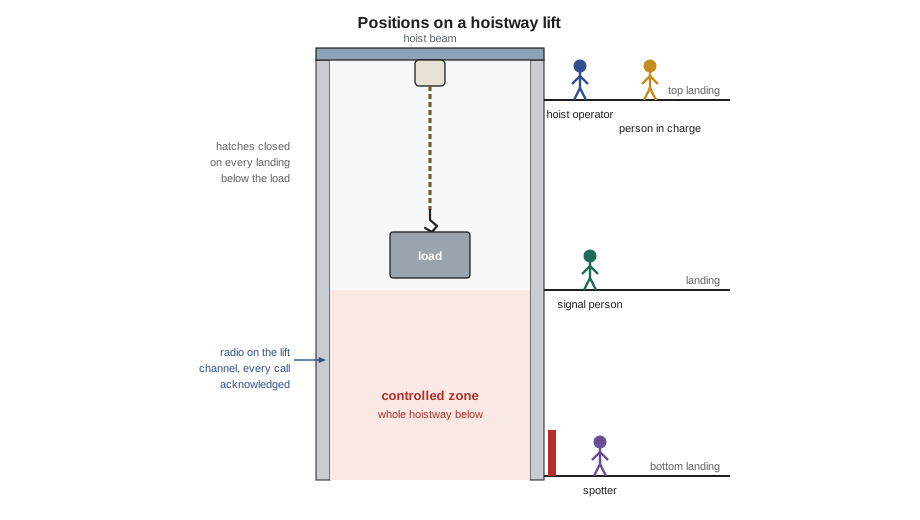
Every lift has people in defined roles, even when the team is two people. The roles matter because they make it clear who decides, who signals and who has hands on the hoist. On a small lift at Quayside, such as raising a bundle of brackets to a landing, Ray may hold all the planning roles and Tamsin may run the hoist. On the machine lift, there will be four people with separate jobs. The names vary between companies and standards; Northcrest uses the following.
- The person in charge of the lift plans it, confirms the weight and the rigging, briefs the team, and has the final say on whether the lift goes. On most Northcrest lifts this is the mechanic in charge of the job; on a critical lift it is someone named in the written lift plan.
- The rigger selects, inspects and attaches the rigging: the slings, hitches, shackles and the connection to the hoist. On a crane lift, the rigger must be qualified for that kind of rigging.
- The hoist operator runs the chain hoist, lever hoist, winch or crane, and moves the load only on a signal from the one person assigned to give signals.
- The signal person watches the load, the rigging and the path, and gives the signals. Where the operator cannot see the load, which is common in a hoistway, the signal person must have a clear view of it or there must be a relay arranged in advance.
- The spotter or lookout keeps other people out of the controlled zone, watches the parts of the path the signal person cannot see, and calls a stop if anything changes.
One rule overrides the roles: anyone on the team, or anyone on the site, can call a stop, and the stop is obeyed at once without discussion. The discussion happens afterwards, with the load landed or held. Tamsin's first stop call came on a bracket lift at Quayside, when she saw a sling start to ride up the edge of the bundle. Ray stopped the hoist, lowered the bundle, and re-rigged it with a choker on each end. He told her afterwards that a stop that turns out to be unnecessary costs a minute, and a stop that is not called can cost a life.
Communication in a hoistway
A hoistway is loud, dark in places and often taller than anyone can see. A signal given by hand from the 20th floor cannot be seen from the 30th. So the team agrees how it will communicate before the lift starts, and tests it. Northcrest uses radios on a dedicated channel for hoistway lifts, with a fixed set of words: 'take a strain', 'up slow', 'down slow', 'hold', 'stop', and 'all stop', the last of which means every motion on site stops. Each command is acknowledged. When a hoist is moved by a second person on a relay, every command goes through the one signal person, and the operator moves the load only for that voice.
Hand signals are used where everyone involved can see each other. They are the standard crane signals, in the version the site uses, and the signal person uses only those signals. For a chain hoist operated by the person who can see the load, signals are not needed at all; the operator is also the signal person. What is not acceptable is a lift where the operator is moving a load blind on shouted directions from someone who may or may not be watching it.
If the radios fail, or a command is not acknowledged, the load is held. Ray's rule is that silence means stop.
The controlled zone
The area below and around a suspended load, where a person could be struck if the load or rigging failed or the load swung, is the controlled zone. In a hoistway, the zone below a load is the whole hoistway beneath it, including the pit, and it often includes the landings where the load could strike something that falls out through an open entrance. No one enters it while the load is suspended. At Quayside, the zone is set up by closing the barricade hatches on every landing below the lift, posting a sign at the bottom landing, and having the spotter stand outside the pit barricade. Lena Ostrander also tells the general contractor's superintendent, because the general contractor's crews work on every floor and need to keep their materials away from the hoistway walls during the lift.
Hands on a load are kept to a minimum. A tag line, a rope tied to the load and held by a person standing clear, is used to stop a load turning and to guide it into position. A person guiding a load by hand stands where the load cannot pin them against a wall, a rail or the platform guardrail, and keeps hands off the rigging as it comes tight, because a sling that slips can trap fingers against the load. In a hoistway, tag lines must be planned so that the person holding one is tied off and is not pulled off balance by a swinging load.
The rules that apply
In British Columbia, rigging is covered by Part 15 of the WorkSafeBC Occupational Health and Safety Regulation. It requires that rigging be done by, or under the direct supervision of, qualified workers familiar with the rigging being used. It sets minimum design factors for slings and fittings, requires that the load applied to rigging never exceed its working load limit, and sets requirements for identification, inspection and removal from service. Slings and attachments must be inspected before use on each shift, and defective gear is removed from service at once. Part 14 covers cranes and hoists, which brings in the operator and equipment rules when a crane or a powered hoist is used.
When a crane is used, as it will be on the Tillicum machine replacement, more rules come in: the crane operator must hold the certification required in British Columbia, the crane must be inspected and its load chart followed, and the lift must be planned with the crane company. Northcrest treats every crane lift as a critical lift with a written plan, whatever its size.
Behind the regulations are the consensus standards of the ASME B30 series, which the manufacturers of rigging gear build to and the regulations refer to. ASME B30.9 covers slings, B30.26 rigging hardware such as shackles, eyebolts and hoist rings, B30.10 hooks, B30.16 overhead hoists including chain hoists, B30.21 lever hoists, and B30.20 below-the-hook lifting devices such as spreader beams and lifting clamps. These standards are revised every few years, and the edition that applies is the one the regulation or contract refers to, so the branch keeps current copies in the office and the key tables in each rigging kit.
The elevator code itself has little to say about rigging during installation, because it is a code for the finished equipment. It matters in two places. It sets requirements for the building structure the elevator bears on, which is why a machine support or hitch beam is not a rigging point unless the design says so. And the installation manual for each piece of equipment, which the code expects the mechanic to follow, usually gives the lifting points, weights and rigging method for the machine, the car frame and the counterweight.
Design factor and working load limit
Every piece of rigging gear has a working load limit, the greatest load it is rated to carry in service in the way it is meant to be used. The working load limit is not the load at which the gear breaks. It is the minimum breaking strength divided by a design factor, which covers wear, small amounts of shock, uneven loading and the uncertainties of real use. For wire rope slings and synthetic slings the design factor is usually 5, for alloy chain slings 4, and for many hardware items 5 or 6, as the manufacturer states. Rigging that supports people needs a far larger factor, at least 10 under the British Columbia rules.
The design factor is not spare capacity for the rigger to use. A sling with a working load limit of 2,000 kg (4,400 lb) is not a sling for a 3,000 kg (6,600 lb) load because it would probably hold. The factor has already been spent by the time the sling is worn, has been bent around an edge, has been shock loaded when a hoist slipped a link, or has been used at an angle. The rule is simple: the load on any piece of rigging never exceeds its working load limit, adjusted for the way it is being used. Most of this course is about making that adjustment correctly.
Tags matter for the same reason. A sling or fitting without a legible tag or marking showing its working load limit cannot be used, because nobody can tell what it is rated for. At Northcrest, a sling with a missing or unreadable tag is cut and thrown away, not set aside, so that nobody picks it up later by mistake.
Inspecting the rigging kit
Each Northcrest crew has a rigging kit in a lockable crate: slings, shackles, a few eyebolts and swivel hoist rings, beam clamps, a chain hoist and a lever hoist, softeners, tag lines and a copy of the key tables. The crew inspects every item it intends to use before the first lift of each shift, looking for the damage that each type of gear can suffer, and checks that the tag is legible. Items are also given a thorough periodic inspection by a designated person, at least yearly and more often in hard service, and that inspection is recorded. The code below checks a kit list for the problems Ray looks for first: a missing tag, an overdue periodic inspection, and gear whose rating is too small for the lift planned.
# Rigging kit check before a lift
from datetime import date
today = date(2026, 11, 2)
lift = 750                     # heaviest planned load on one item (kg)
kit = [  # (item, WLL in kg, tag legible, last periodic inspection)
    ("wire rope sling 1", 1000, True,  date(2026, 3, 10)),
    ("wire rope sling 2", 1000, True,  date(2025, 9, 2)),
    ("roundsling, purple", 1400, False, date(2026, 6, 1)),
    ("shackle 1", 1500, True,  date(2026, 3, 10)),
    ("shackle 2", 500, True,  date(2026, 3, 10)),
    ("chain hoist", 1000, True,  date(2026, 1, 15)),
]
for item, wll, tag, last in kit:
    problems = []
    if not tag:
        problems.append("no legible tag: remove from service")
    if (today - last).days > 365:
        problems.append(f"periodic inspection overdue by {(today - last).days - 365} days")
    if wll < lift:
        problems.append(f"WLL {wll} kg is below the {lift} kg lift")
print(f"{item:<20} {'OK' if not problems else '; '.join(problems)}")wire rope sling 1 OK wire rope sling 2 periodic inspection overdue by 61 days roundsling, purple no legible tag: remove from service shackle 1 OK shackle 2 WLL 500 kg is below the 750 kg lift chain hoist OK
The check finds three things. One wire rope sling is past its yearly inspection and goes back to the branch to be inspected before it is used. The roundsling has lost its tag, so it is cut and discarded. And one shackle is too small for this lift, which does not make it defective; it is simply the wrong size for this job. The kit check takes five minutes, and it is done before the lift, not when the load is already on the hook.
Before every lift
Before each lift, however routine, the team runs through the same short list, which Ray calls the five questions. What does it weigh, including the rigging? Where is its centre of gravity? What will it hang from, and what is that rated for? How is it rigged, and what does each piece carry at the angles used? Where will each person be, and where is the controlled zone? If any answer is 'I think' rather than 'I know', the lift waits until it is 'I know'. The rest of this course is about answering those five questions for the loads an elevator mechanic lifts, and about writing the answers down when the lift is big enough to need a plan.
Common mistakes
MistakeTreating the design factor as spare capacity.
InsteadNever load rigging beyond its working load limit as adjusted for angle and hitch.
MistakeUsing a sling with a missing tag because it looks like the others.
InsteadNo legible tag, no use: remove the sling from service.
MistakeSeveral people giving signals to the hoist operator.
InsteadOne signal person gives the signals; anyone may call a stop.
MistakeHolding a sling in place by hand as the hoist takes the strain.
InsteadHands off the rigging before the strain; use a tag line to guide the load.
MistakeLeaving the hoistway below the lift open to other trades.
InsteadClose the hatches below, post the controlled zone and tell the general contractor.
Summary and key terms
- Rigging fails through unknown weight, overloaded gear, unrated rigging points, unbalanced loads and people in the wrong place.
- Every lift has a person in charge, a rigger, a hoist operator, a signal person and usually a spotter, and anyone can call a stop.
- Communication is agreed and tested before the lift; silence or an unacknowledged command means stop.
- The controlled zone below a hoistway load is the whole hoistway beneath it, and nobody enters it while the load is up.
- The working load limit is the minimum breaking strength divided by the design factor, and the load never exceeds it.
- Rigging gear is inspected before use on each shift and periodically, and gear without a legible tag is removed from service.
- Rigging
- The gear and methods used to attach a load to a hoist and control it while it is lifted.
- Working load limit (WLL)
- The greatest load a piece of rigging is rated to carry in service, used as intended.
- Design factor
- The ratio of minimum breaking strength to working load limit.
- Controlled zone
- The area where a person could be struck if the load or rigging failed or the load swung.
- Signal person
- The one person who gives movement signals to the hoist or crane operator.
- Tag line
- A rope attached to a load and held by a person standing clear, used to control rotation and swing.
Practice problems
Work each problem on paper first, then reveal the answer to check.
A sling has a minimum breaking strength of 10,000 kg and a design factor of 5. What is its working load limit?
Show answer
2,000 kg.
Who can call a stop during a lift?
Show answer
Anyone on the team or on the site, and the stop is obeyed at once.
What is the controlled zone for a load hanging halfway up a hoistway?
Show answer
The whole hoistway below the load including the pit, plus any landing where an object could fall out.
What are the five questions before a lift?
Show answer
Weight including rigging, centre of gravity, what it hangs from and its rating, how it is rigged and what each piece carries, and where each person and the controlled zone will be.
Lesson quiz · 5 questions
Score 60% or more to complete this lesson.
Create a free account to save your progress, take quizzes and earn a certificate.