
ELE-499 · Lesson 12 of 12 · 21 min
Final demonstration, report and reflection
The last weeks of a capstone compress three jobs into a short time: showing the work to the people who will judge it, writing the record that will outlast the project, and handing the results to the client in a form they can use. Leo's team scheduled them deliberately, with the demonstration in week twenty-four, the report due in week twenty-five and the handover meeting with Larchmont in week twenty-six. This lesson covers how they closed the project: the final earned value review, the verification summary, the demonstration, the report and presentation, the handover, and the individual and team reflection that the course required.
Closing the books
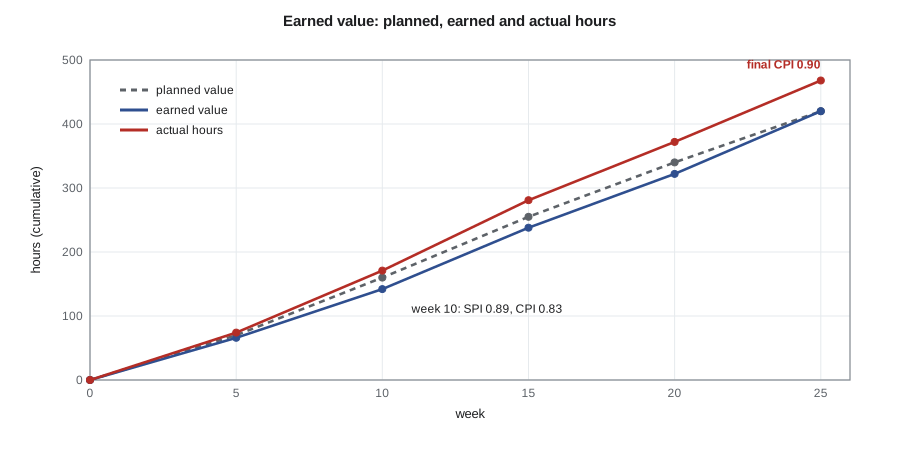
Leo had tracked the team's planned hours as the budget at completion, 420 hours from the plan in lesson 1, and every two weeks he recorded planned value, the hours of work scheduled to be done by then; earned value, the planned hours of the work actually completed; and actual cost, the hours actually spent. Earned value management turns these into two indices. The schedule performance index, SPI = EV / PV, shows whether work is ahead of or behind plan, and the cost performance index, CPI = EV / AC, shows whether it is costing more or less effort than planned. An estimate at completion follows from dividing the budget by the CPI.
# Final earned value review (team hours) and the requirement verification summary
BAC = 420.0                                     # budget at completion, planned team hours
weeks = [  # week, planned value, earned value, actual hours (cumulative)
    (5, 70, 66, 74), (10, 160, 142, 171), (15, 255, 238, 281), (20, 340, 322, 372), (25, 420, 420, 468)]
for w, pv, ev, ac in weeks:
    spi, cpi = ev / pv, ev / ac
    eac = BAC / cpi
    print(f"week {w:2d}: SPI {spi:.2f}, CPI {cpi:.2f}, estimate at completion {eac:4.0f} h")
print(f"final overrun {weeks[-1][3] - BAC:.0f} h ({(weeks[-1][3] / BAC - 1) * 100:.0f} %)")
results = {'R1 daily energy': 'pass (analysis + 24-h run on the demonstrator, scaled)',
           'R2 grid import <= 60 kW': 'pass (60.0 kW peak in the winter case, limiter test)',
           'R3 PV >= 30 kWdc': 'pass (36 kWdc on the drawings)',
           'R4 storm reserve': 'pass (194 kWh usable, 70 % floor holds 150 kWh)',
           'R5 converter efficiency >= 97.5 %': 'pass, narrow (97.51 % at 30 % load)',
           'R6 telemetry': 'pass (Modbus TCP points and OCPP messages logged)',
           'R7 ambient range': 'partial (cold chamber reached -30 C; R7 asks for -35 C)',
           'R8 zero export': 'pass (relay test and controller test)'}
n_pass = sum(v.startswith('pass') for v in results.values())
for k, v in results.items(): print(f"  {k:36s} {v}")
print(f"{n_pass} of {len(results)} requirements verified" + ("; open items go on the handover list" if n_pass < len(results) else ""))week 5: SPI 0.94, CPI 0.89, estimate at completion 471 h week 10: SPI 0.89, CPI 0.83, estimate at completion 506 h week 15: SPI 0.93, CPI 0.85, estimate at completion 496 h week 20: SPI 0.95, CPI 0.87, estimate at completion 485 h week 25: SPI 1.00, CPI 0.90, estimate at completion 468 h final overrun 48 h (11 %) R1 daily energy pass (analysis + 24-h run on the demonstrator, scaled) R2 grid import <= 60 kW pass (60.0 kW peak in the winter case, limiter test) R3 PV >= 30 kWdc pass (36 kWdc on the drawings) R4 storm reserve pass (194 kWh usable, 70 % floor holds 150 kWh) R5 converter efficiency >= 97.5 % pass, narrow (97.51 % at 30 % load) R6 telemetry pass (Modbus TCP points and OCPP messages logged) R7 ambient range partial (cold chamber reached -30 C; R7 asks for -35 C) R8 zero export pass (relay test and controller test) 7 of 8 requirements verified; open items go on the handover list
The history is typical of capstones. The team fell behind early, with an SPI of 0.89 at week ten, mostly because the requirements and trade study took longer than planned. Efficiency was below plan throughout, with a CPI between 0.83 and 0.90. They recovered schedule by working more hours, so that by week twenty-five all planned work was earned, an SPI of 1.00, at a cost of about 468 hours, 11 % over the plan. The estimate at completion at week ten, about 506 hours, was pessimistic; the team's efficiency improved once the design was settled. Leo's report presented this honestly, with the lesson he drew from it: the early estimates for requirements and concept work had been far too optimistic, and the effort for client communication had not been planned at all.
The verification summary shows seven of the eight requirements verified and one, R7, partially verified, because the environmental chamber could reach only −30 °C against a −35 °C requirement. The team did not soften this. It went into the handover list with a recommended action: confirm from the production equipment's certified ratings that each device is rated for −35 °C operation, and add cabinet heating where it is not.
Worked problem
Estimate at completion
At week fifteen the team had earned 238 hours of planned work for 281 actual hours against a 420-hour budget. What are CPI and the estimate at completion?
Show solution
- \[\text{CPI} = 238/281 \approx 0.85\]
- \[\text{EAC} = 420/0.85 \approx 496\ \text{h}\]
Answer: CPI about 0.85, estimate at completion about 496 hours.
The demonstration
The final demonstration had an audience of the course instructor, Professor Gagnon, two faculty assessors, Marguerite, Doug, Nadine, Ravi and Amara. The team had twenty minutes to show the system working and ten minutes for questions. They planned it like a test procedure. The script began with a one-minute summary of the client's need, then showed the converter running at 6 kW in both directions with live efficiency on the power analyzer, then the site controller managing a replay of a storm-night charging schedule at one-tenth scale, enforcing the scaled grid limit while emulated line trucks took priority. It ended with Ravi's relay test repeated live, the relay tripping the demonstrator's contactor when the scaled export threshold was crossed.
Three practices made the demonstration work. The team rehearsed it three times, the last as a full dress rehearsal in the room with the advisor watching, timing every step. Every step had a safety check: the enclosure lid was interlocked, Hannah stood at the emergency stop, and nobody touched the power stage during the demonstration. And every step had a fallback: if the converter would not start, a recorded video of the same test, made the day before, was ready to play. The fallback was not needed, but knowing it existed kept the team calm.
The questions were sharp. One assessor asked why the measured efficiency was lower than predicted; Aisha answered with the three causes from the test report and what the next revision would change. Nadine asked what would happen if the site controller failed during a storm; Mateo described the fallback currents and showed the log from the communication-loss test. Doug asked when the canopy could be built. Leo explained that the design documents now needed an engineer of record, and gave the handover list.
The report
The final report was the team's most lasting product. Its structure followed the work: an executive summary of two pages that a manager could read alone; the problem and the client's needs; requirements with their sources and verification methods; concept generation and the trade study; the system architecture and energy balance; the detailed designs of the converter, controller and site installation; analysis and simulation; build and test, with all results compared against requirements and predictions; compliance, safety and ethics; project management, with the schedule and earned value history; and conclusions and recommendations. Appendices held the requirements and interface documents, drawings, the FMEA, the bill of materials, test procedures and raw data, and the source code repository reference.
Leo, as editor, set the rules: one voice and one set of terms throughout; every figure numbered, captioned and referred to in the text; every number given with units and, where measured, its uncertainty; every source cited; and a clear distinction between what was measured, what was calculated and what was assumed. Each member drafted their own chapters, another member reviewed them, and Leo edited the whole. They finished a complete draft a week before the deadline so that Professor Gagnon could comment on it, which turned a good report into a strong one.
Writing for different readers was the hardest part. The executive summary had to tell Larchmont's managers what had been designed, what it would cost to build, what it would and would not do, and what decisions they needed to make, without technical detail. The technical chapters had to let an engineer of record check the design. And the project management chapter had to show the assessors how the team had worked. A useful test is to give each part to someone from its intended audience and ask them to explain it back.
The handover
A capstone that ends with a grade and a report on a shelf has failed the client. In week twenty-six the team met Larchmont to hand over the project. The package contained the report; the full-size canopy design documents, labelled as student design documents not for construction; the requirements, interface and test documents; the site controller software with its tests, build instructions and licence list; the demonstrator, with its operating and safety procedures; and a one-page handover list of open items. Each open item had a description, the evidence, a recommended action and a suggested owner. The list included R7's partial verification, the zero-margin winter case, the efficiency improvements for a converter revision B, the input filter, and the need for an engineer of record to complete and seal the design.
Larchmont later did what the team recommended. Its engineering group took on the canopy design, an engineer of record reviewed and sealed it with changes to the cable routing and the battery cabinet's foundation, and the canopy was tendered the following year. The site controller became the starting point for the controller the contractor supplied. Leo, by then an engineer-in-training in Marguerite's planning group, found that the experience had prepared him well for the interconnection studies he would soon do on a much larger scale.
Reflection
The course asked each student for an individual reflection and the team for a joint one. Good reflections are specific. Leo wrote that his biggest mistake was underestimating client communication, and that next time he would plan it as a task with hours. Aisha wrote that she had learned to carry every design change back into every analysis that depended on it, after the gate resistor episode. Mateo wrote about the probing incident: he had known the rule and broken it under time pressure, and the lesson was that procedures exist precisely for moments when you are tired and rushing. Hannah wrote about the value of reporting partial results, and about how much of a test lead's work is planning rather than testing.
The team reflection looked at how they had worked together. The charter's decision rule had resolved two disagreements quickly; the planned hours had been uneven, and the imbalance had been fixed only after week ten; and peer evaluations, which the course used to adjust individual marks, were close, which the team attributed to the clear ownership of each area. They also listed what they would keep and change in another project: keep the decision log, the early ordering and the staged bring-up; change the early estimates, the late test of the cold chamber's limits, and the habit of leaving the report's introduction until the end.
Where the capstone fits
This project drew on almost every course in the program: circuits and electronics for the converter, control for its loops, communications and networks for the controller, power systems and protection for the site design, grid integration for the zero-export decision, and project management, ethics and communication throughout. A capstone is the first time those pieces are used together, under real constraints, for someone who needs the result. The methods in this course, requirements, trade studies, architecture, analysis, staged build, verification and honest reporting, are the ones you will use in your own capstone and, with more at stake, in your first engineering job.
Common mistakes
MistakeHoping the demonstration will work without rehearsal.
InsteadScript it, rehearse in the room, assign safety roles and prepare a fallback.
MistakeWriting the report in the last week.
InsteadDraft chapters as work finishes and give the advisor a complete draft early.
MistakeEnding the project with the grade.
InsteadHand over documents, software, hardware and an open-items list the client can act on.
MistakeWriting a vague reflection.
InsteadName specific mistakes, what caused them and what you will do differently.
Summary and key terms
- Earned value management tracks schedule (SPI = EV/PV) and effort efficiency (CPI = EV/AC).
- A verification summary reports every requirement, including partial and narrow results.
- A demonstration should be scripted, rehearsed, safe and backed by a fallback.
- The report records the whole design process and serves several audiences.
- A handover package with an open-items list lets the client act on the work.
- Student designs need an engineer of record before construction.
- Specific individual and team reflections turn experience into lessons.
- Earned value (EV)
- The planned cost or hours of the work actually completed.
- Planned value (PV)
- The planned cost or hours of the work scheduled to be completed by a given date.
- Schedule performance index (SPI)
- EV divided by PV.
- Cost performance index (CPI)
- EV divided by actual cost.
- Estimate at completion (EAC)
- The forecast total cost or effort, often budget divided by CPI.
- Executive summary
- A short, self-contained summary for decision-makers.
- Handover list
- A list of open items with evidence, recommended actions and owners.
Practice problems
Work each problem on paper first, then reveal the answer to check.
At week ten EV = 142 h and PV = 160 h. What is SPI?
Show answer
About 0.89.
With AC = 171 h at week ten, what is CPI and EAC for a 420-hour budget?
Show answer
CPI ≈ 0.83, EAC ≈ 506 h.
Why did the team prepare a recorded video for the demonstration?
Show answer
As a fallback if the live converter would not start.
Name three items on the handover list.
Show answer
R7 verification, the zero-margin winter case, converter revision B improvements, the input filter, or the engineer of record.
Why give a complete report draft to the advisor a week early?
Show answer
To get comments in time to improve it.
What makes a reflection useful?
Show answer
Specific mistakes, their causes and concrete changes for next time.
Lesson quiz · 5 questions
Score 60% or more to complete this lesson.
Create a free account to save your progress, take quizzes and earn a certificate.