
ELE-499 · Lesson 11 of 12 · 21 min
Compliance, ethics and professional practice
Late in the project, two conversations tested the team in ways no simulation could. In week twenty-two the fleet manager asked whether the separate export relay was really necessary, since the hybrid inverter could limit export by itself and the relay, its transformers and their installation added several thousand dollars. A week later, a draft of the final report circulated within Larchmont described requirement R7 as met. This lesson covers the professional framework that guided the team's answers: who may take responsibility for engineering work, how equipment and installations are approved, the codes of ethics, intellectual property, sustainability and the wider responsibilities that come with designing systems other people rely on.
Who takes responsibility
In New Brunswick, the practice of professional engineering is regulated by Engineers and Geoscientists New Brunswick under provincial legislation. Only a licensed professional engineer, or a firm holding the appropriate permit, may take responsibility for engineering work and seal engineering documents. Students and engineers-in-training may do engineering work under the direct supervision of a licensed engineer who takes responsibility for it. The team's drawings and calculations for the full-size canopy were therefore labelled as student design documents. Before Larchmont tenders the work, an engineer of record will review, revise as needed and seal the final design. Professor Gagnon, a licensed engineer, supervised the team's work and the safety of their laboratory activities, but did not seal the canopy design.
Labelling documents correctly is not a formality. Drawings that look finished get used. A clear statement on every sheet that it is a student design document not for construction, together with a list in the report of what an engineer of record must still check, protects both the public and the students.
Approving equipment and installations
Electrical equipment sold or installed in Canada must be certified by a certification body accredited by the Standards Council of Canada, and bear its mark. The canopy's major equipment, the hybrid inverter, battery cabinet and chargers, was specified as certified products, which is one reason Concept C won the trade study. The site energy controller is different: it is a custom assembly. The team specified it as an industrial control panel built from certified components, an industrial computer, power supply, terminal blocks and breakers, assembled to the Canadian standard for industrial control panels, CSA C22.2 No. 286, by a shop able to certify the assembly. Where a custom product cannot be certified in the usual way, a special inspection or field evaluation by an accredited body is the other route.
The laboratory demonstrator is not intended for installation, and the report says so. If Larchmont later develops the common DC bus concept, its custom converters would need product certification against the applicable standards for power conversion equipment and energy storage before they could be installed. The team listed the main standards a future design would need to meet and estimated, from published information, that certification testing would take months and cost far more than the demonstrator itself. That estimate was an important input to Larchmont's decision about whether to pursue the concept.
Codes of ethics
Engineering codes of ethics share a common core. The code of ethics of Engineers and Geoscientists New Brunswick, like those of other Canadian regulators, requires engineers to hold paramount the safety, health and welfare of the public and the protection of the environment; to practise only in areas of their competence; to act as faithful agents of their clients and employers while avoiding conflicts of interest or disclosing them; to be honest and fair in their professional statements; and to report situations that endanger the public. Engineers Canada publishes national guidance on the code of ethics that the provincial regulators draw on.
Both of the conversations at the start of this lesson fall squarely within these codes. On the relay, the team's answer was straightforward once they framed it correctly. Removing the relay was not their decision to make: the relay was a requirement of Larchmont's own protection engineer, and the reason for it, that the simpler approval assumed export could never occur, was a safety and reliability matter. Leo explained this to the fleet manager, showed him the FMEA entry for inverter export-limit failure, and referred the question to Nadine. She kept the requirement. The team also suggested a cheaper relay package that met the same function, which saved about a third of the cost. Serving the client faithfully included finding that saving; it did not include dropping protection.
On the report, the issue was honesty. The draft that circulated had been edited by someone at Larchmont who was summarizing the project for management and had misread the test results. Hannah wrote to Marguerite the same day, pointing out that R7 was only partially verified and why, and asked that the summary be corrected. It was. The temptation in such situations is to stay quiet because the error flatters the team. Codes of ethics are explicit that engineers must not allow their work to be misrepresented.
Leo's conflict of interest, disclosed in the charter, mattered here too. He was the person most likely to soften bad news for the client he was about to join. The safeguard the team had agreed on, the advisor's presence in scope negotiations, and the rule that test results were reported by the test lead, meant that the difficult messages came from the right people.
Intellectual property and openness
Who owns a capstone design? The answer depends on the university's intellectual property policy and the agreement with the sponsor, and teams should find out in the first weeks rather than at the end. Larchmont's sponsorship agreement gave it the right to use the canopy design and the controller software for its own facilities, while the students kept the right to describe the work in their portfolios and the university kept the right to use it for teaching. The controller software used several open-source libraries; Mateo recorded each library's licence and checked that the licences allowed the intended use, including the obligations some licences place on distributing modified code. Using code without checking its licence is a common and avoidable problem.
Sustainability
A solar canopy and battery are often presented as obviously good for the environment. The team checked. They estimated the embodied greenhouse gas emissions of the PV modules, the battery and the canopy's steel, concrete and wiring from published life-cycle data, and compared them with the grid emissions the solar energy displaces each year.
# Carbon payback of the canopy's PV and battery against the New Brunswick grid (study assumptions)
PV_KWDC, BATT_KWH = 36.0, 215.0
EMB_PV, EMB_BATT, EMB_BOS = 600.0, 75.0, 9000.0   # kg CO2e per kWdc, per kWh, and for steel, concrete and wiring
YIELD = 1150.0                                 # kWh per kWdc per year delivered on site
GRID = 290.0                                 # g CO2e per kWh, average
GRID_TREND = -0.04                            # fractional change per year in grid intensity
embodied = PV_KWDC * EMB_PV + BATT_KWH * EMB_BATT + EMB_BOS
print(f"embodied emissions {embodied / 1000:.1f} t CO2e")
cum, yr = 0.0, 0
while cum < embodied and yr < 40:
    yr += 1; g = GRID * (1 + GRID_TREND) ** (yr - 1)
    pv_kwh = PV_KWDC * YIELD * (1 - 0.005) ** (yr - 1)
    avoided = pv_kwh * g / 1000 - 0.02 * BATT_KWH * 365 * 0.6 * g / 1000   # minus battery round-trip losses
    cum += avoided
print(f"carbon payback about {yr} years (grid {GRID} g/kWh falling {-GRID_TREND * 100:.0f} %/yr)")
print(f"avoided over 25 years: about {sum(PV_KWDC * YIELD * (1 - 0.005) ** k * GRID * (1 + GRID_TREND) ** k for k in range(25)) / 1e6:.0f} t CO2e before battery losses")embodied emissions 46.7 t CO2e carbon payback about 5 years (grid 290.0 g/kWh falling 4 %/yr) avoided over 25 years: about 183 t CO2e before battery losses
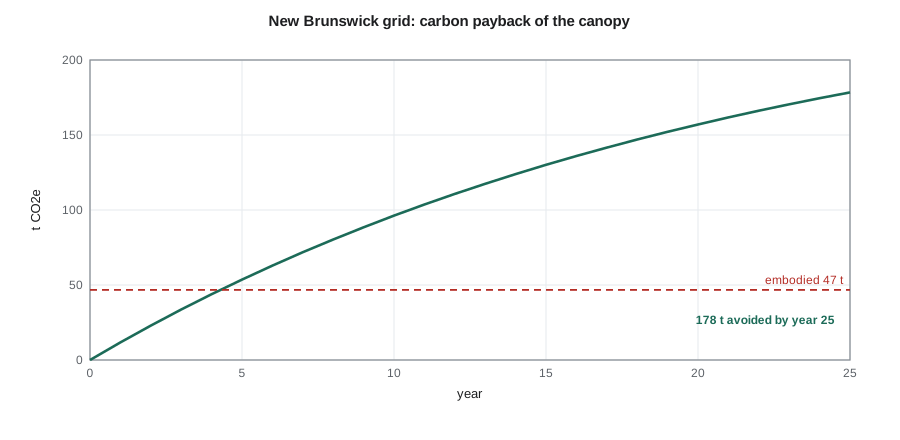
With the assumptions shown, about 47 t of embodied emissions are repaid in about five years against New Brunswick's grid, assumed at 290 g of CO₂e per kWh and falling 4 % a year, and the canopy avoids roughly 180 t over 25 years. The result depends strongly on the grid's carbon intensity: a cleaner grid makes the payback longer. The report presented the result with its assumptions and their sources, and noted that the battery's main benefits, storm readiness and avoiding a service upgrade, are not carbon benefits at all and should not be presented as such.
End of life is part of sustainability. The team's handover manual identified the take-back and recycling routes the battery and module suppliers offer, and recommended that Larchmont's purchase contracts include them. They also noted that lithium iron phosphate cells contain no cobalt or nickel, which reduces some supply-chain and recycling concerns but also lowers their scrap value, so recycling may cost money rather than earn it.
Worked problem
Simple carbon payback
A 36 kW DC array yields 1,150 kWh per kW DC per year on a grid emitting 290 g CO₂e per kWh. Ignoring degradation and grid change, how long does it take to repay 46.7 t of embodied emissions?
Show solution
- Annual energy: 36 × 1150 = 41,400 kWh.
- Annual avoided emissions: 41,400 × 0.29 kg ≈ 12.0 t.
- \[t = 46.7/12.0 \approx 3.9\ \text{years}\]
Answer: About four years before degradation and a cleaner grid are included.
Standards beyond the code
The electrical code is only one of the standards that shape a design like this. The team's report listed the others they relied on and why: equipment safety standards for the inverter, battery, chargers and control panel, which the certified products already meet; the charging communication standards, which determine whether chargers from different makers will work with the site controller; the utility's own interconnection and metering requirements; workplace electrical safety standards for the people who will maintain the canopy; and industrial cybersecurity guidance for the controller. Knowing which standards apply, and which edition, is part of professional competence. When the team was unsure, they asked the people responsible for each one, Nadine for interconnection, Larchmont's safety advisor for workplace practice and its security team for the controller, rather than guessing.
Standards change. Several that the team used had new editions within the previous few years, and some jurisdictions adopt new editions years after they are published. The report recorded the edition of each standard used and noted that the engineer of record should confirm the editions in force at the time of permit.
People and the public
Engineering decisions affect people who are not at the table. The team considered who else the canopy touches: line crews, who need chargers they can use in the dark with gloves on; visitors and contractors who park in the yard; neighbours, who might see the canopy lights at night; and Larchmont's customers, whose rates ultimately pay for the project. Two changes came from this. The chargers were specified with cable management and lit, high-contrast connector holsters, and two charging spaces were laid out to accessible dimensions so that any staff member or visitor with a disability could use them. And the canopy lighting was specified as downward-facing and dimmed after midnight.
Professional habits
Many of the practices in this course are professional habits as much as technical ones: keeping records that let someone else check your work; stating assumptions and the limits of your models; separating what you measured from what you estimated; disclosing conflicts; reporting near misses; and escalating safety concerns to the person with the authority to act on them. Accreditation bodies look for evidence of these habits in capstone reports, and employers look for them in new engineers.
Common mistakes
MistakeIssuing student drawings that look ready for construction.
InsteadLabel them as student design documents and list what an engineer of record must still check.
MistakeTreating a client's cost request as permission to remove protection.
InsteadRefer safety requirements to the person responsible for them and look for cheaper ways to meet the same function.
MistakeStaying quiet when your work is misrepresented in your favour.
InsteadCorrect it promptly; honesty is a core ethical duty.
MistakeUsing open-source code without checking its licence.
InsteadRecord each library's licence and confirm it allows the intended use.
Summary and key terms
- Only licensed engineers may take responsibility for and seal engineering work; students work under supervision.
- In Canada, equipment must be certified by an SCC-accredited body; custom control panels can be built to CSA C22.2 No. 286.
- Codes of ethics put public safety first and require competence, honesty and disclosure of conflicts.
- Protection required for safety is not the team's or the client's to remove for cost.
- Settle intellectual property and software licences early.
- Check sustainability claims with life-cycle data and state the assumptions.
- Consider everyone the design affects, not only the client.
- Engineer of record
- The licensed engineer who takes responsibility for and seals a design.
- Seal
- A licensed engineer's stamp and signature indicating professional responsibility for a document.
- Certification or listing
- Approval of a product by an accredited body as meeting applicable safety standards.
- Field evaluation
- Inspection and approval of a specific installed product that is not otherwise certified.
- Conflict of interest
- A situation in which personal interests could bias professional judgment.
- Embodied emissions
- Greenhouse gases released in making, transporting and installing a product.
- Carbon payback
- The time for avoided emissions to equal a product's embodied emissions.
Practice problems
Work each problem on paper first, then reveal the answer to check.
Can Professor Gagnon's supervision substitute for an engineer of record on the canopy?
Show answer
No; she supervised student work but did not take responsibility for the construction design.
Why did the team refuse to drop the export relay but propose a cheaper package?
Show answer
The relay was a safety requirement from the responsible engineer; serving the client meant finding savings without removing protection.
What should Hannah do when a summary misstates a test result?
Show answer
Correct it promptly in writing to the person responsible.
Why does a cleaner grid lengthen carbon payback?
Show answer
Each kilowatt-hour of solar displaces fewer emissions.
Name one end-of-life issue for the battery.
Show answer
Recycling routes and cost; LFP cells have low scrap value.
Why were two spaces laid out to accessible dimensions?
Show answer
So that staff or visitors with disabilities can use the chargers.
Lesson quiz · 5 questions
Score 60% or more to complete this lesson.
Create a free account to save your progress, take quizzes and earn a certificate.