
CRE-401 · Lesson 5 of 12 · 30 min
Compensation, equity and employment contracts
Once you have chosen a candidate, you need to decide how to pay them and what the written agreement will say. Compensation is more than a salary: it includes payroll costs, benefits, paid time off, bonuses and sometimes equity. Employment contracts set out duties, ownership of creative work, confidentiality, termination and other terms that protect both sides. This lesson builds on the contract basics from CRE-330, focusing on what changes when you employ people rather than hire freelancers or sign brand deals.
Payroll rates and employment rules change every year and differ by jurisdiction, so check current figures with your payroll provider, accountant or lawyer.
Setting pay
Pay should be fair inside the company and competitive with the market. Start with market data: industry salary surveys, job postings with pay ranges (now common because of pay transparency laws), creator economy communities and conversations with peers. Then set a pay range for each role, with a minimum, midpoint and maximum, and place each person in the range based on skills and experience. Written ranges make pay decisions more consistent and help defend against claims of unfair treatment.
Many creator companies pay a mix of fixed and variable pay. Fixed pay is the base salary or hourly wage. Variable pay might include bonuses tied to company profit, channel growth or a show's performance. Variable pay can motivate, but badly designed bonuses cause problems. A bonus paid on views alone may push editors toward clickbait that damages trust. Tie bonuses to several measures, including quality, and keep the rules simple.
The fully loaded cost of an employee
An employee costs more than their salary. Employers pay payroll contributions, insurance, benefits and equipment, and the employee is paid for holidays and vacation when they are not producing. The fully loaded cost is the total annual cost of employing someone. It is the right number to compare with a contractor's fees or with the revenue a role must generate.
In Canada in 2026, employers typically pay:
- Canada Pension Plan contributions of 5.95 % of pensionable earnings between the $3,500 basic exemption and the year's maximum pensionable earnings of $74,600, plus second additional CPP (CPP2) of 4 % on earnings between $74,600 and $85,000, matched by the employee. Quebec uses the Quebec Pension Plan instead.
- Employment Insurance premiums at 1.4 times the employee rate. For 2026 the employee rate is 1.63 % of insurable earnings up to $68,900, so the employer rate is about 2.28 % (Quebec has lower rates because of its parental insurance plan).
- Workers' compensation premiums to the provincial board, at rates that depend on the industry and claims history.
- In some provinces, a payroll or health tax, such as Ontario's Employer Health Tax on payrolls above an exemption, and Quebec's health services fund contributions.
- Vacation pay or paid vacation (at least 4 % or two weeks in most provinces, rising with service), public holiday pay and any benefits plan such as health and dental coverage.
Worked problem
Fully loaded cost in Canada
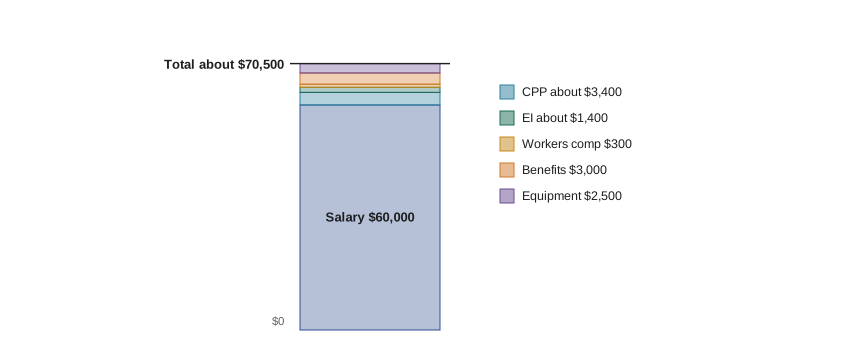
An Ontario company hires an editor at a salary of $60,000. Assume workers' compensation at 0.5 % of salary, a health and dental plan costing $3,000 a year, and equipment and software of $2,500 a year. Estimate the employer's annual cost.
Show solution
- CPP: ($60,000 − $3,500) × 5.95 % ≈ $3,362. No CPP2, since salary is below $74,600.
- EI: $60,000 × 2.28 % ≈ $1,369.
- Workers' compensation: $60,000 × 0.5 % = $300.
- Benefits and equipment: $3,000 + $2,500 = $5,500.
- Total: 60,000 + 3,362 + 1,369 + 300 + 5,500 = $70,531.
Answer: About $70,500, or roughly 18 % above salary. Smaller companies are often surprised by how quickly these costs add up.
Employee or contractor: comparing costs
A contractor's invoice usually has no payroll contributions or benefits on top, but the hourly rate is typically higher, because the contractor pays their own taxes, equipment, insurance and unpaid time between jobs. Compare on a like-for-like basis: the cost per productive hour or per finished piece of work.
Worked problem
Contractor or employee?
A freelance editor charges $55 an hour and would bill about 1,200 hours a year for the company's work. An employee would cost about $70,500 a year fully loaded and give about 1,400 productive hours. Compare the cost per productive hour.
Show solution
- Contractor: $55 an hour, total 1,200 × $55 = $66,000.
- Employee: $70,500 ÷ 1,400 ≈ $50.36 per productive hour.
Answer: The employee is cheaper per hour if there is enough work to keep them busy. The contractor costs less in total for fewer hours and gives flexibility. The legal classification must still follow the real relationship, not the cost.
Equity and ownership
Some creator companies offer equity, meaning a share of ownership, to key early staff. Equity can attract talent the company cannot yet afford to pay at market rates and aligns people with long-term success. It also has costs: it dilutes the founder, can be hard to value, and creates tax and legal complexity. Equity usually takes one of three forms: shares issued directly, stock options giving the right to buy shares at a fixed price later, or phantom equity and profit-sharing plans that pay cash based on value without issuing real shares.
Equity is normally earned over time through vesting. A common schedule is four years with a one-year cliff: nothing vests in the first year, then 25 % vests at the first anniversary and the rest vests monthly over the next three years. If the person leaves, unvested equity returns to the company.
Worked problem
Vesting
A producer receives options over 2 % of the company, vesting over 48 months with a 12-month cliff. How much has vested if they leave after 9 months? After 30 months?
Show solution
- At 9 months: before the cliff, so 0 % vests.
- At 30 months: 2 % × 30 ÷ 48 = 1.25 %.
Answer: Nothing vests at 9 months; 1.25 % has vested at 30 months, and the remaining 0.75 % returns to the company's option pool.
Tax treatment of equity is complex. In Canada, employee stock options generally create a taxable benefit when exercised, with special rules that can defer tax and allow a deduction for options in Canadian-controlled private corporations. Get tax advice before designing a plan.
Key terms in an employment contract
A written employment agreement should cover at least:
- Role, start date, reporting line, location or remote arrangements and hours.
- Pay, bonus rules, benefits, vacation and any equity.
- Probation period, if any, and how it works under local law.
- Confidentiality of business information, unreleased content, sponsor terms and audience data.
- Ownership of intellectual property created on the job.
- Rules on outside work, such as personal channels, and conflicts of interest.
- Termination: notice, severance, return of property and transfer of accounts and passwords.
Intellectual property
For a media company, the content its team creates is its main asset, so ownership must be clear.
Under the Copyright Act, when an employee creates a work in the course of employment, the employer is generally the first owner of the copyright unless there is an agreement to the contrary. Freelancers and contractors own the copyright in what they create unless they assign it in writing. Moral rights, such as the right to be credited and to the integrity of the work, cannot be assigned in Canada but can be waived, so contracts often include a waiver.
Contracts should also cover ownership of channel accounts, logins, project files and social profiles created for the company, and what happens to on-camera appearances by staff after they leave.
Non-competes and non-solicitation
Ontario's Employment Standards Act has banned non-compete agreements in employment since October 25, 2021, with narrow exceptions for executives and for the sale of a business. In other provinces, courts enforce non-competes only if they are reasonable in scope, time and geography, and often refuse them. Narrower clauses, such as non-solicitation of clients or staff and confidentiality, are more likely to hold up.
Payroll and benefits administration
Employers must register for a payroll program account with the CRA, deduct income tax, CPP and EI from each paycheque, remit them with the employer's share on time, and issue T4 slips each year. Many small companies use payroll software or a payroll provider. Employment standards in each province set rules on minimum wage, overtime, vacation, public holidays and termination notice.
Pay equity and fairness
As teams grow, pay decisions made one at a time can drift into unfair patterns, such as people doing the same work being paid differently because one negotiated harder. Review pay at least once a year across each role and level, and correct gaps that cannot be explained by skills, performance or experience.
Several provinces have pay equity or equal pay laws. Ontario and Quebec have pay equity laws that require many employers to compare pay for work of equal value between jobs mainly held by women and those mainly held by men, and federally regulated employers with 10 or more employees are covered by the federal Pay Equity Act. Employment standards in every province also require equal pay for substantially the same work regardless of sex.
Benefits that matter to creative teams
Beyond legally required benefits, small creator companies compete for talent with benefits that cost relatively little but matter a lot: flexible schedules, remote work, a budget for equipment and training, credit on published work, generous time off between big projects and clear limits on after-hours messages. Health and dental coverage is highly valued, especially in the US, where it is often tied to employment. Group plans for small employers are available through insurers, brokers and, in some places, business associations.
Worked problem
Comparing two offers
A senior editor is choosing between two offers. Company A pays $72,000 with a $4,000 training budget and fully remote work. Company B pays $78,000 but requires a daily commute costing $3,500 a year and 6 hours a week of travel time. If the editor values their time at $25 an hour over 48 weeks, which offer is worth more to them?
Show solution
- Company A: $72,000 + $4,000 training value = $76,000.
- Company B: $78,000 − $3,500 commuting = $74,500.
- Travel time at B: 6 × 48 × $25 = $7,200 of time value, giving $74,500 − $7,200 = $67,300 in effective value.
Answer: Company A is worth about $8,700 more to this editor, showing why flexibility and development budgets can win candidates without the highest salary.
Contract checklists
Many companies keep a checklist for each new employment agreement so nothing is missed: correct legal name of the employer, role and start date, pay and pay frequency, benefits start date, vacation entitlement, probation, IP and moral rights terms, confidentiality, account and password ownership, outside work rules, termination provisions that comply with local law, and signatures from both parties before the start date. Review the template with an employment lawyer at least every couple of years, since laws change.
Common mistakes
MistakeComparing a contractor's rate with an employee's salary.
InsteadCompare fully loaded cost per productive hour.
MistakePaying bonuses on views alone.
InsteadTie variable pay to several measures, including quality.
MistakeGranting equity without vesting.
InsteadUse vesting with a cliff so equity is earned over time.
MistakeAssuming you own a freelancer's work because you paid for it.
InsteadGet written assignments or valid work-for-hire terms.
MistakeCopying a non-compete clause from the internet.
InsteadCheck local law; use confidentiality and non-solicitation where non-competes fail.
Summary and key terms
- Set pay with market data, written ranges and simple, balanced bonus rules.
- The fully loaded cost includes payroll contributions, insurance, benefits and equipment.
- Compare employees and contractors by cost per productive hour, but classify by the real relationship.
- Equity usually vests over four years with a one-year cliff.
- Employment contracts should cover pay, confidentiality, IP, outside work and termination.
- Employers usually own employees' work, but contractors' work needs written terms.
- Non-compete rules vary widely; confidentiality and non-solicitation clauses are more reliable.
- Pay range
- The minimum, midpoint and maximum pay for a role.
- Variable pay
- Pay that depends on performance, such as bonuses.
- Fully loaded cost
- The total annual cost of employing someone.
- Payroll contributions
- Employer-paid amounts such as pension, insurance and unemployment taxes.
- Equity
- An ownership share in a company.
- Stock option
- The right to buy shares later at a fixed price.
- Vesting
- The process by which equity is earned over time.
- Cliff
- An initial period before any equity vests.
- Moral rights
- An author's rights to credit and to the integrity of a work.
- Non-solicitation clause
- A promise not to poach clients or staff after leaving.
Practice problems
Work each problem on paper first, then reveal the answer to check.
A 1 % grant vests over 48 months with a 12-month cliff. Vested at 24 months?
Show answer
0.5 %.
Same grant, vested at 6 months?
Show answer
0 %, because the cliff has not passed.
An employee costs $66,000 and gives 1,320 productive hours. Cost per hour?
Show answer
$50.
A contractor bills 1,000 hours at $60. Annual cost?
Show answer
$60,000.
Name three items in a fully loaded cost.
Show answer
CPP, EI, workers' compensation, benefits, equipment.
Why tie bonuses to more than views?
Show answer
To avoid rewarding clickbait that hurts trust.
Who owns an employee's work created on the job?
Show answer
Generally the employer, unless agreed otherwise.
What does a contractor need to sign to give you copyright?
Show answer
A written assignment, or valid work-for-hire terms in the US.
Name a clause more reliable than a non-compete.
Show answer
Confidentiality or non-solicitation.
What annual slip or form reports an employee's pay?
Show answer
The T4.
Lesson quiz · 5 questions
Score 60% or more to complete this lesson.
Create a free account to save your progress, take quizzes and earn a certificate.