
CRE-340 · Lesson 5 of 12 · 29 min
Budgets and buying models
Creator fees are only part of what a campaign costs, and the way a brand pays creators shapes how they behave. This lesson shows how to build a complete campaign budget, explains the main buying models from flat fees to revenue shares, compares their risks for brand and creator, introduces a portfolio approach to allocating budget across creators and tests, and covers the payment and tax paperwork brands must handle.
Building a complete budget
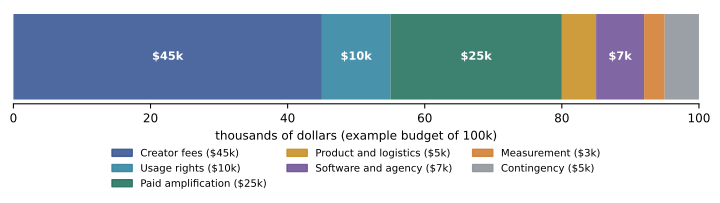
New programs often budget only for creator fees and are then surprised by everything else. A complete budget includes:
- Creator fees for the agreed deliverables, including any premium for exclusivity, rush delivery or extra revisions.
- Usage and licensing fees for reusing content on brand channels or in ads, priced by duration, channels and territory.
- Paid amplification: the media budget for boosting creator posts or running them as ads, covered in Lesson 8.
- Product and logistics: free product, samples, shipping, customs duties for cross-border shipments and returns.
- Production support: props, locations, travel, events or extra editing of creator content into ad formats.
- Platform and agency costs: discovery or management software subscriptions, agency retainers or commissions, and payment-processing fees.
- Measurement: brand-lift studies, surveys, tracking tools or analyst time.
- Contingency: usually 5 to 15 % for replacements, overruns and opportunities that appear mid-campaign.
Sales taxes add another layer. Depending on where the creator is registered and where the services are supplied, invoices may include sales tax that the brand pays and, if registered, may be able to recover. The section on payments below explains the main rules in each country.
The main buying models
Brands pay creators in several ways, and many deals combine more than one. The choice determines who carries the risk that a post performs badly.
| Model | How it works | Who carries performance risk | Best for |
|---|---|---|---|
| Flat fee | Fixed price per deliverable or package | Brand | Awareness, content, predictable budgets |
| CPM-based fee | Fee set from expected impressions × agreed CPM, sometimes with a make-good if delivery falls short | Shared | Reach campaigns with reliable creator history |
| CPE-based fee | Fee per engagement, or set from expected engagements | Shared | Engagement objectives |
| CPA or affiliate | Commission per sale or sign-up, tracked by link or code | Creator | Conversion, evergreen programs |
| Hybrid | Smaller flat fee plus commission or bonus for results | Shared | Balancing reach and sales |
| Gifting or seeding | Free product, no payment, often no posting obligation | Brand (product cost) | Nano creators, launches, discovery |
| Revenue share or co-branded product | Creator earns a share of sales of a product they helped create | Both, long term | Large creators with strong audiences |
| Retainer or ambassadorship | Monthly fee for a set of deliverables over months | Brand | Long-term relationships |
Flat fees are simple and attract the best creators, who prefer certainty. Performance-only deals shift risk to creators, which can look attractive to brands but tends to attract smaller creators and those with direct-response audiences. Many established creators refuse commission-only work for awareness-style content because it pays them for the part of the effect that can be tracked and nothing for the rest. Hybrid deals are a common compromise: the flat portion covers the creator's time and the commission rewards sales.
Gifting deserves special care. Sending free products with no obligation can generate goodwill and authentic content, but brands cannot require posts, and creators who do post must disclose the gift. Unsolicited products that arrive without warning annoy many creators; asking first is both polite and efficient.
Comparing flat and hybrid offers
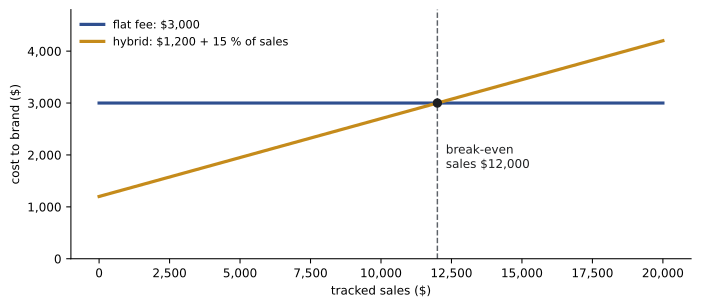
A brand comparing a flat fee with a hybrid offer can find the break-even level of sales at which the two cost the same. Below that level the hybrid costs less; above it, more. That is good news for the brand if sales are high, because commissions are paid only from revenue that has actually arrived.
Worked problem
Flat fee versus hybrid
A creator quotes $3,000 flat. The brand offers $1,200 plus 15 % commission on tracked sales. The product has a 60 % gross margin. At what sales level do the two cost the same, and what is the brand's gross profit after creator costs at that point?
Show solution
- Break-even sales: (3,000 − 1,200) ÷ 0.15 = 1,800 ÷ 0.15 = $12,000.
- Gross profit on $12,000 of sales: 12,000 × 0.60 = $7,200.
- Creator cost at break-even under either deal: $3,000.
- Gross profit after creator cost: 7,200 − 3,000 = $4,200.
Answer: The deals cost the same at $12,000 of tracked sales, where the brand keeps about $4,200 of gross profit after paying the creator.
Setting a price ceiling
Creators set floors; brands should set ceilings. A useful ceiling is the most the brand can rationally pay for the expected result. For awareness, compare the creator's effective CPM with what the brand pays for comparable reach through ads, adjusting for the extra trust and content value of creator posts. For conversion, multiply expected conversions by the maximum the brand can afford to pay per customer, which depends on margin and customer lifetime value.
Worked problem
Ceiling from target CPA
A meal-kit company can afford to pay up to $45 to acquire a new customer. A creator's past sponsored posts for similar brands produced a median of 80 tracked new customers. What is the ceiling for a single post?
Show solution
- Expected conversions: 80.
- Maximum fee: 80 × $45 = $3,600.
- If the creator quotes $5,000, the brand can negotiate, propose a hybrid deal, or decline.
Answer: A ceiling of about $3,600 based on tracked conversions alone; the brand may pay more if it values awareness and content beyond tracked sales.
A portfolio approach
Creator results vary widely, so a campaign is better treated as a portfolio of bets than a list of guaranteed placements. Portfolio thinking suggests spreading budget across several creators and formats, keeping some budget for testing new creators and platforms, and shifting money towards what works. A common rule of thumb splits spending into proven performers, promising tests and experiments, for example 70 %, 20 % and 10 %. The exact split matters less than the discipline of testing and reallocating.
Worked problem
Allocating a test-and-scale budget
A brand has $60,000 for a quarter. It plans 70 % for proven creators, 20 % for new micro creators at $1,500 each and 10 % for a new platform experiment. In month two it will move half of the test budget's remaining funds to the top-performing new creators. How much goes to each part, and how many new creators can be tested?
Show solution
- Proven creators: 0.70 × 60,000 = $42,000.
- New micro tests: 0.20 × 60,000 = $12,000, or 12,000 ÷ 1,500 = 8 creators.
- Platform experiment: 0.10 × 60,000 = $6,000.
- Reallocation keeps the total fixed: scaling winners is funded from the test pool, not new money.
Answer: $42,000 proven, $12,000 testing eight new creators, and $6,000 for the new platform.
Portfolio thinking also argues against spending the entire budget on one celebrity. A single large post can work brilliantly, but it can also be lost in a busy feed or overshadowed by news. Unless the objective specifically needs one big moment, several creators usually give more reliable results.
Negotiating from the brand side
Brand-side negotiation mirrors the creator-side negotiation covered in CRE-310. Know your ceiling and your alternatives before talking. Start with a clear scope, because creators price scope: a request for one post and one story with 30 days of organic usage is very different from three videos with a year of paid usage worldwide. Trade rather than squeeze: if the fee is too high, reduce usage, exclusivity or deliverables instead of simply asking for a discount. Be wary of extracting very low fees from inexperienced creators; it damages your reputation in creator communities and often leads to weaker content.
Make-goods are a useful tool for CPM-based deals. If a creator's post falls well short of the agreed minimum impressions, the contract can require an extra post or a partial refund. Make-goods should be based on a realistic threshold, such as a share of the creator's median, and should exclude causes outside the creator's control, such as platform outages.
Paying creators: paperwork and tax
Paying dozens of creators means collecting tax information, handling invoices in different currencies and meeting reporting obligations. Payment platforms can automate much of this, but the brand remains responsible for getting it right. The rules below are a simplified overview; CRE-330 covers the creator's side, and brands should confirm details with their accountants.
In Canada, creators who are registered for GST/HST, which is required once their taxable supplies exceed $30,000 over four consecutive calendar quarters, charge GST or HST on their fees, and in Quebec QST may also apply. A registered brand can usually claim input tax credits for tax paid on business purchases. Some payers report fees for services paid to self-employed individuals on a T4A slip in box 048; the Canada Revenue Agency's requirements in this area have been applied unevenly and have changed over time, so confirm current obligations with an accountant. Payments to non-resident creators for services performed in Canada are generally subject to 15 % withholding under Regulation 105 unless a waiver is obtained, while services performed entirely outside Canada are generally not. Gifted products are treated as income in kind for the creator, so keep records of their value.
Currency is another practical issue. Agree in the contract which currency the fee is in, who bears exchange-rate changes and how payment-processing fees are split. Late payment is one of the most common complaints creators make about brands; a reputation for paying within 30 days or sooner helps attract the best creators.
Budget pacing and tracking
Track committed and spent amounts separately. Committed spend is money promised in signed contracts; spent is money actually paid. Many creator payments are split, for example half on signing and half on delivery, so committed spend runs ahead of actual payments. A simple tracker listing each creator, the agreed fee, usage fees, product costs, payment dates and status keeps finance and marketing aligned and shows how much contingency remains.
Paying for performance fairly
Performance-based deals can be fair to both sides when the tracking is reliable and the terms are clear. Brands should share the data creators need to check their commissions, pay commission on returns-adjusted sales by a stated date each month and explain how attribution works when a customer used more than one creator's link. Creators reasonably distrust programs that change commission rates without notice or reject sales on vague grounds. A short, clear commission policy, published to all affiliates, avoids most disputes and helps attract creators who drive real sales.
Product costs also deserve honest accounting. Free product sent to creators has a real cost to the brand, even if it is valued at wholesale rather than retail, and large seeding programs can consume thousands of units. Count the cost of goods, packaging and shipping in the budget, and track how many seeded creators actually post, so the effective cost per post from gifting can be compared with paid alternatives. A gifting program in which only one creator in five posts may be more expensive per post than it first appears.
Common mistakes
MistakeBudgeting only for creator fees.
InsteadInclude usage, amplification, product, software, measurement and contingency.
MistakeInsisting on commission-only deals for awareness content.
InsteadUse flat or hybrid deals when much of the value cannot be tracked.
MistakePaying whatever a creator quotes.
InsteadSet a ceiling from comparable media costs or target CPA.
MistakeSpending the whole budget on one large creator.
InsteadSpread budget as a portfolio and keep funds for tests.
MistakeIgnoring tax forms and withholding for foreign creators.
InsteadCollect the right forms and check withholding rules before paying.
Summary and key terms
- A complete budget covers fees, usage, amplification, product, production, software, measurement and contingency.
- Buying models range from flat fees to commission-only, with hybrids sharing risk.
- Break-even sales for flat versus hybrid = (flat − hybrid base) ÷ commission rate.
- Maximum fee = expected conversions × target CPA, plus any value placed on awareness and content.
- Treat creators as a portfolio: proven performers, tests and experiments.
- Negotiate by trading scope, usage and exclusivity rather than squeezing fees.
- Collect tax forms, apply withholding rules and pay promptly.
- Flat fee
- A fixed price for agreed deliverables.
- Hybrid deal
- A base fee plus commission or performance bonus.
- Affiliate
- A creator paid commission on tracked sales.
- Gifting
- Sending free product, usually without a posting obligation.
- Retainer
- A recurring monthly payment for ongoing deliverables.
- Make-good
- Extra delivery or a refund when results fall short of an agreed minimum.
- Price ceiling
- The most a brand can rationally pay for expected results.
- Contingency
- Budget held back for overruns and opportunities.
- Committed spend
- Money promised in signed contracts.
- Withholding
- Tax deducted from a payment and remitted to the government.
Practice problems
Work each problem on paper first, then reveal the answer to check.
List five budget lines beyond creator fees.
Show answer
Usage, amplification, product, software or agency, measurement, contingency.
Flat $2,500 versus $1,000 + 10 %. Break-even sales?
Show answer
$15,000.
Expected 120 conversions, target CPA $30. Ceiling?
Show answer
$3,600.
Who carries performance risk in a commission-only deal?
Show answer
The creator.
$80,000 split 70/20/10. Test budget?
Show answer
$16,000.
Why do top creators often refuse commission-only awareness deals?
Show answer
Much of their value cannot be tracked by links.
What is a make-good?
Show answer
Extra delivery or a refund when results fall short.
Give one way to reduce a fee without squeezing the creator.
Show answer
Reduce usage, exclusivity or deliverables.
Why track committed and spent amounts separately?
Show answer
Payments lag behind signed contracts.
Are gifted products income for the creator?
Show answer
Yes, generally at fair market value.
Lesson quiz · 5 questions
Score 60% or more to complete this lesson.
Create a free account to save your progress, take quizzes and earn a certificate.