
CRE-340 · Lesson 11 of 12 · 27 min
Fraud, brand safety and crisis management
Creator marketing carries risks that most media buying does not. Brands can pay for audiences that do not exist, discover that a creator they hired has a history they missed, or wake up to find a creator at the centre of a public controversy while still wearing the brand's product in a pinned video. Scammers also impersonate brands to exploit creators. This lesson covers the main forms of fraud and how to detect and contract against them, brand-safety monitoring during campaigns, and how to plan for and manage crises involving creators.
Types of influencer fraud
Fraud in creator marketing ranges from crude to sophisticated. The most common forms are:
- Fake followers: purchased accounts, often bots or inactive profiles, that inflate follower counts.
- Purchased engagement: bought likes, comments, views or shares, sometimes delivered gradually to avoid detection.
- Engagement pods: groups of creators who agree to engage with each other's posts to boost algorithmic reach. Pods produce real but artificial engagement from people outside the target audience.
- Giveaway inflation: follower spikes from contests that require following many accounts, attracting people who want prizes rather than content.
- Fake or altered analytics: screenshots that are edited, selected from unusually strong periods or taken from another account.
- Affiliate fraud: self-purchasing through one's own code to earn commission and then returning items, cookie stuffing that drops tracking cookies without real clicks, or bidding on a brand's name in search to claim credit for existing demand.
Not all suspicious signals are fraud. A creator may gain thousands of followers overnight because a video went viral, and some audiences are genuinely international. The task is to look for patterns that do not have an innocent explanation and to ask creators about anomalies before drawing conclusions.
Detecting fraud
Detection combines software, manual review and first-party data. Discovery tools flag suspicious followers and unusual growth. Manual review looks at comment quality, follower profiles and view-to-follower ratios. First-party analytics from the creator show where the audience lives and how posts are distributed. Comparing a creator's results across several posts reveals whether a sponsored post performed in line with their organic work.
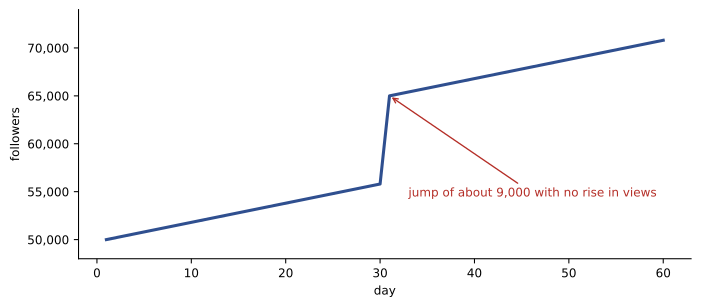
One simple check compares a day's growth with the creator's usual daily growth. If daily growth normally averages about 200 followers with day-to-day variation (standard deviation) of about 60, a single day with 9,000 new followers is more than 100 standard deviations above normal. That alone does not prove purchase, because a viral post could explain it, but if views on the creator's posts did not rise at the same time, the jump is very suspicious.
Worked problem
Flagging an unusual growth day
A creator's daily follower growth over three months averaged 150 with a standard deviation of 50. On one day they gained 1,400 followers, but their views per post that week were normal. Calculate the z-score and interpret it.
Show solution
- Difference from mean: 1,400 − 150 = 1,250.
- z = 1,250 ÷ 50 = 25.
- A z-score of 25 is far outside normal variation, and normal views suggest no viral cause.
Answer: z = 25, a strong signal to ask the creator for an explanation and examine where the new followers came from before hiring.
Fraud affects the effective price the brand pays. If a share of an audience is fake, the cost per real person reached rises in proportion.
Worked problem
The cost of fake reach
A creator quotes a fee equivalent to a $20 CPM on their reported impressions. An audit suggests 35 % of impressions come from fake or irrelevant accounts. What is the effective CPM for real impressions?
Show solution
- Real share of impressions: 1 − 0.35 = 0.65.
- Effective CPM: 20 ÷ 0.65 ≈ $30.77.
Answer: About $30.77 per thousand real impressions, more than 50 % above the quoted price.
Contractual protections
Contracts can deter fraud and give the brand remedies if it occurs. Useful clauses include a warranty that the creator has not bought followers, engagement or views and will not do so during the campaign; a requirement to provide first-party analytics in an agreed format by agreed dates; a right to audit or verify metrics; a clawback or termination right if the warranties prove false; and, for affiliates, rules against self-purchasing, coupon-site posting and brand-name search bidding, with forfeiture of commission for breaches. Holding back part of the payment until metrics are verified also reduces risk.
Brand safety during the campaign
Vetting reduces risk before a campaign, but brand safety continues while content is live. Monitor the creator's posts and comments for the campaign period and, for long-term ambassadors, continuously. Social listening tools can alert the team to sudden spikes in mentions of the creator or brand. Monitor comment sections on campaign posts for hate speech, scams or misinformation that the creator may need help moderating. Watch for impersonators: fake accounts sometimes copy popular creators and run scams using brand names.
Brands should also protect creators. Creators who partner with a brand sometimes face harassment from people who dislike the brand or the creator's identity. A brand that publicly or privately supports creators under attack, helps with moderation and does not quietly drop them for the brand's convenience earns lasting loyalty from creator communities.
Scams that target creators
Fraud runs both ways. Scammers impersonate well-known brands to approach creators with fake sponsorship offers that ask for upfront payments, personal data, or the download of supposed campaign files that contain malware designed to steal account access. Brands can protect creators, and their own reputation, by publishing how they contact creators, using official domains for email, never asking creators to pay to participate and warning their creator community about known scams. If impersonators are active, report them to the platforms and consider a public notice.
Assessing risk
A simple risk register lists the things that could go wrong in a campaign, rates each for likelihood and impact on a scale such as 1 to 5, multiplies the two to rank them and records the planned response. Typical risks include a creator controversy, missing disclosure, a product defect surfacing in creator content, a shipping delay before launch, a platform outage or policy change, fraudulent engagement and a negative comment pile-on.
| Risk | Likelihood (1–5) | Impact (1–5) | Score | Response |
|---|---|---|---|---|
| Missing or unclear disclosure | 3 | 4 | 12 | Brief, review drafts, monitor live posts, withhold payment until fixed |
| Creator controversy mid-campaign | 2 | 5 | 10 | Morals clause, monitoring, crisis plan, ability to pause amplification |
| Fraudulent engagement | 3 | 3 | 9 | Vetting, warranties, verified analytics, clawback |
| Product shipping delay | 3 | 3 | 9 | Ship early, track packages, buffer in timeline |
| Negative comment pile-on | 2 | 3 | 6 | Moderation plan, prepared answers, customer service on standby |
| Platform policy change | 2 | 2 | 4 | Spread across platforms, monitor announcements |
Crisis management
A crisis can start with the creator, the brand or the content. The creator may say or do something offensive, be accused of misconduct or be revealed to have deceived their audience. The brand may face a product recall, a scandal or a boycott that spills onto creators' channels. The content itself may be misunderstood, contain an error or provoke backlash. The worst time to decide how to respond is in the middle of it, so brands with active creator programs should have a short crisis plan in advance.
A practical crisis playbook has five steps:
- Detect and assess. Confirm the facts quickly, judge severity and scope, and identify who needs to be involved: creator program lead, communications, legal and senior management.
- Contain. Pause scheduled posts and paid amplification involving the creator or content. Pausing is reversible; deleting content can look like a cover-up and may breach agreements, so decide on removal deliberately.
- Communicate. Talk to the creator or their manager directly before making public statements. Prepare holding statements for customer service and social teams. If a public statement is needed, be factual, brief and consistent with the brand's values.
- Decide. Choose a course of action: continue, pause, end the relationship under the contract, or support the creator. Base the decision on facts, the contract and the brand's values, not on the loudest comments in the first hour.
- Review. After the crisis, analyse what happened, whether vetting or monitoring could have caught it earlier and how the plan worked, and update the playbook.
Speed matters, but so does accuracy. Online outrage sometimes targets people based on misunderstandings or false accusations, and a brand that drops a creator on the strength of a rumour may face its own backlash and legal claims. A brief holding statement saying the brand is aware and looking into the matter buys time to establish facts.
Ending a relationship
If a brand decides to end a creator relationship because of conduct, it should follow the contract: give notice as required, rely on the specific morals or termination clause, pay for work delivered where the contract requires it and stop using the creator's content in ads promptly. Public statements should avoid unproven allegations, which could be defamatory. In Canada and the US alike, defamation claims can arise from public statements that damage a person's reputation without justification, so legal review of any statement about a creator's conduct is wise.
In Canada, ending a contract for conduct also needs care under provincial contract law and, in Quebec, the Civil Code. Courts look at what the contract actually says, so vague morals clauses give the brand less protection than it may expect.
Platform policy and account risks
Campaigns depend on platforms the brand does not control. Platforms change algorithms, ad policies, branded-content rules and even their availability in particular countries, sometimes with little notice. A creator's account may be restricted or suspended for reasons unrelated to the campaign, taking the brand's content with it. Spreading a program across several platforms and creators, keeping copies of licensed content and having contingency plans for key launches all reduce this risk. Contracts can also say what happens if a creator's account is suspended before content is delivered, for example a replacement deliverable on another platform or a refund of unearned fees.
Regulation is another moving risk. Rules on disclosure, children's data, AI-generated content and specific product categories change regularly in both countries. Assign someone to watch for changes, review templates when rules change and brief creators on anything new before the next campaign rather than after a regulator's warning.
Product safety and quality issues
Creators sometimes discover product problems before the brand does: a batch with a defect, packaging that leaks, or a side effect in a skincare product. A creator who shares a genuine problem publicly is not a crisis to be suppressed; it is valuable early warning. The brand should respond quickly and transparently, fix the issue and thank the creator for raising it. Asking creators to delete honest negative experiences, or penalizing them for sharing, can breach disclosure and consumer protection principles and is likely to backfire if it becomes public.
After any incident, update the risk register with what was learned, so that the next campaign starts from a more accurate picture of what can go wrong.
Common mistakes
MistakeTreating every follower spike as proof of fraud.
InsteadCheck for viral posts or events and ask the creator before concluding.
MistakeRelying on screenshots without verification.
InsteadRequire first-party analytics and keep audit rights.
MistakeIgnoring affiliate fraud such as self-purchasing and coupon-site posting.
InsteadSet affiliate rules, monitor anomalies and forfeit commissions for breaches.
MistakeDeleting creator content immediately when a controversy starts.
InsteadPause amplification and scheduled posts first, establish facts, then decide.
MistakeMaking public accusations about a creator.
InsteadKeep statements factual and brief, and have legal review them.
Summary and key terms
- Fraud includes fake followers, bought engagement, pods, giveaway inflation, altered analytics and affiliate abuse.
- Detect fraud with tools, manual review, first-party data and growth checks such as z-scores.
- Effective CPM = quoted CPM ÷ (1 − fake share).
- Contracts should include authenticity warranties, analytics requirements, audit rights and clawbacks.
- Monitor brand safety throughout campaigns and protect creators from harassment and scams.
- Use a risk register that scores likelihood × impact.
- A crisis playbook covers detect, contain, communicate, decide and review.
- Engagement pod
- A group that exchanges engagement to game algorithms.
- Giveaway inflation
- Follower growth from contests rather than genuine interest.
- Cookie stuffing
- Placing affiliate cookies without genuine clicks.
- Self-purchasing
- An affiliate buying through their own code for commission.
- z-score
- How many standard deviations a value is from the mean.
- Clawback
- Recovery of payments when terms are breached.
- Social listening
- Monitoring online conversation about a brand or person.
- Risk register
- A list of risks scored by likelihood and impact with responses.
- Holding statement
- A brief initial response while facts are established.
- Defamation
- A false statement that damages someone's reputation.
Practice problems
Work each problem on paper first, then reveal the answer to check.
Name four types of influencer fraud.
Show answer
Fake followers, bought engagement, pods, giveaway inflation, altered analytics, affiliate fraud.
Mean growth 100, SD 40, observed 900. z-score?
Show answer
20.
Quoted CPM $15, 25 % fake. Effective CPM?
Show answer
$20.
Give three anti-fraud contract clauses.
Show answer
Authenticity warranty, analytics requirements, audit rights, clawback.
What is cookie stuffing?
Show answer
Dropping affiliate cookies without real clicks.
Likelihood 4, impact 3. Risk score?
Show answer
12.
What is the first step in the crisis playbook?
Show answer
Detect and assess.
Why pause rather than delete content at first?
Show answer
Pausing is reversible and avoids looking like a cover-up.
How can brands protect creators from impersonation scams?
Show answer
Publish contact methods, use official domains, never charge creators, warn about scams.
Why should statements about a creator's conduct be reviewed by legal?
Show answer
To avoid defamation and contract problems.
Lesson quiz · 5 questions
Score 60% or more to complete this lesson.
Create a free account to save your progress, take quizzes and earn a certificate.