
CRE-320 · Lesson 8 of 12 · 27 min
Children, teens and vulnerable audiences
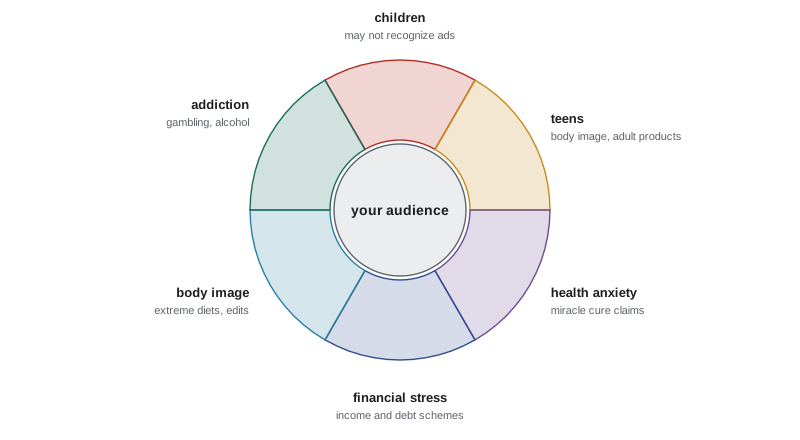
The overall impression test asks how a message is understood by the people it reaches. When those people are children, teenagers or adults in vulnerable situations, the standard rises. Children may not recognize advertising at all, teenagers are especially sensitive to social pressure and body image, and adults facing illness, debt or loneliness can be more easily persuaded by promises that speak to their fears. This lesson covers the special rules on advertising to children in each country, children's privacy, the growing body of law on child influencers themselves, and how creators can recognize and protect vulnerable audiences more generally.
Why children are treated differently
Research on child development shows that younger children often cannot distinguish advertising from other content and do not understand its persuasive intent. Even older children who recognize ads may not resist them in the way adults do. Influencer content makes this harder still: a favourite creator's enthusiasm for a toy or snack feels like a friend's recommendation, not an advertisement, and children may form strong parasocial bonds with creators they watch daily. For these reasons, both countries restrict advertising to children and expect disclosures aimed at children to be extra clear.
Quebec's ban on advertising to children
Quebec has one of the strictest rules in the world. Section 248 of Quebec's Consumer Protection Act prohibits commercial advertising directed at persons under 13 years of age. The Supreme Court of Canada upheld the rule in Irwin Toy Ltd. v. Quebec (1989), finding that protecting children from advertising was a pressing and substantial objective. The ban applies to advertising in any medium that reaches Quebec children, including social media and creator content.
Section 249 sets out how to decide whether an ad is directed at children. The Office de la protection du consommateur considers the context of the ad and, in particular:
- The nature and intended purpose of the goods advertised, such as toys or sweets that appeal mainly to children.
- The manner of presenting the ad, including characters, music, language, animation and themes that attract children.
- The time and place it is shown, such as during children's programming or on channels and platforms where children make up a large part of the audience.
An ad is not considered directed at children simply because it appears in media aimed at both children and adults, or because it can be seen by children. But a creator whose channel attracts a large share of young Quebec viewers should treat sponsored content for child-appealing products as high risk.
Worked problem
Applying the Quebec section 249 factors
A Montreal creator with an audience estimated at 40 % aged 8 to 12 is offered a paid deal to unbox a new collectible toy line, using cartoon sound effects and the creator's catchphrase, in a video posted after school. Is the ad likely directed at children under 13?
Show solution
- Nature of the goods: collectible toys appeal mainly to children.
- Manner of presentation: cartoon effects and a catchphrase aimed at young fans attract children.
- Time and place: posted after school on a channel where a large share of viewers are children.
- All three factors point the same way.
Answer: The ad is very likely directed at children under 13 and would breach section 248 in Quebec; the creator should decline or restructure the deal so it is not directed at children in Quebec, with legal advice.
Self-regulation and the rest of Canada
Outside Quebec, advertising to children is not banned but is regulated. The Broadcast Code for Advertising to Children, administered by Ad Standards with the CRTC, sets detailed rules for children's broadcast advertising, which must be precleared. The Canadian Code of Advertising Standards includes Clause 12, on advertising to children, which says advertising must not exploit children's credulity, lack of experience or sense of loyalty, and Clause 13, on advertising to minors, which says advertising must not exploit minors' inexperience or encourage unsafe behaviour. Ad Standards' 2025 influencer guidelines add that disclosures for child audiences should be noticeable, detailed, attention-grabbing and explained in age-appropriate language.
Health Canada has also proposed restricting advertising directed at children under 13 of foods high in sugars, sodium or saturated fat. At the time of writing, creators promoting food to young audiences should check whether these restrictions have been finalized.
| Element | Adult audience | Child audience |
|---|---|---|
| Wording | #ad, Sponsored | Simple spoken words such as This video is an ad and [Brand] paid me |
| Placement | Start of caption and video | Start of video, spoken and on screen, repeated |
| Frequency | At start and periodically | More often, near each product appearance |
| Visual cues | Platform label | Large on-screen text or icon children recognize |
| Style | Neutral | Age-appropriate, without pressure to buy |
Child influencers and family channels
A newer area of law protects the children who appear in content. Family vlogs and child influencer channels can earn significant income, and the children involved may have no say in how their images are used and no share in the money they help earn.
At the time of writing, Canada has no federal or provincial law specifically protecting child influencers' earnings in the way some US states do. Provincial employment standards and child performer rules, such as those in Ontario's Protecting Child Performers Act, may apply where children work in productions, and privacy law protects personal information. Parents and creators should consider setting aside a share of income for the child, limiting identifying details and respecting a child's wish not to appear.
Teenagers
Teenagers are not covered by the strict children's rules in most places, but they are a sensitive audience. Concerns include body image and appearance pressure, which are heightened by filters and edited images; risky behaviour and dangerous challenges; and products restricted to adults, such as alcohol, vaping and gambling. Many platforms apply teen-specific protections, such as limiting ad targeting and restricting branded content for certain categories to adult audiences. Creators with teen audiences should avoid promoting adult products, cosmetic procedures and extreme diets, and should be especially careful about edited images.
Vulnerable adults
Vulnerability is not only about age. Adults can be vulnerable because of illness, disability, grief, financial stress, addiction, low literacy, language barriers or loneliness. Advertising law in both countries considers the targeted audience, and regulators have taken particular interest in marketing that exploits vulnerability: miracle cures aimed at people with serious diseases, get-rich-quick schemes aimed at people in debt, and products that play on body image insecurity.
- Health anxiety: avoid promising relief to people facing serious or chronic illness; refer them to qualified professionals.
- Financial stress: avoid promoting high-cost credit, risky investments or "side hustle" schemes with unrealistic income claims.
- Body image: avoid promoting extreme diets, unproven weight loss products or cosmetic procedures to audiences struggling with appearance.
- Addiction: avoid gambling, alcohol and similar promotions to audiences that include people in recovery or communities you know are affected.
Worked problem
An ethical check for a vulnerable audience
A creator whose audience is mainly young adults who discuss debt and money struggles is offered $3,000 to promote a "trading academy" that advertises students "earning $500 a day." The brand will not share evidence of typical student results. Apply the ethics check from lesson 1.
Show solution
- Honesty: an earnings claim without evidence of typical results is likely misleading; the audience would feel misled if they knew.
- Fairness: the audience's financial stress makes them more likely to take risks on promised income; the deal exploits that vulnerability.
- Respect: without evidence, the audience cannot make an informed decision.
- Accountability: the creator would struggle to defend the post publicly or to a regulator.
Answer: The deal fails all four questions and should be declined; if the creator wanted to work with the brand at all, it would need substantiated typical-earnings data and could not use the $500-a-day claim.
Practical steps for creators
- Know your audience: check age data and comments for signs of young viewers, and treat estimates cautiously.
- Avoid sponsored content for adult products if a meaningful share of your audience is underage.
- Make disclosures child-friendly where children watch: spoken, simple, repeated and visible.
- Never collect children's personal information through giveaways or comments without proper consent.
- Protect children who appear in your content: limit identifying details and respect their wishes.
- Refuse deals that exploit vulnerability, even if they are legal.
Designing child-safe sponsored content
Where a creator's audience includes children, safe design matters as much as disclosure. Practical techniques include:
- Keep sponsored segments clearly separate from the rest of the content, with a spoken and visual signal at the start and end, such as "Now for an ad from [Brand]" and "The ad is over."
- Avoid direct calls to action aimed at children, such as "ask your parents to buy this" or "get it now before it's gone," which exploit children's limited ability to resist pressure.
- Avoid creating a sense that a child will be less liked, less cool or left out without the product.
- Do not use countdown timers, limited-time scarcity or repeated prompts to pressure purchases.
- Turn off or restrict comments where children might share personal information.
- Keep giveaways aimed at parents rather than children, and never collect children's details directly.
These techniques reflect the principles in self-regulatory codes in both countries: advertising to children must be clearly identifiable as advertising, must not exploit their inexperience and must not urge them to pressure parents.
Teens and platform protections
Platforms have added protections for teenage users that affect creators. Teen accounts often have more restrictive default settings, limits on direct messages from adults and restrictions on which ads and branded content they see, particularly for products such as alcohol, gambling, weight loss and cosmetic procedures. Some platforms also prevent advertisers from targeting teens based on interests. When a creator turns on age restrictions for branded content, teen accounts are excluded from seeing it. Using these tools for age-sensitive products is both good practice and, increasingly, a contractual requirement from brands.
Older adults and accessibility
Older adults are not inherently vulnerable, but scams and high-pressure sales disproportionately target them, and some products, such as hearing aids, mobility devices, supplements marketed for memory and investment products for retirement savings, are often promoted with exaggerated claims. Creators whose audiences include older viewers should be especially careful with health and financial claims and with urgency tactics. Accessibility matters for all audiences: captions, readable text and spoken disclosures help viewers with hearing or vision differences notice and understand that content is sponsored, which is exactly what clear and conspicuous disclosure requires.
When you are unsure about your audience
Platform analytics estimate age from account data, and many young users misstate their age when signing up, so estimates often undercount children and teens. Look for other signals as well: the topics viewers comment on, the language and spelling in comments, mentions of school or parents, and the times when engagement peaks. If those signals suggest a younger audience than the analytics show, treat the audience as younger for compliance purposes. When in doubt, choose the more protective approach: decline adult-product deals, make disclosures child-friendly and avoid collecting personal information.
Common mistakes
MistakeAssuming an audience is adult because the creator is.
InsteadCheck analytics; many creators have large young audiences.
MistakeRunning a giveaway that asks children for names and cities.
InsteadDo not collect children's data without proper consent.
MistakeUsing adult disclosure wording for child viewers.
InsteadUse simple, spoken, repeated disclosures children understand.
MistakeFeaturing children in monetized content without protecting them.
InsteadLimit identifying details and set aside earnings.
MistakePromoting income schemes to financially stressed audiences.
InsteadDecline deals that exploit vulnerability.
Summary and key terms
- Children may not recognize advertising, so the rules are stricter.
- Disclosures for children must be simple, spoken, visible and repeated.
- Children's privacy rules restrict collecting their personal information.
- Self-regulatory codes prohibit exploiting children's credulity and inexperience.
- Laws protecting child influencers are growing in some places.
- Teens need protection from adult products and body image pressure.
- Vulnerable adults deserve care; legal deals can still be unethical.
- Section 248
- The Quebec CPA ban on commercial advertising directed at children under 13.
- Section 249
- The Quebec CPA factors for deciding whether advertising is directed at children.
- Irwin Toy
- The 1989 Supreme Court of Canada case upholding Quebec's ban.
- Broadcast Code for Advertising to Children
- Canada's code for children's broadcast advertising.
- Clause 12
- The Ad Standards Code clause on advertising to children.
- Clause 13
- The Ad Standards Code clause on advertising to minors.
- Parasocial relationship
- A one-sided bond a viewer forms with a creator.
- Child influencer
- A minor who features in monetized content.
- Vulnerable audience
- People more susceptible to persuasion or harm.
- Age-appropriate disclosure
- A disclosure that children can notice and understand.
Practice problems
Work each problem on paper first, then reveal the answer to check.
What does section 248 of Quebec's CPA prohibit?
Show answer
Commercial advertising directed at children under 13.
Name the three section 249 factors.
Show answer
The nature of the goods, the manner of presentation, and time and place.
Which case upheld Quebec's ban?
Show answer
Irwin Toy v. Quebec (1989).
What does Ad Standards Clause 12 prohibit?
Show answer
Exploiting children's credulity, inexperience or loyalty.
How should disclosures for children look?
Show answer
Noticeable, detailed, attention-grabbing and age-appropriate.
Does Canada have a specific child influencer earnings law?
Show answer
Not at the time of writing.
What has Health Canada proposed for food advertising?
Show answer
Restricting ads to children of foods high in sugars, sodium or saturated fat.
Why are teens a sensitive audience?
Show answer
Body image, social pressure, risky behaviour and adult products.
Name two vulnerable adult groups.
Show answer
People with serious illness, debt, addiction or grief.
What should a creator do with a deal that exploits vulnerability?
Show answer
Decline it.
Lesson quiz · 5 questions
Score 60% or more to complete this lesson.
Create a free account to save your progress, take quizzes and earn a certificate.