
CRE-320 · Lesson 12 of 12 · 29 min
Building a compliance workflow and capstone audit
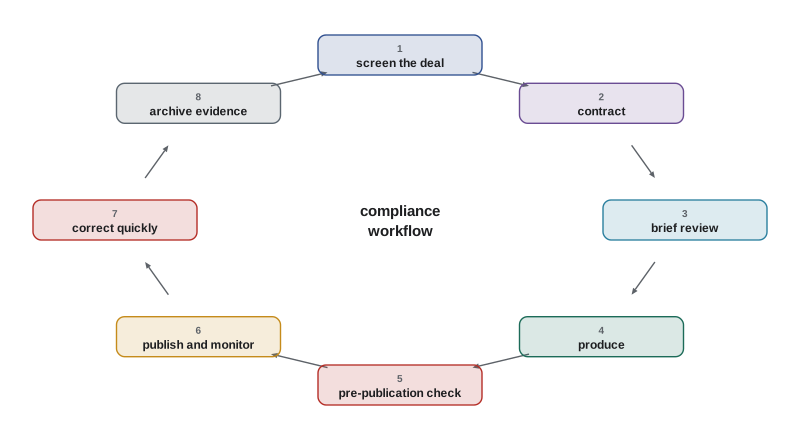
Knowing the rules is not the same as following them consistently. Most compliance failures in creator businesses are not deliberate: a disclosure forgotten on one story frame, a script line nobody checked, a giveaway posted without rules, an old affiliate link with no disclosure. The cure is a workflow, a repeatable set of steps that catches problems before content goes live and fixes them quickly when something slips through. This final lesson builds that workflow step by step, from accepting a deal to archiving the evidence, then shows how to audit a creator's content and finishes with a capstone audit that draws on the whole course.
Why a workflow beats good intentions
Creators work fast, often alone and across several platforms, with brands that have their own deadlines. Under that pressure, memory fails. A written workflow turns the rules into checklists that take minutes to apply. It also shows brands that the creator is professional and low-risk, which matters in a market where brands increasingly vet creators for compliance, and it provides evidence of good faith if a regulator, platform or brand ever questions a post.
Step 1: Screen the deal
Before agreeing to anything, screen the brand and the product.
- Is the product legal to sell and advertise where the audience lives, and does the platform allow branded content for it?
- Is it a regulated category, such as health, alcohol, cannabis, gambling or finance, with extra rules (lesson 7)?
- Does the audience include many children or vulnerable people for whom the product is unsuitable (lesson 8)?
- What claims will the brand want made, and can it substantiate them (lesson 6)?
- Does the deal fit your written standards (lesson 11)?
Step 2: Build compliance into the contract
Contracts are where responsibilities are set. CRE-310 covered contract essentials and CRE-330 covers contracts in depth; from a compliance point of view, look for these provisions.
- Disclosure: a clause requiring clear disclosure in line with the law and platform rules, and a statement that the creator may add disclosures beyond any brand minimum.
- Claims: a list of approved claims, a statement that the brand holds substantiation for them and an obligation on the brand to tell the creator if a claim is withdrawn.
- Approvals: a process for reviewing content that does not allow the brand to remove disclosures or insert unsupported claims.
- Indemnity: ideally, the brand indemnifies the creator for claims arising from the brand's information, and the creator for their own statements.
- Data: rules on any audience data collected, such as giveaway entries, and who is responsible for privacy compliance.
- Takedown and correction: how quickly content must be corrected or removed if a problem is found.
Step 3: Review the brief and script
When the brief arrives, read it for compliance as well as creativity. Mark every objective claim and check it against the approved claims list. Change any line that is not true for you. Flag requests that conflict with the rules, such as "don't make it look like an ad," "put #ad at the end," or "say you've used it for a year." A good brand will welcome the corrections; a brand that resists is a risk.
Step 4: Produce with disclosure built in
Build disclosure into the content itself rather than adding it at the end: a spoken line and on-screen label in the first seconds of video, a disclosure on each story frame and a clear first line in the caption. Avoid edits that exaggerate the product's effect, label AI use where required and avoid making claims in improvised segments that are not on the approved list.
Step 5: Pre-publication check
Just before publishing, run a short checklist on a phone, as the audience will see it.
| Check | Question | Pass when |
|---|---|---|
| Disclosure presence | Does every endorsement carry a disclosure? | Yes, including stories and reposts |
| Disclosure quality | Is it clear, up front and in the right medium? | Spoken and on screen for video; first line for captions |
| Platform tool | Is the branded-content tool on and the brand tagged? | Label visible on mobile |
| Claims | Is every objective claim approved and supported? | Matches the approved list |
| Personal experience | Is every first-person statement true? | Yes |
| Audience | Is the content suitable for the audience's age? | No adult products to minors |
| Promotions | Do giveaways have rules and required statements? | Rules linked and statements present |
| AI and edits | Are edits honest and AI labelled where needed? | No exaggeration; labels applied |
Step 6: Publish and monitor
After publishing, check the live post on mobile and desktop to confirm the disclosure and platform label appear as intended. Monitor comments for questions about the relationship or claims, answer honestly, and watch for signs that a claim is causing confusion. If the brand reposts or runs your content as a partnership ad, check that the disclosure remains visible in the ad version.
Step 7: Correct quickly
Mistakes happen. When one is found, act within hours rather than days.
- Fix the post if the platform allows editing, for example adding a disclosure to the caption.
- If the problem is in the video itself, such as a missing spoken disclosure or a misleading claim, remove and re-upload a corrected version.
- Tell the brand what happened and what you did.
- If the mistake was significant, tell your audience plainly.
- Record what happened and update your checklist so it does not recur.
Step 8: Archive evidence
Keep a simple record for each sponsored post: the contract, the brief, the approved claims, the substantiation the brand provided, the final content, screenshots of the live post showing the disclosure on mobile and the date you checked platform policies. Keep these records for several years; limitation periods for lawsuits and regulatory investigations can be long, and the evidence protects you as much as the brand.
Auditing existing content
An audit applies the same standards to content already published. Creators should audit their own feeds at least once a year, and before signing with a major brand, which may audit them anyway. A practical audit has four parts.
- Inventory: list all posts in the audit period that mention a brand or product, including stories saved to highlights, old affiliate links and link-in-bio pages.
- Classify: for each, identify any material connection: paid, gifted, affiliate, ambassador, own product or none.
- Assess: score each post needing disclosure against the disclosure rubric from lesson 3, and check claims, audience suitability and AI use.
- Remediate: fix or remove non-compliant posts, starting with the most serious.
Worked problem
Calculating a compliance rate and priority
A creator audits 60 posts from the last six months. Twenty-two mention brands. Of these, 4 have no connection, 8 are paid with good disclosure, 3 are paid with disclosure only at the end of the caption, 5 are gifted with no disclosure and 2 contain affiliate links with disclosure only in the bio. One gifted post is for a supplement and says it "cured my migraines." What is the compliance rate and what should be fixed first?
Show solution
- Posts needing disclosure: 22 − 4 = 18.
- Compliant: 8.
- Compliance rate: 8 ÷ 18 ≈ 44 %.
- Priority 1: the supplement post, which combines a missing disclosure with a disease claim; remove it.
- Priority 2: the 5 gifted posts and 2 affiliate posts with no disclosure on the post; add disclosures. Priority 3: move the 3 end-of-caption disclosures to the start.
Answer: About 44 % compliant. Remove the supplement post first, then add disclosures to the seven undisclosed posts, then improve the three weak ones.
A weighted audit score
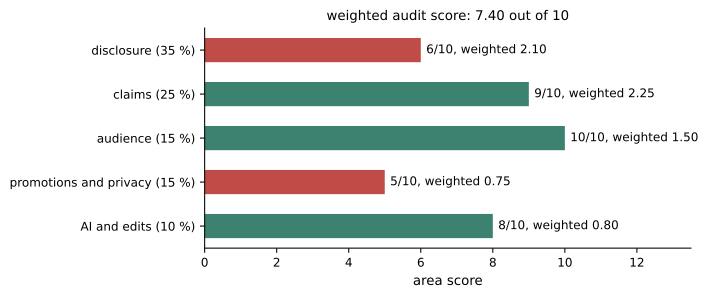
For larger audits, or when comparing creators, a weighted score gives a single figure that reflects the seriousness of different problems. One approach weights five areas: disclosure (35 %), claims (25 %), audience suitability (15 %), promotions and privacy (15 %) and AI and edits (10 %). Score each area from 0 to 10 based on the share of posts that pass, then calculate the weighted total.
Worked problem
Computing a weighted audit score
A creator's audit gives area scores of disclosure 6, claims 9, audience 10, promotions and privacy 5, and AI and edits 8. What is the weighted audit score out of 10, and which area should improve first?
Show solution
- Disclosure: 0.35 × 6 = 2.10.
- Claims: 0.25 × 9 = 2.25.
- Audience: 0.15 × 10 = 1.50.
- Promotions and privacy: 0.15 × 5 = 0.75.
- AI and edits: 0.10 × 8 = 0.80. Total: 2.10 + 2.25 + 1.50 + 0.75 + 0.80 = 7.40.
Answer: The audit score is 7.4 out of 10. Disclosure carries the most weight and scores low, so it should improve first, followed by promotions and privacy.
Working with brands on compliance
Compliance works best as a partnership. Share your standards with brands at the start, ask for their influencer policy and approved claims and welcome their monitoring. When a brand asks for something non-compliant, explain the rule briefly and offer a compliant alternative: instead of hiding the disclosure, suggest a natural spoken line; instead of an unsupported claim, suggest a first-person statement of real experience. Most brands want to comply and appreciate creators who make it easy.
In Canada, brands often follow Ad Standards' guidelines and may ask creators to use particular disclosure tags. Creators can refer brands to the Competition Bureau's guidance and Ad Standards' guidelines when explaining why disclosure must be clear, and Ad Standards offers resources for both creators and brands.
Capstone: auditing a creator's campaign
The capstone brings together the whole course. Use it as a template for your own audits.
Worked problem
Capstone audit
A wellness creator with 180,000 followers, about 15 % aged 13 to 17, ran a month-long campaign for a gummy supplement. Deliverables: (1) a YouTube video, disclosed only in the description, saying the gummies "boost immunity and prevent colds"; (2) three Instagram stories, the first with a paid partnership label and the other two without; (3) a giveaway requiring followers to buy the product and tag friends, with no rules; (4) a newsletter to subscribers who signed up through a pre-ticked box; (5) AI-smoothed before-and-after selfies captioned "glowing skin in 2 weeks." Audit the campaign and recommend fixes.
Show solution
- Disclosure: (1) description-only disclosure for a video fails; add spoken and on-screen disclosure and turn on the paid promotion setting. (2) Stories 2 and 3 lack labels; label every frame.
- Claims: "prevent colds" is a disease claim a supplement cannot make, and "boost immunity" needs authorization or strong substantiation; use only approved claims. "Glowing skin in 2 weeks" needs evidence and the AI smoothing exaggerates results; remove the edited images.
- Audience: 15 % minors is significant for a supplement; check whether the product is suitable for teens and avoid content appealing to them.
- Promotions and privacy: the purchase-required giveaway with no rules risks illegal lottery laws; add free entry, rules and required statements. The pre-ticked box does not give valid consent for marketing emails in Canada and is poor practice everywhere; re-confirm consent.
- AI and edits: AI-smoothed selfies misrepresent results; replace with unedited images or none.
Answer: The campaign fails in every area. Priorities: remove the disease claim and edited images, fix all disclosures, restructure the giveaway, re-confirm email consent and review audience suitability, then update the workflow so each check happens before posting.
Where to go from here
This course has given you a working knowledge of advertising law and ethics for creators. Laws, platform rules and technologies will keep changing, so keep learning: follow the regulator's announcements and guidance, read self-regulatory decisions, check platform policy updates and talk to other creators about what they are seeing. For specific problems, especially in regulated categories or disputes, consult a lawyer. Above all, keep the core idea in mind: audiences trust you because they believe you are honest with them. Every rule in this course exists to protect that trust, which is the most valuable thing a creator has.
Common mistakes
MistakeRelying on memory instead of a written workflow.
InsteadUse checklists at each step.
MistakeAccepting contracts that let brands remove disclosures.
InsteadBuild disclosure and claim controls into contracts.
MistakeChecking posts only on desktop.
InsteadCheck disclosures on mobile as the audience sees them.
MistakeFixing mistakes quietly without recording them.
InsteadCorrect quickly, inform the brand and update the checklist.
MistakeNever auditing old content.
InsteadAudit at least yearly and before major deals.
Summary and key terms
- A written workflow turns rules into quick, repeatable checks.
- Screen deals and build compliance into contracts before production.
- Review briefs for claims and build disclosure into the content itself.
- Run a pre-publication checklist on mobile, then monitor and correct quickly.
- Archive contracts, claims, substantiation and screenshots for each post.
- Audit content regularly using compliance rates and weighted scores.
- Honest practice protects audience trust, a creator's most valuable asset.
- Compliance workflow
- A repeatable set of steps to follow the rules.
- Approved claims list
- Claims a brand has substantiated and authorized.
- Indemnity
- A promise to cover another party's losses from certain claims.
- Pre-publication check
- A final review of content before posting.
- Remediation
- Fixing or removing non-compliant content.
- Audit
- A systematic review of published content against standards.
- Compliance rate
- The share of posts needing disclosure that comply.
- Weighted audit score
- A score combining areas by their importance.
- Evidence archive
- Records kept to show what was posted and why.
- Takedown clause
- A contract term on correcting or removing content.
Practice problems
Work each problem on paper first, then reveal the answer to check.
Name the eight steps of the workflow.
Show answer
Screen, contract, brief review, produce, pre-publication check, publish and monitor, correct, archive.
What should a contract say about disclosure?
Show answer
It must comply with law and platform rules, and the creator may add more.
How should a creator respond to "put #ad at the end"?
Show answer
Explain the rule and offer a compliant alternative.
Why check posts on mobile?
Show answer
Most viewers see them on phones, where truncation differs.
What should an evidence archive contain?
Show answer
Contract, brief, claims, substantiation, content and screenshots.
Compliance rate for 12 compliant of 20 posts needing disclosure?
Show answer
60 %.
Weighted score with D 8, C 8, A 10, P 6, E 10?
Show answer
2.8 + 2.0 + 1.5 + 0.9 + 1.0 = 8.2.
What are the four parts of an audit?
Show answer
Inventory, classify, assess, remediate.
How often should creators audit their content?
Show answer
At least yearly and before major deals.
What is the first step when a mistake is found?
Show answer
Fix or remove the content quickly.
Lesson quiz · 5 questions
Score 60% or more to complete this lesson.
Create a free account to save your progress, take quizzes and earn a certificate.