
CRE-310 · Lesson 9 of 12 · 27 min
Contract essentials: usage, whitelisting, exclusivity and payment
Every brand deal should be documented in writing. A written agreement records what each side has promised, prevents misunderstandings and gives you something to rely on if a problem arises. Brand agreements range from a short email exchange confirming terms to a long contract drafted by the brand's lawyers. This lesson gives an overview of the clauses that matter most in creator partnerships, explains what to look for in each and highlights common traps.
Why written agreements matter
Verbal agreements and informal messages can be legally binding, but they are hard to prove and often leave key points unstated. Disputes in creator partnerships usually arise from ambiguity: the brand thought it had usage rights for a year; the creator thought it was 30 days. The brand expected three revisions; the creator expected one. The brand believed it could pay 90 days after invoice; the creator expected payment on delivery. A clear written agreement prevents most of these disputes.
In Canada, contract law is mainly provincial. The common law applies in every province and territory except Quebec, where the Civil Code of Québec governs contracts. Quebec's Charter of the French Language may also affect contracts and advertising content aimed at Quebec consumers. Agreements usually name the province whose law applies.
Common document types include a master services agreement (MSA), which sets general terms for a relationship, with individual statements of work (SOWs) or insertion orders for each campaign; a single campaign agreement covering everything; or a brand's standard influencer terms accepted through a marketplace. Whatever the format, check that the specific campaign details are written down somewhere binding.
Parties, scope and deliverables
The agreement should identify the parties correctly, including your business name if you operate through a company. The scope section should list each deliverable precisely: platform, format, length, number of pieces, posting dates or windows, and how long content must stay live. Vague descriptions such as "social content" invite disputes. Compare the deliverables in the contract with what you negotiated and the brief; contracts are often drafted from templates that include items never discussed.
Worked problem
Checking a contract against the agreed deal
A creator agreed by email to one dedicated YouTube video and two Instagram Reels for $4,500 with 30 days of paid usage. The contract lists one YouTube video, two Reels, four Instagram stories and "perpetual usage in all media". What should the creator do?
Show solution
- Identify differences: four extra stories and perpetual usage in all media instead of 30 days paid usage.
- Request corrections in writing, referring to the agreed email.
- If the brand wants the extra items, quote for them separately using the rate card, such as a story set fee and a buyout premium.
Answer: Do not sign until the contract matches the agreed scope, or the additional stories and rights are priced and agreed.
Fees and payment
The payment clause should state the total fee, the currency, whether it includes or excludes sales tax, the payment schedule (for example 50 % on signing and 50 % within 30 days of posting), the invoicing process and what happens if payment is late. Watch for clauses that make payment depend on vague conditions, such as "satisfactory performance", or that allow the brand to withhold payment for minor issues. Payment should depend on delivering the agreed content, not on results you cannot control, unless the deal is explicitly performance-based.
Late payment is one of the most common problems creators face. A contract can include interest on late payments and a right to remove content or suspend usage if payment is not made. Keep records of invoices and reminders. For large brands, confirm early what information their accounts payable department needs, such as tax forms, supplier registration and banking details, because missing paperwork often delays payment.
Content ownership and licences
Who owns the content? In most creator deals, the creator owns the copyright in the content they make and grants the brand a licence to use it in defined ways. A licence is permission to use; it can be limited by duration, media, territory and purpose. Some brand contracts instead say that the content is a "work made for hire" or that copyright is assigned to the brand, meaning the brand owns it outright. Assignment or work-for-hire terms transfer far more value and should command a much higher fee, if you accept them at all.
Check also whether the brand can edit your content, combine it with other material, or use your name, likeness and voice separately from the content. Rights to use your name and likeness are particularly valuable and sensitive, because they allow the brand to associate you with its products in new ways. Limit them to the campaign and the agreed term.
Recent contracts may mention artificial intelligence. Some brands seek rights to use creator content to train AI models or to create synthetic versions of the creator's voice or appearance. These rights could affect your future work and identity, and should be excluded unless you specifically agree and are paid for them.
Usage rights in detail
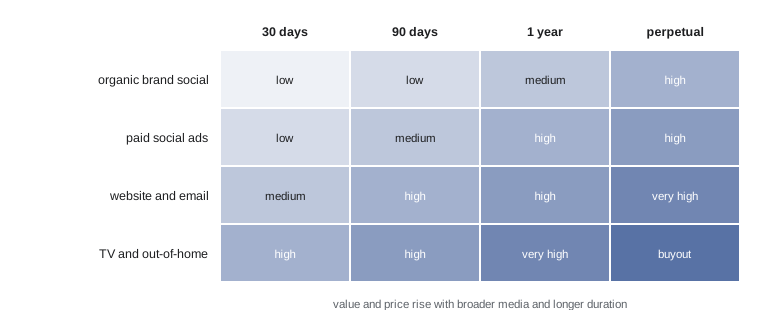
Usage rights, introduced in Lesson 5, are the heart of many contracts. A clear usage clause specifies:
- Media: organic brand social accounts, paid social ads, website, email, digital display, television, in-store, print or out-of-home.
- Duration: a start date and an end date, commonly 30, 60 or 90 days, or a year.
- Territory: the countries where the content may be used.
- Paid versus organic: whether the brand may spend money promoting the content.
- Edits: whether the brand may cut, re-edit or add text to the content.
- What happens at the end: the brand should stop running ads and, often, remove content from paid placements, although organic posts may remain in its archive.
Whitelisting and account access
Whitelisting or partnership ad clauses should state which posts can be boosted, the duration, whether new ads can be created from your content, whether you will approve each ad, how targeting will be handled and whether comments on ads will be moderated. Access should be granted through official platform tools, such as TikTok Spark Ads authorization codes or Meta's partnership ad permissions, not by sharing passwords. The clause should also say when and how access ends. Ads run through your identity can attract negative comments, so agree who moderates them.
Exclusivity and non-compete clauses
Exclusivity clauses restrict working with competitors. Read them very carefully, because broad wording can prevent you from earning in an entire category for months. Check the definition of competitor (a named list is best), the product category (narrow is better), the duration (ideally limited to a short period around the campaign), the platforms covered and whether existing partnerships are excluded. Price exclusivity separately, as in Lesson 5.
| Clause | What to look for | Common trap |
|---|---|---|
| Deliverables | Exact platforms, formats, numbers and dates | Template items never discussed |
| Payment | Amount, currency, tax, schedule, late interest | Payment tied to vague "satisfaction" |
| Ownership | Licence rather than assignment | Work made for hire at a licence price |
| Usage | Media, duration, territory, paid or organic | Perpetual use in all media |
| Whitelisting | Posts, duration, approval, access method | Unlimited ad creation from your content |
| Exclusivity | Named competitors, narrow category, short term | Whole-industry bans for months |
| Morals clause | Mutual, specific triggers, fair process | One-sided and vague |
| Termination | Payment for work done, kill fee | Brand can cancel without paying |
Morals clauses
A morals clause, or morality clause, allows a party to end the agreement if the other party behaves in a way that damages its reputation. Brands use them to protect themselves if a creator becomes involved in a scandal. These clauses are reasonable in principle, but they are often vague and one-sided. Look for clear, specific triggers, a fair process, and mutuality, so that you can also end the partnership if the brand becomes involved in conduct that would embarrass you. Consider what happens to payment for work already done if the clause is used.
Termination and cancellation
Campaigns are sometimes cancelled. The agreement should say what happens if the brand cancels: ideally, you are paid for work already done and a kill fee, a percentage of the total fee, if cancellation comes late. It should also allow you to end the agreement if the brand fails to pay or breaches material terms. Check notice periods and what happens to content and usage rights on termination.
Worked problem
Kill fees
A contract for $6,000 says that if the brand cancels after concept approval, the creator receives 50 % of the fee, and if it cancels after filming, 100 %. The brand cancels after the concept is approved but before filming, having already paid a 30 % deposit. How much more is owed?
Show solution
- Kill fee after concept approval: 50 % × $6,000 = $3,000.
- Deposit already paid: 30 % × $6,000 = $1,800.
- Balance owed: $3,000 − $1,800 = $1,200.
Answer: The brand owes a further $1,200.
Confidentiality, warranties and liability
Confidentiality clauses prevent you from sharing campaign details, fees or unreleased product information. Respect them, and note whether they prevent you from mentioning the partnership in your media kit. Warranties are promises: you may be asked to warrant that the content is original, that you have rights to any music or footage used, and that you will comply with disclosure rules. Indemnities require one party to cover the other's losses from certain problems. Be cautious about broad indemnities that make you responsible for the brand's own claims; ideally, the brand should indemnify you for claims arising from information or materials it supplied.
Liability caps limit how much each party can owe if something goes wrong. A reasonable cap for a creator is often the fee received under the agreement.
Disclosure and compliance clauses
Most brand contracts require the creator to disclose the partnership in line with the law and platform rules, and some specify wording. This is appropriate and protects both sides. Check that the brand's required wording is clear, and do not accept instructions to hide or minimize disclosure. Lesson 10 covers disclosure in detail.
Getting advice
For small, straightforward deals, a careful read and a written list of questions may be enough. For larger deals, long exclusivity, buyouts, management agreements or anything you do not fully understand, have a lawyer review the contract. Some industry organizations and creator unions offer template agreements and resources. The cost of a review is usually small compared with the cost of a bad clause.
Reading a contract efficiently
Long contracts can be intimidating. An efficient approach is to read the deliverables, payment, usage, exclusivity, termination and liability clauses first, because these carry most of the commercial risk, then read the rest. Make a list of questions and proposed changes, and send them together in one email rather than in a series of messages. Brands expect creators to ask for changes; standard terms are often negotiable, especially on usage, exclusivity and payment timing.
Keeping signed agreements organized
Store every signed agreement with its brief, approvals and correspondence in one folder per partnership. Note key dates, such as the end of usage and exclusivity periods, in a calendar, so that you know when you can work with competitors again and when the brand must stop using your content.
When the brand will not change its terms
Some brands, particularly large ones, will not change their standard contracts. In that case, decide whether the commercial terms still make the deal worthwhile, and whether any clause creates an unacceptable risk. It is better to decline a deal than to sign a contract you cannot comply with.
Common mistakes
MistakeRelying on verbal agreements.
InsteadDocument every deal in writing.
MistakeSigning a template without checking it against the deal.
InsteadCompare deliverables, rights and payment with what was agreed.
MistakeAccepting assignment or perpetual usage at a licence price.
InsteadLicense limited rights or charge a buyout premium.
MistakeAgreeing to broad, vague exclusivity.
InsteadName competitors, narrow the category and shorten the term.
MistakeIgnoring termination terms.
InsteadSecure payment for work done and a kill fee.
Summary and key terms
- Written agreements prevent most disputes in brand deals.
- Deliverables, payment terms and currency must be precise.
- Creators usually license, rather than assign, content to brands.
- Usage clauses define media, duration, territory and paid use.
- Whitelisting should use official tools with approval and an end date.
- Exclusivity, morals and termination clauses need careful reading.
- Get legal advice for large or complex deals; CRE-330 covers contracts in depth.
- MSA
- A master services agreement setting general terms.
- SOW
- A statement of work for a specific campaign.
- Licence
- Permission to use content in defined ways.
- Assignment
- Transfer of copyright ownership.
- Work made for hire
- A US term under which the commissioning party owns the work.
- Morals clause
- A right to end a deal over reputation-damaging conduct.
- Kill fee
- Payment due if a project is cancelled.
- Indemnity
- A promise to cover another party's losses.
- Warranty
- A contractual promise that something is true.
- Liability cap
- A limit on how much a party can owe.
Practice problems
Work each problem on paper first, then reveal the answer to check.
Why are written agreements important?
Show answer
They record promises and prevent disputes from ambiguity.
What is the difference between a licence and an assignment?
Show answer
A licence permits use; an assignment transfers ownership.
Name four elements of a usage clause.
Show answer
Media, duration, territory, paid or organic, edits.
How should whitelisting access be granted?
Show answer
Through official platform tools, never passwords.
What makes an exclusivity clause fair?
Show answer
Named competitors, narrow category, short term, paid.
What should a morals clause include?
Show answer
Specific triggers, fair process and mutuality.
Kill fee of 40 % on $5,000 with $1,000 deposit paid: balance owed?
Show answer
$1,000.
What is a reasonable liability cap for a creator?
Show answer
Often the fee received.
Why exclude AI training rights by default?
Show answer
They could affect future work and identity.
When should a lawyer review a contract?
Show answer
For large, complex, exclusive or unclear deals.
Lesson quiz · 5 questions
Score 60% or more to complete this lesson.
Create a free account to save your progress, take quizzes and earn a certificate.