
CRE-310 · Lesson 10 of 12 · 27 min
Disclosure in sponsored content
Audiences have a right to know when a creator has been paid or otherwise rewarded to talk about a product. Disclosure is a legal requirement in both Canada and the United States, a platform rule on every major social network and an ethical obligation that protects the trust on which partnerships depend. This lesson explains when disclosure is required, how to disclose clearly on different platforms and formats, how disclosure applies to gifts, affiliate links, events and AI-assisted content, and what brands and creators are each responsible for. CRE-320 covers advertising law and ethics in depth; this lesson focuses on what you need to run brand partnerships properly.
Why disclosure matters
A recommendation from a creator carries weight because the audience believes it reflects the creator's honest opinion. If the audience does not know the creator was paid, they may give the recommendation more weight than it deserves. Disclosure laws aim to prevent this kind of misleading impression. Disclosure does not reduce the value of good partnerships: research and industry experience suggest that audiences generally accept sponsored content from creators they trust, provided it is honest and relevant. What damages trust is hidden sponsorship that is later discovered.
The legal framework
In Canada, the Competition Act prohibits false or misleading representations to the public, including through influencers. The Competition Bureau has published guidance stating that influencers must disclose material connections with brands and that both brands and influencers can be held responsible. Penalties can be substantial for both businesses and individuals. Ad Standards, the national self-regulatory body, administers the Canadian Code of Advertising Standards and publishes the Influencer Marketing Disclosure Guidelines, updated in October 2025, which set out practical expectations for disclosure.
In both countries, the core idea is the same: if there is a material connection between a creator and a brand, meaning any relationship that might affect how the audience weighs the endorsement, it must be disclosed clearly, so that the audience notices and understands it.
What counts as a material connection
A material connection is broader than a cash payment. It includes:
- Payment of any kind, including fees, retainers and commission.
- Free products or services, including gifts sent without any requirement to post.
- Discounts, loans of products, free travel, accommodation or event access.
- Affiliate links or codes that earn commission.
- Employment, family or business relationships with the brand.
- Being part of a brand ambassador program, even without direct payment for a particular post.
- Contests, prizes or early access offered in return for content.
If any of these exist and you mention the brand or product, disclose it. When in doubt, disclose.
What clear disclosure looks like
Regulators in both countries emphasize that disclosure must be clear, prominent and hard to miss. Practical guidance includes:
- Use plain language that ordinary viewers understand: "ad", "sponsored", "paid partnership with [brand]", "I was sent this for free".
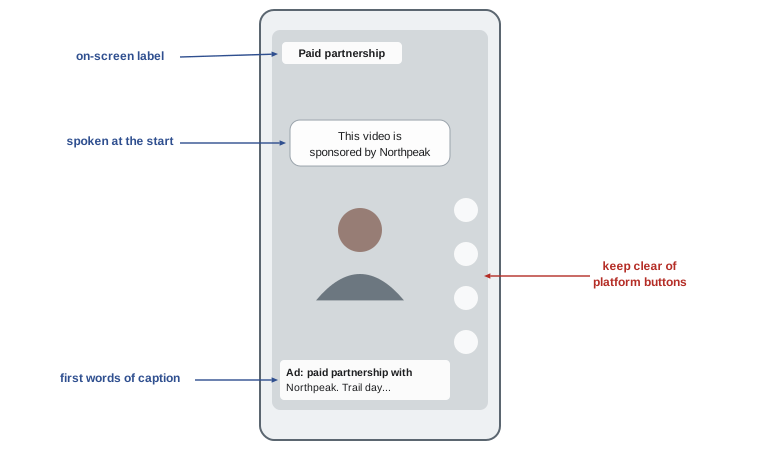
- Place the disclosure where it will be seen without clicking "more" or scrolling: at the start of a caption, on screen and spoken in video.
- Put it close to the endorsement, not hidden among many hashtags or at the end of a long description.
- Repeat it in long content and live streams, so people who join later see it.
- Make it visible on every device and format, and keep it clear of areas covered by platform buttons.
- Match the language of the content: a French-language post should use a French disclosure.
Ad Standards' 2025 guidelines describe #ad on its own as the gold standard hashtag because audiences readily understand it, and recognize #Gifted for free products with no required post and #InvitedGuest for event invitations. Vague hashtags such as #sp, #collab, #thanks or #partner, or the brand's name alone, are generally not considered adequate in either country.
Platform tools
Most platforms offer built-in tools, such as Instagram's and TikTok's paid partnership labels, YouTube's "includes paid promotion" notice, and branded content toggles. These tools help, and platforms often require them for sponsored content. However, regulators in both countries say platform labels may not be enough on their own if they are small, easy to miss or not clearly understood. The safest approach is to use the platform tool and add your own clear disclosure in the content and caption.
Ad Standards' 2025 guidelines say that if a platform's disclosure tool is prominent, clear and effective, additional disclosure may not be required, but recommend adding your own disclosure such as #ad when in doubt.
Disclosure by format
| Format | Where to disclose | Notes |
|---|---|---|
| Feed post or carousel | Start of caption; on the image if possible | Before the "more" cut-off |
| Short video | Spoken at start, on screen and in caption | Many viewers skip captions |
| Long video integration | Spoken and on screen at the start of the segment; description | Platform paid promotion setting too |
| Stories | On every frame that features the product | Viewers may see only one frame |
| Live stream | Spoken and on screen, repeated periodically | People join at different times |
| Podcast | Spoken before or at the start of the ad read | Also in show notes |
| Blog or newsletter | Above or next to the content and links | Not only at the bottom |
Worked problem
Is the disclosure visible?
A caption reads: "Loving my new trail shoes this spring, the grip is amazing on wet rocks and they dried overnight after the river crossing… #hiking #trail #outdoors #spring #nature #adventure #ad". The platform shows about 125 characters before "more". Is the disclosure adequate?
Show solution
- The disclosure appears at the end, after many other hashtags.
- The caption is far longer than 125 characters, so #ad is hidden behind "more".
- Fix: begin the caption with "Ad: paid partnership with [brand]." and add spoken and on-screen disclosure in the video.
Answer: No; the disclosure is hidden and buried among hashtags, so it should be moved to the start and repeated in the content.
Gifts, events and affiliate links
Gifts are a common area of confusion. If a brand sends you a free product and you post about it, disclose that it was a gift, even if you were not required to post and your opinion is genuine. Similarly, disclose free travel, hotel stays and event invitations. Ad Standards suggests #Gifted for free products with no required post and #InvitedGuest for event invitations, while #ad remains appropriate for paid content.
Affiliate links and codes must also be disclosed, because you earn money when people buy. A general statement on your profile is not enough; disclose on each post or page that contains the links, for example "I earn a commission from links in this post". Ad Standards' 2025 guidelines mention hashtags such as #affiliate and #AffiliateLink alongside clear wording.
AI, filters and virtual influencers
Generative AI and editing tools raise new disclosure questions. Ad Standards' 2025 guidelines say that virtual or AI-generated influencers must follow the same disclosure rules as humans, recommend disclosing that an influencer is virtual, and recommend disclosing images of product benefits that were generated or significantly altered with AI, for example with #MadeWithAI. More generally, in both countries, filters and AI must not be used to exaggerate what a product does. Showing a skincare product's results using a skin-smoothing filter, or AI-enhanced "before and after" images, can be misleading even if the sponsorship is disclosed.
Honest opinions and reviews
Disclosure does not make a misleading endorsement acceptable. Endorsements must reflect the creator's honest opinions and experience, and claims must be truthful and supported. A creator should not say they use a product they do not use, describe results they did not get, or claim to be an expert when they are not. Brands must not ask creators to post fake reviews or to delete negative opinions. In the United States, the Consumer Reviews and Testimonials Rule specifically prohibits fake reviews, including AI-generated ones, and knowingly buying or selling fake followers or views for commercial purposes. Canadian law also treats fake reviews and misleading testimonials as deceptive marketing.
Responsibilities of brands and agencies
Brands and agencies share responsibility for disclosure. Regulators expect them to tell creators to disclose, provide guidance, monitor posts and act when disclosures are missing. Good brands include disclosure requirements in contracts and briefs and check content before and after posting. A creator should never accept instructions to hide or weaken disclosure; if a brand asks, it is a red flag about the brand's practices.
Worked problem
Auditing a creator's month
In one month a creator posted 24 times: 3 paid posts with clear disclosure, 2 posts showing gifted products with no disclosure, 4 posts with affiliate links where the disclosure was only in the profile bio, and 15 organic posts with no brand connection. How many posts needed disclosure, and how many were compliant?
Show solution
- Posts needing disclosure: 3 paid + 2 gifted + 4 affiliate = 9.
- Compliant: only the 3 paid posts; the gifted posts lacked disclosure and the affiliate disclosure was not on the posts themselves.
- Compliance rate: 3 ÷ 9 ≈ 33 %; the creator should fix the six posts and change habits.
Answer: Nine posts needed disclosure, but only three were compliant, about 33 %.
Children and young audiences
Creators whose audiences include many children need to take extra care. Disclosures should be especially clear and expressed in words children understand, and some advertising to children is restricted or prohibited.
In Canada, Quebec's Consumer Protection Act prohibits most commercial advertising directed at children under 13, and Ad Standards' 2025 guidelines call for attention-grabbing, age-appropriate disclosures for child audiences.
Disclosure in practice: examples
Clear disclosures use plain wording at the start. Examples include: "Ad: I partnered with [brand] on this video." "Sponsored by [brand]. All opinions are my own." "[Brand] sent me this for free; I wasn't paid to post." "I earn a commission if you buy through my links." In video, a sentence such as "This video is sponsored by [brand]" at the start of the segment, together with on-screen text, makes the relationship clear. For French-language content, use a clear French disclosure such as "Publicité" or "Partenariat rémunéré avec [marque]".
Disclosure and long-term partnerships
In ambassadorships and long-term relationships, every post that features the brand needs disclosure, not just the first one. Audiences may see only one post, and a relationship that began with a paid deal continues to be a material connection while it lasts. Similarly, if you keep mentioning a brand after a paid campaign ends while still receiving free products or commission, the connection should still be disclosed.
Keeping records of compliance
Keep screenshots of disclosures on each sponsored post, the platform label settings and any written instructions from the brand. If a regulator, platform or brand raises a question later, these records show that you disclosed properly. Many brands now ask for screenshots as part of their own compliance monitoring.
When something goes wrong
If you discover that a sponsored post was not properly disclosed, fix it as soon as possible: edit the caption, add on-screen text if the platform allows, or repost with correct disclosure, and tell the brand. If a regulator or platform contacts you about disclosure, respond promptly and honestly, and seek advice if the matter is serious. Correcting errors quickly is far better than leaving misleading content online. Learning from mistakes also matters: review your workflow so that disclosure is part of every pre-posting checklist and cannot be forgotten.
Disclosure across borders
Creators with audiences in both countries should meet the stricter expectations of each. In practice, the core requirements are very similar: disclose material connections clearly, early and in plain language. Using clear wording such as "ad" or "paid partnership", placing it at the start and repeating it in video satisfies the main guidance in both countries. Brands from other countries may have different habits; follow the rules that apply where your audience is.
Common mistakes
MistakeNot disclosing gifted products because the post was optional.
InsteadDisclose any free product you mention.
MistakeHiding #ad at the end of a long caption.
InsteadPut disclosure at the start and in the content.
MistakeRelying only on a platform label.
InsteadUse the label and add your own clear disclosure.
MistakePutting affiliate disclosure only in the bio.
InsteadDisclose on every post containing the links.
MistakeUsing filters to exaggerate product results.
InsteadShow real results and disclose AI-altered images.
Summary and key terms
- Disclosure is required by law in both countries and by platform rules.
- Material connections include payment, gifts, travel, affiliate links and relationships.
- Disclosures must be clear, prominent, early and in the content's language.
- #ad is widely understood; vague tags are not adequate.
- Platform labels help but should be combined with your own disclosure.
- AI and filters must not exaggerate results; endorsements must be honest.
- Brands share responsibility; CRE-320 covers the law in depth.
- Disclosure
- Telling the audience about a material connection.
- Material connection
- A relationship that could affect how an endorsement is weighed.
- Endorsement
- A message that audiences may see as reflecting the creator's opinion.
- Paid partnership label
- A platform tool marking sponsored content.
- Clear and conspicuous
- Easily noticed and understood.
- #ad
- A widely understood disclosure hashtag.
- #Gifted
- A tag for free products with no required post.
- Affiliate disclosure
- A statement that the creator earns commission from links.
- Virtual influencer
- A computer-generated persona used as an influencer.
- Fake indicator of influence
- Purchased followers, views or engagement.
Practice problems
Work each problem on paper first, then reveal the answer to check.
Name four types of material connection.
Show answer
Payment, gifts, travel, affiliate links, employment, ambassador programs.
Where should a disclosure go in a caption?
Show answer
At the start, before the "more" cut-off.
Is #sp an adequate disclosure?
Show answer
No, it is not clearly understood.
Why disclose on every story frame?
Show answer
Viewers may see only one frame.
Is a platform paid partnership label alone always enough?
Show answer
Not necessarily; add your own disclosure.
Must you disclose an unrequested gift you chose to post about?
Show answer
Yes.
Where must affiliate disclosure appear?
Show answer
On each post or page with the links.
What does the US reviews rule prohibit?
Show answer
Fake reviews and buying or selling fake influence indicators.
Compliance rate for 4 compliant of 10 posts needing disclosure?
Show answer
40 %.
Who is responsible for disclosure?
Show answer
Both creators and brands, with agencies.
Lesson quiz · 5 questions
Score 60% or more to complete this lesson.
Create a free account to save your progress, take quizzes and earn a certificate.