
CRE-240 · Lesson 11 of 12 · 25 min
Hosting, RSS, distribution, growth and analytics
A finished episode reaches listeners through hosting, RSS feeds and directories, and a show grows through deliberate promotion, collaboration and consistency. Podcast measurement has its own definitions and limits, quite different from video platforms. This lesson covers podcast hosting services, how RSS feeds work and the tags that matter, submitting to directories, publishing episodes with titles, descriptions, chapters and transcripts, dynamic ad insertion, podcast measurement and the IAB guidelines, the analytics different platforms provide, growth strategies that work for podcasts, and managing a back catalogue.
Podcast hosting
A podcast host stores episode files, generates and updates the RSS feed, delivers files to listeners' apps, provides statistics, and often offers tools for distribution, websites, transcripts, monetization and dynamic advertising. Hosting is separate from directories: Apple Podcasts and Spotify display shows and play episodes, but most independent shows are hosted elsewhere. When choosing a host, consider reliability, statistics certified against industry guidelines, pricing and storage limits, support for video, chapters and transcripts, dynamic ad insertion and monetization options, private or subscriber feeds, and how easy it is to move the show elsewhere. Owning the RSS feed is important: a host should allow you to redirect the feed if you change providers, so that subscribers follow automatically, using a 301 redirect and an updated feed tag.
The RSS feed
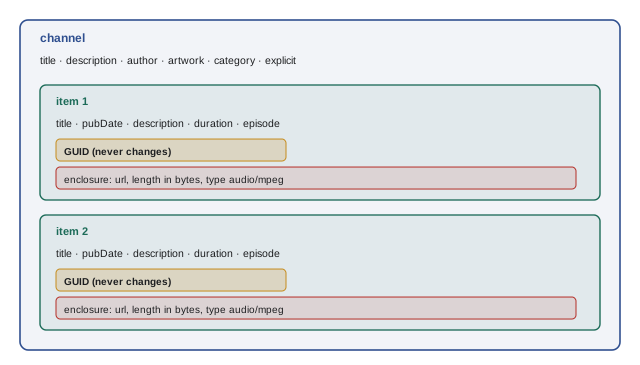
The RSS feed is an XML document following the RSS 2.0 standard with additional tags defined by Apple for podcasts and, increasingly, tags from the open Podcasting 2.0 namespace. Show-level tags include the title, description, author, owner email, artwork, language, categories and explicit content flag; episode-level tags include title, description, publication date, duration, episode number, season, episode type (full, trailer or bonus), the enclosure with the media file's URL, size and type, and a unique identifier (GUID) that must never change once published, or apps will treat the episode as new. Podcasting 2.0 tags add features such as chapters, transcripts, funding links, people credits, soundbites and value-for-value payments, supported by a growing number of apps. Most creators never edit XML by hand, because hosts generate it, but understanding the main tags helps diagnose problems.
Submitting to directories
Once a feed exists, submit it to major directories: Apple Podcasts through Apple Podcasts Connect, Spotify through Spotify for Creators or the host's integration, YouTube through its podcast tools, Amazon Music and Audible, iHeartRadio, and the open Podcast Index, which feeds many independent apps. Many hosts automate submission. Apple and others review shows before listing them, checking artwork, metadata and content. A short trailer episode published before launch lets the show be approved and listed in time for the first full episodes, and gives early subscribers something to hear.
Publishing episodes
Each episode's metadata affects discovery and listener experience. Titles should be clear and specific, with the most important words first, since apps truncate titles; include the guest's name and the topic rather than only an episode number. Descriptions should summarize the episode in the first lines, list key topics and guests, and include links and credits; avoid long promotional text at the top. Chapters with titles and timestamps help listeners navigate and are supported by many apps. Transcripts improve accessibility and search, and apps such as Apple Podcasts generate automatic transcripts for many shows at the time of writing, while creators can also supply their own. Publish on a consistent day and time, and use scheduled publishing to maintain the schedule even when travelling.
| Element | Weak example | Stronger example |
|---|---|---|
| Title | Episode 47 | Why winter tires save lives, with road safety researcher Dr. Maya Chen |
| First line of description | Welcome back to the show! Don't forget to subscribe… | Dr. Maya Chen explains what tire tests show about stopping distances on ice. |
| Chapters | None | 00:00 Intro · 03:10 The ice tests · 18:40 All-season vs winter · 31:05 Listener questions |
Dynamic ad insertion
Traditionally, advertisements were edited into episode files permanently, called baked-in ads. Dynamic ad insertion (DAI) lets the host insert advertisements into marked positions, such as pre-roll, midroll and post-roll, at the moment each listener downloads the episode, targeted by location, date or campaign. DAI allows old episodes to carry current ads, campaigns to be replaced or ended, and ads to differ by country, so a Canadian listener and an American listener can hear different sponsors. Host-read ads can also be inserted dynamically. The trade-off is that dynamically inserted ads can feel less integrated than baked-in host reads, and back catalogue advertising requires care to avoid outdated or mismatched messages.
Podcast measurement
Podcast measurement is based mainly on downloads recorded by the hosting server, because many apps do not report what listeners actually play. The IAB Tech Lab's Podcast Measurement Technical Guidelines, followed by certified hosts, define how to count downloads consistently: filtering out bots and duplicate requests, identifying unique downloads by combinations such as IP address and user agent within a defined window, typically 24 hours, and counting a download only when enough of the file has been delivered to represent about one minute of content. At the time of writing, version 2.3, finalized in September 2026, extends these rules to video delivered through open feeds, including HLS. Downloads are not listens: a download may never be played, and automatic downloads by apps inflate counts, while streams counted by platforms may measure different things. Compare figures only within the same host and definition.
Worked problem
Estimating an episode's audience
A show's host reports 4,800 downloads for an episode after 30 days. Platform dashboards suggest that about 70 % of downloads are played and that listeners hear about 65 % of the episode on average. How many people played it, and how many full-episode equivalents were heard?
Show solution
- Estimated plays: 4,800 × 0.70 = 3,360.
- Full-episode equivalents: 3,360 × 0.65 ≈ 2,184.
- Report downloads using the host's certified figure, and describe plays and consumption as estimates from platform data.
Answer: About 3,360 plays and about 2,200 full-episode equivalents, reported as estimates alongside the certified download count.
Platform analytics
Beyond host downloads, platforms provide their own analytics. Apple Podcasts Connect shows followers, listeners, plays, average consumption and where listeners drop off in each episode for Apple listeners. Spotify's creator tools show starts, streams, followers, demographics, retention and video metrics. YouTube Studio shows views, watch time, retention curves, traffic sources and audience data for video episodes (CRE-202). Each platform measures only its own audience, so totals cannot simply be added, and definitions differ. The most useful analytics for improving a show are consumption and retention: where listeners stop, which episodes are finished, which topics bring new followers. Surveys, listener emails and reviews add qualitative understanding that numbers cannot.
Growing a podcast
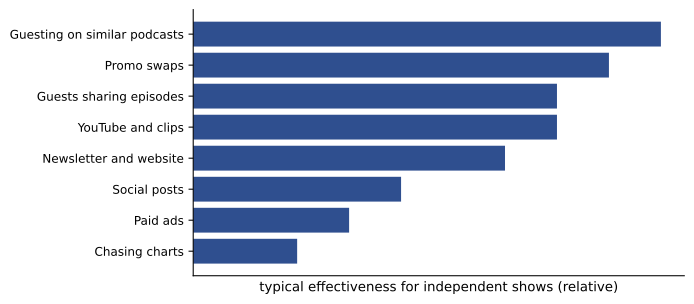
Podcast discovery is notoriously difficult: app charts favour already popular shows, and there is no algorithmic feed in most podcast apps comparable to short-form video platforms. Strategies that consistently work include:
- Guesting on other podcasts in the same niche, the most effective growth method for many shows, because listeners of similar shows are already podcast listeners.
- Episode swaps and promo trades: playing a short trailer for another show in exchange for a mention on theirs.
- Guests sharing episodes with their own audiences; make it easy with clips, quotes and images.
- YouTube and short-form clips (Lesson 10), which bring discovery that podcast apps lack.
- Owned channels: email newsletters, websites with show notes and transcripts that rank in search, and communities.
- Word of mouth: asking listeners to share a specific episode with one person who would enjoy it.
- Consistency and quality over time, which build trust and back catalogue value.
Paid advertising in other podcasts and in podcast apps can work for funded shows but is expensive relative to organic methods for most independents. Ratings and reviews help credibility and may influence charts, but the effect on discovery is often overstated.
The back catalogue
Podcast episodes keep attracting listeners long after release, especially evergreen episodes. New subscribers often binge earlier episodes, and search can bring listeners to old episodes for years. Managing the back catalogue includes keeping episode titles and descriptions accurate and searchable; organizing episodes into seasons or playlists; creating "start here" playlists or episodes for new listeners; updating or annotating episodes with outdated information; removing or re-editing episodes that no longer meet the show's standards, with care, since removing episodes can confuse listeners; and using dynamic ad insertion to monetize older episodes. Keep archived master files of every episode so that re-releases and re-edits are possible.
Private and premium feeds
Hosts can create private RSS feeds, unique to each subscriber, for paid memberships, internal company podcasts or courses. Each listener receives a personal feed address that can be revoked if their subscription ends. Private feeds work in most podcast apps, giving subscribers the same listening experience as public shows. Some platforms, such as Apple Podcasts subscriptions, offer premium content inside their apps instead. Private feeds should not be shared publicly, and hosts may monitor for misuse. For internal company podcasts, check that the hosting service meets the organization's security and privacy requirements.
Show websites and search
A website for the show, with an episode page for each episode, extends discovery beyond podcast apps. Episode pages with full show notes, transcripts, links and embedded players can rank in web search for the topics discussed, bringing listeners who were searching for information rather than podcasts. A website also gives the show a permanent home independent of any platform, a place for an email signup, and a professional presence for guests and sponsors. Many hosts provide simple website builders; custom sites offer more control.
Email newsletters
An email list is one of the most valuable assets a podcaster can build, because it reaches listeners directly without depending on platform algorithms or app features. Newsletters can announce new episodes, share extra material, gather questions for listener segments and promote events or memberships. Offering a useful incentive, such as a resource list related to the show, encourages signups. Follow anti-spam laws when collecting and using email addresses: CASL in Canada and the CAN-SPAM Act in the United States both require consent or appropriate opt-out mechanisms, sender identification and honest subject lines.
Charts, ratings and reviews
Podcast charts in Apple Podcasts, Spotify and other apps are based on algorithms that weigh factors such as recent new followers and listening, and they are dominated by established shows. A new show may briefly appear in category charts after a strong launch, which can bring some new listeners, but chasing charts is rarely a sustainable strategy. Ratings and reviews help new listeners judge a show and provide feedback. Asking listeners to rate and review is reasonable, but buying reviews or ratings, or trading them artificially, breaches platform rules and, in many cases, consumer protection law.
Reporting statistics honestly
When reporting audience figures to sponsors, guests or the public, use certified host statistics with a clear definition, such as average downloads per episode within 30 days of release, and avoid inflating figures with lifetime totals or combining incompatible numbers. Explain what the figures include and exclude, such as YouTube views reported separately. Honest reporting builds long-term trust with sponsors, who increasingly compare figures from multiple sources (CRE-202).
Moving hosts and feed redirects
To move a show to a new host, set up the show on the new host by importing the existing feed, which copies episodes and metadata while keeping GUIDs. Then set a permanent 301 redirect on the old feed and add the new-feed tag supported by Apple, so that apps update subscriptions automatically. Keep the old hosting account active for a few weeks to make sure the redirect works, and check that directories show the new feed. Done correctly, listeners notice nothing. Done badly, a show can lose subscribers or create duplicate listings, which is why owning your feed and choosing a host that supports redirects matter.
Common mistakes
MistakeChoosing a host that locks in the feed.
InsteadEnsure you can redirect the RSS feed to move hosts.
MistakeChanging episode GUIDs.
InsteadKeep GUIDs permanent once published.
MistakeTitles like "Episode 47".
InsteadUse specific titles with guest and topic first.
MistakeTreating downloads as listens.
InsteadReport certified downloads and estimate plays separately.
MistakeRelying on charts for growth.
InsteadGuest on similar shows, swap promos and use clips.
Summary and key terms
- Hosts store files, generate RSS, deliver episodes and measure downloads.
- RSS feeds carry show and episode tags; GUIDs must never change.
- Submit feeds to Apple, Spotify, YouTube, Amazon and the Podcast Index.
- Clear titles, descriptions, chapters and transcripts help listeners.
- Dynamic ad insertion places targeted ads at download time.
- IAB guidelines standardize downloads; downloads are not listens.
- Grow through guesting, swaps, clips and owned channels, and nurture the back catalogue.
- Podcast host
- Service storing media and publishing the feed.
- RSS 2.0
- XML standard used for podcast feeds.
- GUID
- Permanent unique identifier for an episode.
- Enclosure
- Feed element linking to the media file.
- Podcasting 2.0
- Open namespace adding new feed features.
- Trailer
- Short preview episode.
- Dynamic ad insertion
- Inserting ads into episodes at download time.
- Baked-in ad
- Ad permanently edited into an episode.
- IAB guidelines
- Industry rules for counting podcast downloads.
- Promo swap
- Exchange of promotional mentions between shows.
Practice problems
Work each problem on paper first, then reveal the answer to check.
What does a podcast host do?
Show answer
Stores files, generates RSS, delivers episodes, provides stats.
Why must you be able to redirect the feed?
Show answer
So subscribers follow if you change hosts.
What happens if a GUID changes?
Show answer
Apps treat the episode as new.
Name three directories.
Show answer
Apple Podcasts, Spotify, YouTube, Amazon Music, Podcast Index.
Why publish a trailer before launch?
Show answer
To get approved and listed early.
What is dynamic ad insertion?
Show answer
Ads inserted at download time.
What does the IAB download definition require?
Show answer
Filtered, unique requests delivering about a minute of content.
Plays from 2,000 downloads at 75 % played?
Show answer
1,500.
Most effective growth method for many shows?
Show answer
Guesting on similar podcasts.
Name two back-catalogue tactics.
Show answer
Start-here playlists, updated metadata, DAI, annotations.
Lesson quiz · 5 questions
Score 60% or more to complete this lesson.
Create a free account to save your progress, take quizzes and earn a certificate.