
CRE-240 · Lesson 1 of 12 · 25 min
The podcast landscape
A podcast is a series of audio or video episodes distributed so that listeners can subscribe and receive new episodes automatically. That simple idea has grown into one of the most intimate and loyal forms of media: people listen to podcasts while commuting, cooking, exercising and falling asleep, often for hours each week, and many feel they know the hosts personally. For creators, podcasts offer deep relationships with audiences, conversations with guests who would never appear in a short video, and business models from advertising and sponsorship to memberships and live shows. This course covers podcasting from concept to distribution: formats and planning, recording equipment and spaces, interviewing, solo and co-hosted shows, editing, mixing and loudness, video podcasts, hosting and RSS, growth and analytics, monetization, and the law and ethics of the medium. This first lesson describes the landscape: how podcasting began, how it works technically, who listens, the platforms that matter and the realities of making a show.
A short history of podcasting
Audio on demand existed before podcasting, but the podcast took shape in 2004, when software developers and broadcasters combined RSS feeds, which already delivered blog updates, with enclosures, links to audio files that a program could download automatically. The word "podcast", combining iPod and broadcast, appeared in a Guardian article that year. In 2005, Apple added podcasts to iTunes, giving listeners a directory and a simple subscribe button, and the medium grew steadily among enthusiasts. A second wave began in 2014 with Serial, a serialized investigative show from the team behind This American Life, which attracted millions of listeners and showed that podcasts could be a mainstream storytelling medium. Smartphones with built-in podcast apps, connected cars and smart speakers made listening easier, and in the late 2010s and early 2020s, large investments from companies such as Spotify, SiriusXM and Amazon brought exclusive deals, networks and advertising technology. More recently, video has become central: YouTube reported in 2025 that more than a billion people a month watch podcasts there, and Spotify and Apple have added video features.
| Year | Milestone |
|---|---|
| 2004 | RSS enclosures and the word "podcast" |
| 2005 | Apple adds podcasts to iTunes |
| 2012 | Apple launches a standalone Podcasts app |
| 2014 | Serial reaches a mass audience |
| 2019–2021 | Spotify invests heavily in podcasts and exclusives |
| 2023–2026 | Video podcasts grow on YouTube, Spotify and Apple Podcasts |
How podcasting works
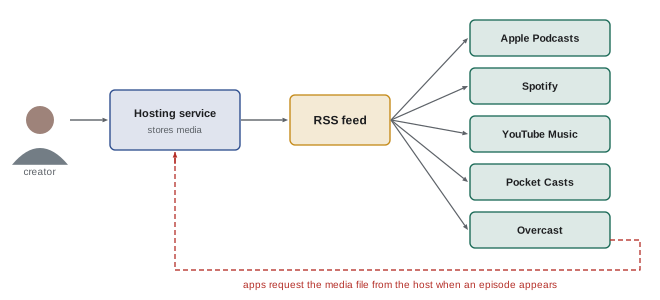
Technically, a podcast is built on an open standard. The creator uploads episodes to a hosting service, which stores the media files and generates an RSS feed: a text file in XML format that lists the show's title, description, artwork and categories, and, for each episode, a title, description, publication date and a link to the media file. Apps such as Apple Podcasts, Spotify, Pocket Casts, Overcast and many others read this feed, display the show and download or stream new episodes when they appear. Because the feed is open, a show can appear in hundreds of apps without the creator signing separate agreements with each, and listeners can move between apps without losing their subscriptions. Some platforms also host shows directly, without an open RSS feed, and some content is exclusive to one platform; these are sometimes called closed or walled-garden podcasts. Lesson 11 covers hosting and feeds in detail.
Who listens and why
Podcast audiences have grown into a large share of the population in Canada and the United States, with surveys in recent years finding that a majority of people aged 12 and older have listened to a podcast and a substantial minority listen every week. Exact figures vary between surveys and change every year, so check current studies, such as those published by Edison Research in the United States and by Canadian research firms and broadcasters, before quoting numbers. Several patterns are consistent across studies:
- Listening is habitual: people subscribe to a handful of shows and listen to them regularly, often finishing most of each episode.
- Listening happens alongside other activities: driving, commuting, housework, exercise and work, which shapes how shows should be structured.
- Audiences are loyal and trusting: listeners often feel a personal connection with hosts, which makes host-read advertising particularly effective.
- Discovery is difficult: most listeners find new shows through word of mouth, recommendations from other podcasts, social media and YouTube, rather than through charts or app browsing.
- Video is now part of podcasting: many people consume podcasts on YouTube or with video on Spotify, watching some parts and only listening to others.
The platforms
Several platforms dominate podcast listening, and their roles differ:
- Apple Podcasts: a major directory and app, especially on iPhones, with ratings, charts, subscriptions and, at the time of writing, expanding support for video using HTTP Live Streaming (HLS).
- Spotify: a large share of listening, combining music and podcasts, with video podcasts, comments, Q&A features and a partner program that pays some video podcasters.
- YouTube: the largest platform for video podcasts and a major discovery engine, with a podcast designation for playlists, RSS ingestion for audio shows in some regions and listening through YouTube Music.
- Other apps: Amazon Music and Audible, iHeartRadio, Pocket Casts, Overcast, Castbox and others, plus regional and public broadcaster apps.
Most independent creators distribute everywhere through one host and an RSS feed, then add a YouTube presence for video and discovery. Platform features change frequently, so check current documentation before relying on any specific feature.
The economics of podcasting
Podcasting is a hit-driven medium: a small number of shows attract very large audiences and most of the advertising revenue, while most shows have modest audiences. Hosting statistics have long shown that a typical episode of an independent podcast receives fewer than a few hundred downloads in its first month, and a show that consistently reaches a few thousand downloads per episode is already in a relatively small group. This does not make small shows worthless: a podcast with 500 engaged listeners in a professional niche can generate consulting work, sponsorship from specialized companies, community and credibility far beyond its download numbers. But it means creators should set realistic goals, measure success in several ways, and plan for a long build. Lesson 11 covers growth and Lesson 12 monetization.
Worked problem
Estimating listening time
A weekly interview show releases 50-minute episodes. It has about 1,200 regular listeners, who finish on average 70 % of each episode. How many hours of listening does the show receive per year?
Show solution
- Listening per episode: 1,200 × 50 min × 0.70 = 42,000 minutes = 700 hours.
- Episodes per year: about 50.
- Annual listening: 700 × 50 = 35,000 hours.
Answer: About 35,000 hours of listening a year, an enormous amount of attention for a show many would call small.
Independent, network and branded shows
Podcasts are made by many kinds of producers. Independent creators make shows alone or with a few collaborators, keeping creative control and revenue but carrying all the work. Podcast networks and studios produce or represent groups of shows, offering production support, cross-promotion and advertising sales in exchange for a share of revenue and sometimes ownership or exclusivity. Public broadcasters such as CBC and NPR produce many shows. Media companies, newspapers and magazines use podcasts to extend their journalism. Branded podcasts are produced for companies, as marketing that aims to be genuinely useful or entertaining rather than a long advertisement. Each model involves different contracts, rights and incentives, which matter when a creator is offered a network deal (Lesson 12).
What makes podcasting different
Podcasting rewards different strengths from other creator formats. Audio is intimate: a voice in someone's ears creates closeness that video and text rarely match. Episodes are long, so depth, personality and conversation matter more than hooks and visual pacing, though openings still matter. Listeners are often doing something else, so clarity, signposting and good sound are essential, and complex visual references do not work. Production can be inexpensive, but the time cost is high: planning, recording, editing and promotion of a weekly hour-long show can easily take 8 to 15 hours. And podcasts compound slowly: back catalogues keep attracting listeners for years, especially for evergreen subjects, and loyal audiences build over many episodes rather than in viral bursts.
Course overview
Lesson 2 covers formats, concepts and positioning a show; Lesson 3, planning a season and structuring episodes; Lessons 4 and 5, equipment, recording spaces and remote recording; Lesson 6, interviewing for audio; Lesson 7, solo, co-hosted and narrative shows; Lessons 8 and 9, editing, mixing, mastering and loudness; Lesson 10, video podcasts; Lesson 11, hosting, RSS, distribution, growth and analytics; and Lesson 12, monetization, law, ethics and the capstone, in which you produce a pilot episode and a launch plan.
Podcasting in Canada and the United States
Podcasting in Canada and the United States shares platforms, formats and advertising markets, but each country has its own ecosystem. Public broadcasters play a large role: CBC and Radio-Canada produce many popular English- and French-language shows in Canada, and NPR and its member stations are among the largest American podcast publishers. French-language podcasting is a distinct and growing market in Quebec and francophone communities, with its own networks, audiences and sponsors. Indigenous podcasters in both countries use the medium to share languages, stories and perspectives, often on their own terms. Many independent creators serve audiences across both countries, and dynamic ad insertion (Lesson 11) allows different advertisements for listeners in each.
Audio as a medium
Audio has qualities that make it distinctive among creator formats. It is a "theatre of the mind": listeners imagine scenes, faces and places from words and sounds, which can make stories more vivid than video. It is portable and hands-free, fitting into parts of the day when screens are impossible. It favours conversation and nuance: long-form audio gives space for complex ideas, hesitation and changes of mind that short video rarely allows. And it is accessible to many people with visual impairments, though transcripts are needed for people who are deaf or hard of hearing. Understanding these qualities helps creators decide when a podcast is the right medium for an idea, and when another format would serve it better.
Common reasons shows stop
Many podcasts stop after fewer than ten episodes, a pattern sometimes called podfade. Common causes include unrealistic expectations about audience growth, underestimating the time required, co-host conflicts or scheduling difficulties, lack of a clear concept, technical frustration, and running out of ideas. Planning for these risks from the start, by setting realistic goals, budgeting time, agreeing on roles and expectations with co-hosts, building an idea bank and a buffer of episodes, and simplifying production where possible, gives a show a far better chance of lasting long enough to find its audience. Seasonal formats also allow planned breaks without losing listeners, because the pause is expected.
Measuring success beyond downloads
Because download numbers for most shows are modest, it helps to define success in several ways from the start: the number of loyal listeners who finish episodes, messages and reviews showing impact, guests and relationships gained, skills developed, business opportunities created, revenue from all sources, and personal satisfaction. Writing these goals down, with realistic targets for the first year, provides motivation and a fair basis for deciding whether to continue, change or end a show.
The skills a podcaster needs
Making a podcast draws on many skills: editorial judgement to choose topics and guests, interviewing and presenting, writing for the ear, audio engineering for recording and mixing, editing, graphic design for artwork, marketing and community building, and business skills for sponsorship and finance. Few creators begin with all of them. Many start by learning the essentials, such as clean recording, simple editing and consistent publishing, and add skills over time, or collaborate with others whose strengths complement their own. This course aims to give you a working foundation in each area.
Common mistakes
MistakeExpecting large audiences quickly.
InsteadSet realistic goals and plan for a long build.
MistakeDistributing only on one platform without reason.
InsteadUse an open RSS feed to reach all apps, plus YouTube for video.
MistakeIgnoring how people listen.
InsteadStructure shows for listeners who are doing other things.
MistakeQuoting outdated audience statistics.
InsteadCheck current surveys before citing numbers.
MistakeUnderestimating the time cost.
InsteadBudget planning, recording, editing and promotion time.
Summary and key terms
- Podcasts are episodic audio or video series delivered by subscription.
- The medium began with RSS enclosures in 2004 and grew through Apple, Serial and smartphones.
- Hosts generate RSS feeds that apps read, so one show reaches many apps.
- Listening is habitual, multitasking and loyal, but discovery is hard.
- Apple Podcasts, Spotify and YouTube dominate, with video now central.
- Podcasting is hit-driven; small engaged audiences can still be valuable.
- Audio rewards intimacy, clarity and depth, and back catalogues compound.
- Podcast
- An episodic audio or video series delivered by subscription.
- RSS feed
- XML file listing a show's episodes and media links.
- Enclosure
- Link to the media file in an RSS item.
- Hosting service
- Company that stores media and generates the feed.
- Directory
- App or service listing podcasts for discovery.
- Walled garden
- Platform-exclusive distribution without an open feed.
- Network
- Company producing or representing a group of shows.
- Branded podcast
- Show produced for a company as marketing.
- Back catalogue
- All previously published episodes.
- Video podcast
- Podcast published with a video version.
Practice problems
Work each problem on paper first, then reveal the answer to check.
When did the word "podcast" appear?
Show answer
2004.
What did Apple add in 2005?
Show answer
Podcasts in iTunes.
Why was Serial significant?
Show answer
It brought podcasts to a mass audience in 2014.
What does a hosting service generate?
Show answer
An RSS feed.
Name two listening patterns.
Show answer
Habitual, multitasking, loyal, finishing episodes.
How do most listeners discover shows?
Show answer
Word of mouth, other podcasts, social media, YouTube.
Which platform is largest for video podcasts?
Show answer
YouTube.
Listening hours: 500 listeners, 40 min, 80 % completion, 50 episodes?
Show answer
13,333 hours.
Name two kinds of podcast producer.
Show answer
Independent, network, public broadcaster, media company, brand.
Why do back catalogues matter?
Show answer
Old episodes keep attracting listeners.
Lesson quiz · 5 questions
Score 60% or more to complete this lesson.
Create a free account to save your progress, take quizzes and earn a certificate.