
CRE-211 · Lesson 2 of 12 · 25 min
Video concepts and research
Every strong long-form video starts with a strong concept: a clear idea of what the video is about, who it is for, why they will care and what they will get from it. Weak concepts produce videos that are hard to title, hard to structure and hard to finish, however much effort goes into filming and editing. Research then gives the concept substance, finding what the audience wants, what already exists, what is true, and what material is available to tell the story. This lesson covers where concepts come from, the elements of a strong concept, researching audience demand, studying competing videos and outliers, researching the subject itself, evaluating sources and checking facts, gathering visual material and rights, and writing a concept statement.
Where concepts come from
Long-form concepts come from many sources, and experienced creators keep an idea log, adding to it constantly:
- Audience questions: comments, emails, community posts and live chats reveal what viewers want to know or see next.
- Personal experience and expertise: problems you have solved, projects you are working on, places you have been, mistakes you have made.
- Search demand: questions people type into YouTube and search engines, revealed by autocomplete suggestions and keyword tools.
- Gaps in existing content: subjects that are popular but poorly covered, outdated or missing a perspective you can offer.
- News, events and seasons: product launches, anniversaries, holidays, sports seasons and cultural moments.
- Curiosity: things you genuinely want to understand, which often produce the most engaging investigative and explanatory videos.
- Adjacent niches: ideas that work in neighbouring subjects, adapted for your audience.
The best ideas sit where audience interest, your knowledge or access, and your ability to make the video meet.
The elements of a strong concept
A strong concept has several elements, which can be tested before any filming begins:
- A clear subject: what, specifically, the video is about.
- A defined viewer: who it is for, such as beginners, enthusiasts, parents, professionals or fans of a particular game.
- A promise: what the viewer will gain, such as a skill, an answer, an experience, a story or entertainment.
- An angle: what makes this video different from others on the subject, such as a unique test, a perspective, access, depth, humour or a story.
- Stakes or tension: a question, problem, conflict or challenge that creates a reason to keep watching.
- Feasibility: whether it can be made with the time, budget, access and skills available.
A concept such as "a video about coffee" has a subject but no viewer, promise or angle. "Testing whether a 30-dollar grinder can match a 600-dollar one for home espresso" has all of them: a clear subject, a viewer (home espresso enthusiasts on a budget), a promise (an answer to a real buying question), an angle (a direct test) and tension (will the cheap one hold up?).
| Weak concept | Stronger concept |
|---|---|
| How to edit videos | Editing your first YouTube video in DaVinci Resolve in 30 minutes |
| History of Toronto | Why Toronto almost built an expressway through its downtown |
| My trip to Japan | Seven days in Japan on a 1,000-dollar budget: what worked and what didn't |
| Budget tips | I tracked every dollar for a year: the three changes that saved the most |
Researching audience demand
Demand research estimates whether enough people want a video and how they think about the subject. Useful methods include:
- Search suggestions: typing the start of a query into YouTube's search bar shows popular completions, a simple indicator of what people search.
- Keyword and trend tools: Google Trends shows relative interest over time and by region; third-party tools estimate search volume and competition for YouTube queries. Treat their numbers as rough guides.
- Your own analytics: the search terms that already bring viewers to your channel, the videos your audience watches before and after yours, and the topics with the highest retention (CRE-202).
- Comments and communities: recurring questions in comment sections, forums, subreddits and groups dedicated to the subject.
- Audience surveys and community posts: asking viewers which of several ideas they would watch.
Demand research does not replace judgement. Some of the most successful videos create demand by telling a story nobody knew they wanted, while some high-volume search terms are dominated by established channels or attract viewers who leave quickly.
Studying competing videos and outliers
Before making a video, look at what already exists on the subject. Search for it, note the top results and the most-viewed videos, and watch the best ones. Ask what they do well, what they miss, which questions viewers raise in the comments that the video did not answer, how old the information is, and how their titles and thumbnails frame the subject. Outliers are particularly instructive: videos that earned far more views than their channel's typical videos, which suggest a topic or packaging that resonates beyond the channel's existing audience. A video with ten times its channel's median views on a small channel is often a stronger signal of topic demand than a video with high views on a channel that always gets high views.
Worked problem
Measuring an outlier
A small woodworking channel's last 20 videos have a median of 8,000 views. One video, "I built a workbench with only hand tools," has 150,000 views. Another large channel's video on the same subject has 400,000 views, against its median of 350,000. Which is the stronger signal of topic demand?
Show solution
- Small channel outlier ratio: 150,000 / 8,000 ≈ 18.8 times its median.
- Large channel ratio: 400,000 / 350,000 ≈ 1.1 times its median.
- The small channel's video reached far beyond its usual audience, which suggests the topic and packaging resonated widely.
- The large channel's result is typical for that channel, so it says little about this topic in particular.
Answer: The small channel's video, at about 19 times its median, is the much stronger signal of demand for the topic.
Researching the subject
Long-form viewers expect depth and accuracy, and poorly researched videos lose trust quickly, especially when knowledgeable viewers point out errors in the comments. Subject research methods depend on the format:
- Reading: books, academic articles, reputable journalism, official reports, manufacturer documentation, court records and archives.
- Interviews: speaking with experts, participants and people affected, either on camera or as background research.
- Hands-on testing: trying products, methods or recipes yourself, with careful notes and repeatable procedures.
- Data: public datasets, statistics from official agencies and your own measurements.
- Site visits and observation: visiting places, events and workplaces.
Keep organized research notes with every source, date accessed and key quotation, so that claims can be checked and cited later. Many educational and documentary creators maintain a research document for each video, with sources listed and linked in the description.
Evaluating sources and checking facts
Not all sources are equally reliable. Prefer primary sources, such as original studies, official statistics, documents and direct accounts, over secondary summaries, and secondary sources from reputable publishers over anonymous websites. Consider each source's expertise, evidence, potential bias and date. Check surprising claims against at least two independent reliable sources, and be wary of statistics without clear origins, quotations attributed to famous people, and viral claims that are widely repeated but never sourced. Distinguish clearly between established facts, expert consensus, contested claims and your own opinion, and say which is which in the video. When covering health, finance, law or safety, the consequences of errors are serious, so consult authoritative sources and experts and avoid presenting yourself as a professional if you are not. When you make an error, correct it openly with a pinned comment, an on-screen correction or an edit where the platform allows.
Gathering visual material and rights
Research also identifies the visual material a video needs. List what you can film yourself, what you need to create (graphics, animations, maps), and what you must obtain from others: archival footage and photographs, news clips, film or television excerpts, stock footage, music and screen captures. Each third-party item needs permission or a lawful basis for use. Stock libraries and archives license material for a fee or under specific terms; public domain material can be used freely, though determining public domain status requires care; and Creative Commons licences permit use under conditions such as attribution. Using short excerpts for commentary, criticism or education may be permitted under fair dealing in Canada or fair use in the United States, but these are legal defences assessed case by case rather than guarantees, and YouTube's Content ID system may still claim or block videos automatically. Record the source and licence of every item in a rights log.
Writing a concept statement
Before moving to packaging and structure, write a short concept statement, a few sentences that capture the essential decisions. A useful template is: "This video is for [viewer] who want [need]. It will [promise], by [angle or method]. The key question or tension is [stakes]. We can make it with [resources] by [date]." For example: "This video is for home cooks who want restaurant-quality ramen without special equipment. It will show how to make three bowls from scratch in one afternoon, by testing shortcuts against traditional methods side by side. The tension is whether the shortcuts are good enough. We can make it in two filming days with our kitchen setup within three weeks." A concept statement keeps the team aligned, makes packaging easier, and provides a test for every later decision: does this scene serve the promise?
Research for different formats
Research depth depends on the format. A tutorial needs a tested procedure, an understanding of common mistakes, and awareness of differences between software versions, product models or regional variations. A review needs hands-on time with the product, comparison with alternatives, and knowledge of the price and the buyer's situation. A history or documentary video needs primary sources, archives, interviews, and attention to competing interpretations. A video essay needs a clear thesis, examples and engagement with counterarguments. An entertainment or challenge video needs logistical research: locations, permissions, safety, costs and contingency plans. Estimating the research required at the concept stage helps decide whether an idea fits the schedule.
Working with experts and interviewees
Experts and interviewees add credibility, knowledge and human stories. Approach them with a clear, short request explaining the video, the audience, what you would like to ask, how long it will take and how their contribution will be used. Prepare questions in advance, but listen and follow up during the conversation. Agree in writing how the interview may be edited and used, including on other platforms and in sponsored videos, and obtain releases for on-camera appearances. Represent their views fairly in the edit, avoiding cutting their words to change their meaning, and consider sending them the published video. Treating contributors well builds a network of people willing to help with future videos.
Ideas that last
When choosing between concepts, consider their likely lifespan. Topical ideas, such as reactions to news or new product launches, can bring a burst of views but fade quickly. Evergreen ideas, such as fundamental skills, enduring questions, histories and timeless stories, can keep attracting viewers for years. Many channels balance the two, using topical videos for momentum and evergreen videos to build a library. A useful test is to ask whether someone searching for this subject in three years would still find the video useful. If the answer is yes, the effort invested in research and production keeps paying off.
Keeping an idea log
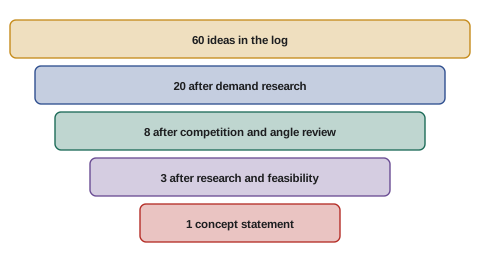
An idea log, kept in a spreadsheet, notes app or project management tool, records ideas as they arise with a short description, the source, a working title, notes on demand and competition, and a rough feasibility rating. Reviewing the log regularly and promoting the strongest ideas into concept statements creates a steady pipeline, so that the channel never stalls for lack of ideas. Many creators find that ideas improve when they sit in the log for a while, gathering angles and examples.
Common mistakes
MistakeStarting production with only a vague topic.
InsteadDefine viewer, promise, angle and stakes first.
MistakeTrusting tool search volumes as precise.
InsteadUse them as rough guides with other evidence.
MistakeJudging demand by raw views on large channels.
InsteadCompare views with each channel's median.
MistakeRepeating unsourced statistics.
InsteadCheck claims against reliable primary sources.
MistakeUsing third-party footage without a rights record.
InsteadLicence material and keep a rights log.
Summary and key terms
- Concepts come from questions, expertise, search, gaps, events and curiosity.
- Strong concepts define subject, viewer, promise, angle, stakes and feasibility.
- Demand research uses search suggestions, trends, analytics and communities.
- Outliers relative to a channel's median reveal resonant topics.
- Subject research combines reading, interviews, testing and data.
- Evaluate sources, check facts and correct errors openly.
- Plan visual material, secure rights and write a concept statement.
- Concept
- Core idea defining a video's subject, viewer and promise.
- Angle
- What makes a video different from others on the subject.
- Stakes
- The tension that gives viewers a reason to keep watching.
- Demand research
- Estimating audience interest in a topic.
- Outlier
- Video far exceeding its channel's typical views.
- Primary source
- Original evidence such as data, documents or direct accounts.
- Fact-checking
- Verifying claims against reliable sources.
- Rights log
- Record of the source and licence of third-party material.
- Public domain
- Material free of copyright restrictions.
- Concept statement
- Short summary of a video's key decisions.
Practice problems
Work each problem on paper first, then reveal the answer to check.
Name four sources of concepts.
Show answer
Questions, expertise, search, gaps, events, curiosity.
What are the elements of a strong concept?
Show answer
Subject, viewer, promise, angle, stakes, feasibility.
Sharpen "a video about running".
Show answer
For example, "Training for a first 10 km in eight weeks after age 40".
What does Google Trends show?
Show answer
Relative interest over time and by region.
Outlier ratio of 60,000 views on a channel median of 5,000?
Show answer
12 times.
Why compare with a channel's median?
Show answer
It reveals topic resonance beyond the usual audience.
Prefer which sources?
Show answer
Primary and reputable sources.
How should errors be handled?
Show answer
Correct openly with a pinned comment or on-screen note.
What is a rights log?
Show answer
A record of the source and licence of each item used.
Why write a concept statement?
Show answer
To align the team and test every later decision.
Lesson quiz · 5 questions
Score 60% or more to complete this lesson.
Create a free account to save your progress, take quizzes and earn a certificate.