
CRE-211 · Lesson 1 of 12 · 25 min
The long-form landscape
Short videos capture attention; long videos build relationships. A ten-minute tutorial that solves a real problem, a forty-minute documentary about a forgotten piece of history, or a weekly two-hour conversation can earn a level of trust, loyalty and income that a feed of fifteen-second clips rarely matches. Long-form video on YouTube and similar platforms remains the backbone of many creator businesses: it is searchable for years, it earns advertising revenue at higher rates than short-form, it supports sponsorships and memberships, and it lets creators go deep on subjects their audience cares about. This course follows a long-form video from idea to channel strategy: concept and research, packaging, structure, retention by design, filming setups, visual storytelling with B-roll, editing, titles and thumbnails, publishing tools, channel strategy, and the business of long-form. This first lesson maps the landscape: what counts as long-form, how and where people watch it, the main formats, how long-form differs from short-form, the economics, and the roles involved in making it.
What long-form means
There is no single definition of long-form. On YouTube, any video that is not a Short is a long-form upload, which in practice means horizontal videos longer than the Shorts limit, which at the time of writing is three minutes. Creators usually think of long-form as videos from about five minutes to several hours: an eight-minute explainer, a twenty-minute video essay, a one-hour documentary, a three-hour live stream or podcast. What unites them is that viewers choose to commit time, usually after reading a title and seeing a thumbnail, and that the video must reward that commitment with depth, story or companionship rather than a single quick payoff. The right length is the length the content needs: a tutorial should be as short as it can be while still teaching the skill, and a story should be as long as it can be while staying engaging.
How people watch long-form
Viewing contexts shape how videos should be made. Long-form video is watched on phones during commutes and breaks, on laptops while working or studying, and increasingly on televisions, where YouTube has reported that the TV screen is the fastest-growing and, in some markets, the most-used device for watching its content. Television viewing is lean-back: people watch for longer, often with others, from a distance, with good speakers. This rewards strong audio, clear visuals that read from across a room, and pacing suited to sustained attention rather than constant stimulation. Many viewers also listen rather than watch, treating long videos like podcasts while cooking, driving or working, which rewards content whose story is carried by the audio. Good long-form videos work across these contexts: readable on a phone, comfortable on a television and understandable by ear.
| Context | Viewer behaviour | What helps |
|---|---|---|
| Phone | Short sessions, small screen, interruptions | Large text, close shots, clear structure |
| Laptop or desktop | Search-driven, learning, multitasking | Chapters, precise titles, readable screen recordings |
| Television | Lean-back, longer sessions, shared viewing | Strong audio, clean visuals, sustained pacing |
| Audio-only listening | Background attention while doing other tasks | Story carried by narration, minimal reliance on visuals |
Long-form formats
Long-form video spans many formats, each with its own craft:
- Tutorials and how-to videos teach skills, from cooking and software to car repair and makeup. They are driven by search, stay useful for years and are judged by whether the viewer succeeds.
- Explainers and educational videos make complex subjects understandable, often with graphics and animation.
- Video essays and commentary develop an argument or analysis, frequently about culture, media, history or ideas, carried by a strong narrating voice.
- Documentaries tell true stories with interviews, footage, archives and narration, sometimes over months of production.
- Vlogs and lifestyle videos follow the creator's life, travels or projects, relying on personality and authenticity.
- Reviews and comparisons evaluate products, services or media, valued for honesty and expertise.
- Challenges, experiments and entertainment build around a premise with escalating stakes.
- Interviews, podcasts and conversations rely on guests, chemistry and ideas, often filmed with several cameras.
- Live streams and their recordings, including gaming, events and community sessions.
Many successful channels combine formats, but most are known for one core format that defines what viewers expect when they click.
How long-form differs from short-form
CRE-210 covered short-form video in depth. Long-form shares many principles, such as strong openings, clear payoffs and respect for the viewer's time, but the differences change how videos are planned and made:
- The click decision: short-form viewers arrive through a feed and decide in a second whether to keep watching; long-form viewers usually decide before the video starts, based on the title and thumbnail. Packaging therefore carries enormous weight (Lessons 3 and 9).
- Sustained structure: a short video has a hook, a body and a payoff; a long video needs a structure of segments, each with its own tension and payoff, and a reason to keep watching across many minutes (Lessons 4 and 5).
- Depth and trust: long-form allows nuance, evidence, demonstration and personality to develop, which builds trust and expertise.
- Production scale: long videos usually involve more research, more footage, more editing time and often a team.
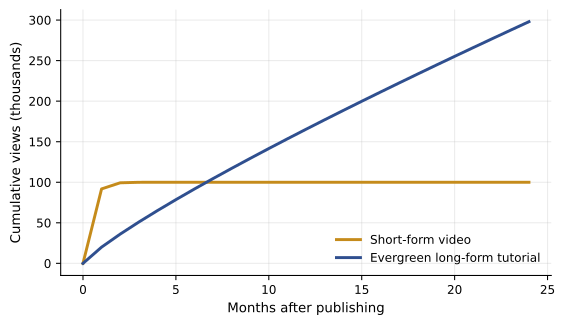
- Longevity: long-form videos that answer lasting questions continue to earn views from search and recommendations for years, while most short videos peak within days.
- Monetization: long-form videos can carry mid-roll advertisements and integrated sponsorships, and typically earn more per view than short-form.
The economics of long-form
Long-form video can support a business, but income is uneven and depends on the niche, audience location and format. Main revenue sources, covered in Lesson 12, include advertising revenue shared through the YouTube Partner Program, sponsorships and brand integrations, channel memberships and fan funding, affiliate links, merchandise and products, and licensing. Advertising rates vary widely: finance, business, technology and education audiences often command higher rates than entertainment or gaming audiences, and viewers in some countries are worth more to advertisers than others. Costs include equipment, software, music and stock licences, travel, and, as channels grow, editors, researchers, thumbnail designers and managers. Many full-time creators describe long-form as a business in which a small number of successful videos fund many that underperform, so planning finances around averages rather than hits is wise.
Worked problem
Comparing the revenue of a long video and many short videos
A creator's 12-minute tutorial earns 80,000 views in its first year at a long-form RPM (revenue per thousand views) of 6 dollars. Their short videos earn an RPM of about 0.10 dollars. How many short-form views would be needed to match the tutorial's advertising revenue?
Show solution
- Tutorial revenue: 80,000 / 1,000 × 6 = 480 dollars.
- Short-form views needed: 480 / 0.10 × 1,000 = 4,800,000 views.
- The tutorial would also continue earning in later years, while short videos usually stop gaining views quickly.
Answer: About 4.8 million short-form views would be needed to match 480 dollars from 80,000 long-form views; RPMs vary widely, so use your own channel figures.
Roles in long-form production
Many long-form channels begin with one person doing everything. As channels grow, roles separate, and understanding them helps both solo creators, who must switch between them, and those building teams:
- Host or presenter: the on-camera or voice personality.
- Producer: plans the video, manages schedules, budgets, guests and locations.
- Writer and researcher: develops the concept, finds sources, checks facts and writes outlines or scripts.
- Camera operator and sound recordist: capture footage and audio.
- Editor: assembles footage into the finished video, often the most time-consuming role.
- Motion graphics artist and animator: create graphics, maps and animations.
- Thumbnail designer: creates thumbnails and often contributes to packaging decisions.
- Channel manager or strategist: oversees publishing, analytics, community and sponsorships.
Solo creators can make excellent long-form videos, but they must budget their time across these roles; editing alone can take five to twenty hours per finished minute for heavily produced videos, and far less for simpler formats.
Choosing a format and a scope
Before making a long-form video, decide what kind of video it is and how big it should be. Questions to ask include: what does the viewer want, and which format delivers it best? How much research and footage will it need? Can it be made with the equipment, skills and time available? Will it remain useful or interesting in a year? Does it fit the channel's identity? Many creators keep a mix of quick, simpler videos that maintain a regular schedule and occasional ambitious "tentpole" videos that take weeks or months and can define a channel. Matching ambition to capacity prevents both stagnation and burnout.
What this course covers
Lesson 2 covers concepts and research; Lesson 3, designing packaging before production; Lesson 4, outlining long-form structure; Lesson 5, retention by design; Lessons 6 and 7, filming setups and visual storytelling; Lesson 8, editing long-form; Lesson 9, titles and thumbnails; Lesson 10, the publishing toolkit; Lesson 11, channel strategy and growth; and Lesson 12, the business of long-form, workflow and a capstone in which you plan, produce and publish a complete long-form video.
A short history of long-form online video
YouTube launched in 2005 with a ten-minute limit on most uploads, which shaped early online video into short clips, vlogs and music videos. As the limit was lifted for verified accounts and broadband became faster, creators began making longer tutorials, gaming series, documentaries and talk shows. The 2010s saw the rise of professional creator channels, multi-channel networks, and formats such as video essays, long product reviews and investigative documentaries made by small independent teams. YouTube's recommendation system shifted from rewarding clicks to rewarding watch time and viewer satisfaction (CRE-201), which favoured videos that held attention for longer. More recently, podcasts have moved to video, live streams have become a major format, and television screens have become a central place for watching YouTube, bringing long-form creators into direct competition with traditional broadcasters and streaming services for living-room attention.
Long-form beyond YouTube
YouTube dominates long-form creator video, but it is not the only option. Other places include streaming platforms such as Twitch for live content and its archives; podcast platforms such as Spotify, which supports video podcasts; Vimeo, used for professional portfolios, client work and paid video on demand; Nebula and similar creator-owned subscription services; course platforms for educational content; and social platforms that allow longer uploads, though they are generally optimized for short-form. Some creators syndicate long-form work across several platforms, while others focus on one and use the rest for promotion. Platform choice affects discovery, revenue, rights and control over the audience relationship, which is why many creators also build owned channels such as email newsletters (CRE-301).
What audiences value in long-form
Surveys and creator experience point to several qualities that long-form audiences value: genuine expertise or experience, honesty about products and opinions, depth that goes beyond what a quick search provides, a distinctive personality or voice, care in production, and respect for their time. These qualities are built video by video, and they are difficult to fake over the long run. Channels that earn them often find that their audience follows them across formats, platforms and changes in the algorithm.
Long-form and short-form together
Most long-form channels now also publish short-form content. The two can support each other: Shorts can introduce a channel to new viewers, preview upcoming long videos, highlight the best moments of existing ones, and keep a channel active between long uploads. However, viewers who enjoy a creator's Shorts do not automatically watch long videos, and YouTube treats Shorts and long-form viewing somewhat separately in recommendations. A sensible approach is to treat Shorts as their own content, made well for their format (CRE-210), while linking them to related long videos where the platform allows. Judge the strategy by whether it brings viewers who stay for long-form, not only by Shorts view counts.
Starting small
New creators often feel pressure to match the production values of established channels. In practice, many successful channels began with simple setups: a phone or basic camera, a decent microphone, good window light and a clear idea. Viewers forgive modest production when the content is valuable and the creator is genuine. Starting with simpler formats builds skills, habits and an audience, and production can improve as the channel grows.
Common mistakes
MistakePadding videos to reach a target length.
InsteadMake each video the length its content needs.
MistakeTreating long-form as a long short video.
InsteadPlan segments, structure and depth for sustained viewing.
MistakeIgnoring television and audio-only viewers.
InsteadMake audio strong and visuals readable from a distance.
MistakePlanning income around one viral hit.
InsteadBudget around typical performance.
MistakeTaking on tentpole projects without capacity.
InsteadMatch ambition to time, skills and team.
Summary and key terms
- Long-form videos build trust, depth and lasting income.
- Viewers watch on phones, laptops, televisions and by ear.
- Formats include tutorials, essays, documentaries, vlogs, reviews and conversations.
- Long-form depends on packaging, sustained structure and depth.
- Evergreen long-form keeps earning views for years.
- Revenue is uneven and varies by niche and audience.
- Production involves many roles that solo creators must balance.
- Long-form video
- Videos viewers commit to watching, usually five minutes or longer.
- Lean-back viewing
- Relaxed, sustained viewing, often on a television.
- Evergreen content
- Content that remains relevant for a long time.
- Tutorial
- Video teaching a skill or process.
- Video essay
- Video developing an argument or analysis.
- RPM
- Revenue per thousand views earned by the creator.
- Mid-roll
- Advertisement placed during a video.
- Tentpole video
- Ambitious video that defines a channel.
- Producer
- Person who plans and manages a production.
- Packaging
- The title and thumbnail that sell a video.
Practice problems
Work each problem on paper first, then reveal the answer to check.
What is the Shorts length limit at the time of writing?
Show answer
Three minutes.
Name three long-form formats.
Show answer
Tutorials, essays, documentaries, vlogs, reviews, conversations.
What does television viewing reward?
Show answer
Strong audio, clean visuals and sustained pacing.
Why do long-form viewers decide before the video starts?
Show answer
They click based on title and thumbnail.
Why do evergreen videos matter?
Show answer
They keep earning views for years.
Revenue from 50,000 views at a 5-dollar RPM?
Show answer
250 dollars.
Name three production roles.
Show answer
Host, producer, writer, editor, designer, manager.
What is a tentpole video?
Show answer
An ambitious, channel-defining video.
Name two factors affecting ad rates.
Show answer
Niche and audience location.
What should decide a video's length?
Show answer
What the content needs.
Lesson quiz · 5 questions
Score 60% or more to complete this lesson.
Create a free account to save your progress, take quizzes and earn a certificate.