
CRE-120 · Lesson 12 of 12 · 26 min
Writing workflow, AI tools, ethics and capstone
Consistent publishing demands a reliable writing process. Creators who post several times a week across platforms write a remarkable volume: hooks, titles, captions, scripts, threads, newsletters, descriptions and replies. Without a system, writing becomes a daily scramble that produces rushed work and burnout. This final lesson brings the course together: idea capture and content calendars, a repeatable workflow from idea to publication, using analytics to improve writing, using AI writing tools responsibly, the ethics and legal requirements of persuasive writing, including disclosure of sponsorships, and a capstone portfolio that demonstrates your skills across formats.
Capturing ideas
Writers never run out of material when they capture ideas systematically. Sources include audience questions in comments and messages, your own experiences and mistakes, conversations, trends and news in your niche, content that performed well (which can be extended, updated or approached from a new angle), and gaps in what other creators cover. A single place for ideas, such as a notes app, a spreadsheet or a project board, with a quick note of the angle and format, turns fleeting thoughts into a backlog. Periodically reviewing the backlog, grouping related ideas into series and discarding weak ones keeps it useful.
The content calendar
A content calendar plans what will be published, where and when. It typically lists the date, platform, format, topic, hook or title, status (idea, drafting, editing, scheduled, published), and links to drafts and assets. Calendars help balance content pillars (CRE-110), plan around launches, holidays and seasonal topics, coordinate repurposing of one idea across platforms, and keep a sustainable rhythm. A calendar is a plan, not a prison: leaving space for timely ideas and reacting to news and trends keeps content fresh.
| Day | Platform | Format | Topic / hook | Status |
|---|---|---|---|---|
| Monday | YouTube | Long-form tutorial | How to Fix a Running Toilet: 3 Causes | Editing |
| Tuesday | Carousel | 5 tools every renter should own | Drafting | |
| Wednesday | TikTok and Reels | Short video | The 30-second leak test | Scripted |
| Thursday | Text post | What 200 service calls taught me about customers | Idea | |
| Friday | Newsletter | Hybrid | Fix of the week plus 3 reader questions | Scheduled |
A repeatable workflow
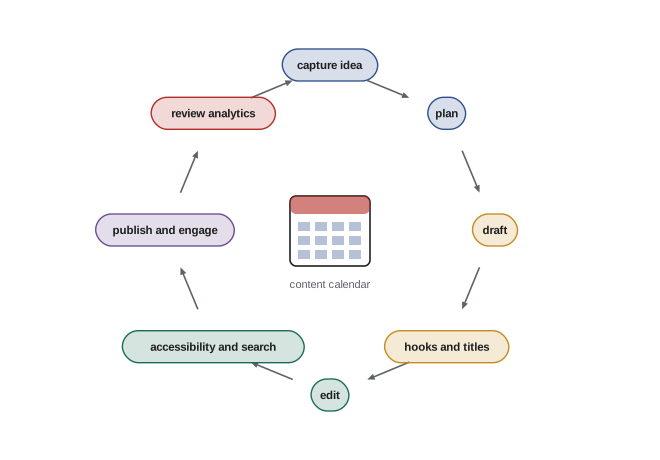
A typical workflow for each piece moves through stages:
- Plan: define the audience, promise and format; gather research and examples.
- Draft: write quickly without editing, getting the ideas down.
- Hook and title: draft many options and choose (Lesson 2).
- Edit: structural, line, accuracy and proofreading passes (Lesson 9).
- Accessibility and search: captions, alt text, descriptive titles and keywords (Lessons 10 and 11).
- Publish and engage: post at a suitable time and respond to early comments.
- Review: check analytics after a set period and note lessons.
Batching, doing similar tasks together, saves time: writing several scripts in one session, editing a week's captions together, and scheduling posts in advance with scheduling tools. Templates for recurring formats speed drafting while leaving room for fresh content.
Learning from analytics
Analytics show how writing performs. Relevant measures include impressions and click-through rate (how well titles, thumbnails, hooks and subject lines earn attention), retention and average view duration (how well scripts hold attention), saves and shares (how valuable and shareable content is), comments (how much it provokes conversation), and conversions (how many readers act on a call to action). Useful habits: compare similar pieces to isolate what made the difference, look at retention graphs to find weak moments in scripts, track which hook structures work for your audience, and run deliberate tests rather than drawing conclusions from single posts, because performance varies a lot from post to post. CRE-202 and CRE-440 go deeper into analytics and experiments.
Worked problem
Learning from a pair of posts
Two carousels on similar topics had these results: Carousel A ("Budgeting tips") reached 18,000 accounts with 240 saves; Carousel B ("The 3-envelope budget I use every month") reached 21,000 accounts with 1,470 saves. What does this suggest?
Show solution
- Save rate A: 240 / 18,000 = 1.3 %.
- Save rate B: 1,470 / 21,000 = 7.0 %.
- B was saved more than five times as often per account reached.
- B's hook is specific, personal and promises a concrete method; A's is generic.
- Hypothesis: specific, personal method hooks drive saves for this audience; test it again on the next few carousels.
Answer: The specific, personal hook earned a 7 % save rate against 1.3 %; test this pattern further.
Using AI writing tools
AI tools can help with many writing tasks: brainstorming ideas and angles, generating hook and title variations, outlining scripts, summarizing transcripts for repurposing, suggesting tighter phrasings, translating, and checking grammar. Used well, they save time and help writers get past a blank page. Used carelessly, they produce generic writing that sounds like everyone else, introduce factual errors and fabricated sources, flatten a creator's voice, and can raise issues of originality. Responsible use means:
- Treat AI output as a first draft or a list of options, not a finished piece.
- Edit for your voice, using your style guide and examples.
- Verify every fact, statistic, quote and source independently; AI tools can state falsehoods confidently.
- Add your own experience, stories and expertise, which audiences value and which AI cannot provide.
- Respect platform rules and laws that require disclosure of realistic synthetic or AI-generated content, and be transparent with your audience when AI plays a substantial role.
- Protect confidential information, such as unreleased sponsor details or personal data, by not pasting it into tools whose terms allow use of inputs.
CRE-410 covers AI tools for creators in more depth.
Ethics and legal requirements
Persuasive writing carries responsibilities. Claims about health, finance, products and results must be truthful and supported by evidence; testimonials must reflect genuine experiences; and urgency or scarcity claims must be real. Writing that targets vulnerable audiences, such as children, people in financial distress or people with health conditions, requires particular care. Creators should also correct errors openly when they make them, which builds trust.
When content is sponsored or the creator has a material connection to a brand, such as payment, free products, affiliate commissions or a business relationship, the connection must be disclosed clearly and prominently in the content itself, not hidden in hashtags or behind a "more" link. Disclosures should be in plain language ("Paid partnership with...", "Ad", "I get a commission if you buy through this link"), placed where viewers will see them, including in the video itself for video content, and used on every platform where the content appears. Platform tools such as paid partnership labels help but may not be sufficient on their own.
In Canada, the Competition Bureau enforces the Competition Act's prohibition of false or misleading representations, including undisclosed material connections in influencer marketing, and Ad Standards' Influencer Marketing Disclosure Guidelines describe how to disclose clearly, for example with #ad or "sponsored" at the beginning of a caption and verbally in videos; CRE-320 covers these rules in detail.
Capstone: a writing portfolio
The capstone asks you to build a portfolio that demonstrates the skills from this course for a niche of your choice (ideally the one you developed in CRE-110). It includes:
- A one-page voice and style guide with a "this, not that" chart and examples.
- Hooks and titles: twenty title or hook options for one piece of content, with the chosen one and your reasoning.
- Three captions for different post types (educational, story, promotional with proper disclosure), each with a clear call to action and alt text for its image.
- A two-column script for a 30 to 45 second short video, timed to words per second.
- An outline and full intro for a long-form video or podcast episode, with open loops and transitions.
- A thread or carousel of at least seven parts.
- A newsletter issue with subject line, preview text and one primary CTA, plus a welcome email.
- A search plan for one piece: target keyword, intent, title, description and chapters.
- An accessibility checklist applied to all pieces.
- A one-month content calendar and a short reflection on how you will use analytics to improve.
Publishing some of the pieces and reporting their early performance strengthens the portfolio, which can then serve as a writing sample for brand partnerships, freelance work and future collaborators.
Sustainable output
Writing for social media at a professional level can be demanding, and creator burnout is common. Sustainable workflows set realistic publishing goals based on available time, rather than copying the schedules of full-time creators with teams. Batching, templates and repurposing reduce the effort per piece. Building a buffer of finished content, such as two weeks of scheduled posts, provides breathing room for illness, holidays and busy periods. Taking planned breaks, and telling the audience about them, rarely harms a channel as much as creators fear. Quality and consistency over the long term matter more than intense bursts followed by exhaustion.
Working with collaborators
As creators grow, they often work with others: editors, scriptwriters, social media managers, designers and virtual assistants. Clear briefs make collaboration effective. A good brief explains the goal, audience, format, key points, voice and any constraints, and links to examples and the style guide. Shared documents, comment threads and version history keep feedback organized. Agreements should cover deadlines, payment, revisions, credit and ownership of the work, and whether collaborators may show the work in their own portfolios. Respecting collaborators' time and expertise, and giving specific feedback, produces better work and lasting relationships.
Writing for brand partnerships
Brand partnerships add another layer to writing. Brands usually provide a brief describing the product, key messages, required elements, prohibited claims and disclosure requirements, and they may require approval before publication. The creator's job is to translate the brief into content that fits their voice and genuinely serves their audience, while staying accurate about the product. Creators should not make claims they cannot support or that the brand cannot substantiate, such as health benefits, and should push back on scripts that would mislead their audience. Clear contracts specify deliverables, usage rights, deadlines, approval rounds and payment. CRE-310 and CRE-320 cover brand deals and their legal requirements in detail.
Originality, copyright and credit
Writers must respect other people's work. Copying text, scripts or captions from other creators without permission is plagiarism and may infringe copyright. Quoting short passages with credit, for commentary or criticism, can be permitted under fair dealing in Canada or fair use in the United States, but these exceptions have limits and depend on the circumstances. Ideas, formats and trends are generally free to use, but their specific expression is not. Crediting sources, collaborators and inspirations builds trust and goodwill. When AI tools are used, creators should check that outputs do not reproduce existing text closely and remain responsible for originality.
Planning the capstone
A practical approach to the capstone is to pick one core topic within your niche and develop it across all formats, which demonstrates repurposing skills and keeps research manageable. Start with the voice and style guide, then write the long-form outline, since the other pieces can draw on it. Draft the hooks and titles next, then the short script, captions, thread or carousel, and newsletter. Apply the search plan and accessibility checklist to everything. Finish with the content calendar and reflection. Present the portfolio in a simple document or web page with short notes explaining your choices, which shows potential partners and clients how you think, not only what you produce.
Where to go next
This course has covered the core writing skills that creators use every day. Related courses build on them: CRE-210 and CRE-211 develop short-form and long-form video, CRE-220 deepens storytelling and on-camera presence, CRE-240 covers podcasting, CRE-202 covers analytics, CRE-310 covers brand partnerships, CRE-320 covers advertising law and disclosure, CRE-410 explores AI tools for creators, and CRE-350 addresses creator wellbeing and burnout. Whichever path you take, the habits from this course, writing clear hooks, editing in passes, respecting your audience's time and telling the truth, will continue to serve you across every platform and format.
Reviewing the workflow itself
The workflow should be reviewed as well as the content. Every few months, creators can ask which stages take the most time, where pieces get stuck, which templates and checklists are actually used, and which tasks could be batched, delegated or dropped. Tracking how long each piece takes from idea to publication, alongside its performance, shows whether extra effort is paying off. Small improvements to the process, such as a better idea capture system or a reusable caption template, compound over hundreds of pieces.
Common mistakes
MistakeWriting everything at the last minute.
InsteadUse an idea backlog, calendar and batching.
MistakeJudging writing by single posts.
InsteadCompare patterns and run deliberate tests.
MistakePublishing AI drafts unedited.
InsteadEdit for voice and verify every fact.
MistakeHiding sponsorship disclosures.
InsteadDisclose clearly at the start and in the content.
MistakeMaking unsupported health or financial claims.
InsteadMake truthful, evidence-based claims.
Summary and key terms
- Capture ideas systematically in a single backlog.
- Content calendars balance pillars, platforms and timing.
- A repeatable workflow moves from plan to draft, edit, publish and review.
- Analytics show how hooks, scripts and calls to action perform.
- AI tools help with drafts and options but require editing and fact-checking.
- Persuasive writing must be truthful; sponsorships must be clearly disclosed.
- The capstone portfolio demonstrates writing across formats.
- Idea backlog
- Collected list of future content ideas.
- Content calendar
- Schedule of planned content.
- Batching
- Grouping similar tasks to save time.
- Template
- Reusable structure for recurring formats.
- Save rate
- Saves divided by accounts reached.
- Retention graph
- Chart of viewers remaining over time.
- AI writing tool
- Software that generates or edits text.
- Material connection
- Relationship with a brand that must be disclosed.
- Disclosure
- Clear statement of sponsorship or connection.
- Portfolio
- Collection of work demonstrating skills.
Practice problems
Work each problem on paper first, then reveal the answer to check.
Name three sources of content ideas.
Show answer
Audience questions, experiences, trends, past hits, gaps.
What does a content calendar track?
Show answer
Date, platform, format, topic, status and links.
List the workflow stages.
Show answer
Plan, draft, hooks, edit, accessibility and search, publish, review.
Why batch tasks?
Show answer
It saves time and keeps focus.
Which metric reflects how well a script holds attention?
Show answer
Retention or average view duration.
Save rate for 600 saves on 15,000 reached?
Show answer
4 %.
Name two risks of AI writing tools.
Show answer
Generic voice, factual errors, fabricated sources.
What must be done with AI-generated facts?
Show answer
Verify them independently.
What is a material connection?
Show answer
A relationship such as payment, free products or commissions.
Where should a sponsorship disclosure appear?
Show answer
Clearly at the start and within the content itself.
Lesson quiz · 5 questions
Score 60% or more to complete this lesson.
Create a free account to save your progress, take quizzes and earn a certificate.