
CON-499 · Lesson 5 of 12 · 20 min
The estimate and the bid
Bid day for Pembrook Fire Station No. 3 started at 6:30 in the morning and ended at 2:00 in the afternoon, when the town clerk stamped the last envelope. In between, the Tamarack team received sixty-three subtrade prices, found two mechanical quotes that excluded work the others included, lost the low electrical price when its bidder withdrew at 12:40, and changed the bid total four times. Ruth signed the bid form at 1:41. Owen said later that the four hours before the deadline were the most intense of his career, and that they would have been impossible without the six weeks of work that came before them.
This lesson covers the fifth deliverable: the estimate and the bid. It builds on estimating and bidding (CON-300) and uses the scope from lesson 2, the procurement plan from lesson 3 and the quantities from lesson 4. For a capstone, the estimate must be complete, organized, traceable to its quantities and quotes, and honest about its markups and contingency.
The structure of a contractor's estimate
A contractor's estimate for a stipulated price bid has four layers. Direct costs are the cost of the work itself: labour, material and equipment for self-performed work, and subtrade prices for the rest. General conditions, sometimes called site overhead or general requirements, are the costs of running the site that do not belong to any one trade: supervision, the site office, temporary services, cleaning and similar items. Contingency covers pricing risk that the estimator cannot remove. Markups cover bonds, insurance, head office overhead and profit. The bid is the sum of all four.
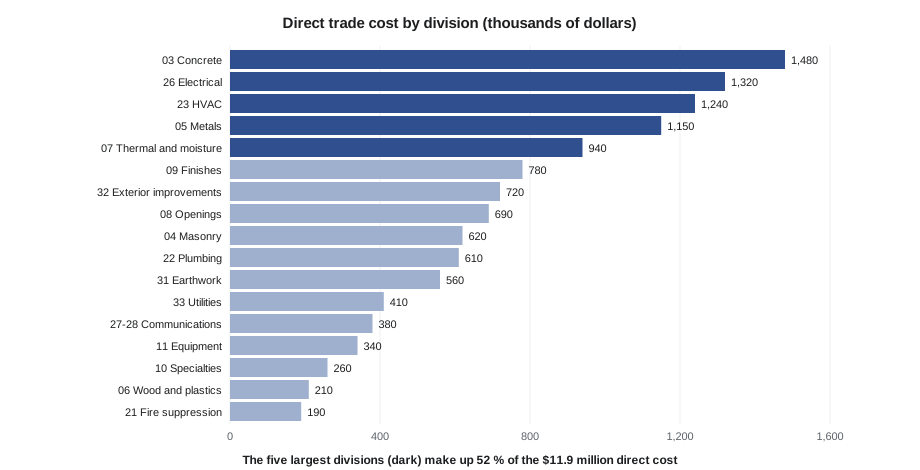
Owen organized the direct costs by MasterFormat division, because that is how subtrades quote and how the town's schedule of values form was arranged. Each line carried the WBS code from lesson 2, so that the estimate could later be turned into a schedule-linked budget.
| Division | Cost | Source |
|---|---|---|
| 03 Concrete | $1,480,000 | Concrete subtrade quote plus Tamarack tower formwork |
| 04 Masonry | $620,000 | Masonry subtrade quote |
| 05 Metals | $1,150,000 | Steel quote plus miscellaneous metals |
| 07 Thermal and moisture | $940,000 | Roofing, insulation, air barrier, sealants |
| 08 Openings | $690,000 | Overhead doors, hollow metal, glazing, hardware |
| 09 Finishes | $780,000 | Drywall, flooring, painting, ceilings |
| 22 and 23 Plumbing and HVAC | $1,850,000 | Mechanical subtrade quote |
| 26 Electrical | $1,320,000 | Electrical subtrade quote including generator |
| 31 to 33 Earthwork, exterior and utilities | $1,690,000 | Site works subtrade quote and Tamarack estimate |
| Other divisions | $1,380,000 | Wood, specialties, equipment installation, fire suppression, alerting rough-in |
| Direct trade cost | $11,900,000 |
Pricing self-performed work
For the work Tamarack would do with its own crews, Owen priced labour from quantities, productivity rates and labour rates. A labour rate starts with the wage and adds the employer's costs on top of it.
Worked problem
Building up a loaded labour rate
A carpenter's base wage is $38.50 per hour. Statutory costs (employer pension plan and employment insurance contributions, workers' compensation premiums and vacation pay) add 24 % of wages, and benefits and training add $4.80 per hour. What is the loaded hourly rate?
Show solution
- Statutory costs: $38.50 × 0.24 = $9.24.
- Benefits and training: $4.80.
- Loaded rate: $38.50 + $9.24 + $4.80 = $52.54 per hour.
- The loaded rate, not the wage, is what goes into the estimate, along with an allowance for small tools and consumables.
Answer: About $52.54 per hour.
Productivity came from Tamarack's records of similar work, adjusted for site conditions. Forming the training tower's footings and walls, for example, was priced at 0.55 crew-hours per square metre of contact area, slower than the company average because the tower was small, tall and needed many corners and openings. The tower had 410 m² of contact area, so the formwork labour was about 225 crew-hours.
General conditions
General conditions are often underpriced by students and by contractors in a hurry, because they are not shown on any drawing. They depend mostly on time: a 14-month project pays for a superintendent, a site office and temporary services for 14 months. Owen priced them month by month from the schedule Tomas was building in parallel, then checked the total against Tamarack's history for similar projects, where general conditions usually ran between 5 % and 7 % of direct cost.
| Item | Basis | Cost |
|---|---|---|
| Superintendent | 14 months × $13,500 | $189,000 |
| Assistant superintendent and field engineer | 12 months × $9,000 | $108,000 |
| Project manager at 60 % | 14 months × $7,200 | $100,800 |
| Project coordinator at 50 % | 14 months × $3,300 | $46,200 |
| Site office, trailers, furniture and IT | 14 months × $3,100 | $43,400 |
| Temporary power and water | 14 months × $1,800 | $25,200 |
| Temporary toilets and safety supplies | 14 months × $1,500 | $21,000 |
| Winter heat and hoarding | Lump sum | $68,000 |
| Cleaning and waste bins | 14 months × $2,600 | $36,400 |
| Small tools, survey and layout | 14 months × $1,200 | $16,800 |
| Fencing and signage | Lump sum | $17,200 |
| Total general conditions | $672,000 |
Analysing subtrade quotes
Most of the estimate came from subtrades, and the main skill on bid day is comparing their quotes fairly. Subtrades rarely quote exactly the same scope. One excludes fire stopping, another excludes the controls, a third includes the extraction system connections that the others assumed someone else would do. Bid levelling, or scope levelling, adds the cost of each missing item to each quote so that every price covers the same scope.
| Item | Mechanical A | Mechanical B | Mechanical C |
|---|---|---|---|
| Quoted price | $1,795,000 | $1,850,000 | $1,768,000 |
| Exhaust extraction connections | Excluded: add $38,000 | Included | Excluded: add $38,000 |
| Building automation controls | Excluded: add $62,000 | Included | Included |
| Fire stopping of mechanical penetrations | Included | Included | Excluded: add $12,000 |
| Generator fuel piping | Included | Included | Excluded: add $24,000 |
| Levelled price | $1,895,000 | $1,850,000 | $1,842,000 |
After levelling, Mechanical C was $8,000 lower than Mechanical B. But C had not passed prequalification: its surety would not bond a contract of this size. Tamarack carried Mechanical B at $1,850,000. The lowest quoted price, Mechanical C at $1,768,000, would have looked attractive to a team that did not level, and would have left Tamarack with $74,000 of missing scope and an unbonded subcontractor on its largest package.
Owen's bid-day spreadsheet had one tab per package, each with a levelling table, the plug number Tamarack would use if no acceptable quote arrived, and a column for the subtrade's acknowledgement of each addendum. A plug number is the contractor's own estimate of a package, used until real quotes arrive, and it is one of the reasons the earlier takeoff work matters.
Contingency and markups
With direct costs and general conditions in place, the estimate needed its top-of-the-page items. Each one is a business decision as much as a calculation, and Ruth made the final calls.
- Pricing contingency of 2.5 % covered estimating uncertainty and minor risks that Tamarack carried under the contract. It was not meant for owner changes, which would be paid as changes.
- Bonds and insurance of 1.6 % covered the performance and payment bonds, builder's risk insurance and the project share of liability insurance.
- Fee of 5.5 % covered head office overhead and profit. Ruth set it after considering the expected competition and Tamarack's backlog.
Tomas turned the whole roll-up into a short program that the team reran every time a number changed on bid day. It printed the bid total and the share of direct cost in the five largest divisions, a quick check that nothing large had gone missing.
# Pembrook Fire Station No. 3: estimate roll-up from trade costs to bid price
trades = {
    '03 Concrete': 1_480_000, '04 Masonry': 620_000, '05 Metals': 1_150_000,
    '06 Wood and plastics': 210_000, '07 Thermal and moisture': 940_000,
    '08 Openings': 690_000, '09 Finishes': 780_000, '10 Specialties': 260_000,
    '11 Equipment': 340_000, '21 Fire suppression': 190_000, '22 Plumbing': 610_000,
    '23 HVAC': 1_240_000, '26 Electrical': 1_320_000, '27-28 Communications and alerting': 380_000,
    '31 Earthwork': 560_000, '32 Exterior improvements': 720_000, '33 Utilities': 410_000,
}
direct = sum(trades.values())
general_conditions = 14 * 48_000          # 14 months of site overhead
subtotal = direct + general_conditions
contingency = round(subtotal * 0.025)     # contractor's pricing contingency
before_bonds = subtotal + contingency
bonds_ins = round(before_bonds * 0.016)   # bonds and builder's risk/liability insurance
before_fee = before_bonds + bonds_ins
fee = round(before_fee * 0.055)           # head office overhead and profit
bid = before_fee + fee
for k, v in [('Direct trade cost', direct), ('General conditions', general_conditions),
             ('Pricing contingency 2.5%', contingency), ('Bonds and insurance 1.6%', bonds_ins),
             ('Fee 5.5%', fee), ('Bid price', bid)]:
    print(f'{k:26s} ${v:>12,}')
top = sorted(trades.items(), key=lambda kv: -kv[1])[:5]
print('Largest five trades:', ', '.join(k for k, _ in top), f'= {sum(v for _, v in top)/direct:.0%} of direct cost')Direct trade cost $ 11,900,000 General conditions $ 672,000 Pricing contingency 2.5% $ 314,300 Bonds and insurance 1.6% $ 206,181 Fee 5.5% $ 720,086 Bid price $ 13,812,567 Largest five trades: 03 Concrete, 26 Electrical, 23 HVAC, 05 Metals, 07 Thermal and moisture = 52% of direct cost
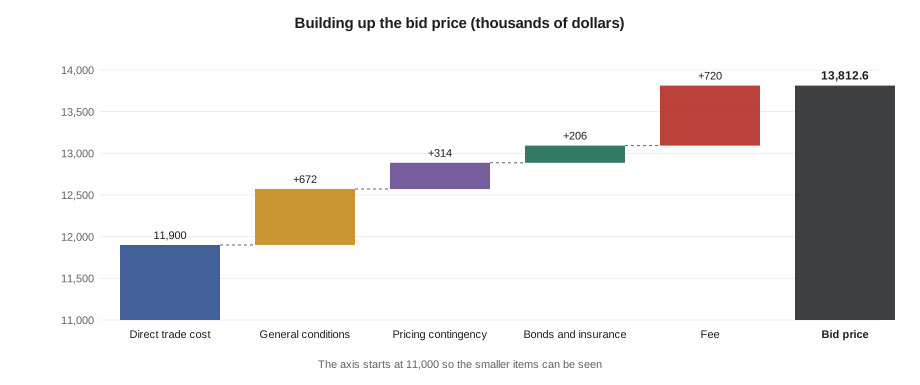
The bid total of $13,812,567 worked out to about $7,940 per square metre of gross floor area. Tamarack's records for three recent municipal emergency services buildings, adjusted for location and escalation, ranged from $7,300 to $8,600 per square metre. The bid was also just under the town's published budget of about $14 million. Neither check proved the estimate right, but both suggested it was not badly wrong.
Alternates, unit prices and the bid form
The bid form asked for more than a single number. It required one separate price, for a rooftop solar array on the apparatus bay, and unit prices for rock excavation and for removing and replacing unsuitable soil. Owen priced the solar array at $186,000 from a specialty contractor's quote and the rock excavation unit price at $95 per cubic metre, which would be used if rock was found. The bid form also required the bidder to acknowledge each addendum by number, to attach the bid bond and the surety's agreement to provide contract bonds, and to list the major subtrades.
Mistakes on the bid form, not in the estimate, are the most common reason a low bid is rejected. A missing addendum acknowledgement, an unsigned form, a bid bond in the wrong amount or a price written in words that does not match the figures can each disqualify a bid. Farah used a bid-form checklist and had a second person check every entry before Ruth signed. The envelope reached the town hall at 1:52.
Ethics on bid day
Bid day puts pressure on everyone, and some practices that look clever are unfair, unethical or illegal. Bid shopping is using one subtrade's price to pressure another into a lower price after the bid, or shopping a price around before the bid in a way that breaks confidence. It damages trust and, in the long run, leads subtrades to inflate their prices to the contractors who do it. Collusion between bidders, such as agreeing who will submit the low bid or sharing prices, is a serious crime in both Canada and the United States. Tamarack's policy was simple: keep every quote confidential, award to the subtrade whose price was used when its bid was compliant, and never discuss prices with another general contractor.
At 3:15 the town posted the results. Tamarack was second of six, $41,000 above the low bidder, whose bid was later found to have omitted the generator. The town rejected the low bid as non-compliant and began its review of Tamarack's. For the capstone, the team continued as if Tamarack had been awarded the contract, with substantial performance due 14 months after award.
Your capstone deliverable
- An estimate summary by division, with each line traced to quantities, productivity and rates, or to quotes.
- A loaded labour rate build-up and productivity basis for self-performed work.
- A general conditions estimate tied to the schedule duration.
- A levelling table for at least two major subtrade packages, with your reasons for the price carried.
- Contingency and markups with your reasoning, the bid total and at least two benchmark checks.
- A completed bid form, including separate prices, unit prices and addendum acknowledgements.
Common mistakes
MistakeUsing the lowest quoted price without levelling scope.
InsteadAdd the cost of missing items to each quote so they cover the same scope.
MistakePricing labour at the base wage.
InsteadUse loaded rates that include statutory costs, benefits and burden.
MistakeForgetting that general conditions depend on time.
InsteadPrice them month by month from the schedule duration.
MistakeTreating contingency as profit or as a fund for owner changes.
InsteadUse contingency for pricing risk the contractor carries; owner changes are paid as changes.
MistakeLosing a good bid to a form error.
InsteadUse a bid-form checklist and a second check of every entry.
Summary and key terms
- A stipulated price estimate has four layers: direct costs, general conditions, contingency and markups.
- Self-performed work is priced from quantities, productivity and loaded labour rates.
- General conditions are mostly time-related and should be built from the schedule.
- Bid levelling adjusts subtrade quotes to a common scope before comparison.
- Prequalification can override price: an unbondable or unsafe low subtrade is not a real saving.
- Benchmarks per unit of floor area and against the owner's budget are useful checks, not proof.
- Bid forms must be complete and correct; collusion and bid shopping are unethical, and collusion is illegal.
- Direct cost
- The cost of the work itself, from self-performed labour, material and equipment and subtrade prices.
- General conditions
- Site costs that do not belong to one trade, such as supervision, the site office and temporary services.
- Loaded labour rate
- The hourly wage plus statutory costs, benefits and other employer costs.
- Bid levelling
- Adjusting subtrade quotes to a common scope so they can be compared fairly.
- Plug number
- The contractor's own estimate of a package, used until acceptable quotes arrive.
- Unit price
- A price per unit of work, used to adjust the contract if quantities change.
Practice problems
Work each problem on paper first, then reveal the answer to check.
A wage is $41.00 per hour, statutory costs are 24 % and benefits are $5.10 per hour. What is the loaded rate?
Show answer
$41.00 + $9.84 + $5.10 = $55.94 per hour.
Quote X is $900,000 and excludes $45,000 of scope. Quote Y is $930,000 and is complete. Which is lower after levelling?
Show answer
X levels to $945,000, so Y at $930,000 is lower.
Why are general conditions priced from the schedule?
Show answer
Most of them, such as supervision and site facilities, cost a fixed amount per month.
A bid of $9,450,000 is for a building of 1,260 m². What is the cost per square metre?
Show answer
$9,450,000 ÷ 1,260 = $7,500 per m².
Give three bid-form errors that can disqualify a bid.
Show answer
Any three of: missing addendum acknowledgement, unsigned form, wrong bid bond amount, words and figures that disagree, late delivery.
Lesson quiz · 5 questions
Score 60% or more to complete this lesson.
Create a free account to save your progress, take quizzes and earn a certificate.