
CON-430 · Lesson 8 of 12 · 26 min
Waste management, deconstruction and circularity
Construction, renovation and demolition generate some of the largest waste streams in the economy. The US Environmental Protection Agency estimated that the United States generated about 600 million tons of construction and demolition debris in 2018, more than twice the amount of municipal solid waste, and that demolition accounted for more than 90 % of it. Canadian estimates are less complete, but construction, renovation and demolition waste is a large share of non-residential waste, and several provinces and regions restrict landfilling of materials such as clean wood, drywall and asphalt shingles. Waste costs money twice, once to buy the material and again to haul it away, and every tonne wasted carries the embodied carbon of making it. This lesson covers waste planning and diversion on new construction, deconstruction and reuse when buildings come down, and the circular economy ideas that are changing how buildings are designed.
The waste hierarchy
The waste hierarchy ranks options from most to least preferred. It is a guide rather than a rule, since in some cases a lower option has a smaller overall impact, but it is a useful starting point for any waste plan.
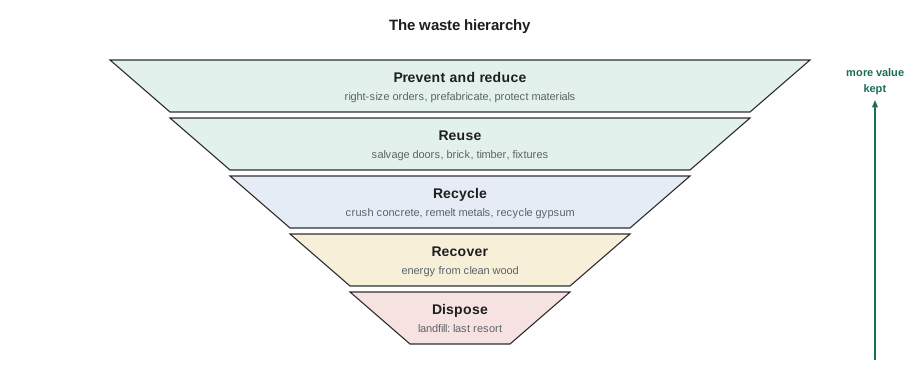
Prevention comes first because material never bought produces no waste and no embodied carbon. On a construction project, prevention means designing to standard material sizes, ordering accurately, prefabricating components in a factory where offcuts are reused, protecting materials from weather and damage, and asking suppliers to reduce packaging or take it back. CON-410 (lesson 9) covers prefabrication and modular construction, which can cut site waste substantially. Reuse keeps materials in their current form, for example by salvaging doors, fixtures, bricks and timbers. Recycling reprocesses materials into new products, such as crushing concrete into aggregate or remelting metals. Recovery extracts energy, for example by burning clean wood in a biomass plant. Disposal in landfill is last.
Planning waste on a new building
A construction waste management plan sets diversion goals, identifies the expected waste streams, decides which will be separated on site and which will go to a mixed-waste sorting facility, names the haulers and facilities, and sets out how diversion will be tracked and reported. Most green building rating systems and many municipal standards require such a plan, and owners increasingly set diversion targets of 75 % or more by weight.
| Stream | Typical sources | Common destinations | Notes |
|---|---|---|---|
| Concrete and masonry | Overpours, cut-outs, demolition rubble | Crushed for aggregate or fill | Heavy, so it raises diversion rates by weight |
| Clean wood | Formwork, blocking, pallets, offcuts | Reuse, mulch, panel board, biomass fuel | Must be kept free of paint, preservatives and glue for most uses |
| Metals | Rebar offcuts, studs, ductwork, wire | Scrap recyclers | Often earns a rebate |
| Drywall | Offcuts and damaged sheets | Gypsum recycling | Disposal bans in some regions; keep dry and clean |
| Cardboard and packaging | Deliveries | Paper recycling, supplier take-back | Volume rather than weight |
| Plastics and film | Wrapping, pipe offcuts | Limited recycling | Reduce at source |
| Mixed waste | Everything not separated | Sorting facility or landfill | Ask for the facility's actual recovery rate |
Source separation, with separate bins for each stream on site, usually gives the highest-quality recycling and the lowest cost per tonne, but it needs space, training and supervision; contaminated bins can be rejected or downgraded to mixed waste. Commingled collection, where all waste goes to a sorting facility that separates it mechanically and by hand, needs less site space and effort but depends on the facility's recovery rate, which can be much lower than advertised. Tight urban sites like Cedar Row often use a hybrid: a few clean streams such as metal, concrete and drywall are separated, and the rest goes to a facility whose recovery rate is documented.
Calculating diversion
The diversion rate is the weight of material diverted from landfill divided by the total weight of waste generated, expressed as a percentage.
Most programs exclude some materials from the calculation, such as land-clearing debris, excavated soil and hazardous waste, and do not count material used as alternative daily cover at landfills or, in some systems, material burned for energy as diversion. Mixed waste counts only to the extent the sorting facility actually recovers it. Weights come from hauler tickets and facility reports, which should be collected monthly rather than at project end.
# Cedar Row construction waste: diversion rate and disposal cost from hauler tickets (illustrative)
import random
random.seed(8)
# stream: (t per month on average, cost per UNIT; negative means a rebate)
streams = {
    'Mixed waste to landfill': (7, 135),
    'Clean wood':              (3, 70),
    'Metals':                  (1.2, -120),
    'Concrete and masonry':    (4.5, 30),
    'Drywall offcuts':         (1.5, 95),
    'Cardboard and packaging': (1, 45),
}
months = 18
totals = {k: sum(max(0.0, random.gauss(avg, 0.3 * avg)) for _ in range(months)) for k, (avg, _) in streams.items()}
landfill = totals['Mixed waste to landfill']
total = sum(totals.values())
cost = sum(totals[k] * streams[k][1] for k in streams)
for k, v in totals.items():
    print(f"{k:24s} {v:6.0f} t")
print(f"Total {total:,.0f} t; diverted {total - landfill:,.0f} t; diversion rate {(total - landfill) / total:.1%}")
all_landfill = total * streams['Mixed waste to landfill'][1]
print(f"Disposal cost ${cost:,.0f} vs ${all_landfill:,.0f} if everything went to landfill")Mixed waste to landfill 145 t Clean wood 58 t Metals 23 t Concrete and masonry 86 t Drywall offcuts 26 t Cardboard and packaging 18 t Total 355 t; diverted 210 t; diversion rate 59.3% Disposal cost $26,696 vs $47,920 if everything went to landfill
Cedar Row's tickets show about 355 tonnes of waste over 18 months, about 33 kilograms per square metre of floor area, and a diversion rate of about 59 %. Separating streams has also saved about $21,000 in disposal costs compared with sending everything to landfill, because landfill tipping fees are high and metal earns a rebate. The plan's goal is 75 %. To have reached it, only about 89 tonnes could have gone to landfill instead of 145, which would have required better sorting, a documented recovery rate at the mixed-waste facility, or less waste in the first place; the example at the end of this lesson shows what that means for the rest of the job.
Diversion by weight has limits as a metric. Concrete and masonry are heavy, so projects can reach high diversion rates by crushing concrete while sending lighter but more carbon-intensive materials, such as plastics and insulation, to landfill. Some programs now encourage reporting waste per square metre, diversion by stream, or the carbon embodied in wasted materials, which better reflect real impacts. And diversion says nothing about prevention: a project that generates half as much waste with a lower diversion rate may be better than one that generates a lot and recycles most of it.
Site practices that reduce waste
- Detail and order to standard sizes; use BIM quantity takeoffs to avoid over-ordering (CON-260).
- Use reusable formwork systems, and return pallets, reels and packaging to suppliers.
- Store materials dry, off the ground and protected from damage; drywall and insulation are easily ruined.
- Sequence deliveries just in time on tight sites to reduce double handling and damage.
- Set up clearly signed bins near the work, with a waste champion who checks for contamination.
- Include waste requirements in subcontracts so that trades separate and report their waste.
- Track waste monthly against the plan and discuss results at site meetings.
Deconstruction versus demolition
When an existing building must come down, conventional demolition with excavators is fast and cheap, but it mixes materials and sends most of them to landfill or low-grade recycling. Deconstruction takes a building apart carefully, largely in reverse order of construction, so that materials can be reused or recycled at high value. It takes longer and needs more labour, but it recovers materials with resale value, reduces disposal fees and avoids the embodied carbon of new products. Some cities, including Vancouver and Portland, Oregon, have required deconstruction or high recovery rates for older houses, and many owners use partial deconstruction, salvaging valuable components before machine demolition of the rest.
Before any demolition or deconstruction, a hazardous materials survey is needed to identify asbestos, lead paint, polychlorinated biphenyls (PCBs) in old electrical equipment and sealants, mercury in lamps and thermostats, and mould. These must be removed and disposed of by qualified contractors under provincial, state and federal rules; HSE-251 covers the regulations for hazardous waste and spills, and this course does not repeat them. Hazardous materials found during work stop the job, so the survey must be thorough.
| Factor | Machine demolition | Deconstruction |
|---|---|---|
| Duration | Days to a few weeks | Weeks to months |
| Labour | Small crew, heavy equipment | Larger crew, more hand work |
| Material recovery | Mostly low-grade recycling or landfill | High-value reuse and clean recycling streams |
| Disposal cost | Higher | Lower |
| Salvage revenue | Little | Can offset part of the labour cost |
| Carbon | Little avoided | Reuse avoids embodied carbon of new materials |
| Best suited to | Contaminated or low-value buildings, tight schedules | Buildings with heavy timber, brick, steel, fixtures; flexible schedules |
Reuse and the circular economy
The circular economy is a model in which materials and products are kept in use at their highest value for as long as possible, through reuse, repair, remanufacturing and recycling, instead of the linear take-make-dispose pattern. For buildings, circularity has three layers. First, keep existing buildings in use: renovating and adapting a building usually emits far less carbon than demolishing and replacing it, because the structure, often the largest share of embodied carbon, is kept. Second, reuse components and materials from buildings that do come down. Third, design new buildings so their parts can be recovered in future.
Reusing salvaged materials in new construction raises practical questions that builders must manage. Structural members need assessment and sometimes testing or regrading to confirm their capacity; codes and engineers may require documentation that salvaged items meet current standards; supply is irregular, so design must be flexible; and warranties and liability need clear allocation. Online marketplaces, salvage yards and material reuse organizations have grown, and some owners now ask contractors to identify reuse opportunities as part of preconstruction.
Design for disassembly, described in ISO 20887, aims to make future recovery easy: bolted rather than welded or glued connections, accessible fixings, standard dimensions, simple layers that can be separated, and documentation of what is in the building. Material passports, digital records of the materials and products in a building, help future owners find and recover them. Mass timber panels with screwed connections, steel frames with bolted connections, demountable partitions and raised floors are examples. For builders, design for disassembly often means following less familiar details precisely and keeping good as-built records.
Worked problem
Reaching the 75 % target on Cedar Row
Cedar Row has generated 355 t of waste with 145 t landfilled, a 59 % diversion rate. The remaining work will generate about 60 t more, mostly from interior finishes, of which 30 t would normally go to mixed waste. The mixed-waste facility can document a 45 % recovery rate if Marlowe Builders switches its mixed bins there from the current landfill-only hauler. Can the project reach 75 %?
Show solution
- Total waste at completion: 355 + 60 = 415 t.
- Mixed waste if all goes to landfill: 145 + 30 = 175 t, so diversion = (415 − 175) / 415 ≈ 58 %.
- If the past 145 t cannot be changed but the remaining 30 t goes to the sorting facility, landfill = 145 + 30 × 0.55 = 161.5 t, diversion ≈ 61 %.
- To reach 75 %, landfill must be at most 0.25 × 415 ≈ 104 t, which is less than the 145 t already landfilled.
- The target cannot be met for the project as a whole without changing past results, which is impossible.
Answer: Diversion targets must be managed from the first month: once tonnes are landfilled, they cannot be recovered. Marlowe Builders should report the shortfall honestly, switch to the documented facility now and apply the lesson to the next project by setting up the hybrid separation system at mobilization.
Common mistakes
MistakeCollecting hauler tickets only at the end of the project.
InsteadCollect and track tickets monthly so problems can be corrected in time.
MistakeAssuming a mixed-waste facility recovers most of what it receives.
InsteadObtain documented, project-specific recovery rates.
MistakeCounting alternative daily cover or excavated soil as diversion.
InsteadFollow the program's exclusions.
MistakeFocusing only on diversion rate by weight.
InsteadPrevent waste first and consider carbon and stream-level performance.
MistakeStarting deconstruction without a hazardous materials survey.
InsteadSurvey, remove and dispose of hazardous materials under the applicable rules first.
Summary and key terms
- Construction and demolition debris is one of the largest waste streams; demolition produces most of it.
- The waste hierarchy ranks prevention, reuse, recycling, recovery and disposal.
- A waste management plan sets goals, streams, separation methods, haulers and tracking.
- Diversion rate = diverted weight divided by total weight, with exclusions for soil, land-clearing debris, hazardous waste and alternative daily cover.
- Source separation gives better recycling; commingled sorting depends on the facility's real recovery rate.
- Diversion by weight can be misleading; prevention and carbon-based measures matter too.
- Deconstruction recovers high-value materials and avoids embodied carbon but takes longer and needs more labour.
- Circularity means keeping buildings in use, reusing materials and designing for disassembly.
- Waste hierarchy
- A ranking of waste options from prevention and reuse down to disposal.
- Waste management plan
- A project plan for reducing, separating, diverting and tracking construction waste.
- Diversion rate
- The share of waste by weight kept out of landfill.
- Source separation
- Separating waste streams into different bins at the point where waste is generated.
- Commingled collection
- Collecting mixed waste for separation at an off-site sorting facility.
- Deconstruction
- Taking a building apart carefully so that materials can be reused or recycled.
- Circular economy
- An economic model that keeps products and materials in use at their highest value.
- Design for disassembly
- Designing buildings so that components can be easily recovered and reused.
- Material passport
- A digital record of the materials and products in a building.
Practice problems
Work each problem on paper first, then reveal the answer to check.
List the waste hierarchy from most to least preferred.
Show answer
Prevent and reduce, reuse, recycle, recover, dispose.
What does a waste management plan contain?
Show answer
Goals, expected streams, separation method, haulers and facilities, and tracking and reporting.
How is the diversion rate calculated?
Show answer
Diverted weight divided by total waste weight, times 100 %.
Name two materials usually excluded from diversion calculations.
Show answer
For example, excavated soil and land-clearing debris.
What is Cedar Row's diversion rate after 18 months?
Show answer
About 59 %.
Why can diversion by weight be misleading?
Show answer
Heavy concrete dominates, while lighter carbon-intensive materials may be landfilled.
Give one advantage and one disadvantage of source separation.
Show answer
Higher-quality recycling and lower cost; needs space, training and supervision.
What must happen before any demolition or deconstruction?
Show answer
A hazardous materials survey and proper abatement.
Why does renovation usually emit less carbon than replacement?
Show answer
The structure, often the largest share of embodied carbon, is kept.
Give two design for disassembly strategies.
Show answer
For example, bolted connections and standard dimensions.
Lesson quiz · 5 questions
Score 60% or more to complete this lesson.
Create a free account to save your progress, take quizzes and earn a certificate.