
CON-385 · Lesson 8 of 12 · 20 min
Functional performance testing and integrated systems testing
At 2:00 on a Wednesday afternoon in March, Kwame Asante stood in the East Wing mechanical room with a printed test procedure, a radio and a laptop showing the building automation system. 'Step 14,' he said. 'Simulate failure of supply fan 2.' Helen's controls technician opened the disconnect on one of the four fans in the new air handling unit's fan array. Kwame watched the screen. Within ten seconds the remaining three fans should have ramped up to hold duct pressure, an alarm should have appeared at the operators' workstation, and the dialysis unit room pressures should have stayed positive. The fans ramped up. The duct pressure dipped and recovered in fifteen seconds. The alarm appeared, but it said 'AHU-3 general fault' instead of 'AHU-3 supply fan 2 failure', which would have sent a night operator to the wrong place. Kwame wrote 'fail: alarm text' on the sheet, logged it as issue 211, and moved on to step 15. That is functional performance testing: proving, one condition at a time, that systems do what the owner needs, including when something goes wrong.
What functional testing is
Functional performance testing, often shortened to functional testing or FPT, checks that equipment and systems operate according to the approved sequences of operation and the owner's project requirements, in all the modes they will see in real life. Construction checklists confirm that things are installed correctly; functional tests confirm that they behave correctly. A properly installed air handling unit with a wrong control sequence will pass every checklist and fail its functional test.
Functional tests cover normal operation, but the most valuable steps test the conditions that rarely happen: equipment failures, loss of power, fire alarm activation, extreme weather, loss of communication with the automation system, sensor failures. Those conditions are exactly the ones in which a hospital most needs its systems to work, and exactly the ones nobody sees in daily operation until a real emergency.
| Mode | Example test on AHU-3 serving the dialysis unit |
|---|---|
| Normal occupied | Supply air temperature, duct pressure and room temperatures held at setpoints during treatment hours |
| Unoccupied and setback | Fan speed reduced overnight while dialysis rooms stay positive to corridors |
| Equipment failure | One supply fan fails; others ramp up; correct alarm at operators' workstation |
| Sensor failure | Supply air temperature sensor fails; unit goes to a safe default and alarms |
| Power failure | Normal power lost; fans restart on emergency power within the required time |
| Fire alarm | Smoke detected in return air; unit stops or goes to smoke control mode as designed |
| Loss of communication | Network link to the hospital automation system lost; unit continues on local control |
| Seasonal extremes | Heating at design cold conditions; cooling and dehumidification in summer |
Writing test procedures
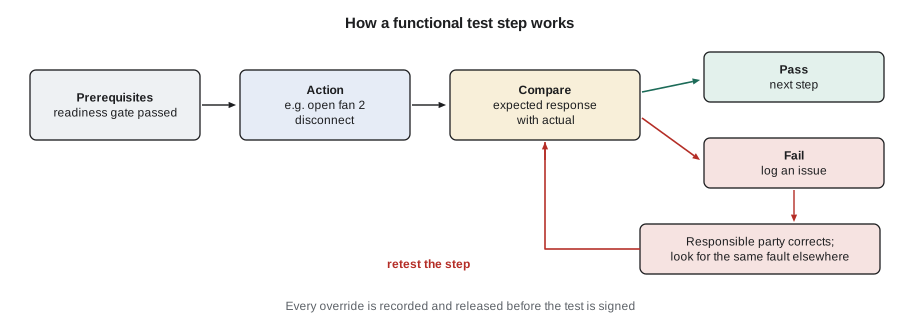
Kwame's team wrote a test procedure for every system type. Each procedure is a script: it lists prerequisites, then numbered steps, each with an action, the expected response drawn from the sequence of operation, a space for the actual response, and a pass or fail mark. Procedures are sent to the contractor and designers before testing so that everyone agrees what will be tested and what counts as a pass. Disagreements about the expected response are much easier to resolve at a desk than in a mechanical room with ten people watching.
| Step | Action | Expected response | Actual | Result |
|---|---|---|---|---|
| 12 | Confirm all four supply fans running at normal speed | Each fan near the same speed; duct pressure at setpoint | Fans at about 72 %; pressure at setpoint | Pass |
| 13 | Record room pressures in bays 1 to 8 | All bays positive to corridor by at least the setpoint | All positive | Pass |
| 14 | Open disconnect for supply fan 2 | Other fans ramp up within 30 s; alarm names fan 2 | Fans ramped; alarm text generic | Fail |
| 15 | Record duct pressure and room pressures for 5 min | Duct pressure recovers; rooms stay positive | Recovered in 15 s; rooms positive | Pass |
| 16 | Close disconnect for fan 2 | Fan 2 restarts; others return to normal speed; alarm clears | As expected | Pass |
Methods: watching, forcing and trending
Some steps can be tested by watching the system respond to a real change, such as switching the unit to occupied mode. Others need the tester to force a condition: overriding a sensor value in the automation system, opening a disconnect, closing a valve or heating a sensor with a heat gun. Forcing has to be done carefully, because a forced value left in place after the test can cause problems for months. On Ashgrove every override was recorded on the test sheet and released before the test was signed.
Trend logging is the third method. The automation system records values such as temperatures, pressures, valve positions and fan speeds every few minutes over days or weeks. Trend data shows how systems behave across real cycles of occupancy and weather, catching problems that a two-hour test cannot, such as valves hunting back and forth, simultaneous heating and cooling, or rooms that overheat every afternoon. Kwame required two weeks of trend data from the dialysis unit before it opened and reviewed it with the controls subcontractor. It showed that two reheat valves were opening while the cooling coil was at full capacity: the units were heating and cooling the same air at the same time, wasting energy, because of a reversed control signal.
Sampling: test everything or test a sample?
Critical equipment, such as air handling units, generators, fire pumps and pressure-critical rooms, is usually tested in full. Repetitive equipment, such as dozens of identical reheat terminals, may be tested by sampling: a random sample is tested, and if the failure rate in the sample is above an agreed threshold, a further sample is tested, and if that also fails, the contractor must test and correct every unit at its own cost. Sampling saves time while still giving the owner confidence, and the threat of full testing encourages the contractor to get things right the first time.
Worked problem
Applying a sampling rule
The East Wing has 64 reheat terminals of the same type. The commissioning plan says: test a random 20 % sample; if more than 10 % of the sample fails, test a second random 20 %; if more than 10 % of the second sample fails, the contractor must test all remaining units and pay for the commissioning authority's extra time. In the first sample, 2 terminals fail. In the second sample, 1 terminal fails. What happens?
Show solution
- First sample: 20 % of 64 = 12.8, round up to 13 terminals.
- Failure rate: 2 ÷ 13 = 15.4 %, which is above 10 %, so a second sample is required.
- Second sample: another 13 terminals from the 51 untested ones.
- Failure rate: 1 ÷ 13 = 7.7 %, which is not above 10 %, so full testing is not triggered.
- The three failed terminals are corrected and retested; the remaining 38 untested terminals are accepted on the evidence of the samples.
Answer: Two samples of 13 are tested; the second passes the threshold, so the remaining 38 terminals are accepted once the three failures are fixed and retested.
Tomas wanted to know how likely Harbourline was to end up testing every terminal if its installers had a given error rate, so he wrote a quick simulation. It showed that at a true failure rate of 5 %, full testing was unlikely; at 15 %, it happened in about half of all trials. He showed the result to the controls subcontractor's foreman as a reason to check every terminal before the commissioning authority arrived.
# Probability that a sampling rule forces full testing
import random
random.seed(7)
N, frac, limit = 64, 0.20, 0.10
n = -(-int(N * frac * 10) // 10)        # 20 % of 64, rounded up = 13

def full_test(rate):
    units = [random.random() < rate for _ in range(N)]
    random.shuffle(units)
    s1, s2 = units[:n], units[n:2 * n]
    return sum(s1) / n > limit and sum(s2) / n > limit

for rate in (0.02, 0.05, 0.10, 0.15, 0.25):
    trials = 20000
    p = sum(full_test(rate) for _ in range(trials)) / trials
print(f'True failure rate {rate:4.0%}: full testing in {p:5.1%} of trials')True failure rate 2%: full testing in 0.1% of trials True failure rate 5%: full testing in 1.9% of trials True failure rate 10%: full testing in 14.1% of trials True failure rate 15%: full testing in 35.9% of trials True failure rate 25%: full testing in 76.6% of trials
Emergency power and other critical systems
In a hospital, the emergency power system is one of the most important systems to test, because it keeps life safety and critical care equipment running when normal power fails. In Canada, CSA C282, the standard for emergency electrical power supply for buildings, and CSA Z32, the standard for electrical safety and essential electrical systems in health care facilities, set requirements for design, testing and maintenance. On Ashgrove, the new air handling unit, the dialysis unit's water treatment system and part of the lighting were connected to the hospital's existing generators through new transfer switches. Functional testing included a full transfer test: Helen's electricians opened the normal power supply, and the commissioning team recorded the time for each transfer switch to transfer, each fan to restart and each critical load to recover.
The test had to be scheduled with the hospital's clinical leaders, because a transfer affects every load on the switches involved. It was done at 6:00 on a Sunday, with the dialysis unit not yet open and the Main Building loads on separate switches. The test found one transfer switch with a time-delay setting longer than the design, which would have left the dialysis water treatment system without power for nearly a minute. The setting was corrected and the test repeated the following Sunday.
Integrated systems testing
Integrated systems testing checks that separate systems work together as designed, especially for life safety. When the fire alarm detects smoke, the air handling unit should stop or go into smoke control mode, smoke dampers should close, door hold-open devices should release, elevators should recall and the hospital's switchboard should receive the right signal. Each system may pass its own test and still fail in combination, because one contractor assumed the other would provide a relay or a signal. Lesson 9 covers fire alarm and life safety testing in detail; the important point here is that integrated testing needs every trade involved present at once, with a single procedure and a single person in charge of the test.
When tests fail
Failures are expected; that is why tests are done. What matters is how they are handled. Every failed step on Ashgrove became an entry in the issues log with a description, the responsible party and a target date. The responsible party corrected the problem and told the commissioning authority, who then retested the step, or the whole test if the correction could have affected other steps. Most contracts, including Ashgrove's, allow the owner to charge the contractor for the commissioning authority's time on repeated retests caused by the contractor's failure to be ready, which concentrates minds.
The generic alarm text found in step 14 took the controls subcontractor two hours to fix: the alarm points had been named from a template that had never been edited. Kwame retested steps 14 to 16 the following week, and they passed. A check of the other alarm points found 37 more with generic text, all corrected before handover. One failed step had exposed a pattern.
Common mistakes
MistakeTreating functional testing as a repeat of checklists.
InsteadTest behaviour against sequences and the OPR in all modes, especially failures and emergencies.
MistakeTesting only normal operation.
InsteadInclude equipment, sensor, power and communication failures, fire alarm events and seasonal extremes.
MistakeLeaving overrides in place after testing.
InsteadRecord every override on the test sheet and release it before signing.
MistakeRelying on a short test alone.
InsteadUse trend logs over days or weeks to catch hunting, simultaneous heating and cooling, and daily cycles.
MistakeScheduling emergency power tests without clinical leaders.
InsteadPlan transfers with the hospital, at quiet times, with a clear restoration plan.
Summary and key terms
- Functional tests prove that systems behave according to sequences and the OPR, not just that they are installed.
- Test procedures are scripts with prerequisites, actions, expected responses, actual responses and results, agreed before testing.
- Testers observe real changes, force conditions with care and use trend logs for long-term behaviour.
- Critical equipment is tested in full; repetitive equipment may be sampled with rules that expand testing if failures exceed a threshold.
- Hospital emergency power testing follows standards such as CSA C282 and CSA Z32 and is scheduled with clinical leaders.
- Integrated systems testing checks that separate systems, especially life safety systems, work together.
- Every failed step becomes an issue that is corrected and retested, and patterns are searched for.
- Functional performance test
- A test proving that a system operates to its sequences and the OPR in all modes.
- Sequence of operation
- The written description of how a system is controlled in each mode.
- Override
- A forced value or command used during testing that must be released afterwards.
- Trend log
- Automated recording of system values over time.
- Sampling
- Testing a random share of identical units, with expansion if failures exceed a threshold.
- Integrated systems testing
- Testing separate systems together to confirm their interactions.
Practice problems
Work each problem on paper first, then reveal the answer to check.
What does a functional test prove that a checklist does not?
Show answer
That the system behaves correctly in operation, following its sequences and the OPR.
Name four modes a functional test should cover.
Show answer
Any four of: normal, unoccupied, equipment failure, sensor failure, power failure, fire alarm, loss of communication, seasonal extremes.
Why use trend logs?
Show answer
To see behaviour across real cycles and catch problems short tests miss, such as hunting or simultaneous heating and cooling.
A 25 % sample of 40 units has 2 failures. Is a 10 % threshold exceeded?
Show answer
Sample of 10; 2 ÷ 10 = 20 %, so yes.
What did the generic alarm text failure reveal?
Show answer
A pattern: 37 other alarm points had the same template error.
Lesson quiz · 5 questions
Score 60% or more to complete this lesson.
Create a free account to save your progress, take quizzes and earn a certificate.