
CON-375 · Lesson 6 of 12 · 20 min
Submittals and shop drawings
The glulam beams and cross-laminated timber panels for Westgate were made in a factory 600 kilometres from site. Before the factory could cut a single piece, its engineers had to turn the structural drawings into fabrication drawings showing every panel, every connection, every screw pattern and every penetration for services. Those shop drawings went through Brightwater to Arden Moss and the structural engineer, Kessler Structural, who reviewed them and sent them back with comments. The first submission came back marked 'revise and resubmit'. The second came back 'reviewed as noted'. Only then did fabrication begin. Each review cycle took about two weeks, and the factory needed ten weeks after that to make and ship the first floor. That chain of dates, more than any single site activity, determined when the timber frame could start.
Submittals are the documents, samples and data that the contractor sends to the design team to show how it intends to carry out the design. They sit between the contract documents and the work: the designer says what is required, the submittal shows exactly what the contractor proposes to supply and install, and the designer's review confirms that it conforms to the design intent. This lesson covers the types of submittals, the process and the review actions, the responsibilities of each party, and how to plan submittals so that they never delay the work.
Types of submittals
| Type | What it is | Westgate examples |
|---|---|---|
| Shop drawings | Drawings, diagrams and schedules prepared by the contractor, a subcontractor or a supplier to show how work will be fabricated and installed | Glulam and CLT fabrication drawings, ductwork layouts, curtain wall drawings |
| Product data | Manufacturers' literature, data sheets and performance information | Air handling unit data, sealant data sheets, lighting fixture cut sheets |
| Samples | Physical examples of materials or finishes | Timber finish samples, brick, carpet, paint draw-downs |
| Mock-ups | Full-size assemblies built on or off site to set standards of appearance and performance | Curtain wall and timber cladding mock-up, washroom mock-up |
| Test reports and certificates | Evidence that products meet standards or specified performance | Fire test listings, timber grading certificates, acoustic test reports |
| Delegated design submittals | Designs prepared and sealed by the contractor's own engineer for elements the contract delegates | Timber connection design, curtain wall anchors, sprinkler hydraulic calculations |
| Closeout submittals | Documents needed at handover | Operation and maintenance manuals, warranties, as-builts |
Specifications list required submittals in each technical section, usually under a heading such as 'Action submittals' and 'Informational submittals'. Action submittals need the designer's review before the work proceeds. Informational submittals, such as test reports or installer qualifications, are filed for the record without a formal review action. The general procedures for all submittals are in Division 01, in the MasterFormat section 01 33 00 Submittal Procedures.
The submittal process
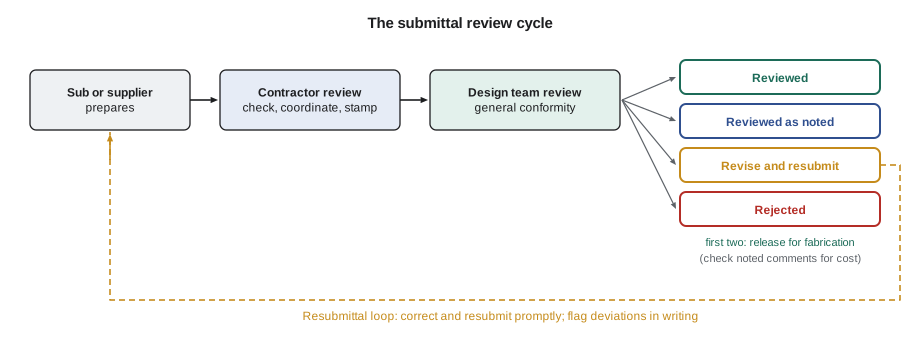
On Westgate, a submittal starts with the subcontractor or supplier who prepares it. It comes to Brightwater, where Hannah or the relevant project engineer checks it before it goes further. That check is not a formality. The contractor's review confirms that the submittal is complete, that field measurements and quantities have been checked, that it is coordinated with other trades, and that it matches the contract documents. Brightwater then stamps it, records it in the submittal log and sends it under a transmittal to Arden Moss, who reviews it or routes it to the responsible consultant.
CCDC 2 2020 requires the Contractor to review Shop Drawings before submitting them, to confirm that it has done so, and to point out in writing any deviations from the contract documents. The Consultant reviews them for general conformity with the design concept. The Contractor remains responsible for errors and omissions in its submittals and for meeting the contract documents.
Review actions
The designer returns each submittal with an action stamp. Wording varies from firm to firm, but the meanings are standard.
| Action | Meaning | What Brightwater does |
|---|---|---|
| Reviewed (or no exceptions taken) | Conforms to the design concept; no comments | Release for fabrication or ordering |
| Reviewed as noted (or make corrections noted) | Conforms if the comments are incorporated | Release with comments; check the comments for cost or time effects |
| Revise and resubmit | Significant problems; must be corrected and reviewed again | Do not release; correct and resubmit promptly |
| Rejected (or not acceptable) | Does not conform; a different approach or product is needed | Do not release; investigate and resubmit |
| Not reviewed (or for record only) | Not a required action submittal, or submitted out of sequence | File; confirm whether a review was needed |
'Reviewed as noted' deserves care. Comments sometimes add requirements that were not in the contract documents, such as a heavier gauge or an extra coat. Hannah reads every comment against the specification. Where a comment changes the scope, she treats it like a changed RFI answer: Brightwater writes within the notice period to say it considers the comment a change, and does not simply absorb the cost.
Review does not transfer responsibility. A designer's review is a check of general conformity with the design intent, not a guarantee that dimensions, quantities, fabrication methods or coordination are correct. If a shop drawing contains an error that the designer misses, the contractor generally still bears the consequences, unless the error came from the contract documents or the deviation was specifically pointed out and accepted.
Deviations and substitutions
Sometimes a submittal departs from the contract documents: a different product, a changed detail, a revised dimension. The contractor must flag any deviation clearly, in writing, on the submittal itself and in the transmittal, so the designer can make a conscious decision. A deviation buried in the fine print of a 200-page product data package and not noticed by the reviewer is not accepted just because the package came back stamped.
Substitutions, where the contractor proposes a product other than the one specified, usually follow their own procedure set out in Division 01, with a request form, a comparison of the proposed and specified products, and a statement of any effect on cost, schedule and other work. Brightwater keeps substitutions out of the normal submittal stream so they are not mistaken for routine reviews.
The submittal register and schedule
At the start of Westgate, Jun built a submittal register by reading every specification section and listing each required submittal: about 640 items. Each item has a specification reference, type, responsible subcontractor, reviewer, and three key dates: when it must be submitted, when the review is due back, and when the material must be on site.
Westgate's Division 01 asks for a submittal schedule within 30 days of award, coordinated with the construction schedule, and allows the Consultant 10 working days for each review unless otherwise agreed. Brightwater's schedule links long-lead submittals directly to the activities they support.
The key is to work backwards from the date material is needed on site. For each item, Brightwater subtracts the delivery and fabrication time, then the review time, then a resubmittal allowance for items likely to need a second cycle, then the time the subcontractor needs to prepare the submittal. The result is the latest date preparation must start.
Worked problem
When must the CLT shop drawings start?
The first floor of CLT panels must be on site by Monday 2026-08-03. The factory needs 10 weeks to fabricate and ship after receiving reviewed shop drawings. Each review takes 10 working days (2 weeks). Brightwater allows one resubmittal cycle of 1 week to correct and 2 weeks to re-review. The factory's engineers need 6 weeks to prepare the first submission. When must preparation start, working in weeks back from the delivery date?
Show solution
- Delivery needed: week of 2026-08-03.
- Fabrication and shipping: 10 weeks back gives 2026-05-25 for released drawings.
- Resubmittal allowance: 1 week to correct plus 2 weeks review = 3 weeks back gives 2026-05-04.
- First review: 2 weeks back gives 2026-04-20 for the first submission.
- Preparation: 6 weeks back gives 2026-03-09 as the latest start.
- Total lead time: 10 + 3 + 2 + 6 = 21 weeks before delivery.
Answer: Preparation must start by about 2026-03-09, 21 weeks before the panels are needed on site.
The calculation shows why long-lead submittals must start in the first weeks of a project, sometimes before the subcontract is even signed. On Westgate, Brightwater issued a letter of intent to the timber supplier so that shop drawing work could begin while the subcontract was finalized.
# Work back from required-on-site dates to latest submittal start dates
from datetime import date, timedelta
items = [  # name, on-site date, fabrication weeks, prep weeks, resubmit expected
    ('CLT panels level 2', date(2026, 8, 3), 10, 6, True),
    ('Curtain wall units', date(2026, 10, 5), 14, 5, True),
    ('Air handling units', date(2026, 11, 2), 16, 2, False),
    ('Door hardware', date(2027, 1, 11), 8, 3, False),
]
review, resub = 2, 3  # weeks
for name, need, fab, prep, again in items:
    weeks = fab + (resub if again else 0) + review + prep
    start = need - timedelta(weeks=weeks)
print(f'{name:20} start by {start} ({weeks} weeks before on-site)')CLT panels level 2 start by 2026-03-09 (21 weeks before on-site) Curtain wall units start by 2026-04-20 (24 weeks before on-site) Air handling units start by 2026-06-15 (20 weeks before on-site) Door hardware start by 2026-10-12 (13 weeks before on-site)
Tracking and expediting
Once submittals are moving, the register becomes a tracking tool. Each week Hannah reviews items due for submission in the next three weeks, items with the designers past their review date, and items returned 'revise and resubmit' that have not yet come back. Like RFIs, the overdue list goes to the weekly meeting. Expediting continues after review: Brightwater tracks fabrication and delivery for long-lead items, with factory visits for the timber and curtain wall.
- Never release fabrication on a submittal that has not been returned with a review action allowing it.
- Distribute reviewed submittals to the field: the installing crew must build from the reviewed shop drawing, not the original contract drawing alone.
- Keep reviewed submittals in the record: they form part of the closeout documentation and are often needed for maintenance.
- Watch for submittals that sit with the subcontractor; slow preparation is as damaging as slow review.
Samples and mock-ups
Samples and mock-ups set standards that drawings cannot. Once approved, they become the benchmark for the work, so they must be labelled, photographed and kept safe until the work is accepted. On Westgate, the approved timber finish samples are stored in a locked cabinet in the site office, each tagged with its submittal number and approval date. The cladding mock-up was photographed from fixed points in daylight and kept on site until the cladding was complete; it was demolished only after Arden Moss confirmed in writing that it was no longer needed.
Electronic review and the record
Almost all Westgate submittals are reviewed electronically. Reviewers mark up PDFs in the platform, apply a digital action stamp and return them under an automatic transmittal. This is faster than paper, but it creates its own risks. Markups made in a reviewer's own software may not survive if the file is flattened or re-saved; comments added after the stamp may never be seen; and a consultant who reviews only the pages relevant to its discipline may leave other pages unreviewed without saying so. Brightwater asks every reviewer to stamp the cover sheet, list the pages reviewed, and return a single flattened PDF so the record shows exactly what came back and when. The platform keeps every version, so if a dispute arises about what a comment said on a given date, the answer is in the file history rather than in anyone's memory.
Common mistakes
MistakeForwarding subcontractor submittals without checking them.
InsteadReview for completeness, field dimensions, coordination and conformity before stamping and sending.
MistakeAssuming the designer's review makes the designer responsible for errors.
InsteadRemember that review is for general conformity; the contractor remains responsible for its submittals.
MistakeHiding a deviation in a large package.
InsteadFlag every deviation clearly in writing on the submittal and transmittal.
MistakeStarting long-lead submittals too late.
InsteadWork back from on-site dates, including review and resubmittal time.
MistakeAccepting 'reviewed as noted' comments without checking their cost.
InsteadRead each comment against the specification and give notice where a comment changes the scope.
Summary and key terms
- Submittals show exactly how the contractor intends to carry out the design: shop drawings, product data, samples, mock-ups, test reports, delegated design and closeout items.
- Action submittals need review before work proceeds; informational submittals are filed for the record.
- The contractor reviews, coordinates and stamps submittals before sending them; the designer reviews for general conformity with the design concept.
- Review actions range from reviewed to rejected; 'reviewed as noted' comments must be checked for changes in scope.
- Deviations must be flagged in writing; substitutions follow their own procedure.
- A submittal register lists every required item; working back from on-site dates sets the latest start for preparation.
- Reviewed submittals must reach the field and the closeout record; samples and mock-ups become benchmarks.
- Submittal
- A document, sample or data package sent by the contractor to show how it will carry out the design.
- Shop drawing
- A drawing prepared by the contractor, subcontractor or supplier showing fabrication and installation details.
- Product data
- Manufacturers' literature and data sheets showing the products proposed.
- Mock-up
- A full-size assembly built to set standards of appearance and performance.
- Delegated design
- Design work the contract assigns to the contractor's own professional engineer.
- Submittal register
- A list of every required submittal with responsibilities and key dates.
- Deviation
- A departure in a submittal from the requirements of the contract documents.
Practice problems
Work each problem on paper first, then reveal the answer to check.
What is the difference between an action submittal and an informational submittal?
Show answer
An action submittal needs the designer's review before work proceeds; an informational submittal is filed for the record without a review action.
Does the designer's review make the designer responsible for dimension errors in a shop drawing?
Show answer
Generally no; review is for general conformity with the design concept, and the contractor stays responsible for its submittals.
Material is needed on 2026-11-02 with 12 weeks of fabrication, 2 weeks of review and 4 weeks of preparation, no resubmittal. When must preparation start?
Show answer
18 weeks earlier: 2026-06-29.
What must the contractor do if its submittal departs from the specification?
Show answer
Flag the deviation clearly in writing on the submittal and in the transmittal so the designer can accept or reject it consciously.
Why keep approved samples locked and labelled?
Show answer
They become the benchmark for accepting the work and may be needed to settle disputes about quality.
Lesson quiz · 5 questions
Score 60% or more to complete this lesson.
Create a free account to save your progress, take quizzes and earn a certificate.