
CON-315 · Lesson 7 of 12 · 24 min
Embeds, sleeves, blockouts and openings
A concrete slab or wall is not just concrete and reinforcing. Before each pour, dozens or hundreds of items must be placed in the forms: steel plates for connections, anchors for cladding and railings, sleeves for pipes and ducts, conduits, floor boxes, drains, blockouts for future openings and inserts for hangers. Once the concrete is placed they are fixed for the life of the building. A missing sleeve means coring through finished concrete, which may be impossible near tendons or heavy reinforcing; a misplaced embed plate means a redesigned connection. This lesson covers how field engineers coordinate, lay out and check embedded items and openings, how to deal with post-tensioning, and how to work safely when concrete has to be cut or drilled after the fact.
What gets embedded
Embedded items come from many trades and suppliers, which is why they are so easy to miss.
| Item | Typical source | Purpose |
|---|---|---|
| Embed plates and angles | Steel fabricator or miscellaneous metals supplier | Connections for steel beams, stairs, canopies, equipment |
| Cladding and curtain wall anchors | Cladding or curtain wall subcontractor | Attachment of the envelope to slab edges |
| Railing and guard anchors | Miscellaneous metals supplier | Balcony and stair guards |
| Sleeves | Mechanical, plumbing, electrical and fire protection trades | Passages for pipes, ducts and conduits through slabs and walls |
| Embedded conduit and boxes | Electrical and low-voltage trades | Power and data in floors and walls |
| Floor drains and cleanouts | Plumbing trade | Drainage of wet areas, podium roof and parking |
| Inserts and hanger anchors | Mechanical, electrical and fire protection trades | Supports for services hung from the slab |
| Blockouts and openings | Formwork crew to the drawings | Shafts, stairs, future penetrations, recesses |
| Hold-down couplers and anchors | Wood framer or hold-down supplier | Anchoring the wood-frame shear walls into the podium |
On Larkspur Commons, the level 3 transfer slab, which carries the four wood-frame storeys above the podium, is the most crowded pour. It contains embed plates for the canopy and stairs, cladding anchors along two edges, hold-down rod couplers for every shear wall above, roof drains for the podium amenity deck, dozens of sleeves for plumbing and electrical risers and the post-tensioning tendons that run through all of it.
Coordinating embeds before the forms go up
Embed coordination starts weeks before the pour. Each trade's sleeve and embed drawings must be compared with the structural drawings, the post-tensioning shop drawings and each other. Building information modelling makes this easier, because each trade's sleeves can be placed in a coordinated model and checked for clashes with structure and tendons (CON-260). On Larkspur Commons, the mechanical, electrical and plumbing trades model their sleeves, and Mei runs a clash review against the structural and post-tensioning models two weeks before each pour.
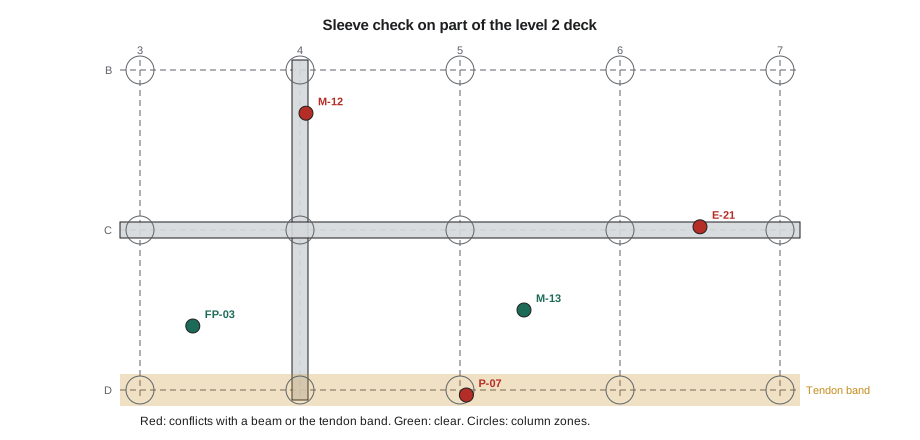
Even with a model, field engineers often perform a simple rule-based check of sleeve locations: no sleeves through beams unless detailed, no sleeves within a set distance of column centres where punching shear is critical, and no sleeves in the banded tendon zones unless the post-tensioning designer has approved them. The structural general notes usually give these rules. The example checks five level 2 sleeves against beams, a tendon band and the column zones.
# Check level 2 sleeves against beams, tendon bands and column zones (plan coordinates in mm from A/1)
sleeves = {  # id: (x, y, diameter) ; x along grids 1..9, y along grids A..F
    "M-12": (23400 + 450, 7800 + 2100, 300),
    "M-13": (31200 + 3000, 15600 + 3900, 150),
    "P-07": (31200 + 300, 23400 + 600, 100),
    "E-21": (39000 + 3900, 7800 + 7650, 100),
    "FP-03": (15600 + 2600, 31200 + 3900, 150),
}
beams = [  # rectangles (x1, y1, x2, y2): beams along grid lines, 600 mm wide
    (23100, 0, 23700, 39000),          # beam on grid 4
    (0, 15300, 62400, 15900),          # beam on grid C
]
tendon_bands = [(0, 22800, 62400, 24000)]   # banded tendons along grid D, 1200 mm wide
column_zone = 450                            # keep sleeves this far from column middles
columns = [(i * 7800, j * 7800) for i in range(9) for j in range(6)]

def hits_rect(x, y, r, rect, clear=50):
    x1, y1, x2, y2 = rect
    return x1 - r - clear < x < x2 + r + clear and y1 - r - clear < y < y2 + r + clear

for sid, (x, y, d) in sleeves.items():
    r = d / 2; problems = []
    if any(hits_rect(x, y, r, b) for b in beams): problems.append("beam")
    if any(hits_rect(x, y, r, t) for t in tendon_bands): problems.append("tendon band")
    if any(abs(x - cx) < column_zone + r and abs(y - cy) < column_zone + r for cx, cy in columns): problems.append("column zone")
print(f"{sid:5s} at ({x:6d}, {y:6d}) dia {d} mm: {'CONFLICT: ' + ', '.join(problems) if problems else 'clear'}")M-12 at ( 23850, 9900) dia 300 mm: CONFLICT: beam M-13 at ( 34200, 19500) dia 150 mm: clear P-07 at ( 31500, 24000) dia 100 mm: CONFLICT: tendon band E-21 at ( 42900, 15450) dia 100 mm: CONFLICT: beam FP-03 at ( 18200, 35100) dia 150 mm: clear
Three of five sleeves conflict: M-12 and E-21 fall within beams, and P-07 sits in the banded tendon zone along grid D. Mei groups the conflicts into one question to the structural engineer and the post-tensioning designer, with proposed moves for each sleeve, and copies the trades. Finding these conflicts two weeks before the pour costs an hour of work. Finding them on pour morning, or after the pour, costs far more.
The embed register
An embed register is a list of every embedded item for each pour, with its location, type, supplier, drawing reference and status. It is the backbone of embed coordination. The register shows who must supply each item, when it must arrive, who sets it and who checks it. Missing items are much easier to spot in a list than on a crowded deck.
Two days before the level 3 transfer slab pour, Mei reviews the register to see what is not yet ready.
# Embed register for the level 3 transfer slab pour: is every item ready? (invented data)
from collections import Counter
register = [  # (id, type, supplier, status)
    ("EP-01", "embed plate, canopy beam", "steel fabricator", "set and checked"),
    ("EP-02", "embed plate, canopy beam", "steel fabricator", "set and checked"),
    ("EP-07", "embed plate, stair landing", "steel fabricator", "set, not checked"),
    ("CW-01..CW-38", "cladding anchors, north edge", "cladding subcontractor", "set and checked"),
    ("CW-39..CW-74", "cladding anchors, east edge", "cladding subcontractor", "delivered, not set"),
    ("HD-01..HD-24", "hold-down rod couplers for wood frame", "framer", "set and checked"),
    ("SL-M", "mechanical sleeves (31)", "mechanical", "set and checked"),
    ("SL-E", "electrical sleeves (18)", "electrical", "set, 2 relocated per RFI 22"),
    ("FD-01..FD-06", "floor drains, podium roof", "plumbing", "on order"),
]
ready = {"set and checked"}
count = Counter("ready" if s in ready else "not ready" for *_, s in register)
print(f"Lines ready: {count['ready']} of {len(register)}")
for item_id, kind, who, status in register:
    if status not in ready:
print(f" HOLD {item_id:13s} {kind:38s} {who:22s} {status}")Lines ready: 5 of 9 HOLD EP-07 embed plate, stair landing steel fabricator set, not checked HOLD CW-39..CW-74 cladding anchors, east edge cladding subcontractor delivered, not set HOLD SL-E electrical sleeves (18) electrical set, 2 relocated per RFI 22 HOLD FD-01..FD-06 floor drains, podium roof plumbing on order
Only five of nine lines are ready. The stair embed plate is set but not checked, which Arjun can fix that afternoon. The east-edge cladding anchors have arrived but are not set, so the cladding subcontractor's crew must be scheduled before the pour. Two electrical sleeves have been moved following an answered question and must be checked in their new positions. The podium roof drains are still on order, which is serious: without them the pour cannot proceed unless the design team accepts blockouts for later installation. Mei raises the drains with Priya and Dana at once. The register makes the holds visible early enough to act.
Setting and fixing embeds
Embeds must stay where they are set while concrete is placed and vibrated. Poorly fixed items float, tilt or move. Good practice includes fixing plates to the formwork with screws or nails through dedicated holes, tying sleeves to the reinforcing or to the form deck, using templates for groups of anchors, protecting threads and openings with tape or caps, and labelling each item on the form so that the inspector and the finishers can see what it is.
The field engineer marks embed locations on the deck from offset lines and the drawings, the trades set their items, and then the field engineer or the trade foremen check each item against the register before the pour. For critical items, such as cladding anchors and embed plates for steel connections, the field engineer measures and records each one. For sleeves, a combination of measurement and a walk with the trade foremen is common.
Edge embeds for cladding need particular attention because the slab edge is also where formwork tolerances are largest (lesson 6). Setting cladding anchors from a string line or offset line rather than from the edge form, and checking them after stripping, gives the cladding contractor the information it needs. On Larkspur Commons, the cladding subcontractor surveys every anchor after the pour and designs its brackets for the as-built positions, within the ±20 mm adjustment allowed by the system.
Blockouts and openings
Openings in slabs and walls range from large shafts and stairwells to small recesses for floor boxes. Large openings are shown on the structural drawings, with added reinforcing around them. Small openings may appear only on trade drawings. Each opening needs a defined size, position and edge treatment, and each must be protected after the pour.
Openings in slabs are a fall hazard during construction. Any opening large enough for a person or a foot to go through must be covered with a secured, labelled cover able to carry the expected loads, or guarded with guardrails, under occupational health and safety rules (CON-355). Covers must be marked so that nobody mistakes them for loose sheets of plywood. The field engineer's layout of openings should include where covers will go, and openings should never be left unprotected between stripping and the next trade's work.
Future openings are sometimes formed as blockouts filled later, or left as thinned areas with extra reinforcing that can be cut through later. Each approach must be documented, because a future tenant or trade will rely on the information to cut safely.
Post-tensioned slabs
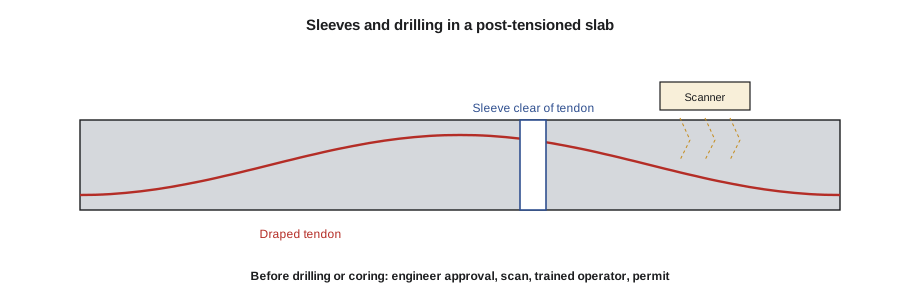
Post-tensioned slabs contain high-strength steel tendons that are stressed after the concrete gains strength. The tendons hold large forces permanently. Cutting or damaging a tendon can cause it to release suddenly, which is dangerous to anyone nearby and can damage the slab's capacity. For field engineers, post-tensioning raises three issues: coordinating embeds and sleeves with the tendon layout, marking tendon locations for the future, and controlling any drilling or coring after the pour.
The post-tensioning supplier's shop drawings show tendon profiles and locations. Sleeves and embeds should be coordinated with them before the pour, and tendons may need to be deviated around sleeves within the limits set by the designer. After the pour, many contractors mark the tendon locations on the slab soffit or record them in as-built drawings, because anyone who drills into the slab later needs to know where they are.
Scanning before cutting, coring or drilling
No matter how good the coordination, some holes will be drilled or cored after concrete is placed: a missed sleeve, a changed fixture location or an added anchor. Before any cutting, coring or drilling into structural concrete, three things should happen. First, the structural engineer approves the location, size and method, because the hole may cut reinforcing or reduce capacity. Second, the area is scanned to locate tendons, reinforcing, conduits and pipes. Third, the work is done by trained operators following the approved method.
Ground-penetrating radar is the most common scanning method on building sites. It is quick and safe, but it has limits: it may struggle to see beneath dense reinforcing, through wet concrete or to great depths, and its results need interpretation by a trained technician. Radiography, which uses X-rays or gamma rays to image the concrete, can see more detail but requires licensed operators and exclusion zones because of the radiation hazard.
In Canada, radiography sources and devices are regulated by the Canadian Nuclear Safety Commission, and operators must be certified; in practice radiography is usually done at night or when the area can be cleared. The field engineer coordinates scanning, keeps the reports with the layout records and ensures that marked locations are respected.
Scanning reduces risk; it does not remove it. Drilling should still follow the approved location and depth, and drillers should stop immediately if they hit steel that was not expected. A clear rule on Larkspur Commons is that no one cores or drills the post-tensioned transfer slab without a signed permit that records the engineer's approval and the scan results.
The embed walk
Before every pour on Larkspur Commons, Mei leads an embed walk with the foremen of each trade that has items in the pour. The walk follows the register, checks each item in place and records the result. It also gives the foremen a last chance to spot items that are missing from the register or have changed. The walk is followed by the pour card sign-off described in lesson 4.
| Embed walk step | Purpose |
|---|---|
| Review the register and recent answered questions | Make sure everyone is checking the current list |
| Walk the deck by grid zone with each trade | Check each item for location, type, fixing and protection |
| Measure critical items | Record positions of embed plates, cladding anchors and hold-down couplers |
| Check against tendons and reinforcing | Confirm sleeves are clear of tendons and beams as approved |
| Check openings and covers | Confirm openings are formed correctly and covers are planned |
| Record and sign | Update the register, note holds and sign the pour card only when complete |
Common mistakes
MistakeRelying on each trade to remember its own embeds.
InsteadKeep an embed register for each pour and walk it with the trades before signing the pour card.
MistakePlacing sleeves where they are convenient without checking structure.
InsteadCheck sleeves against beams, column zones and tendon bands, and get approval for any exceptions.
MistakeFixing embeds only to the reinforcing where they may float or tilt.
InsteadFix embeds securely to the forms or templates so they stay put during the pour.
MistakeCoring a slab after only a quick look.
InsteadGet the structural engineer's approval, scan the area and use trained operators under a permit.
MistakeLeaving openings uncovered after stripping.
InsteadInstall secured, labelled covers or guardrails as soon as openings exist.
Summary and key terms
- Embedded items come from many trades and are fixed for the life of the building once concrete is placed.
- Coordinate embeds and sleeves with structure and post-tensioning weeks before each pour, using models and simple rules.
- An embed register lists every item with its location, supplier and status, and shows holds early.
- Embeds must be fixed securely and labelled; critical items are measured and recorded.
- Openings need defined sizes and positions, and must be covered or guarded as fall hazards.
- Post-tensioning tendons hold large forces; sleeves and embeds must be coordinated with them and their locations recorded.
- Any cutting, coring or drilling needs engineering approval, scanning and trained operators.
- A pre-pour embed walk with the trades completes the check before the pour card is signed.
- Embedded item
- Any item cast into concrete, such as a plate, anchor, sleeve, conduit or drain.
- Sleeve
- A tube cast into a slab or wall to provide a passage for a pipe, duct or conduit.
- Blockout
- A formed void in concrete that leaves an opening or recess.
- Embed register
- A list of every embedded item in a pour with its location, type, supplier and status.
- Tendon
- A high-strength steel strand or bundle in a post-tensioned element that is stressed after the concrete cures.
- Banded tendons
- Tendons grouped in a narrow band, usually along column lines.
- Ground-penetrating radar
- A scanning method that uses radio waves to locate objects within concrete.
- Embed walk
- A pre-pour inspection of every embedded item with the trades, following the register.
Practice problems
Work each problem on paper first, then reveal the answer to check.
Name four types of embedded item and the trades that supply them.
Show answer
Embed plates from the steel fabricator, cladding anchors from the cladding subcontractor, sleeves from mechanical and electrical trades, drains from plumbing, hold-down couplers from the framer.
Why is the level 3 transfer slab the most crowded pour on Larkspur Commons?
Show answer
It contains canopy and stair embeds, cladding anchors, hold-down couplers, drains, many sleeves and post-tensioning tendons.
In the sleeve check, which sleeves conflicted and with what?
Show answer
M-12 and E-21 with beams, P-07 with the tendon band.
What was the most serious hold in the embed register example, and why?
Show answer
The podium roof drains were still on order; without them the pour could not proceed unless blockouts were accepted.
Why should cladding anchors be surveyed after the pour?
Show answer
So the cladding contractor can design brackets for the as-built positions within its adjustment range.
Why are post-tensioning tendons dangerous to cut?
Show answer
They hold large forces and can release suddenly, injuring people and reducing slab capacity.
What three things should happen before coring structural concrete?
Show answer
Structural engineer's approval, scanning to locate tendons and reinforcing, and trained operators following the approved method.
What are two limitations of ground-penetrating radar?
Show answer
It can struggle under dense reinforcing, in wet concrete or at depth, and results need trained interpretation.
Lesson quiz · 5 questions
Score 60% or more to complete this lesson.
Create a free account to save your progress, take quizzes and earn a certificate.