
CON-230 · Lesson 2 of 12 · 31 min
Water supply and plumbing fixtures
Plumbing is the oldest building service and still one of the most regulated, because a plumbing failure can make people sick. A building's water supply system brings safe drinking water from the municipal main or a well, measures it, protects it from contamination, distributes it at a usable pressure, heats part of it, and delivers it to fixtures. Lesson 3 follows the water back out through the drainage system. This lesson covers the supply side: the service and meter, pressure, materials, backflow protection, hot water, fixtures and the way designers size pipes.
For the construction manager, water supply work is mostly rough-in hidden in walls and ceilings, tested under pressure, inspected, then covered. Mistakes are expensive to find later. Understanding the system helps you sequence the work, organize pressure tests and inspections, review submittals for fixtures and water heaters, and recognize when a field change might affect water quality or code compliance.
The water service and meter
The supply begins at the municipal water main in the street. A service pipe runs from the main, through a curb stop or service valve at the property line, to the building, where it enters below the frost line, passes through a main shut-off valve and a water meter, and then through a backflow preventer that stops building water from flowing back into the public system. Large buildings may have a separate fire service for sprinklers, often with its own backflow preventer and meter arrangement, as lesson 7 explains.
Frost protection matters in a Canadian climate. Service pipes are typically buried 1.5 to 2.5 metres deep depending on the region, and municipalities set minimum cover in their standards. Meter rooms and service entries must stay above freezing, and exposed piping in unheated spaces needs insulation and, sometimes, heat tracing.
The construction manager coordinates the service connection with the municipality or water utility, which usually performs or inspects the tap into the main and may have long waiting times for connection permits and meters. Temporary water for construction is a separate early arrangement, often through a hydrant meter.
Pressure: static, residual and the effect of height
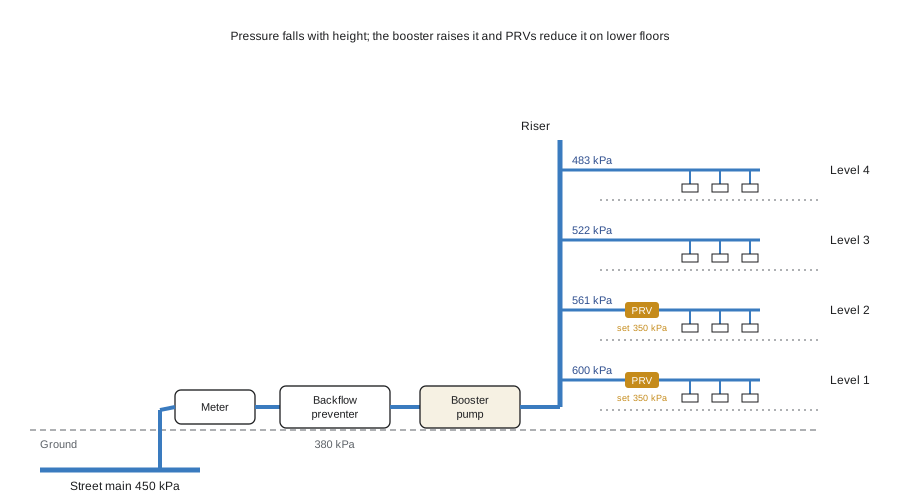
Water pressure is what pushes water up through the building and out of fixtures. Static pressure is the pressure when no water is flowing; residual pressure is the pressure while water is flowing, which is lower because of friction. Each metre of height costs about 9.81 kPa (each foot costs about 0.433 psi), so upper floors of tall buildings receive less pressure than the ground floor.
Fixtures need a minimum flowing pressure to work well, typically around 100 to 140 kPa (15 to 20 psi) for ordinary fixtures and more for flush valves. Too much pressure is also a problem: it wastes water, wears out fixtures and causes noise and water hammer.
The National Plumbing Code requires a pressure-reducing valve where the static pressure at a fixture can exceed 550 kPa, so supply systems are often divided into pressure zones. Low pressure on upper floors is solved with booster pumps.
Worked problem
Pressure at the top floor
The municipal main delivers 450 kPa static pressure at street level. The highest fixture is 18 metres above the main. Friction losses at design flow through the meter, backflow preventer and piping are estimated at 120 kPa. Will a fixture needing 140 kPa flowing pressure work?
Show solution
- Elevation loss: 18 × 9.81 = 176.6 kPa.
- Available after elevation: 450 − 176.6 = 273.4 kPa.
- Subtract friction: 273.4 − 120 = 153.4 kPa.
- 153.4 kPa exceeds 140 kPa, so the fixture works, but with little margin; a lower street pressure in summer could leave it short.
Answer: About 153 kPa is available, enough but marginal; the engineer may specify a booster pump.
Piping materials
Water supply piping must be approved for potable water, which in practice means certified to NSF/ANSI 61 for health effects and, for lead content, NSF/ANSI 372. Common materials include:
- Copper tube (types K, L and M), joined by soldering, brazing or press fittings; durable, but costly and sensitive to aggressive water.
- Cross-linked polyethylene (PEX), flexible and fast to install with crimp or expansion fittings, widely used in residential and increasingly in commercial work.
- Chlorinated polyvinyl chloride (CPVC), solvent-welded, used for hot and cold water in some buildings.
- Stainless steel and ductile iron for larger mains and services; polypropylene (PP-R) in some commercial systems.
Lead-free requirements apply in both countries. In Canada, the plumbing codes reference CSA B125.1 and NSF/ANSI 372 for fittings, and Health Canada's guideline for lead in drinking water is 0.005 mg/L.
Material substitutions are a common source of submittal questions. A change from copper to PEX may be acceptable to the code and cheaper, but it can affect fire stopping, support spacing, thermal expansion and the owner's maintenance preferences, so it needs the engineer's approval.
Backflow and cross-connection control
A cross-connection is any link between the potable water system and a source of contamination: a hose in a mop sink, a boiler fill line, a chemical dispenser, an irrigation system or a fire sprinkler system. If pressure in the supply drops, for example during a main break or heavy fire flow, contaminated water can be siphoned back (back-siphonage) or pushed back by higher pressure (backpressure).
The defences, from simplest to most protective, are:
- Air gaps, a physical space between the outlet and the flood level of the receptor; the most reliable protection.
- Atmospheric and pressure vacuum breakers, for back-siphonage on hose bibbs and irrigation.
- Double check valve assemblies, for low-hazard connections such as many fire sprinkler systems.
- Reduced pressure principle assemblies (RP or RPZ), for high-hazard connections such as boilers with chemical treatment, labs and medical equipment.
Backflow devices in Canada are certified to the CSA B64 series, and their selection, installation and testing follow CSA B64.10. Most municipalities run cross-connection control programs that require testable devices to be tested by a certified tester at installation and annually.
Reduced pressure assemblies discharge water when they operate, so they need a floor drain or air gap nearby; this is a frequent coordination miss in mechanical rooms.
Hot water
Domestic hot water can be generated by storage tanks (gas or electric), tankless or instantaneous heaters, boilers with indirect tanks, or heat pump water heaters, which are increasingly required to meet energy targets. Large buildings use a recirculation loop so that hot water reaches distant fixtures quickly.
Temperature is a safety balance. Water must be stored hot enough to control Legionella bacteria, typically at least 60 °C (140 °F), but delivered cool enough to avoid scalding, typically no more than 49 °C (120 °F) at fixtures such as showers and lavatories, through thermostatic mixing valves. Building water management programs, guided by ASHRAE 188 in both countries, address Legionella risk in larger buildings.
Worked problem
Energy to heat a storage tank
A 300-litre tank is filled with water at 10 °C and heated to 60 °C. How much energy is needed, and how long does a 12 kW electric element take?
Show solution
- Mass of water: 300 L ≈ 300 kg.
- Energy: Q = m c ΔT = 300 × 4.186 × (60 − 10) = 62,790 kJ.
- Convert: 62,790 kJ ÷ 3,600 = 17.4 kWh.
- Time: 17.4 kWh ÷ 12 kW = 1.45 hours, ignoring standby losses.
Answer: About 17.4 kWh, roughly 1.5 hours with a 12 kW element.
Fixtures and fixture counts
The building code sets the minimum number of water closets, urinals, lavatories, drinking fountains and service sinks from the occupant load and the occupancy type, and requires accessible and, increasingly, universal washrooms. Water efficiency standards set maximum flow rates: for example, about 4.8 litres (1.28 gallons) per flush for high-efficiency toilets and about 1.9 litres per minute (0.5 gpm) for public lavatory faucets, though the exact limits depend on the code edition and the green building program.
Fixture counts in Canada come from the National Building Code (Subsection 3.7.2) or the provincial code, which set the number of fixtures by occupancy and number of persons of each sex, with provisions for universal washrooms.
Worked problem
Counting required water closets
An office floor has an occupant load of 180, split evenly between men and women. Using an illustrative ratio of one water closet per 25 persons of each sex for the first 50 and one per 50 thereafter (check the actual table in the adopted code), how many water closets are required for women?
Show solution
- Women: 180 ÷ 2 = 90.
- First 50: 50 ÷ 25 = 2.
- Remaining 40: 40 ÷ 50 = 0.8, rounded up to 1.
- Total for women: 2 + 1 = 3 water closets (the code may allow urinals to substitute for some men's water closets).
Answer: 3 water closets for women; check the adopted table and local amendments.
How pipes are sized
Pipe sizing is the engineer's job, but the method is worth understanding. Not every fixture runs at once, so designers estimate a probable peak demand. The traditional method assigns each fixture a number of water supply fixture units, adds them up, and converts the total to a design flow using Hunter's curve, then sizes each pipe so that velocity stays within limits (often around 1.5 to 2.4 m/s, or 5 to 8 ft/s) and pressure stays above fixture minimums. Newer methods, such as the Water Demand Calculator in Appendix M of the IPC and UPC, estimate peak demand from modern low-flow fixtures and often allow smaller pipes for dwellings.
Worked problem
Checking velocity in a pipe
A 50 mm (inside diameter 52.5 mm) copper main carries a design flow of 3.0 L/s. What is the velocity?
Show solution
- Area: π × (0.0525)² ÷ 4 = 0.002165 m².
- Flow: 3.0 L/s = 0.0030 m³/s.
- Velocity: 0.0030 ÷ 0.002165 = 1.39 m/s.
- That is below the usual upper limits of about 1.5 to 2.4 m/s, so noise and erosion should not be a problem.
Answer: About 1.4 m/s, acceptable.
Testing, disinfection and handover
Before concealment, water piping is pressure tested. The National Plumbing Code requires water systems to be tested at the greater of the maximum working pressure or a specified test pressure, commonly with water at about 1,000 kPa or as the code and specification require, held without leakage. Before use, the system is flushed and disinfected, typically with a chlorine solution held for a set period, and water samples are tested for bacteria.
The construction manager should schedule tests floor by floor, witness them with the inspector or engineer as required, record results, and keep disinfection reports for the closeout package. Newly built systems that sit unused before occupancy can develop stagnant water and Legionella risk, so flushing plans before turnover are increasingly part of commissioning.
Common mistakes
MistakeAssuming municipal pressure is constant.
InsteadUse the lowest expected pressure, check upper floors, and confirm whether booster pumps or pressure-reducing valves are needed.
MistakeForgetting the drain for a reduced pressure backflow assembly.
InsteadEvery RP assembly discharges water; provide a floor drain or air gap sized for its flow.
MistakeSubstituting pipe materials without approval.
InsteadSubmit substitutions; they affect code compliance, fire stopping, expansion and maintenance.
MistakeSetting water heaters below 60 °C to save energy or prevent scalding.
InsteadStore hot enough to control Legionella and use mixing valves to deliver safe temperatures.
MistakeCovering piping before testing and inspection.
InsteadTest, inspect and record each section before walls and ceilings close.
Summary and key terms
- The water service runs from the main through a valve, meter and backflow preventer into the building.
- Each metre of height costs about 9.81 kPa; pressure-reducing valves are required above 550 kPa static.
- Potable water materials must meet health and lead-free standards; substitutions need approval.
- Air gaps, vacuum breakers, double checks and reduced pressure assemblies protect against backflow.
- Store hot water at about 60 °C (140 °F) and deliver it at no more than about 49 °C (120 °F).
- The building code sets minimum fixture counts; efficiency standards set maximum flows.
- Supply piping is pressure tested, flushed and disinfected before use, with records kept for closeout.
- Static pressure
- Water pressure when no water is flowing.
- Residual pressure
- Water pressure while water is flowing, reduced by friction losses.
- Pressure-reducing valve (PRV)
- A valve that lowers downstream water pressure to a set value.
- Booster pump
- A pump that raises water pressure for upper floors or high-demand areas.
- Cross-connection
- Any link between potable water and a possible source of contamination.
- Backflow
- Reverse flow of water or other substances into the potable supply.
- Air gap
- An unobstructed vertical space between a water outlet and the flood level of a receptor.
- Reduced pressure assembly
- A testable backflow preventer for high-hazard connections that relieves water to atmosphere.
- Water supply fixture unit
- A measure of a fixture's probable demand used to size piping.
- Thermostatic mixing valve
- A valve that blends hot and cold water to deliver a safe, steady temperature.
Practice problems
Work each problem on paper first, then reveal the answer to check.
How much pressure is lost over a rise of 30 metres?
Show answer
About 294 kPa.
What is the difference between static and residual pressure?
Show answer
Static is with no flow; residual is while water flows and is lower because of friction.
Above what static pressure must a PRV be provided?
Show answer
550 kPa.
Name the most reliable form of backflow protection.
Show answer
An air gap.
Which backflow device suits a boiler with chemical treatment?
Show answer
A reduced pressure principle assembly.
Why are water heaters set to about 60 °C (140 °F)?
Show answer
To control Legionella growth.
What device keeps shower water at a safe temperature?
Show answer
A thermostatic mixing valve.
How much energy heats 200 L of water by 40 °C?
Show answer
200 × 4.186 × 40 = 33,488 kJ, about 9.3 kWh.
Why can't you simply add all fixture flows to size a main?
Show answer
Not all fixtures run at once; designers estimate probable peak demand.
What must happen before new water piping is used?
Show answer
Pressure testing, flushing, disinfection and bacteriological testing.
Lesson quiz · 5 questions
Score 60% or more to complete this lesson.
Create a free account to save your progress, take quizzes and earn a certificate.