
CON-130 · Lesson 3 of 12 · 33 min
Perimeters and areas of plane shapes
Areas drive a large share of every construction estimate. Floors, walls, ceilings, roofs, paving, formwork contact surfaces, insulation, membranes and paint are all measured and priced by area, and perimeters measure footings, curbs, baseboards, fences, edge forms and flashing. The shapes on drawings are rarely simple rectangles: buildings have notches and bays, sites have curved and irregular boundaries, and walls are interrupted by doors and windows. This lesson builds a toolkit of area and perimeter formulas, shows how to break complex shapes into simple ones, and introduces three methods for irregular shapes: the trapezoidal rule, Simpson's rule and Heron's formula for triangles measured only by their sides.
Throughout the lesson, keep two habits. First, sketch the shape and label every dimension before calculating; most area errors come from using the wrong dimension, not from bad arithmetic. Second, write units on every line, because area units are squared and a missing square sign is the beginning of a conversion error.
Perimeter
The perimeter of a shape is the total length around its edge. For a rectangle it is twice the sum of the length and width. For a polygon it is the sum of all sides. For a circle the perimeter is called the circumference.
A useful shortcut applies to any shape made only of horizontal and vertical edges, such as an L-shaped or stepped building outline: its perimeter equals the perimeter of the smallest rectangle that encloses it, as long as the notches are on the outside corners and do not cut deep inlets into the middle of a side. The horizontal steps add up to the overall length and the vertical steps add up to the overall width. Inlets cut into a side, however, add twice their depth.
Perimeters in takeoffs usually need a decision about which line to measure. A strip footing is often measured along its centre line, because using the outside perimeter overstates corners and using the inside understates them. For a rectangular building, the centre-line perimeter equals the outside perimeter minus four times the footing width, or the inside perimeter plus four times the width. Lesson 4 applies this rule to footing volumes.
Areas of basic shapes
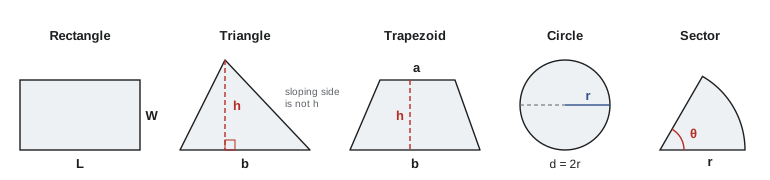
The table collects the area formulas used most often in construction. Each assumes consistent units: multiply metres by metres to get square metres, feet by feet to get square feet.
| Shape | Area | Typical use |
|---|---|---|
| Rectangle or square | A = L × W | Rooms, slabs, wall panels |
| Parallelogram | A = base × perpendicular height | Skewed parking stalls, ramps in plan |
| Triangle | A = ½ × base × perpendicular height | Gable ends, site corners, stair stringers |
| Trapezoid | A = ½ × (a + b) × h, with a and b the parallel sides | Hip roof faces, tapered lots, embankments |
| Circle | A = π r² = π d² ÷ 4 | Column bases, tanks, manholes |
| Sector of a circle | A = (θ ÷ 360°) × π r² | Curved driveways, radial walls |
| Ring (annulus) | A = π (R² − r²) | Tank walls in plan, pipe sections |
| Ellipse | A = π a b, with a and b the half-axes | Feature planters, oval rooms |
The perpendicular height is the most frequently misused dimension. The sloping side of a triangle or parallelogram is not its height; using it overstates the area. Gable ends, sloping sites and trapezoidal roof faces should be drawn with the perpendicular height shown explicitly before calculating.
Composite shapes
Most real outlines are composite shapes made of rectangles, triangles and curves. There are two strategies, and it is good practice to use one to calculate and the other to check.
- Addition: divide the shape into non-overlapping simple shapes, calculate each area and add them.
- Subtraction: take an enclosing simple shape, then subtract the missing pieces, such as a notch, a courtyard or an opening.
Label each piece on a sketch and tabulate its dimensions and area. A table makes the calculation easy to check, easy to revise when drawings change and easy for someone else to follow. Estimating software does the same thing behind the scenes, and understanding the hand method lets you check what the software reports.
Worked problem
Area and perimeter of an L-shaped floor
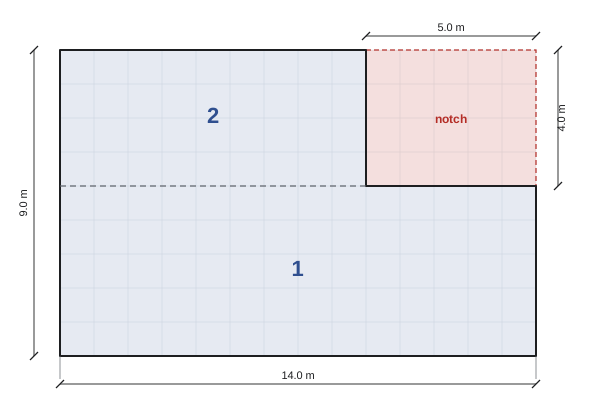
A building has an L-shaped footprint measured to the outside of the walls: an enclosing rectangle of 14.0 m × 9.0 m with a 5.0 m × 4.0 m notch removed from one corner. Find the floor area and the outside perimeter, and check the area by the addition method.
Show solution
- Subtraction: 14.0 × 9.0 = 126.0 m²; notch 5.0 × 4.0 = 20.0 m²; area = 106.0 m².
- Addition: split into a 14.0 × 5.0 m strip (70.0 m²) and a 9.0 × 4.0 m strip (36.0 m²), because the remaining part is 14.0 − 5.0 = 9.0 m long and 9.0 − 5.0 = 4.0 m wide: 70.0 + 36.0 = 106.0 m². The two methods agree.
- Perimeter: the notch is at a corner, so the perimeter equals that of the enclosing rectangle: 2 × (14.0 + 9.0) = 46.0 m.
- Check by adding the six sides: 14.0 + 5.0 + 9.0 + 4.0 + 5.0 + 9.0 = 46.0 m.
Answer: Floor area 106.0 m²; perimeter 46.0 m.
Circles and curves
Circular and curved elements appear in tanks, columns, manholes, planters, curved walls and the radii at the corners of curbs and driveways. Use π to at least four figures (3.1416) or the calculator key. When a drawing gives a diameter, remember to halve it before squaring, or use the diameter form of the formula, A = π d² ÷ 4. The arc length of a sector, needed for curved edge forms and curbs, is a fraction of the circumference.
Worked problem
A circular tank pad and a curved curb
A circular concrete pad for a tank is 6.0 m (19.7 ft) in diameter. (a) What is its area? (b) What length of edge form is needed? (c) At the entrance to the site, a curb follows a 90° curve with a radius of 9.0 m (29.5 ft) measured to the face of the curb. How long is the curved curb?
Show solution
- (a) r = 3.0 m; A = π × 3.0² = 28.27 m². In feet: π × 19.7² ÷ 4 = 304.8 ft², about 304.3 ft² if you start from the exact 19.685 ft.
- (b) Circumference = π × 6.0 = 18.85 m (61.8 ft).
- (c) s = (90 ÷ 360) × 2π × 9.0 = 0.25 × 56.55 = 14.14 m. In feet: 0.25 × 2π × 29.5 = 46.3 ft.
- Check: a quarter circle of radius 9 is a little longer than the straight chord between its ends, 9 × √2 = 12.7 m, so 14.1 m is reasonable.
Answer: Pad area about 28.3 m² (304 ft²); edge form 18.85 m (61.8 ft); curved curb 14.1 m (46.3 ft).
Wall areas and openings
Walls are measured as gross area, the perimeter times the height, less openings. Painters, drywall installers and cladding contractors each have rules about which openings to deduct: many estimators do not deduct small openings, because cutting around them takes as much time and wastes as much material as covering them, and deduct only openings above a stated size. The estimate should state the rule used so that quantities can be compared fairly.
Worked problem
Net wall area for painting
A room is 5.4 m × 4.2 m with a 2.7 m ceiling. It has one door 0.9 m × 2.1 m and two windows 1.5 m × 1.2 m. The paint covers 10 m² per litre per coat and two coats are needed. Find the net wall area and the paint required, and the number of 3.78 L cans.
Show solution
- Perimeter = 2 × (5.4 + 4.2) = 19.2 m.
- Gross wall area = 19.2 × 2.7 = 51.84 m².
- Openings = 0.9 × 2.1 + 2 × 1.5 × 1.2 = 1.89 + 3.60 = 5.49 m².
- Net area = 51.84 − 5.49 = 46.35 m².
- Paint = 46.35 × 2 coats ÷ 10 m²/L = 9.27 L, so three 3.78 L cans (11.3 L) are needed.
Answer: Net wall area 46.35 m²; about 9.3 L of paint, so three cans.
Irregular shapes: the trapezoidal rule
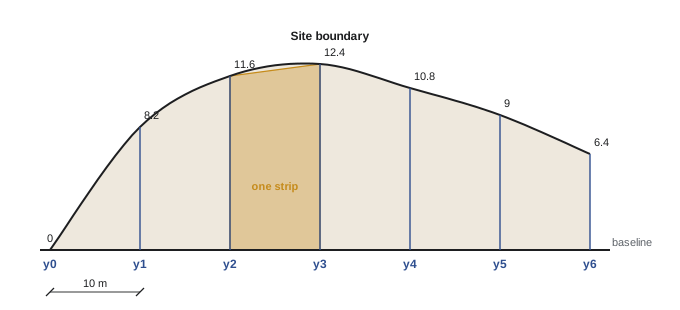
Sites, ponds, cut slopes and curved boundaries often have no simple formula. A practical method is to draw a straight baseline through or along the shape and measure perpendicular offsets from the baseline to the boundary at equal intervals. Each strip between two offsets is then treated as a trapezoid. Adding the trapezoids gives the trapezoidal rule.
Here h is the interval between offsets and y₀ to yₙ are the offsets. The first and last offsets count half; all the others count fully. The rule treats the boundary between offsets as straight lines, so it slightly underestimates areas bounded by outward-curving edges and overestimates those bounded by inward-curving edges. Closer offsets make it more accurate.
Irregular shapes: Simpson's rule
Simpson's rule fits curves rather than straight lines through each group of three offsets, so it is usually more accurate for smoothly curving boundaries. It needs an even number of intervals, which means an odd number of offsets.
Odd-numbered offsets are multiplied by 4, even-numbered interior offsets by 2, and the first and last by 1. If a survey has an odd number of intervals, apply Simpson's rule to all but the last interval and the trapezoidal rule to the last one.
Worked problem
Area of an irregular site by two methods
Offsets measured at 10 m intervals from a straight baseline to a curved site boundary are 0, 8.2, 11.6, 12.4, 10.8, 9.0 and 6.4 m. Estimate the area by the trapezoidal rule and by Simpson's rule, and convert the Simpson result to square feet.
Show solution
- There are 7 offsets and 6 intervals, so both methods apply; h = 10 m.
- Trapezoidal: 10 × [(0 + 6.4) ÷ 2 + 8.2 + 11.6 + 12.4 + 10.8 + 9.0] = 10 × (3.2 + 52.0) = 552.0 m².
- Simpson: (10 ÷ 3) × [0 + 6.4 + 4 × (8.2 + 12.4 + 9.0) + 2 × (11.6 + 10.8)] = (10 ÷ 3) × (6.4 + 118.4 + 44.8) = (10 ÷ 3) × 169.6 = 565.3 m².
- The boundary curves outward, so the trapezoidal rule is slightly low, as expected.
- In square feet: 565.3 × 10.7639 = 6,085 ft².
Answer: About 552 m² by the trapezoidal rule and 565 m² (about 6,085 ft²) by Simpson's rule.
Triangles from three sides: Heron's formula
Survey plans and site sketches sometimes give the three sides of a triangle but not its height, for example when a lot is measured with a tape along its boundaries. Heron's formula gives the area directly from the three sides a, b and c using the semi-perimeter s.
Any polygon can be divided into triangles by drawing diagonals and measuring them, which is how sites were measured with chains and tapes for centuries, and how a quick check can be made today when a survey instrument is not available. Lesson 8 shows the coordinate method, which calculates the area of any polygon directly from the coordinates of its corners.
Worked problem
A triangular corner lot
A triangular lot has sides of 42.0 m, 35.0 m and 28.0 m (137.8 ft, 114.8 ft and 91.9 ft). What is its area in square metres, square feet and hectares?
Show solution
- s = (42.0 + 35.0 + 28.0) ÷ 2 = 52.5 m.
- s − a = 10.5; s − b = 17.5; s − c = 24.5.
- A = √(52.5 × 10.5 × 17.5 × 24.5) = √236,348 = 486.2 m².
- In square feet: 486.2 × 10.7639 = 5,233 ft². In hectares: 486.2 ÷ 10,000 = 0.0486 ha, or about 0.12 acre.
- Check: the sides 28, 35 and 42 are in the ratio 4:5:6, a fairly ordinary triangle. Its area must be less than ½ × 42 × 28 = 588 m², which would apply only if the angle between those two sides were 90°.
Answer: About 486 m² (5,233 ft², 0.049 ha).
Units of area on site
Canadian projects measure building and site areas in square metres and larger land areas in hectares, although residential real estate is still often advertised in square feet. Converting with 1 m² = 10.7639 ft² is common when comparing a metric drawing with a product priced per square foot.
Building areas are also defined in different ways: gross floor area measured to the outside of walls, net or usable area measured to the inside, and rentable areas defined by standards such as those published by BOMA. The definition matters when areas are used for pricing, rent or code limits, and a drawing's area schedule should state which definition applies.
Common mistakes
MistakeUsing the sloping side as the height of a triangle or trapezoid.
InsteadAlways use the height perpendicular to the base.
MistakeSquaring a diameter in πr².
InsteadHalve the diameter first or use A = π d² ÷ 4.
MistakeCounting first and last offsets fully in the trapezoidal rule.
InsteadThe end offsets count half; interior offsets count fully.
MistakeApplying Simpson's rule to an odd number of intervals.
InsteadUse an even number of intervals or finish the last interval with the trapezoidal rule.
MistakePricing by the wrong area unit.
InsteadConfirm whether the price is per square foot, square yard, square or square metre.
Summary and key terms
- Perimeter is the distance around a shape; an L-shape with a corner notch has the perimeter of its enclosing rectangle.
- Area formulas need the perpendicular height, not a sloping side.
- Composite shapes are calculated by adding parts or subtracting missing parts; using both is a check.
- Arc length and sector area are fractions of the full circle.
- Net wall area is gross area less openings, using a stated deduction rule.
- The trapezoidal rule and Simpson's rule estimate irregular areas from offsets.
- Heron's formula gives a triangle's area from its three sides.
- Perimeter
- Total length around a shape.
- Circumference
- Perimeter of a circle.
- Perpendicular height
- Height measured at right angles to the base.
- Composite shape
- Shape made of simpler shapes.
- Sector
- Part of a circle between two radii.
- Arc length
- Distance along a curved edge.
- Offset
- Perpendicular distance from a baseline to a boundary.
- Trapezoidal rule
- Area method treating strips as trapezoids.
- Simpson's rule
- Area method fitting curves through offsets.
- Semi-perimeter
- Half the perimeter of a triangle.
Practice problems
Work each problem on paper first, then reveal the answer to check.
Find the area of a triangle with base 7.2 m and perpendicular height 3.5 m.
Show answer
12.6 m².
Find the area of a trapezoid with parallel sides 18 ft and 26 ft and height 10 ft.
Show answer
220 ft².
A round column is 600 mm in diameter. What is its cross-sectional area?
Show answer
π × 0.3² = 0.283 m².
A rectangle 30 m × 20 m has a 6 m × 4 m notch at one corner. Area and perimeter?
Show answer
576 m²; 100 m.
What length of curb follows a 60° arc of radius 12 m?
Show answer
(60 ÷ 360) × 2π × 12 = 12.57 m.
Offsets 4, 7, 9, 8 and 5 m at 5 m spacing. Area by the trapezoidal rule?
Show answer
5 × (4.5 + 24) = 142.5 m².
Same offsets by Simpson's rule?
Show answer
(5 ÷ 3) × (9 + 4 × 15 + 2 × 9) = 145 m².
A triangle has sides 13, 14 and 15 m. Area by Heron's formula?
Show answer
s = 21; √(21 × 8 × 7 × 6) = 84 m².
A room 20 ft × 12 ft with an 8 ft ceiling has 45 ft² of openings. Net wall area?
Show answer
512 − 45 = 467 ft².
How many square yards are in 1,350 ft²?
Show answer
150 yd².
Lesson quiz · 5 questions
Score 60% or more to complete this lesson.
Create a free account to save your progress, take quizzes and earn a certificate.