
CMPUT-331 · Lesson 5 of 12 · 35 min
Public-key cryptography: key agreement, RSA, signatures and the post-quantum transition
Symmetric cryptography needs both parties to share a key in advance, which is impossible between strangers on the internet. Public-key cryptography, invented in the 1970s, solves this. Each party has a key pair: a public key that can be shared with anyone and a private key that never leaves its owner. With these pairs two strangers can agree on a shared secret over an open network, anyone can encrypt a message that only the owner can read, and the owner can sign data so that anyone can verify the signature. This lesson builds the mathematics from small examples, then uses real library code, and ends with the transition to post-quantum algorithms that governments in Canada and the United States have now scheduled.
Two warnings frame everything here. First, the small numbers in the examples show the arithmetic but are trivially insecure; real keys are thousands of bits long. Second, public-key primitives are notoriously easy to misuse, so production code uses vetted protocols such as TLS (Lesson 6) and maintained libraries, never hand-rolled RSA. CISSP-112 covered algorithm selection and key management policy for managers; here the goal is to understand why the mechanisms work.
One-way functions with trapdoors
Public-key cryptography rests on functions that are easy to compute in one direction and hard to reverse, unless you know a secret, the trapdoor. Multiplying two large primes is easy; factoring their product is hard. Raising a number to a power modulo a prime is easy; recovering the exponent, the discrete logarithm problem, is hard for well-chosen groups. Modular exponentiation is fast because of square-and-multiply: a 2048-bit exponent takes about 2,048 squarings, not \( 2^{2048} \) multiplications.
# Modular exponentiation is fast even for huge numbers (square-and-multiply)
def power_mod(base, exp, mod):
    result, steps = 1, 0
    base %= mod
    while exp:
        if exp & 1:
            result = result * base % mod
        base = base * base % mod
        exp >>= 1
        steps += 1
    return result, steps
r, steps = power_mod(5, 117, 19)
print("5^117 mod 19 =", r, "in", steps, "squaring steps; built-in pow agrees:", pow(5, 117, 19) == r)
big_exp = 2**2048 - 1159
r, steps = power_mod(3, big_exp, 2**3072 - 1103)
print("a 2048-bit exponent needs only", steps, "squaring steps")
# The reverse problem, the discrete logarithm, has no known fast method for well-chosen groups.
# For a toy prime we can simply try every exponent; for a 2048-bit prime that is hopeless.
print("exponents x with 5^x mod 19 = 7:", [k for k in range(1, 19) if pow(5, k, 19) == 7])5^117 mod 19 = 1 in 7 squaring steps; built-in pow agrees: True a 2048-bit exponent needs only 2048 squaring steps exponents x with 5^x mod 19 = 7: [6, 15]
The hardness is an assumption backed by decades of failed attempts, not a proof. Key sizes are chosen so that the best known algorithms, such as the general number field sieve for factoring, would need far more computation than is feasible. Today a 2048-bit RSA modulus gives roughly 112 bits of security and 3072 bits roughly 128 bits; elliptic-curve keys give the same security with much smaller numbers, 256 bits for 128-bit security.
Diffie–Hellman key agreement
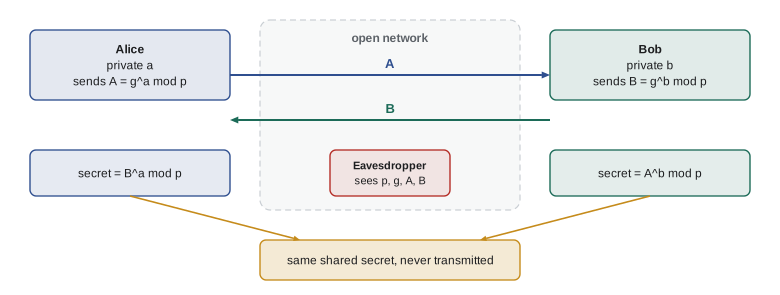
In 1976 Whitfield Diffie and Martin Hellman showed how two parties can agree on a secret over a public channel. They fix public values: a large prime \( p \) and a generator \( g \). Alice picks a private \( a \) and sends \( A = g^a \bmod p \); Bob picks \( b \) and sends \( B = g^b \bmod p \). Each combines their own private value with the other's public value:
An eavesdropper sees \( p \), \( g \), \( A \) and \( B \) but would need a discrete logarithm to find \( s \). The example runs the exchange with toy numbers and then with the standardized 2048-bit group from RFC 3526.
# Diffie-Hellman key agreement with toy numbers, then with a real-size group
p, g = 23, 5                      # public parameters (toy)
a, b = 6, 15                      # private values chosen by Alice and Bob (fixed for the demo)
A, B = pow(g, a, p), pow(g, b, p) # sent in the clear
print("toy:  A =", A, " B =", B, " Alice's secret =", pow(B, a, p), " Bob's secret =", pow(A, b, p))

# RFC 3526 group 14: a 2048-bit safe prime (the full hexadecimal value)
P14 = int(
 "FFFFFFFFFFFFFFFFC90FDAA22168C234C4C6628B80DC1CD129024E088A67CC74020BBEA63B139B22514A08798E3404DD"
 "EF9519B3CD3A431B302B0A6DF25F14374FE1356D6D51C245E485B576625E7EC6F44C42E9A637ED6B0BFF5CB6F406B7ED"
 "EE386BFB5A899FA5AE9F24117C4B1FE649286651ECE45B3DC2007CB8A163BF0598DA48361C55D39A69163FA8FD24CF5F"
 "83655D23DCA3AD961C62F356208552BB9ED529077096966D670C354E4ABC9804F1746C08CA18217C32905E462E36CE3B"
 "E39E772C180E86039B2783A2EC07A28FB5C55DF06F4C52C9DE2BCBF6955817183995497CEA956AE515D2261898FA0510"
 "15728E5A8AACAA68FFFFFFFFFFFFFFFF", 16)
a = int.from_bytes(b"alice demo private value, never fixed in real code", "big")
b = int.from_bytes(b"bob demo private value, also random in practice!!", "big")
A, B = pow(2, a, P14), pow(2, b, P14)
sa, sb = pow(B, a, P14), pow(A, b, P14)
print("real: prime has", P14.bit_length(), "bits; shared secrets equal:", sa == sb)
print(" first 16 hex digits of the shared secret:", hex(sa)[2:18])toy: A = 8 B = 19 Alice's secret = 2 Bob's secret = 2
real: prime has 2048 bits; shared secrets equal: True
first 16 hex digits of the shared secret: af1ab3e3d954f4acPlain Diffie–Hellman has a crucial limit: it is unauthenticated. An attacker in the middle can run one exchange with Alice and another with Bob, and relay traffic between them. Real protocols therefore combine key agreement with signatures or certificates so each side knows whom it is talking to, which is exactly what the TLS handshake in Lesson 6 does. Modern protocols also use ephemeral key pairs, freshly generated for each session and then deleted. This gives forward secrecy: if a server's long-term key is stolen later, past sessions still cannot be decrypted, because their ephemeral secrets no longer exist.
RSA
RSA, published by Rivest, Shamir and Adleman in 1977, was the first practical public-key encryption and signature scheme. Key generation picks two large random primes \( p \) and \( q \), computes \( n = pq \) and \( \varphi(n) = (p-1)(q-1) \), chooses a public exponent \( e \) (almost always 65,537) and computes the private exponent \( d = e^{-1} \bmod \varphi(n) \). Encryption is \( c = m^e \bmod n \) and decryption is \( m = c^d \bmod n \); it works because of Euler's theorem. Security rests on the difficulty of factoring \( n \).
from math import gcd
# Textbook RSA with tiny primes, to show the arithmetic (never use like this)
p, q = 61, 53
n, phi = p * q, (p - 1) * (q - 1)
e = 17
assert gcd(e, phi) == 1
d = pow(e, -1, phi)               # modular inverse (Python 3.8+)
print(f"n = {n}, phi = {phi}, e = {e}, d = {d}")
m = 65
c = pow(m, e, n)
print("encrypt 65 ->", c, "; decrypt ->", pow(c, d, n))
# Why textbook RSA is unsafe: it is deterministic and multiplicative
print("same message encrypts the same way every time:", pow(65, e, n) == c)
c2 = pow(2, e, n)
print("E(65) * E(2) decrypts to", pow(c * c2 % n, d, n), "= 65 * 2: ciphertexts can be combined")n = 3233, phi = 3120, e = 17, d = 2753 encrypt 65 -> 2790 ; decrypt -> 65 same message encrypts the same way every time: True E(65) * E(2) decrypts to 130 = 65 * 2: ciphertexts can be combined
The output shows why textbook RSA must never be used directly. It is deterministic, so the same message always gives the same ciphertext and an observer can test guesses. It is also multiplicative: multiplying two ciphertexts gives the encryption of the product of the plaintexts. Real systems therefore use padding schemes that add randomness and structure: OAEP for encryption and PSS for signatures. The older PKCS #1 v1.5 encryption padding has caused a long series of practical failures and should not be used in new designs. In practice RSA encryption is rarely used for data at all; it, or more often an elliptic-curve key agreement, transports a symmetric key, and the data is encrypted with AES-GCM or ChaCha20-Poly1305, an arrangement called hybrid encryption.
from cryptography.hazmat.primitives.asymmetric import rsa, padding
from cryptography.hazmat.primitives import hashes
key = rsa.generate_private_key(public_exponent=65537, key_size=3072)
pub = key.public_key()
oaep = padding.OAEP(mgf=padding.MGF1(hashes.SHA256()), algorithm=hashes.SHA256(), label=None)
secret = b"a 32-byte AES key would go here."
c1, c2 = pub.encrypt(secret, oaep), pub.encrypt(secret, oaep)
print("key size:", key.key_size, "bits; ciphertext length:", len(c1), "bytes")
print("OAEP is randomized, so two encryptions differ:", c1 != c2)
print("decrypts correctly:", key.decrypt(c1, oaep) == secret)key size: 3072 bits; ciphertext length: 384 bytes OAEP is randomized, so two encryptions differ: True decrypts correctly: True
Digital signatures
A digital signature is the public-key counterpart of a MAC, with one extra property: anyone with the public key can verify, but only the private-key holder can sign. That gives non-repudiation, the basis for software signing, certificates, signed documents and secure boot. A signature scheme signs a hash of the message, so it works for inputs of any length. Today's main schemes are RSA-PSS, ECDSA on the NIST P-256 curve, and EdDSA, usually Ed25519, which is fast, uses deterministic nonces and avoids several historical pitfalls.
from cryptography.hazmat.primitives.asymmetric.ed25519 import Ed25519PrivateKey
from cryptography.exceptions import InvalidSignature
# Deterministic demo key from a fixed seed; real keys come from Ed25519PrivateKey.generate()
sk = Ed25519PrivateKey.from_private_bytes(bytes(range(32)))
pk = sk.public_key()
release = b"hsm-tool-2.4.1.tar.gz sha256=3f1c...e9"
sig = sk.sign(release)
print("signature length:", len(sig), "bytes")
def check(msg):
    try:
        pk.verify(sig, msg); return "valid"
    except InvalidSignature:
        return "INVALID"
print("original release note:", check(release))
print("tampered release note:", check(release.replace(b"2.4.1", b"2.4.2")))signature length: 64 bytes original release note: valid tampered release note: INVALID
Nonces are the classic failure point of DSA and ECDSA. Each signature needs a fresh secret random number; if one is ever reused, or is merely predictable, the private key can be computed from two signatures. A famous game console signing key was exposed this way in 2010. EdDSA derives its nonce deterministically from the key and message, removing this risk, and RFC 6979 does the same for ECDSA.
Elliptic-curve cryptography
Elliptic-curve cryptography (ECC) performs Diffie–Hellman and signatures in the group of points on an elliptic curve over a finite field. Adding two points follows a geometric rule, and multiplying a point by an integer \( k \) means adding it to itself \( k \) times, computed quickly with double-and-add. The hard problem is the elliptic-curve discrete logarithm: given \( G \) and \( kG \), find \( k \). Because the best known attacks are far slower than those against factoring, a 256-bit curve matches a 3072-bit RSA key. X25519 (Curve25519 key agreement) and Ed25519 signatures are now the defaults in TLS 1.3, SSH, Signal and WireGuard.
# Points on a tiny elliptic curve y^2 = x^3 + 2x + 3 over the integers mod 97
P_, A_, B_ = 97, 2, 3
def add(Pt, Qt):
    if Pt is None: return Qt
    if Qt is None: return Pt
    (x1, y1), (x2, y2) = Pt, Qt
    if x1 == x2 and (y1 + y2) % P_ == 0: return None          # point at infinity
    if Pt == Qt: s = (3 * x1 * x1 + A_) * pow(2 * y1, -1, P_) % P_
    else:        s = (y2 - y1) * pow(x2 - x1, -1, P_) % P_
    x3 = (s * s - x1 - x2) % P_
    return (x3, (s * (x1 - x3) - y1) % P_)
def mul(k, Pt):
    R = None
    while k:
        if k & 1: R = add(R, Pt)
        Pt = add(Pt, Pt); k >>= 1
    return R
G = (87, 70)                                    # a point of order 50
assert (G[1]**2 - (G[0]**3 + A_ * G[0] + B_)) % P_ == 0
print("G =", G, " 2G =", mul(2, G), " 5G =", mul(5, G), " 50G =", mul(50, G), "(point at infinity)")
a, b = 13, 29                                   # private scalars (toy)
print("ECDH: a(bG) =", mul(a, mul(b, G)), " b(aG) =", mul(b, mul(a, G)))G = (87, 70) 2G = (24, 95) 5G = (53, 24) 50G = None (point at infinity) ECDH: a(bG) = (0, 10) b(aG) = (0, 10)
The post-quantum transition
A large, fault-tolerant quantum computer running Shor's algorithm would factor RSA moduli and solve discrete logarithms, including on elliptic curves, in polynomial time, breaking every scheme in the first three rows of the table. Grover's algorithm only halves the effective strength of symmetric keys and hashes, so AES-256 and SHA-384 remain comfortable. No such quantum computer exists yet, but data recorded today could be decrypted when one does, the harvest-now, decrypt-later threat, so long-lived secrets need protection now.
After an open competition, NIST published its first post-quantum standards in August 2024: FIPS 203 (ML-KEM, from CRYSTALS-Kyber) for key encapsulation, FIPS 204 (ML-DSA, from CRYSTALS-Dilithium) and FIPS 205 (SLH-DSA, from SPHINCS+) for signatures. In March 2025 NIST selected HQC, a code-based scheme, as a backup key-encapsulation mechanism, with a draft standard expected in 2026. Browsers and major servers already negotiate hybrid key exchange, combining X25519 with ML-KEM-768, so a connection stays secure if either component holds.
In Canada, the Canadian Centre for Cyber Security published a roadmap in June 2025 for migrating federal non-classified systems to post-quantum cryptography. Departments must have migration plans by April 2026, complete high-priority systems by the end of 2031 and finish all systems by the end of 2035. The Cyber Centre encourages critical infrastructure operators and suppliers to follow similar timelines, starting with an inventory of where cryptography is used.
For developers the first steps are the same everywhere: build an inventory of where public-key cryptography is used, prefer crypto-agile designs in which algorithms are configuration rather than hard-coded constants, keep libraries current so hybrid modes arrive automatically, and protect long-lived data first.
Worked examples
Worked problem
Computing an RSA private key
With p = 11, q = 17 and e = 7, find n, phi(n) and d, then encrypt and decrypt m = 9.
Show solution
- n = 11 x 17 = 187 and phi(n) = 10 x 16 = 160.
- d is the inverse of 7 modulo 160: 7 x 23 = 161 = 1 (mod 160), so d = 23.
- c = 9^7 mod 187 = 4,782,969 mod 187 = 70.
- Decrypt: 70^23 mod 187 = 9, recovering the message (pow(70, 23, 187) in Python).
Answer: n = 187, phi = 160, d = 23; 9 encrypts to 70 and decrypts back to 9.
Worked problem
Why authenticate key agreement?
An app on a café network performs plain Diffie–Hellman with its server and then encrypts traffic with the shared secret. A device on the network can intercept and modify packets. What can it do, and what is the fix?
Show solution
- The interceptor replaces the server's public value with its own and the app's value with another of its own, running one exchange with each side.
- It now shares one secret with the app and another with the server, decrypting, reading and re-encrypting everything that passes.
- Fix: authenticate the exchange. In TLS the server signs the handshake with a private key whose public key is certified, and the client verifies the certificate and the signature before trusting the secret.
Answer: Unauthenticated DH allows a person-in-the-middle; sign the handshake and verify certificates, as TLS does.
Worked problem
Planning a post-quantum migration
A provincial health records service keeps archived records for 30 years and exchanges them with clinics over TLS. Which assets are most urgent to protect against future quantum attacks?
Show solution
- Records sent today must stay confidential for decades, so harvest-now, decrypt-later is the main risk for key exchange.
- Enable hybrid key exchange (X25519 plus ML-KEM-768) in TLS on both ends as soon as libraries support it.
- Signatures matter at verification time, so signing keys can migrate on a slightly later schedule, but long-lived roots of trust should be planned now.
- Archived data encrypted with AES-256 stays safe; rewrap any archive keys protected only by RSA.
Answer: Key establishment for long-lived data first: hybrid ML-KEM in TLS, then rewrap archive keys, then plan signature migration.
Common mistakes
MistakeSmall example keys show how RSA works, so they are fine for testing production code.
InsteadUse real key sizes (RSA 3072+, or 256-bit curves) even in tests that touch production code paths.
MistakeTextbook RSA encryption is secure if the key is large enough.
InsteadAlways use OAEP for encryption and PSS for signatures; textbook RSA is deterministic and malleable.
MistakeDiffie–Hellman protects against a person-in-the-middle.
InsteadAuthenticate the exchange with signatures and certificates; plain DH does not.
MistakeECDSA nonces only need to be unique.
InsteadNonces must be secret and unpredictable too; use deterministic nonces (RFC 6979) or Ed25519.
MistakeQuantum computers will break AES-256 as easily as RSA.
InsteadGrover's algorithm only halves symmetric strength; it is RSA, DH and ECC that Shor's algorithm breaks.
Summary and key terms
- Public-key cryptography uses trapdoor problems: factoring and discrete logarithms in finite fields and on elliptic curves.
- Diffie–Hellman lets two parties agree on a secret in public, but must be authenticated; ephemeral keys give forward secrecy.
- RSA works by modular exponentiation; real use requires OAEP or PSS padding, never textbook RSA.
- Hybrid encryption transports a symmetric key with public-key methods and encrypts data with AEAD.
- Signatures (RSA-PSS, ECDSA, Ed25519) give integrity and non-repudiation; nonce misuse can leak private keys.
- ECC gives equivalent security with much smaller keys; X25519 and Ed25519 are modern defaults.
- NIST standardized ML-KEM, ML-DSA and SLH-DSA in 2024; Canada and the US have set migration timelines ending around 2035.
- Trapdoor function
- A function easy to compute but hard to invert without secret information.
- Discrete logarithm
- Finding x from g^x in a group; believed hard for well-chosen groups.
- Forward secrecy
- The property that compromise of long-term keys does not expose past session keys.
- OAEP
- Optimal asymmetric encryption padding, the randomized padding for RSA encryption.
- PSS
- Probabilistic signature scheme, the recommended padding for RSA signatures.
- Hybrid encryption
- Using public-key methods to establish a symmetric key that encrypts the data.
- Ed25519
- An Edwards-curve signature scheme with deterministic nonces, widely used in SSH and TLS.
- Key encapsulation mechanism
- A public-key method for securely sending a fresh symmetric key, such as ML-KEM.
- Harvest now, decrypt later
- Recording encrypted traffic today in the hope of decrypting it with a future quantum computer.
- Crypto-agility
- Designing systems so cryptographic algorithms can be replaced without major redesign.
Practice problems
Work each problem on paper first, then reveal the answer to check.
What hard problem does RSA rely on?
Show answer
The difficulty of factoring the product of two large primes.
In Diffie–Hellman, what does each party send over the network?
Show answer
Its public value, g raised to its private exponent modulo p.
Why is plain Diffie–Hellman vulnerable on an active network?
Show answer
It does not authenticate the parties, so an attacker can run separate exchanges with each side.
What is forward secrecy and how is it achieved?
Show answer
Past sessions stay safe if long-term keys leak; achieved with ephemeral key agreement whose secrets are deleted.
Name two problems with textbook RSA.
Show answer
It is deterministic and multiplicatively malleable.
Which padding should be used for RSA signatures?
Show answer
PSS.
Why are elliptic-curve keys shorter than RSA keys for the same security?
Show answer
The best known attacks on the elliptic-curve discrete logarithm are much slower than factoring algorithms.
What happens if an ECDSA nonce is reused?
Show answer
The private key can be computed from the two signatures.
Which NIST standard specifies ML-KEM?
Show answer
FIPS 203 (August 2024).
Why does harvest-now, decrypt-later make key exchange migration urgent?
Show answer
Traffic recorded today could be decrypted once a large quantum computer exists, so long-lived secrets need quantum-resistant key exchange now.
Lesson quiz · 5 questions
Score 60% or more to complete this lesson.
Create a free account to save your progress, take quizzes and earn a certificate.