
CMPUT-325 · Lesson 9 of 12 · 36 min
Data abstraction, objects and modules
Large programs survive only if their parts can be understood, changed and replaced independently. Programming languages support this through abstraction mechanisms: abstract data types that hide a representation behind operations, objects that bundle state with behaviour and choose code at run time, and modules that control which names a unit of code exposes. This lesson studies these mechanisms as language features with precise semantics: what an object is in terms of closures and records, how dynamic dispatch and inheritance are resolved, why multiple inheritance needs a linearization rule, how structural and nominal typing differ, and what modules and metaprogramming add. CMPUT-274 taught you to write classes; here the question is how languages define them.
Abstract data types
Barbara Liskov and Stephen Zilles introduced abstract data types in 1974, and Liskov's language CLU (1975) built them in. An abstract data type is a type defined by its operations and their behaviour, not by its representation. Clients can only use the operations, so the implementer can change the representation without breaking clients. The idea goes back to David Parnas's 1972 paper on information hiding, which argued that modules should be divided around design decisions likely to change, each hidden behind an interface.
# Two implementations of one abstract data type: a FIFO queue.
# Clients see only the operations empty, push, pop and is_empty, never the representation.
class ListQueue:                       # representation 1: a single Python list
    def __init__(self): self._xs = []
    def push(self, x): self._xs.append(x)
    def pop(self): return self._xs.pop(0)          # O(n): shifts every element
    def is_empty(self): return not self._xs

class TwoStackQueue:                   # representation 2: two stacks, amortized O(1)
    def __init__(self): self._front, self._back = [], []
    def push(self, x): self._back.append(x)
    def pop(self):
        if not self._front:
            while self._back: self._front.append(self._back.pop())
        return self._front.pop()
    def is_empty(self): return not (self._front or self._back)

def client(q):                         # written once, against the interface only
    for word in ["alpha", "beta", "gamma"]: q.push(word)
    out = [q.pop()]
    q.push("delta")
    while not q.is_empty(): out.append(q.pop())
    return out

for impl in (ListQueue, TwoStackQueue):
print(f"{impl.__name__:14} {client(impl())}")ListQueue ['alpha', 'beta', 'gamma', 'delta'] TwoStackQueue ['alpha', 'beta', 'gamma', 'delta']
The client function produces the same results with both representations, even though one stores a single list and the other two stacks. This property, representation independence, is what makes abstraction valuable: the slow ListQueue can be replaced by TwoStackQueue without touching a line of client code. Python enforces the boundary only by convention (a leading underscore); CLU, Ada, ML and Java enforce it with the type system or access modifiers. John Reynolds showed in 1983 that parametric polymorphism guarantees representation independence, a result known as parametricity.
Objects as closures and records
Under the surface, an object is a record of functions that share hidden state. A closure already gives us that: the local variables of an enclosing function are private, and the inner functions that capture them are the methods. The slogan 'objects are a poor man's closures, and closures are a poor man's objects' captures the equivalence. Smalltalk (Alan Kay and others at Xerox PARC, 1972 to 1980) described method calls as messages sent to objects, and the dispatch function below makes that view literal.
# Objects from closures: state is hidden in the enclosing scope, methods are a dispatch table.
def make_account(balance):
    def deposit(amount):
        nonlocal balance
        balance += amount
        return balance
    def withdraw(amount):
        nonlocal balance
        if amount > balance: return "insufficient funds"
        balance -= amount
        return balance
    def send(message, *args):                  # message passing: dispatch on a name
        return {"deposit": deposit, "withdraw": withdraw,
                "balance": lambda: balance}[message](*args)
    return send

acct = make_account(100)
print(acct("deposit", 50))
print(acct("withdraw", 500))
print(acct("withdraw", 30))
print(acct("balance"))
other = make_account(10)
print("independent state:", other("balance"), acct("balance"))150 insufficient funds 120 120 independent state: 10 120
William Cook's essay 'On understanding data abstraction, revisited' (2009) argues that objects and abstract data types are two different forms of abstraction. An abstract data type hides a representation behind a type, so operations on two values of the type can look inside both (two sets of one implementation can be merged efficiently). An object hides its representation behind an interface of methods, so an object can only ask other objects to do things through their methods, which lets different implementations interoperate (a set backed by a list can be combined with one backed by a hash table). Each choice makes some extensions easy and others hard.
The last two rows describe the expression problem, named by Philip Wadler in 1998: how to add both new variants and new operations to a data type without modifying or recompiling existing code, while keeping static type safety. Functional languages with algebraic data types make new operations easy and new variants hard; object-oriented languages do the reverse. Visitors, type classes, multimethods and Scala's traits are all partial answers.
Dynamic dispatch and inheritance
The defining feature of object-oriented languages is dynamic dispatch: the method run by obj.m() is chosen by the run-time class of obj, not by the static type of the expression. Inheritance lets a class reuse its parent's methods and override some of them. Crucially, self (or this) is late bound: when an inherited method calls self.area(), it calls the override in the subclass. That late binding is what lets a superclass define a template whose steps subclasses fill in, and it is also what makes inheritance fragile.
# Dynamic dispatch by hand: each class is a record with a parent link and a method table.
def lookup(cls, name):
    while cls is not None:
        if name in cls["methods"]: return cls["methods"][name]
        cls = cls["parent"]
    raise AttributeError(name)

def send(obj, name, *args):
    method = lookup(obj["class"], name)          # chosen by the object's run-time class
    return method(obj, *args)

Shape = {"name": "Shape", "parent": None, "methods": {
    "describe": lambda self: f"a {self['class']['name']} with area {send(self, 'area'):.2f}",
}}
Circle = {"name": "Circle", "parent": Shape, "methods": {
    "area": lambda self: 3.14159 * self["r"] ** 2,
}}
Square = {"name": "Square", "parent": Shape, "methods": {
    "area": lambda self: self["side"] ** 2,
}}
Unit = {"name": "UnitSquare", "parent": Square, "methods": {
    "describe": lambda self: "the unit square",   # override
}}

for obj in [{"class": Circle, "r": 1.0}, {"class": Square, "side": 3}, {"class": Unit, "side": 1}]:
print(send(obj, "describe"))a Circle with area 3.14 a Square with area 9.00 the unit square
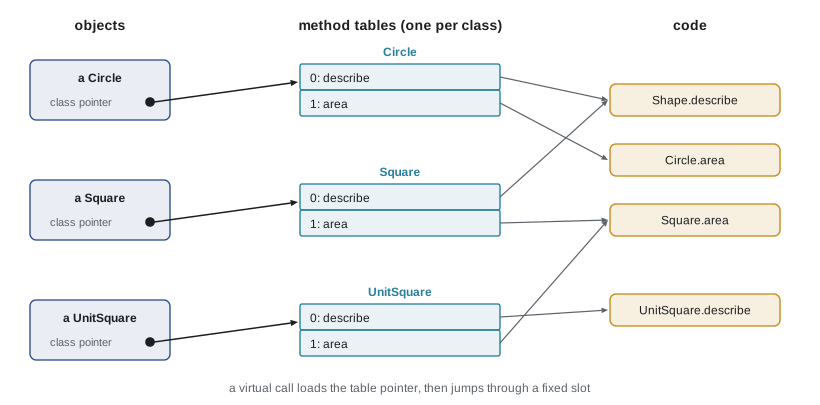
The describe method is defined once in Shape, yet it calls the right area for each object, because send looks up area starting from the object's own class. Compiled languages make this fast with virtual method tables: each class has an array of method pointers, every object carries a pointer to its class's table, and a call becomes one indirect jump at a fixed index. C++ and Java implement virtual calls this way; just-in-time compilers go further by inlining the method they observe at a call site and guarding with a cheap class check.
The fragile base class problem is the price of late-bound self. If a library's base class changes how its own methods call each other, subclasses that override one of those methods can break without any change on their side. The classic example, from Joshua Bloch's Effective Java, is a subclass of HashSet that counts insertions by overriding both add and addAll: because HashSet.addAll calls add internally, every element is counted twice. This is why modern advice favours composition over inheritance, and why Go and Rust have no implementation inheritance at all.
Multiple inheritance and linearization
If a class may have several parents, a method name may be found along several paths. The diamond problem arises when two parents share a common ancestor: which version of an inherited method should the child see, and should the ancestor's state be duplicated? C++ answers with explicit qualification and virtual base classes. Python, like Dylan, Perl 6 (now Raku) and Solidity, computes a single method resolution order with the C3 linearization algorithm, which preserves each class's local order of parents and puts every class before its ancestors. super() then means 'the next class in the linearization', not 'my parent'.
# Multiple inheritance needs a linearization: Python uses C3 (from Dylan, 1996).
class Base:
    def hello(self): return "Base"
class Left(Base):
    def hello(self): return "Left -> " + super().hello()
class Right(Base):
    def hello(self): return "Right -> " + super().hello()
class Child(Left, Right):
    def hello(self): return "Child -> " + super().hello()

print([c.__name__ for c in Child.__mro__])
print(Child().hello())

try:
    class X(Left, Base): pass
    class Y(Base, Left): pass       # Base before its own subclass: no consistent order
except TypeError as e:
print("TypeError:", e)['Child', 'Left', 'Right', 'Base', 'object'] Child -> Left -> Right -> Base TypeError: Cannot create a consistent method resolution order (MRO) for bases Base, Left
Observe that super() in Left calls Right, not Base, because Right comes next in Child's resolution order. That cooperative behaviour is useful but surprising. When no ordering consistent with every class's declared parent order exists, Python refuses to create the class. Traits, introduced by Nathanael Schärli and colleagues in 2003 and adopted by Scala, PHP, Rust and Pharo Smalltalk, offer composable units of behaviour without state, with explicit resolution of conflicting method names. Mixins, a related idea from Flavors and CLOS, are classes designed to be combined with others.
# Mixins: small classes that add methods to any class providing a few hooks.
import functools

class ComparableMixin:              # needs: key()
    def __lt__(self, other): return self.key() < other.key()
    def __eq__(self, other): return self.key() == other.key()

class ReprMixin:                    # needs: nothing but attributes
    def __repr__(self):
        fields = ", ".join(f"{k}={v!r}" for k, v in vars(self).items())
        return f"{type(self).__name__}({fields})"

@functools.total_ordering          # derives <=, >, >= from < and ==
class Version(ComparableMixin, ReprMixin):
    def __init__(self, text): self.text = text
    def key(self): return tuple(int(p) for p in self.text.split("."))

vs = [Version("1.10.0"), Version("1.2.9"), Version("1.2.10")]
print(sorted(vs))
print(Version("2.0") > Version("1.99"), max(vs))[Version(text='1.2.9'), Version(text='1.2.10'), Version(text='1.10.0')] True Version(text='1.10.0')
Nominal and structural typing
Two object types can be compatible for two different reasons. In nominal typing, used by Java, C# and C++, a class is a subtype of an interface only if it declares so by name. In structural typing, used by Go interfaces, TypeScript, OCaml objects and Python's typing.Protocol, a type is compatible with an interface simply by having the required methods with compatible types. Duck typing is the dynamic counterpart: Python and Ruby check only at the moment a method is called. Structural typing lets independently written code fit together without a shared declaration, while nominal typing prevents accidental matches between types that happen to share method names.
package main

import (
	"fmt"
	"math"
)

// Structural typing: a type satisfies an interface just by having the methods.
type Shape interface {
	Area() float64
}

type Circle struct{ R float64 }
type Rect struct{ W, H float64 }

func (c Circle) Area() float64 { return math.Pi * c.R * c.R }
func (r Rect) Area() float64   { return r.W * r.H }

// Embedding instead of inheritance: Tagged reuses Rect's methods by composition.
type Tagged struct {
	Rect
	Label string
}

func main() {
	shapes := []Shape{Circle{1}, Rect{2, 3}, Tagged{Rect{4, 5}, "door"}}
	total := 0.0
	for _, s := range shapes {
		fmt.Printf("%-24T %.3f\n", s, s.Area())
		total += s.Area()
	}
	fmt.Printf("total %.3f\n", total)
}main.Circle 3.142 main.Rect 6.000 main.Tagged 20.000 total 29.142
Neither Circle nor Rect mentions Shape, yet both satisfy it. Tagged has no Area method of its own; it embeds a Rect, and Go promotes the embedded field's methods. That is composition with convenient syntax, not inheritance: inside Rect's Area there is no late-bound self pointing back to the Tagged value.
Prototypes instead of classes
Classes are not the only way to organize objects. In prototype-based languages, pioneered by Self (David Ungar and Randall Smith, 1987), objects are created by cloning other objects and inherit by delegation: if an object lacks a property, the lookup continues in its prototype. JavaScript adopted this model, and its class syntax, added in ECMAScript 2015, is a layer over prototype chains. The Self project also developed the adaptive compilation techniques, such as inline caches and type feedback, that later made the HotSpot Java virtual machine and the V8 JavaScript engine fast.
// Prototype-based objects (Self, 1987; JavaScript): no classes, only delegation.
const animal = { speak() { return `${this.name} makes ${this.sound()}`; },
                 sound() { return "a noise"; } };
const dog = Object.create(animal);           // dog delegates to animal
dog.sound = function () { return "woof"; };
const rex = Object.create(dog);              // rex delegates to dog
rex.name = "Rex";

console.log(rex.speak());
console.log(Object.getPrototypeOf(rex) === dog, Object.getPrototypeOf(dog) === animal);
animal.sound = () => "a changed noise";      // only affects objects that do not override it
const generic = Object.create(animal); generic.name = "Thing";
console.log(generic.speak(), "|", rex.speak());

// ES2015 class syntax is a layer over the same prototype chain.
class Point { constructor(x, y) { this.x = x; this.y = y; } norm() { return Math.hypot(this.x, this.y); } }
console.log(typeof Point, Object.getPrototypeOf(new Point(3, 4)) === Point.prototype, new Point(3, 4).norm());Rex makes woof true true Thing makes a changed noise | Rex makes woof function true 5
Modules and interfaces
A module groups related definitions and controls which are visible outside. Modula-2 (Niklaus Wirth, 1978) and Ada (1983) separated a module's interface from its implementation; Standard ML went further with signatures (module types) and functors, which are functions from modules to modules, so that, for example, a balanced-tree set can be built for any ordered key module. OCaml, Rust and modern JavaScript and Python have module systems with explicit exports; Java added modules in version 9 (2017). Separate compilation, namespaces and abstract types are the three jobs a module system does.
// Modules give information hiding at the file level; TypeScript adds type-level hiding.
// A "branded" type: callers cannot forge a UserId from an arbitrary number.
type UserId = number & { readonly __brand: "UserId" };

const Users = (() => {
  let next = 1;                               // private to the module closure
  const names = new Map<UserId, string>();
  return {
    create(name: string): UserId { const id = next++ as UserId; names.set(id, name); return id; },
    name(id: UserId): string { return names.get(id) ?? "unknown"; },
  };
})();

const a = Users.create("Ada");
const b = Users.create("Alan");
console.log(Users.name(a), Users.name(b));
console.log(Users.name(42)); // type error: number is not UserId$ tsc --strict --target es2020 users.ts
users.ts(17,24): error TS2345: Argument of type 'number' is not assignable to parameter of type 'UserId'.
Type 'number' is not assignable to type '{ readonly __brand: "UserId"; }'.
$ node users.js
Ada Alan
unknownMetaprogramming
Some languages let programs manipulate programs. Lisp's macros, from the 1960s, transform code represented as lists before it is evaluated, and Scheme's hygienic macros (1986 onward) prevent accidental variable capture, the same problem met with substitution in lesson 5. Rust has macro_rules! and procedural macros, C++ has templates and constexpr evaluation, and Python exposes its abstract syntax tree through the ast module. Reflection is the run-time counterpart: Java's java.lang.reflect and Python's getattr let a program inspect and call methods by name.
# Metaprogramming on the abstract syntax tree: rewrite x ** 2 into x * x before running.
import ast

source = "def area(r):\n    return 3.14159 * r ** 2\n\nprint(area(2.0), area(10))\n"

class SquareToMultiply(ast.NodeTransformer):
    def visit_BinOp(self, node):
        self.generic_visit(node)
        if isinstance(node.op, ast.Pow) and isinstance(node.right, ast.Constant) and node.right.value == 2:
            return ast.BinOp(left=node.left, op=ast.Mult(), right=node.left)
        return node

tree = ast.parse(source)
new_tree = ast.fix_missing_locations(SquareToMultiply().visit(tree))
print(ast.unparse(new_tree).splitlines()[1].strip())
exec(compile(new_tree, "<rewritten>", "exec"))return 3.14159 * (r * r) 12.56636 314.159
Worked examples
Worked problem
Late-bound self
Class A has methods f(self) returning self.g() and g(self) returning "A". Class B extends A and overrides g to return "B". What does B().f() return, and why?
Show solution
- B has no f of its own, so f is found in A.
- Inside f, self is still the B object.
- self.g() is dispatched on the run-time class B, so it finds B.g.
Answer: "B": self is late bound, so A's method calls B's override.
Worked problem
Computing a C3 linearization
With class O, class A(O), class B(O) and class C(A, B), find C's method resolution order.
Show solution
- L(A) = [A, O] and L(B) = [B, O].
- L(C) = C + merge([A, O], [B, O], [A, B]).
- Take A (head of the first list, not in any tail), then O is in the tail of [B, O], so take B, then O.
Answer: [C, A, B, O].
Worked problem
Choosing ADT or object style
A drawing program will gain many new shapes over time but its set of operations (draw, area, bounding box) is stable. Which decomposition suits it?
Show solution
- New variants (shapes) are frequent; new operations are rare.
- Object style makes new variants cheap: write one new class.
- ADT style with an algebraic data type would require editing every operation for each new shape.
Answer: Object style, with one class per shape implementing a common interface.
Common mistakes
Mistakesuper() always calls the parent class.
InsteadIn Python super() calls the next class in the method resolution order, which may be a sibling.
MistakeObjects and abstract data types are the same thing.
InsteadADTs hide a type's representation; objects hide each value's representation behind methods.
MistakeA Go type must declare which interfaces it implements.
InsteadGo interfaces are structural: having the methods is enough.
MistakeJavaScript classes work like Java classes.
InsteadThey are syntax over prototype delegation, and prototypes can be changed at run time.
MistakeOverriding any method of a library class is always safe.
InsteadLate-bound self means the base class may call your override internally: the fragile base class problem.
Summary and key terms
- Abstract data types hide a representation behind operations, giving representation independence.
- Objects can be modelled as closures over hidden state with a method dispatch table.
- Dynamic dispatch selects a method by run-time class; self is late bound.
- Virtual method tables make dispatch one indexed indirect call.
- Multiple inheritance needs a linearization such as C3; traits and mixins are lighter alternatives.
- Typing can be nominal or structural; duck typing is its dynamic form; prototypes replace classes with delegation.
- Modules provide namespaces, separate compilation and abstract types; metaprogramming manipulates code as data.
- Abstract data type
- A type defined by its operations and laws, with its representation hidden.
- Information hiding
- Concealing design decisions behind an interface so they can change.
- Dynamic dispatch
- Choosing the method to run from the run-time class of the receiver.
- Late binding of self
- Inherited code calling methods on self finds the subclass overrides.
- Virtual method table
- A per-class array of method pointers used to implement dynamic dispatch.
- Method resolution order
- The linear order in which classes are searched for a method.
- Trait
- A reusable, stateless set of methods composed into classes with explicit conflict resolution.
- Structural typing
- Compatibility determined by the methods and fields a type has.
- Prototype
- An object to which another object delegates missing properties.
- Expression problem
- Adding both new variants and new operations without changing existing code.
Practice problems
Work each problem on paper first, then reveal the answer to check.
What did Parnas propose as the criterion for dividing a system into modules?
Show answer
Hide each design decision likely to change behind a module interface.
How can a closure implement an object?
Show answer
Captured local variables hold private state, and the inner functions act as methods.
Why does inherited code see subclass overrides?
Show answer
Calls on self are dispatched on the object's run-time class.
What does a virtual method call cost in C++?
Show answer
Loading the table pointer from the object and an indirect call through a fixed slot.
State the fragile base class problem.
Show answer
Changes inside a base class can break subclasses that override methods the base class calls internally.
Why did Python reject class Y(Base, Left)?
Show answer
Base would have to come both before Left (declared order) and after it (Left is its subclass), so no C3 order exists.
Contrast nominal and structural typing.
Show answer
Nominal requires a declared relationship by name; structural needs only matching members.
In JavaScript, where is a missing property looked up?
Show answer
Along the object's prototype chain.
What is an ML functor?
Show answer
A function from modules to modules, such as a set module parameterized by an ordered key module.
Which extension is easy in object style and hard in ADT style?
Show answer
Adding a new variant (class).
Lesson quiz · 5 questions
Score 60% or more to complete this lesson.
Create a free account to save your progress, take quizzes and earn a certificate.