
CIV-440 · Lesson 8 of 12 · 18 min
Slope stability by the method of slices
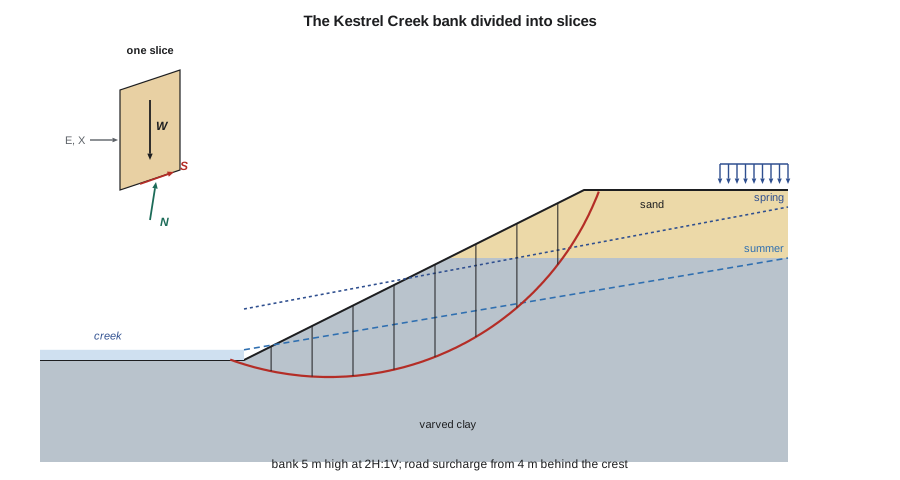
Real slopes have layers, water tables that are not at the surface, loads at the crest and slip surfaces that are neither planes nor arcs in a single soil. In a drained analysis, the strength on the slip surface also depends on the normal effective stress, which varies along it. The method of slices handles all of this by dividing the sliding mass into vertical slices, writing equilibrium for each and summing. It was introduced by Fellenius in Sweden in the 1920s and 1930s, and its refinements, by Bishop, Janbu, Spencer and Morgenstern and Price, are the basis of every slope stability program in use today. This lesson applies it to the Kestrel Creek bank under its summer and spring water levels.
The problem of statical indeterminacy
For a sliding mass divided into \(n\) slices, the unknowns are the normal force on the base of each slice, its point of action, the horizontal and vertical forces between slices and their points of action, and the factor of safety: about \(5n - 2\) in all. Equilibrium provides three equations per slice, \(3n\). The problem is indeterminate, and every method of slices makes assumptions about the interslice forces to close it. The methods differ in which assumptions they make and which equilibrium conditions they satisfy.
With the Mohr-Coulomb criterion and the factor of safety defined on the strength, the shear force mobilized on the base of slice \(i\), of width \(b\), base length \(l = b/\cos\alpha\) and base angle \(\alpha\), is
and the factor of safety appears in every slice. Most methods solve for \(F\) by iteration.
The ordinary method of slices
Fellenius's method, also called the ordinary or Swedish method, ignores the interslice forces altogether. Resolving the forces on each slice perpendicular to its base gives the base normal force \(N = W\cos\alpha\), and moments about the centre of the circle give
The method is explicit and simple, but neglecting the interslice forces makes it inconsistent: the forces on each slice do not satisfy equilibrium in any direction except perpendicular to the base. With high pore pressures and flat circles, it underestimates the factor of safety, sometimes by 20 % or more, and it can give negative effective normal forces on steep slices. It is now used mainly for hand checks and teaching.
Bishop's simplified method
Bishop, in 1955, assumed that the interslice forces are horizontal, so the vertical shear forces between slices are zero, and resolved the forces on each slice vertically instead. This gives the base normal force in terms of the factor of safety, and moment equilibrium about the centre of the circle then gives
Because \(F\) appears on both sides, the equation is solved by iteration, starting from the ordinary method's value; convergence takes a few cycles. Bishop's simplified method satisfies moment equilibrium for the whole mass and vertical equilibrium for each slice, but not horizontal equilibrium. For circular surfaces it agrees closely with the rigorous methods, usually within a few percent, and it is the most widely used method for circles. Problems arise only when \(m_\alpha\) becomes small or negative, on steeply inclined slices near the toe of deep circles, where the method should be checked.
Rigorous and non-circular methods
Spencer's method assumes that the interslice forces are all parallel, at an unknown angle, and solves for both the factor of safety and that angle so that force and moment equilibrium are both satisfied. Morgenstern and Price's method generalizes this with a function describing how the interslice force angle varies across the mass. These methods, with Janbu's for non-circular surfaces, are used for slip surfaces that follow weak layers, for embankments over soft foundations and for reinforced slopes, where a circle is a poor approximation. Programs search over thousands of circles or optimized non-circular surfaces, and the engineer's job is to check that the critical surface makes sense, that the search covered the right region and that the input, especially the pore pressures, is right.
| Method | Interslice forces | Equilibrium satisfied | Use |
|---|---|---|---|
| Ordinary (Fellenius) | ignored | moments only (overall) | hand checks; conservative |
| Bishop simplified | horizontal | moments; vertical forces per slice | circular surfaces |
| Janbu simplified | horizontal | forces only | non-circular, with a correction |
| Spencer | parallel, unknown angle | all | circular and non-circular |
| Morgenstern-Price | angle varies by a function | all | general, most programs |
Pore pressures
The pore pressure on the base of each slice usually comes from a phreatic surface, taking the pressure as the vertical distance from the base to the phreatic line times the unit weight of water. This is approximate where seepage is not horizontal: with downward flow near the crest it overestimates the pressure, and with upward flow near the toe it underestimates it. A flow net or a seepage analysis gives better values. Alternatively, the pore pressure ratio \(r_u = u/(\gamma z)\) is used in stability charts. For Kestrel Creek, piezometers installed in April show the two conditions the team analyses: a summer level close to the creek at the face and about 2 m below the top of the bank far back, and a spring level seeping from the face about 1.5 m above the toe and only 0.5 m below the top far back.
Worked problem
The Kestrel Creek bank, drained, summer and spring
The bank is 5.0 m high at 2H:1V. The upper 2.0 m are sand (\(c' = 0\), \(\phi' = 34^\circ\), \(\gamma = 19\) kN/m³); below is the varved clay (\(c' = \) 5 kPa, \(\phi' = 27^\circ\), \(\gamma = 18\) kN/m³). The road surcharge of 12 kPa begins 4 m behind the crest. Search for the critical circle by Bishop's simplified method for the summer and spring water levels, and compare with the ordinary method on the same circles.
Show solution
- For each trial circle, the mass is divided into 60 slices and Bishop's equation iterated from the ordinary method's value. A grid of centres and a range of tangent depths is searched.
- \[F_{summer} = 1.45 \;(\text{ordinary } 1.26) \qquad F_{spring} = 1.13 \;(\text{ordinary } 0.96)\]
- The critical circles pass through the clay just below the toe and break out on the bank near the crest, about 8.5 to 9.5 m in radius.
Answer: In summer the bank is just below the usual long-term requirement of 1.5. In spring, with the high water table, it is at 1.13, below the 1.3 the team accepts for a seasonal high water condition and close enough to 1.0 to explain the cracking after the 2019 flood. The ordinary method would have reported it as failing, which it is not; Bishop's method is the one to rely on.
Sofia's script builds the section, slices each trial circle, computes the base pore pressures from the phreatic surface for each season, and runs the two methods.
# Method of slices for the Kestrel Creek bank beside the new culvert: ordinary method and Bishop's simplified method
from math import tan, radians, sqrt
UNITS = "SI"
SI = UNITS == "SI"
L, P = ("m", "kPa") if SI else ("ft", "psf")
k = 1.0 if SI else 3.281                       # length scale: the US section is the same geometry in feet
gw = 9.81 if SI else 62.4
sand = dict(c=0.0, phi=34.0, g=19.0 if SI else 121.0)
clay = dict(c=5.0 if SI else 105.0, phi=27.0, g=18.0 if SI else 115.0)
Hb, n, y_int = 5.0 * k, 2.0, 3.0 * k           # bank height, slope n:1, sand above elevation y_int, clay below
q, xq = (12.0 if SI else 250.0), 4.0 * k        # road surcharge starting 4 m | 13 ft behind the crest
def ground(x): return 0.0 if x <= 0 else (x / n if x <= n * Hb else Hb)
WATER = {"summer": (0.3, 2.0), "spring": (1.5, 0.5)}   # water level at the bank face above the toe, depth below the crest far back
def phreatic(x, case):
    yf, db = WATER[case]; yf *= k; yb = Hb - db * k; xb = n * Hb + 6 * k
    if x <= 0: return min(yf, ground(x))
    y = yf + (yb - yf) * min(x / xb, 1.0)
    return min(y, ground(x))
def slices(xc, yc, R, case, N=60):
    out = []; dx = 2 * R / N
    for i in range(N):
        x = xc - R + (i + 0.5) * dx
        yb = yc - sqrt(max(R * R - (x - xc) ** 2, 0)); yt = ground(x)
        h = yt - yb
        if h <= 0: continue
        hs = max(0.0, yt - max(yb, y_int)); hc = h - hs         # sand and clay thicknesses in the slice
        W = (sand["g"] * hs + clay["g"] * hc) * dx + (q * dx if x >= n * Hb + xq else 0.0)
        u = max(0.0, phreatic(x, case) - yb) * gw
        soil = sand if yb >= y_int else clay
        s = (x - xc) / R; cth = sqrt(1 - s * s)
        out.append((W, u, soil, s, cth, dx))
    return out
def fs_ordinary(sl):
    if sum(W * s for W, u, sm, s, ca, dx in sl) <= 0: return 99
    num = sum(sm["c"] * dx / ca + (W * ca - u * dx / ca) * tan(radians(sm["phi"])) for W, u, sm, s, ca, dx in sl)
    den = sum(W * s for W, u, sm, s, ca, dx in sl)
    return num / den if den > 0 else 99
def fs_bishop(sl):
    F = fs_ordinary(sl)
    if F >= 99 or F <= 0: return 99
    for _ in range(50):
        num = 0.0
        for W, u, sm, s, ca, dx in sl:
            tp = tan(radians(sm["phi"])); m = max(ca + s * tp / F, 0.2)
            num += (sm["c"] * dx + (W - u * dx) * tp) / m
        den = sum(W * s for W, u, sm, s, ca, dx in sl)
        Fn = num / den
        if abs(Fn - F) < 1e-5: break
        F = Fn
    return Fn if Fn > 0 else 99
def search(case):
    best = (99, None)
    for i in range(-4, 17):
        for j in range(0, 15):
            xc, yc = i * 0.5 * k, Hb + j * 0.5 * k
            for d in range(0, 7):
                R = yc + d * 0.5 * k               # circles tangent to levels from the toe down to 3 m | 10 ft below it
                sl = slices(xc, yc, R, case)
                if len(sl) < 5: continue
                F = fs_bishop(sl)
                if F < best[0]: best = (F, (xc, yc, R), fs_ordinary(sl))
    return best
for case in ("summer", "spring"):
    F, (xc, yc, R), Fo = search(case)
print(f"{case:7s} water levels: Bishop FS = {F:.2f} (ordinary method on the same circle {Fo:.2f}); circle about ({xc:.1f}, {yc:.1f}) {L}, R = {R:.1f} {L}")summer water levels: Bishop FS = 1.45 (ordinary method on the same circle 1.26); circle about (2.5, 8.5) m, R = 9.5 m spring water levels: Bishop FS = 1.13 (ordinary method on the same circle 0.96); circle about (2.5, 8.0) m, R = 8.5 m
Reading the results
The difference between the two methods, about 15 %, is typical for a drained analysis with significant pore pressures, and it shows why the ordinary method is conservative. The critical circles are shallow to moderate, with their deepest point in the clay a little below the creek bed; deeper circles are more stable because they mobilize more of the clay's frictional strength. The road surcharge lies outside the critical circles, so the widening of Ridgeway Road on its own does not change the bank's stability. The MSE wall of lesson 4, however, will be built on the crest of this bank, and its weight lies within the critical zone. The capstone returns to that combination.
The spring condition governs. Between summer and spring, the factor of safety falls by about a quarter, because the higher water table reduces the effective normal stress on the base of the slices in the sand and the clay alike. This sensitivity to water is the strongest argument for drainage in lesson 9: lowering the spring water table is often the most effective and the cheapest way to stabilize a bank.
Checking a computer analysis
Stability programs are powerful and easy to misuse. A reviewer should check that the geometry and the soil boundaries match the borehole logs; that the strength parameters are appropriate for the drainage condition; that the pore pressures are realistic and include the seasonal high; that the search grid and the range of radii cover the possible surfaces, including shallow ones near the face and deep ones through weak layers; that the critical surface does not sit at the edge of the search region; and that a hand calculation by the ordinary method or a stability chart gives a value of the same order. Back-analysis of an observed failure, adjusting the strength until \(F = 1.0\), is one of the most valuable checks on parameters: if the 2019 cracking corresponds to \(F\) slightly above 1 with the spring water level, the parameters used here are reasonable.
Practical points
- Use Bishop's simplified method for circles, and a rigorous method for non-circular surfaces.
- Make the pore pressures the focus of the input; they usually matter more than the strength parameters.
- Search widely, and check that the critical surface is not on the edge of the search.
- Check the computer result with a hand calculation or a chart.
- Back-analyse any observed failure to calibrate the parameters.
Common mistakes
MistakeReporting the ordinary method's factor of safety as the design value.
InsteadIt is conservative and inconsistent; use Bishop's method or a rigorous method.
MistakeUsing the summer water level for a bank that seeps in spring.
InsteadAnalyse the seasonal high water level; it usually governs.
MistakeAccepting a critical circle on the edge of the search grid.
InsteadExtend the grid until the minimum lies inside it.
MistakeIgnoring negative or very small \(m_\alpha\) on steep slices.
InsteadCheck the slices near the toe of deep circles, or use another method.
Summary and key terms
- The method of slices divides the sliding mass into slices; the problem is indeterminate, so every method assumes something about interslice forces.
- Ordinary method: \(F = \sum[c'l + (W\cos\alpha - ul)\tan\phi']/\sum W\sin\alpha\), conservative.
- Bishop's simplified method: horizontal interslice forces, iteration on \(m_\alpha\); accurate for circles.
- Spencer and Morgenstern-Price satisfy all equilibrium conditions and handle non-circular surfaces.
- Pore pressures from the phreatic surface, flow nets or \(r_u\); the seasonal high governs.
- Kestrel Creek bank: \(F\) = 1.45 in summer and 1.13 in spring by Bishop's method, both below the targets.
- Method of slices
- A slope stability analysis that divides the sliding mass into vertical slices and sums their equilibrium.
- Interslice forces
- The normal and shear forces acting between adjacent slices.
- Ordinary method of slices
- Fellenius's method, which neglects interslice forces.
- Bishop's simplified method
- A method that assumes horizontal interslice forces and satisfies overall moment equilibrium.
- Rigorous method
- A method, such as Spencer's or Morgenstern and Price's, that satisfies both force and moment equilibrium.
- Phreatic surface
- The surface at which the pore water pressure is atmospheric.
- Pore pressure ratio
- The ratio r_u of pore pressure to the vertical total stress at a point.
- Back-analysis
- Finding the strength parameters that make an observed failure correspond to a factor of safety of one.
Practice problems
Work each problem on paper first, then reveal the answer to check.
A slice has \(W = 120\) kN/m, base angle 30°, width 2.0 m, pore pressure 20 kPa, \(c' = 0\) and \(\phi' = 30^\circ\). Find its contribution to the resisting sum in the ordinary method.
Show answer
\(l = 2.31\) m; \((120\cos 30^\circ - 20 \times 2.31)\tan 30^\circ = (103.9 - 46.2)(0.577) = 33.3\) kN/m.
For the same slice, find \(m_\alpha\) when \(F = 1.3\).
Show answer
\(m_\alpha = \cos 30^\circ + \sin 30^\circ\tan 30^\circ/1.3 = 0.866 + 0.222 = 1.088\).
Why does Bishop's method usually give a higher factor of safety than the ordinary method?
Show answer
It accounts for the horizontal interslice forces, which increase the normal force on the bases of the slices, while the ordinary method's normal forces are too low when pore pressures are high.
How would you use the 2019 cracking of the bank to check your parameters?
Show answer
Back-analyse the bank with the spring water level of 2019; the parameters should give a factor of safety close to, but not below, about 1.0 to 1.1 on the observed crack.
Lesson quiz · 5 questions
Score 60% or more to complete this lesson.
Create a free account to save your progress, take quizzes and earn a certificate.