
CIV-440 · Lesson 7 of 12 · 21 min
Slope stability fundamentals
Natural slopes, cuts and embankments stand because the shear strength of the soil exceeds the shear stress that gravity imposes on it. When the balance tips, through erosion at the toe, a rise in pore pressure, a new load at the crest or the slow loss of strength of a clay, a mass of soil slides. Slope stability analysis compares the available strength with the strength needed for equilibrium along a trial slip surface, and repeats the comparison for many surfaces to find the most critical. This lesson introduces the factor of safety and the three simplest analyses: the infinite slope, the planar wedge and the circular surface in undrained clay. Lesson 8 develops the method of slices that is used for most real problems.
The slope of interest at Kestrel Bay is the east bank of Kestrel Creek, beside the new culvert. The bank is about 5 m high at a slope of roughly 2 horizontal to 1 vertical, with the sand in its upper part and the varved clay in its lower part and below the creek bed. The city's maintenance staff report shallow slumps in the sandy upper bank most springs, and a larger crack along the top of the bank appeared after the flood of 2019. Ridgeway Road will be widened toward this bank, and the MSE wall of lesson 4 will sit on it.
The factor of safety
The factor of safety of a slope is defined with respect to shear strength. It is the factor by which the strength parameters would have to be divided to bring the slope to the point of failure along a given surface:
where \(\tau_f\) is the available shear strength and \(\tau_m\) the shear stress mobilized for equilibrium. A slope with \(F = 1.0\) is at the point of failure on that surface; the minimum factor of safety over all possible surfaces is the factor of safety of the slope. Common minimum values are 1.5 for permanent slopes under long-term conditions, 1.3 for temporary works and for rarer conditions such as high water, and about 1.1 for brief extreme events. The Canadian Foundation Engineering Manual and provincial road authorities give values that depend on the consequence of failure and the confidence in the parameters. Limit states design of slopes is also used, with factors on the strength parameters instead of a single factor of safety.
The analysis must use the right strength for the right time. Immediately after a cut or a fill in clay, before pore pressures have changed, the clay behaves undrained and its strength is \(s_u\), used with total stresses (\(\phi = 0\) analysis). In the long term, the pore pressures come into equilibrium with the groundwater, and the drained parameters \(c'\) and \(\phi'\) are used with effective stresses and the pore pressures from the long-term water levels. For cuts in clay, the long-term condition is usually critical, because unloading lowers the pore pressure initially and the clay softens as it recovers. For fills on soft clay, the end of construction is usually critical, because loading raises the pore pressure and the clay gains strength as it consolidates.
The infinite slope
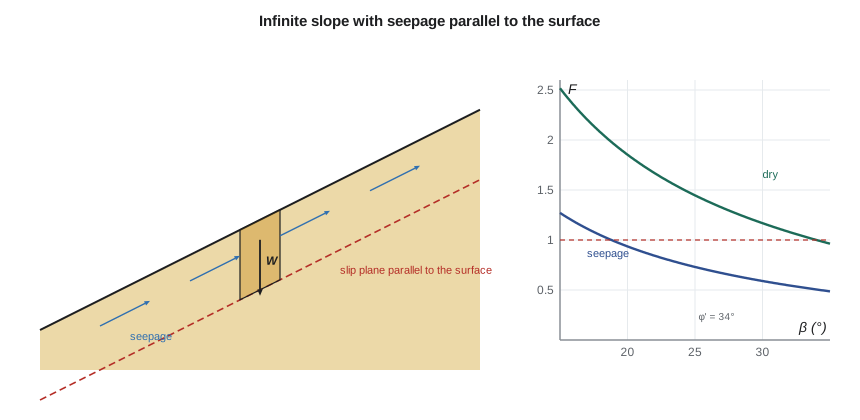
Where a slope is long compared with the depth of the potential slip, as in a hillside with a thin weathered layer or a sand bank with a shallow slump, the slip surface is parallel to the ground surface and end effects can be ignored. For a cohesionless soil with no water, equilibrium of a slice gives
independent of the depth. A dry sand slope is stable at any angle less than \(\phi'\); the angle of repose of a loose sand is close to its friction angle at the critical state. With seepage parallel to the slope and the water table at the surface, the pore pressure reduces the normal effective stress and
Since \(\gamma'/\gamma_{sat}\) is about one half, seepage parallel to the surface halves the factor of safety. This is why sandy banks and hillsides slump in the spring, when snowmelt saturates the upper soil and water seeps out of the face, and why they stand in the dry summer. With cohesion, the factor of safety depends on depth, and a cohesive soil can stand steeper than its friction angle down to a limiting depth.
Planar wedges
In some slopes the slip is along a plane through the toe: a weak layer dipping out of the slope, a joint in rock, or the steep face of a fresh cut in stiff soil. Culmann's method considers a wedge bounded by the slope face and a trial plane at angle \(\theta\) through the toe. The weight of the wedge is resisted by the cohesion and friction on the plane:
where \(L\) is the length of the plane. Trying a range of angles gives the critical wedge. For steep cuts in soils with some cohesion, the planar wedge gives a reasonable estimate; for flatter slopes in clay, the critical surface is curved and deeper, and a circle gives a lower factor of safety.
Circular surfaces in undrained clay
Rotational slips in homogeneous clay take place on surfaces close to circular arcs. For an undrained analysis (\(\phi = 0\)), the strength along the arc is simply \(s_u\), independent of the normal stress, and moments about the centre of the circle give
where \(L_a\) is the length of the arc, \(R\) its radius, \(W\) the weight of the sliding mass and \(x\) the horizontal distance from the centre of the circle to the centre of gravity of the mass. Taylor, in 1937, analysed many such circles for homogeneous slopes and produced charts of the stability number \(N_s = \gamma H F/s_u\) against slope angle and the depth to a firm base. For slopes flatter than about 53° in deep clay, the critical circle passes below the toe, and \(N_s\) approaches 5.5. Stability charts of this kind, extended by Bishop, Morgenstern, Janbu and others to drained conditions, are still useful for preliminary checks and for checking computer results.
Worked problem
Infinite slope of the sandy upper bank
The upper bank is sand with \(\phi' = 34^\circ\) and \(\gamma_{sat} = 19.8\) kN/m³, at a slope of 2H:1V (\(\beta = 26.6^\circ\)). Find the factor of safety against shallow sliding when dry and with seepage parallel to the face.
Show solution
- Dry:
- \[F = \frac{\tan 34^\circ}{\tan 26.6^\circ} = \frac{0.675}{0.500} = 1.35\]
- With seepage parallel to the surface:
- \[F = \frac{19.8 - 9.81}{19.8}(1.35) = 0.505(1.35) = 0.68\]
Answer: The dry bank is stable with a modest margin; the saturated bank with water seeping from the face is not. This is the mechanism of the spring slumps. A slope of 3H:1V would only just reach \(F = 1.0\) with seepage, so flattening alone would not cure it; drainage of the face or a buttress is needed, as lesson 9 shows.
Sofia's script repeats the infinite slope calculation for three slope angles, runs a Culmann wedge search for a temporary cut in the clay for the culvert works, and searches for the critical \(\phi = 0\) circle through the whole bank.
# Slope stability fundamentals for the Kestrel Creek bank: infinite slope, planar wedge and phi = 0 circles
from math import tan, sin, cos, radians, degrees, atan, sqrt
UNITS = "SI"
SI = UNITS == "SI"
L, P = ("m", "kPa") if SI else ("ft", "psf")
gw = 9.81 if SI else 62.4
# 1) infinite slope in the bank sand (phi' 34 deg)
phi = 34.0; gsat = 19.8 if SI else 126.0
for name, b in (("2H:1V", degrees(atan(1 / 2))), ("2.5H:1V", degrees(atan(1 / 2.5))), ("3H:1V", degrees(atan(1 / 3)))):
    dry = tan(radians(phi)) / tan(radians(b))
    wet = (gsat - gw) / gsat * dry
    print(f"Infinite slope {name} ({b:.1f} deg): dry FS = {dry:.2f}; seepage parallel to the surface FS = {wet:.2f}")
# 2) Culmann planar wedge in a 4 m | 13 ft cut in the clay, drained strength c' 5 kPa, phi' 27 deg, 1H:1V
c, ph, g = (5.0, 27.0, 18.0) if SI else (105.0, 27.0, 115.0)
H = 4.0 if SI else 13.0; beta = 45.0
best = None
for k in range(1, 440):
    th = 0.1 * k
    if th >= beta: break
    t, b = radians(th), radians(beta)
    W = 0.5 * g * H * H * (1 / tan(t) - 1 / tan(b)); Lp = H / sin(t)
    FS = (c * Lp + W * cos(t) * tan(radians(ph))) / (W * sin(t))
    if best is None or FS < best[0]: best = (FS, th)
print(f"\nCulmann wedge, {H:g} {L} cut at 1H:1V in the clay (drained): minimum FS = {best[0]:.2f} on a plane at {best[1]:.1f} deg")
# 3) phi = 0 circular analysis of the clay bank, end of construction (su 55 kPa | 1,150 psf)
su = 55.0 if SI else 1150.0
Hb, n = (5.0, 2.0) if SI else (16.0, 2.0)        # bank height and slope (n horizontal : 1 vertical)
def ground(x):                                    # toe at x = 0, crest at x = n Hb
    return 0.0 if x <= 0 else (x / n if x <= n * Hb else Hb)
def fs_circle(xc, yc, R, N=120):
    # slices between the two intersections of the circle with the ground
    xs = [xc - R + 2 * R * (i + 0.5) / N for i in range(N)]
    drive = resist = 0.0; dx = 2 * R / N; ok = False
    for x in xs:
        yb = yc - sqrt(max(R * R - (x - xc) ** 2, 0))
        h = ground(x) - yb
        if h <= 0: continue
        ok = True
        sin_a = (x - xc) / R; cos_a = sqrt(1 - sin_a ** 2)
        drive += g * h * dx * sin_a
        resist += su * dx / cos_a
    return resist / drive if ok and drive > 0 else 99
best = (99, 0, 0, 0)
for i in range(-20, 41, 2):
    for j in range(0, 41, 2):
        xc = i * Hb * 0.05; yc = Hb + j * Hb * 0.05
        for depth in [0.1 * k for k in range(0, 11)]:     # circles tangent to depths below the toe
            R = yc + depth * Hb
            f = fs_circle(xc, yc, R)
            if f < best[0]: best = (f, xc, yc, R)
print(f"phi = 0 circles, {Hb:g} {L} bank at {n:g}H:1V: minimum FS = {best[0]:.2f}, circle about ({best[1]:.1f}, {best[2]:.1f}) {L}, radius {best[3]:.1f} {L}")
print(f"Taylor's chart, deep circle, stability number about 5.5: FS = 5.5 su/(gamma H) = {5.5*su/(g*Hb):.2f}")Infinite slope 2H:1V (26.6 deg): dry FS = 1.35; seepage parallel to the surface FS = 0.68 Infinite slope 2.5H:1V (21.8 deg): dry FS = 1.69; seepage parallel to the surface FS = 0.85 Infinite slope 3H:1V (18.4 deg): dry FS = 2.02; seepage parallel to the surface FS = 1.02 Culmann wedge, 4 m cut at 1H:1V in the clay (drained): minimum FS = 1.64 on a plane at 31.1 deg phi = 0 circles, 5 m bank at 2H:1V: minimum FS = 3.56, circle about (5.0, 9.0) m, radius 14.0 m Taylor's chart, deep circle, stability number about 5.5: FS = 5.5 su/(gamma H) = 3.36
Reading the results
The temporary cut in the clay for the culvert works, 4 m deep at 1H:1V, has a drained factor of safety of about 1.65 on a plane at 31°, enough for a short-term excavation that will be backfilled within weeks. The cut must still be protected from rain and from surcharges at its crest, and inspected daily, because a planar analysis gives only an approximation for a clay slope.
The undrained analysis of the whole bank gives a minimum factor of safety of 3.56 on a deep circle, close to the Taylor chart value of 3.36. In the short term the clay bank is very safe. That does not mean the bank is safe: the long-term drained analysis with the seasonal water levels, which needs the method of slices, gives a much lower value in lesson 8. Comparing the two is the usual experience with banks in lightly overconsolidated clay, and it explains why such banks stand for decades and then fail after a wet spring.
What triggers slope failures
Slopes fail when the shear stress increases or the strength decreases. Shear stress increases with loading at the crest, such as fill, buildings or stockpiles; with removal of support at the toe, by excavation or erosion; with steepening; and with earthquake shaking. Strength decreases with rising pore pressure, from rainfall, snowmelt, leaking pipes, blocked drainage or rising creek water followed by rapid drawdown; with weathering and softening of clay; with the progressive failure of strain-softening clays; and, in some soils, with the leaching of salts. At Kestrel Bay, the creek erodes the toe of the bank in floods, and snowmelt raises the water table in the bank every spring. Both appear in lesson 8's analysis.
Before any analysis, an engineer should look at the slope. Tension cracks at the crest, bulging or seepage at the toe, tilted trees and fence posts, hummocky ground and old slump scars all indicate past or current movement. Air photographs of different years, which in this case go back to the 1950s, show how the creek has migrated and how the bank has retreated. The site visit to Kestrel Creek in April found seepage from the face of the bank about 1.5 m above the creek bed, which is the water level used for the spring condition in lesson 8.
| Analysis | Slip surface | Typical use | Kestrel Creek result |
|---|---|---|---|
| Infinite slope | plane parallel to the surface | shallow slides, sand banks | 1.35 dry, 0.68 with seepage |
| Planar wedge (Culmann) | plane through the toe | steep cuts, weak planes | 1.64 for the 4 m cut |
| φ = 0 circle | circular arc | end of construction in clay | 3.56 |
| Method of slices | circular or non-circular | most real problems | lesson 8 |
Practical points
- Decide whether the critical condition is undrained (end of construction) or drained (long term) before analysing.
- Use the infinite slope for shallow slides parallel to the surface; remember that seepage halves the factor of safety.
- Check undrained circles with Taylor's charts for a quick estimate.
- Look for evidence of past movement and seepage on site before calculating.
- Use the seasonal high water levels for long-term analyses.
Common mistakes
MistakeAnalysing a cut in clay only for undrained conditions.
InsteadFor cuts, the long-term drained condition is usually critical.
MistakeUsing the dry infinite slope result for a bank that seeps in spring.
InsteadSeepage parallel to the surface roughly halves the factor of safety.
MistakeReporting the factor of safety of one trial surface as that of the slope.
InsteadThe slope's factor of safety is the minimum over all possible surfaces.
MistakeIgnoring toe erosion by a creek.
InsteadErosion steepens the slope and removes support; protect the toe or include it in the analysis.
Summary and key terms
- \(F\) is the factor by which the strength must be divided to reach failure; minimum values are about 1.3 to 1.5.
- Undrained (\(\phi = 0\)) analyses suit fills on clay at the end of construction; drained analyses suit cuts and the long term.
- Infinite slope: \(F = \tan\phi'/\tan\beta\), halved by seepage parallel to the surface.
- Planar wedge: \(F = (c'L + W\cos\theta\tan\phi')/(W\sin\theta)\), minimized over \(\theta\).
- φ = 0 circle: \(F = s_u L_a R/(W x)\); Taylor's charts give \(N_s \approx 5.5\) for deep circles in flat slopes.
- The Kestrel Creek sand bank slumps in spring because seepage reduces its \(F\) from 1.35 to 0.68.
- Factor of safety (slope)
- The factor by which the shear strength would have to be reduced to bring a slope to failure on a given surface.
- Infinite slope
- A slope long enough that the slip surface can be taken as parallel to the surface and end effects ignored.
- Planar wedge
- A sliding mass bounded by a plane through the toe of the slope.
- Rotational slip
- A slide on a curved, roughly circular surface.
- Stability number
- In Taylor's charts, the dimensionless group γHF/su for undrained slopes.
- Tension crack
- A crack at the crest of a slope indicating movement or a zone of tensile stress.
- Rapid drawdown
- A fall in the water level in front of a slope faster than the pore pressures in the slope can dissipate.
- Angle of repose
- The steepest angle at which a loose granular material stands.
Practice problems
Work each problem on paper first, then reveal the answer to check.
A sand slope with \(\phi' = 32^\circ\) stands at 2.5H:1V. Find its factor of safety when dry and with seepage parallel to the surface (take \(\gamma'/\gamma_{sat} = 0.5\)).
Show answer
Dry \(F = 0.625/0.400 = 1.56\); with seepage, about 0.78.
A clay slope 6 m high, \(\gamma = 18\) kN/m³, with \(s_u = 40\) kPa and a deep firm base. Using \(N_s = 5.5\), estimate its undrained factor of safety.
Show answer
\(F = 5.5(40)/(18 \times 6) = 2.04\).
Why is the long-term condition usually critical for a cut slope in clay?
Show answer
Excavation lowers the pore pressures; as they recover to the groundwater equilibrium, the effective stress and the strength decrease, and the clay softens.
Name three signs on site that a slope is moving.
Show answer
Tension cracks at the crest, bulging or seepage at the toe, tilted trees or posts, hummocky ground or fresh scarps.
Lesson quiz · 5 questions
Score 60% or more to complete this lesson.
Create a free account to save your progress, take quizzes and earn a certificate.