
CIV-440 · Lesson 1 of 12 · 23 min
Lateral earth pressure: at rest, Rankine and Coulomb
Every structure that holds back soil, from a garden wall to the sheeting of a deep excavation, is loaded by lateral earth pressure. The soil pushes sideways because it has weight and because, unlike a liquid, it can carry shear stress only up to a limit. How hard it pushes depends on how much the structure is allowed to move. This lesson develops the three classical states of lateral earth pressure, at rest, active and passive, and the two theories used to calculate them, Rankine's and Coulomb's. They are the starting point for every design in this course.
The Kestrel Bay team is now preparing the geotechnical design package for phase 3 of the Thunder Bay operations centre and the Ridgeway Road improvements beside it. Dr. Lena Kowalczyk leads the geotechnical work, with Owen Lachance on the calculations and Sofia Martel writing the Python checks. The package contains a cantilever retaining wall where Ridgeway Road is widened onto the site, a mechanically stabilized earth wall on the approach to the new Kestrel Creek culvert, sheet pile walls at the creek outfall, a braced excavation for a new wet well, the repair of the creek bank and the frost design of all of them. The ground is the one the team knows from Soil Mechanics and Foundation Engineering: 4.0 m of compact sand over 7 m of varved clay on an artesian till.
Earth pressure at rest
Consider an element of soil at depth \(z\) in level ground. Its vertical effective stress is \(\sigma'_v\). Because the ground extends sideways in every direction and has not been strained laterally since it was deposited, the element is in a state of zero lateral strain. The horizontal effective stress that goes with this state is the earth pressure at rest:
For normally consolidated soils, Jaky's expression, derived for granular soils and confirmed by many laboratory and field measurements, is used almost universally:
It gives values of about 0.4 to 0.5 for sands and normally consolidated clays. Overconsolidation raises \(K_0\), because the horizontal stress locked in during loading does not fully relax on unloading. A common estimate, due to Mayne and Kulhawy, is \(K_0 = (1 - \sin\phi')\,\mathrm{OCR}^{\sin\phi'}\). Heavily overconsolidated clays can have \(K_0\) above 1, so the horizontal stress exceeds the vertical stress. The varved clay at Kestrel Bay is lightly overconsolidated by about 45 kPa, so its \(K_0\) near the top of the layer is somewhat above the normally consolidated value and close to it lower down.
Earth pressure at rest applies to walls that cannot move: basement walls braced by floors, the walls of a rigid box culvert, bridge abutments locked between a deck and a footing, and the walls of the pump station from Foundation Engineering. It also applies to a wall built against compacted backfill, which can exceed even \(K_0\), as lesson 2 shows. Water pressure, where present, is added separately; \(K_0\) multiplies only the effective stress.
Active and passive states
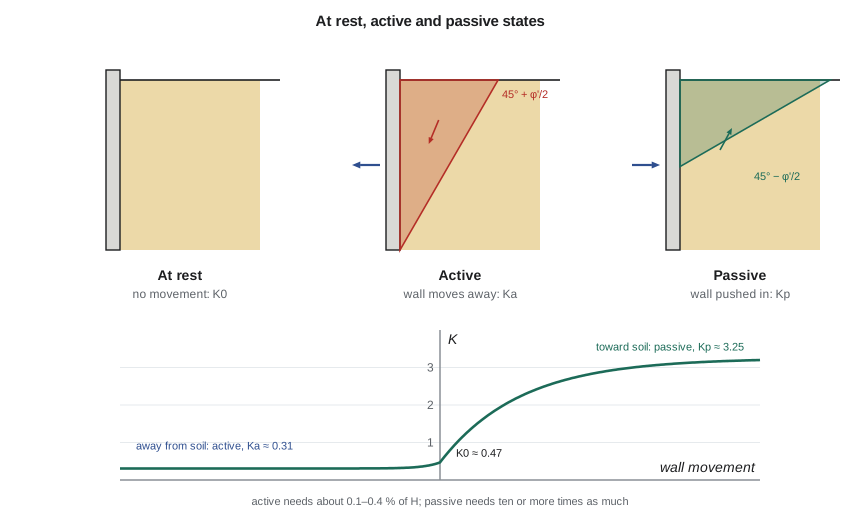
Now let a wall retaining dry sand move slowly away from the soil. The horizontal stress on the wall falls. With enough movement, the soil behind the wall reaches failure, a wedge of soil slides down and toward the wall, and the horizontal stress reaches its minimum value, the active earth pressure. If instead the wall is pushed into the soil, the horizontal stress rises until a much larger wedge fails by being pushed upward, at the maximum value, the passive earth pressure. Between the two limits lies the whole range of states, with the at-rest state somewhere in the middle.
The movements needed are very different. The active state develops after a wall rotation or translation of only about 0.1 to 0.4 % of its height in sand, about 5 to 20 mm for a wall of the height of the Ridgeway Road wall. The passive state needs movements ten or more times larger, typically 1 to 5 % of the height for dense to loose sand, and more in clay. This asymmetry runs through all of retaining wall design: active pressure can be relied on because a free-standing wall easily moves enough, but full passive resistance usually cannot be mobilized without unacceptable movement, so passive resistance is reduced or ignored.
Rankine's theory
In 1857, William Rankine considered a semi-infinite mass of cohesionless soil with a level surface, stretched or compressed horizontally until every point is at failure. Using the Mohr circle, the horizontal stress at failure is a fixed fraction of the vertical stress. For a soil with friction angle \(\phi'\) and no cohesion, the active and passive coefficients are
The failure planes in the active state are inclined at \(45^\circ + \phi'/2\) to the horizontal, and in the passive state at \(45^\circ - \phi'/2\). For a dry backfill of uniform unit weight \(\gamma\), the active pressure increases linearly with depth, \(\sigma'_a = K_a\gamma z\), and the resultant thrust on a wall of height \(H\) acts at \(H/3\) above the base:
Rankine's theory assumes a frictionless wall, because the shear stress on vertical planes in his stress field is zero. A real wall has friction with the soil, which tilts the thrust downward and slightly reduces its horizontal component. Rankine's theory is still widely used in practice, for two reasons. It is simple, and for cantilever walls the pressure is usually calculated on a vertical plane through the heel of the base, passing through soil rather than along the concrete, where the frictionless assumption is reasonable.
For a soil with effective cohesion \(c'\), Bell's extension gives the active pressure as
The equation predicts tension near the surface, down to the depth \(z_0 = 2c'/(\gamma\sqrt{K_a})\). Soil cannot sustain tension against a wall; it cracks instead. The tension zone is ignored, and if the crack can fill with water, the water pressure in the crack is added. In design, the cohesion of clay backfill is usually ignored altogether, because clay backfills shrink, swell and creep, and because a small cohesion makes a large difference to the calculated pressure. This is one reason why walls are backfilled with free-draining granular material.
Coulomb's theory
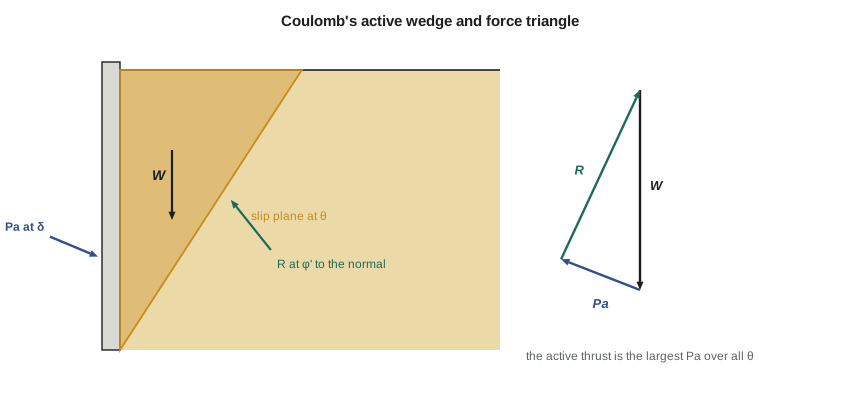
Charles Coulomb's analysis of 1776 predates Rankine's by eighty years and takes the opposite approach. Instead of a stress field, it considers a rigid wedge of soil sliding on a plane, with the wall and the slip plane both at failure. For a trial wedge at angle \(\theta\), the weight \(W\), the reaction \(R\) on the slip plane at \(\phi'\) to its normal and the wall thrust \(P\) at the wall friction angle \(\delta\) to the normal of the wall must close a force triangle. The active thrust is the largest value of \(P\) found by trying every wedge angle; the passive thrust is the smallest. The closed-form result for the active coefficient, for a wall whose back makes angle \(\alpha\) with the horizontal and a backfill sloping at \(\beta\), is
For a vertical, frictionless wall and level backfill, it reduces to Rankine's coefficient. The thrust acts at angle \(\delta\) to the normal to the wall. Wall friction is typically taken as \(\delta = \tfrac{2}{3}\phi'\) for concrete cast against soil or for precast walls with rough backs, and smaller for smooth steel. Coulomb's theory is the more general of the two: it handles wall friction, sloping wall backs and sloping backfill, and the trial wedge method extends to irregular ground, line loads and layered backfill, solved graphically or by computer.
For passive pressure, Coulomb's planar wedge becomes unsafe when the wall friction is large, because the true failure surface is curved and the plane overestimates the resistance. For \(\delta\) greater than about \(\phi'/3\), the passive coefficients of Caquot and Kérisel, or of the log-spiral solutions given in design manuals, should be used instead.
Worked problem
The Ridgeway Road wall: pressure coefficients and thrust
The retaining wall where Ridgeway Road is widened onto the site has an overall height of 5.0 m from the underside of its base to the road. It will be backfilled with a granular fill with \(\phi' = 32^\circ\) and \(\gamma = 20\) kN/m³. Find the at-rest, Rankine and Coulomb active thrusts on a vertical plane, with \(\delta = \tfrac{2}{3}\phi'\) for Coulomb.
Show solution
- Coefficients:
- \[K_0 = 1 - \sin 32^\circ = 0.470 \qquad K_a = \tan^2 29^\circ = 0.307 \qquad K_p = \tan^2 61^\circ = 3.25\]
- Coulomb's coefficient with \(\alpha = 90^\circ\), \(\beta = 0\) and \(\delta = 21.3^\circ\) is 0.275.
- \[P_0 = \tfrac12(0.470)(20)(5.0)^2 = 117.5\ \text{kN/m} \qquad P_a = \tfrac12(0.307)(20)(5.0)^2 = 76.8\ \text{kN/m}\]
- \[P_{a,\text{Coulomb}} = \tfrac12(0.275)(20)(5.0)^2 = 68.8\ \text{kN/m, horizontal component } 64.0\ \text{kN/m}\]
Answer: A wall that is free to move will be loaded by the active thrust of about 77 kN/m by Rankine's method; one that cannot move carries half as much again. The Coulomb thrust is smaller and inclined, and its horizontal component is about 17 % less than Rankine's.
Sofia's script computes the coefficients, the pressures and the thrusts, and then checks Coulomb's closed-form result by searching numerically for the critical wedge. It ends with the long-term active pressure of the varved clay, which matters for the excavation in lesson 6.
# Lateral earth pressure coefficients and forces on the Ridgeway Road wall
from math import sin, cos, tan, radians, degrees, sqrt
UNITS = "SI"
SI = UNITS == "SI"
L, F, P = ("m", "kN/m", "kPa") if SI else ("ft", "lb/ft", "psf")
H, gam, phi = (5.0, 20.0, 32.0) if SI else (16.0, 125.0, 32.0)   # wall height, backfill unit weight, backfill friction angle
f = radians(phi)
K0 = 1 - sin(f)                                   # Jaky, normally consolidated
Ka = tan(radians(45 - phi / 2)) ** 2              # Rankine active
Kp = tan(radians(45 + phi / 2)) ** 2              # Rankine passive
def coulomb_ka(phi, delta, alpha=90.0, beta=0.0):
    f, d, a, b = (radians(x) for x in (phi, delta, alpha, beta))
    num = sin(a + f) ** 2
    den = sin(a) ** 2 * sin(a - d) * (1 + sqrt(sin(f + d) * sin(f - b) / (sin(a - d) * sin(a + b)))) ** 2
    return num / den
delta = 2 / 3 * phi
KaC = coulomb_ka(phi, delta)
print(f"Backfill phi' = {phi:.0f} deg, gamma = {gam:g} {'kN/m3' if SI else 'pcf'}, wall height H = {H:g} {L}")
print(f"K0 = {K0:.3f}   Ka (Rankine) = {Ka:.3f}   Kp (Rankine) = {Kp:.2f}   Ka (Coulomb, delta = {delta:.1f} deg) = {KaC:.3f}")
for name, K in (("at rest", K0), ("Rankine active", Ka), ("Coulomb active", KaC)):
    sig = K * gam * H; Pf = 0.5 * K * gam * H * H
    print(f"  {name:15s}: pressure at base {sig:7.1f} {P}, force {Pf:7.1f} {F} acting at H/3 = {H/3:.2f} {L}")
print(f"Rankine active wedge: slip plane at {45 + phi/2:.0f} deg to horizontal, reaching {H / tan(radians(45 + phi/2)):.2f} {L} behind the wall")

# Coulomb's trial wedge: search for the wedge angle that gives the largest thrust
def thrust(theta):              # theta = slip plane angle from horizontal, vertical smooth-backed wall, level backfill
    t = radians(theta); W = 0.5 * gam * H * H / tan(t)
    return W * tan(t - f) / (cos(radians(delta)) + sin(radians(delta)) * tan(t - f))
best = max(range(40, 80), key=thrust)
print(f"Trial wedges: maximum thrust {thrust(best):.1f} {F} at theta = {best} deg (closed form {0.5*KaC*gam*H*H:.1f}; the horizontal component {0.5*KaC*gam*H*H*cos(radians(delta)):.1f})")

# The native clay in the long term: c' - phi' active pressure and the tension crack
cp, phc, gc = (5.0, 27.0, 18.0) if SI else (105.0, 27.0, 115.0)
Kac = tan(radians(45 - phc / 2)) ** 2
z0 = 2 * cp / (gc * sqrt(Kac))
print(f"Varved clay, c' = {cp:g} {P}, phi' = {phc:.0f} deg: Ka = {Kac:.3f}, sigma_a = Ka gamma z - 2c' sqrt(Ka)")
print(f"  tension crack depth z0 = 2c'/(gamma sqrt Ka) = {z0:.2f} {L}")
for z in ((2.0, 4.0) if SI else (6.0, 13.0)):
print(f" at depth {z:g} {L}: sigma_a = {Kac*gc*z - 2*cp*sqrt(Kac):.1f} {P}")Backfill phi' = 32 deg, gamma = 20 kN/m3, wall height H = 5 m K0 = 0.470 Ka (Rankine) = 0.307 Kp (Rankine) = 3.25 Ka (Coulomb, delta = 21.3 deg) = 0.275 at rest : pressure at base 47.0 kPa, force 117.5 kN/m acting at H/3 = 1.67 m Rankine active : pressure at base 30.7 kPa, force 76.8 kN/m acting at H/3 = 1.67 m Coulomb active : pressure at base 27.5 kPa, force 68.8 kN/m acting at H/3 = 1.67 m Rankine active wedge: slip plane at 61 deg to horizontal, reaching 2.77 m behind the wall Trial wedges: maximum thrust 68.8 kN/m at theta = 57 deg (closed form 68.8; the horizontal component 64.0) Varved clay, c' = 5 kPa, phi' = 27 deg: Ka = 0.376, sigma_a = Ka gamma z - 2c' sqrt(Ka) tension crack depth z0 = 2c'/(gamma sqrt Ka) = 0.91 m at depth 2 m: sigma_a = 7.4 kPa at depth 4 m: sigma_a = 20.9 kPa
Reading the results
The trial-wedge search finds its maximum thrust at a wedge angle of 57°, a little flatter than the 61° of Rankine's plane, because wall friction rotates the critical wedge. The maximum agrees with the closed-form value to the first decimal, which is a useful check on both. The Rankine active wedge reaches 2.77 m behind the wall at the road surface: anything founded closer than that, such as a sign post or a light standard, adds load to the wall and moves with it.
For the clay, the drained strength parameters \(c' = 5\) kPa and \(\phi' = 27^\circ\) give a tension crack 0.91 m deep and active pressures that are small near the top of the layer. In design these are not relied on: the crack may fill with water, and the clay at Kestrel Bay will be retained only temporarily, by the excavation support of lesson 6.
Choosing the coefficient
The choice between \(K_0\) and \(K_a\) is a judgement about wall movement, not a matter of conservatism alone. Cantilever retaining walls on soil, gravity walls and MSE walls rotate or slide enough to mobilize active pressure, and are designed for it. Walls restrained at the top, such as basement walls and integral abutments, are designed for at-rest pressure, sometimes more. Walls founded on rock or piles, which cannot move much at the base, may be designed for a pressure between the two. Codes and manuals give guidance: the Canadian Foundation Engineering Manual and the bridge codes (CSA S6, the Canadian Highway Bridge Design Code, issued in a 2025 edition) relate the coefficient to the expected movement, and specify the load factors to be used with each.
| Wall type | Typical movement | Design pressure |
|---|---|---|
| Cantilever wall on soil | rotation and sliding, 0.1–0.5 % of H | active |
| Gravity or MSE wall | sliding and tilt | active |
| Basement wall braced by floors | very small | at rest |
| Box culvert, rigid frame | very small | at rest, sometimes more |
| Wall on rock or piles | small at the base | between active and at rest |
| Soil in front of a wall | large movement needed | reduced passive or ignored |
Practical points
- Decide first how much the wall will move, and choose \(K_0\) or \(K_a\) accordingly.
- Multiply the coefficient by the vertical effective stress, and add water pressure separately.
- Use Rankine's theory on a vertical plane through the heel of cantilever walls; use Coulomb's theory where wall friction or a sloping back matters.
- Do not use Coulomb's planar passive wedge with large wall friction; use log-spiral coefficients.
- Ignore the cohesion of clay backfill, and use free-draining granular backfill wherever possible.
Common mistakes
MistakeApplying \(K_a\) to the total stress below the water table.
InsteadApply it to the effective stress and add the water pressure separately.
MistakeRelying on full passive resistance in front of a wall.
InsteadPassive resistance needs large movement; reduce it or ignore the upper part, which may be excavated or frozen.
MistakeDesigning a braced basement wall for active pressure.
InsteadA wall that cannot move carries at least the at-rest pressure.
MistakeUsing Bell's equation with the cohesion of a clay backfill to show a small thrust.
InsteadIgnore backfill cohesion in design.
Summary and key terms
- At rest: \(\sigma'_h = K_0\sigma'_v\), with \(K_0 = 1 - \sin\phi'\) for normally consolidated soils, higher when overconsolidated.
- Active and passive states need wall movement away from or toward the soil; passive needs ten or more times as much.
- Rankine: \(K_a = \tan^2(45^\circ - \phi'/2)\), \(K_p = \tan^2(45^\circ + \phi'/2)\), for a frictionless vertical wall and level backfill.
- Coulomb: a trial wedge with wall friction; the closed form handles sloping backs and backfill.
- Cohesion reduces active pressure and causes a tension crack to \(z_0 = 2c'/(\gamma\sqrt{K_a})\); it is ignored for backfill.
- The Ridgeway Road wall carries 76.8 kN/m active (Rankine) or 117.5 kN/m at rest.
- Earth pressure at rest
- The horizontal stress in soil that has undergone no lateral strain.
- Active earth pressure
- The minimum horizontal pressure, reached when a wall moves away from the soil enough for a wedge behind it to fail.
- Passive earth pressure
- The maximum horizontal resistance, reached when a wall is pushed into the soil enough for a wedge in front of it to fail.
- Earth pressure coefficient
- The ratio of horizontal to vertical effective stress.
- Wall friction angle
- The angle of shearing resistance between the wall and the soil, which tilts the thrust.
- Trial wedge method
- Coulomb's procedure of testing wedges of different angles to find the largest active or smallest passive thrust.
- Tension crack
- A crack near the surface of a cohesive soil where the calculated active pressure would be negative.
- Overconsolidation ratio
- The ratio of the preconsolidation stress to the present vertical effective stress.
Practice problems
Work each problem on paper first, then reveal the answer to check.
Find \(K_0\), \(K_a\) and \(K_p\) (Rankine) for a sand with \(\phi' = 36^\circ\).
Show answer
\(K_0 = 0.412\), \(K_a = 0.260\), \(K_p = 3.85\).
A 3.0 m wall retains dry sand with \(\gamma = 18\) kN/m³ and \(\phi' = 30^\circ\). Find the Rankine active thrust and its point of action.
Show answer
\(K_a = 0.333\); \(P_a = 0.5(0.333)(18)(9) = 27\) kN/m, at 1.0 m above the base.
A clay backfill has \(c' = 10\) kPa, \(\phi' = 25^\circ\) and \(\gamma = 19\) kN/m³. Find the depth of the tension crack.
Show answer
\(K_a = 0.406\); \(z_0 = 2(10)/(19 \times 0.637) = 1.65\) m.
Why is the passive resistance in front of a retaining wall usually reduced or ignored in design?
Show answer
It needs large movement to develop, and the soil in front may be excavated, eroded or frozen during the life of the wall.
Lesson quiz · 5 questions
Score 60% or more to complete this lesson.
Create a free account to save your progress, take quizzes and earn a certificate.