
CIV-390 · Lesson 8 of 12 · 20 min
Horizontal alignment
East of the operations site, Ridgeway Road becomes a two-lane rural road that the city plans to rebuild as an access route to the site and to a future industrial park. The existing road follows old property lines, with a sharp curve that has seen several run-off-road collisions in winter. The city asks Kestrel Bay to realign the road for a design speed of 80 km/h. This lesson covers the design of horizontal curves: the physics of a vehicle on a curve, superelevation and side friction, the geometry and stationing of circular curves, sight distance across the inside of a curve, and the transitions that take a driver smoothly from a tangent into a curve.
Design speed and alignment
The design speed is a selected speed used to determine the geometric features of a road. It should be at least as high as the speed most drivers are expected to travel, and consistent along a route, because drivers form expectations from what they have just driven. A curve that is much sharper than its neighbours surprises drivers, and surprise is a frequent factor in run-off-road crashes. Modern practice also checks the operating speed, the speed drivers actually travel, which on rural roads is often near or above the design speed on tangents and falls on sharp curves. A large drop in operating speed from a tangent to a curve is a warning sign of an inconsistent alignment.
The horizontal alignment of a road is a sequence of tangents (straight sections), circular curves and, often, transition (spiral) curves between them. Its design is governed by the radius needed for the design speed, the sight distance on the inside of curves, the location of intersections and structures, the terrain, drainage and the environment. A well-designed alignment is also pleasing to drive: long, flat curves rather than short sharp ones, and curves coordinated with crests and sags, a topic for lesson 9.
A vehicle on a curve
A vehicle travelling around a curve of radius \(R\) at speed \(v\) needs a centripetal acceleration \(v^2/R\) toward the centre of the curve. That acceleration is provided by two sources: the component of gravity along a pavement banked at superelevation \(e\) (the cross slope rising toward the outside of the curve), and the side friction between the tires and the pavement, characterized by a side friction factor \(f\). A force balance on the vehicle gives, for small angles,
With \(V\) in km/h and \(R\) in metres, this becomes \(R = V^2/(127\,(e + f))\). The minimum radius for a design speed is found by using the maximum superelevation the agency allows and the maximum side friction factor it considers comfortable at that speed.
The design side friction factors are not the limits of tire grip, which on dry pavement can exceed 0.8. They are values at which most drivers feel comfortable and do not instinctively slow down, determined from studies of driver behaviour and vehicle tests, with a margin for wet pavement and worn tires. They decrease as speed increases, from about 0.30 at very low speeds to about 0.14 at 80 km/h (50 mph) and about 0.08 at highway speeds of 130 km/h (80 mph). The margin between design friction and available friction is what keeps a driver on the road when the pavement is wet or the curve is taken a little too fast. On ice, available friction may fall below the design value, which is why the sharp curve on the old road has a winter crash problem.
Superelevation
The maximum superelevation rate depends on the climate and the setting. Where snow and ice are common, slow vehicles or stopped trucks on a highly banked curve may slide toward the inside, so agencies in cold regions limit superelevation to about 6 % (and sometimes 4 % in urban areas, where drainage, driveways and intersections make high superelevation awkward). Warmer regions may use 8 % or even 10 % on rural highways. For Ridgeway Road, Kestrel Bay uses a maximum of 6 %, matching the city's standard.
Curves flatter than the minimum radius do not need the full superelevation. Design guides distribute \(e\) and \(f\) over the range of radii so that drivers on flatter curves use less friction and the superelevation changes smoothly with curvature; the guides tabulate the resulting design superelevation for each radius and speed. A very flat curve may need no superelevation at all and can keep the normal crown, typically a 2 % cross slope sloping both ways from the centreline.
Geometry of a circular curve
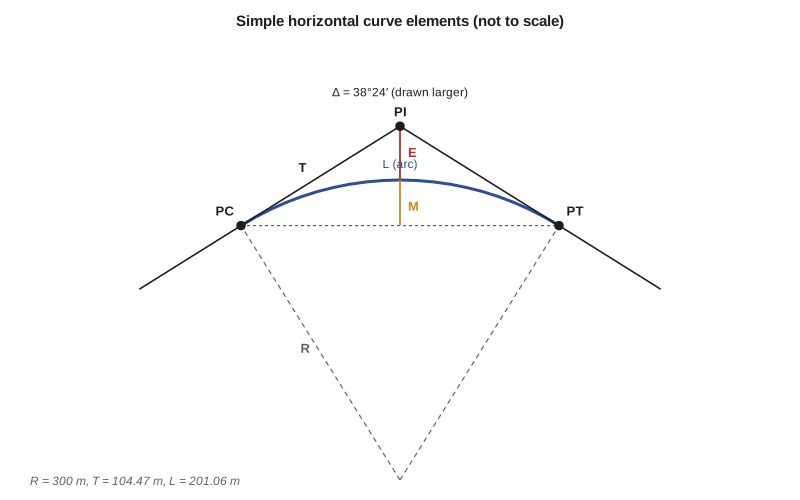
A simple circular curve joins two tangents that meet at the point of intersection (PI) with a deflection angle \(\Delta\). The curve begins at the point of curvature (PC) and ends at the point of tangency (PT). Its elements follow from the radius and the deflection angle:
where \(T\) is the tangent length from the PC or PT to the PI, \(L\) the length of the curve along the arc, \(E\) the external distance from the PI to the midpoint of the curve and \(M\) the middle ordinate from the midpoint of the curve to the midpoint of the long chord. Positions along the road are given by stationing, measured along the centreline from a starting point. The PC station is the PI station minus \(T\), and the PT station is the PC station plus \(L\), not the PI station plus \(T\), because the curve is shorter than the two tangents it replaces.
Canadian practice writes stations in kilometres plus metres: station 1+245.30 is 1,245.30 m from the start. US practice writes stations in hundreds of feet: station 40+85.60 is 4,085.60 ft from the start.
Designing the realigned curve
The realignment replaces the old sharp curve with a single circular curve. The tangents meet with a deflection angle of 38°24′, and the PI is at station 1+245.30. With \(e_{max}\) = 6 % and \(f\) = 0.14 at 80 km/h, the minimum radius is about 252 m; the team chooses 300 m to give a margin for winter conditions and to keep the curve consistent with the gentler curves to the east. The script computes the minimum radius, the curve elements and stations, the sight-line offset on the inside of the curve and the superelevation runoff.
# Horizontal curve on the Ridgeway Road extension
import math
UNITS = "SI"
SI = UNITS == "SI"
if SI:
    V, e, f = 80, 0.06, 0.14          # design speed km/h, max superelevation, side friction
    Rmin = V ** 2 / (127 * (e + f)); R = 300.0; u = "m"
else:
    V, e, f = 50, 0.06, 0.14          # mph
    Rmin = V ** 2 / (15 * (e + f)); R = 1000.0; u = "ft"
print(f"minimum radius at e = {e:.2f}, f = {f:.2f}: {Rmin:.0f} {u}; chosen R = {R:.0f} {u}")
D = 38 + 24 / 60                       # deflection angle 38 deg 24 min
T = R * math.tan(math.radians(D / 2)); Lc = math.pi * R * D / 180
E = R * (1 / math.cos(math.radians(D / 2)) - 1); M = R * (1 - math.cos(math.radians(D / 2)))
print(f"T = {T:.2f}  L = {Lc:.2f}  E = {E:.2f}  M = {M:.2f} {u}")
pi = 1245.30 if SI else 4085.60        # station of the PI (m or ft from the start)
pc = pi - T; pt = pc + Lc
def sta(x):
    return f"{int(x//1000)}+{x%1000:06.2f}" if SI else f"{int(x//100)}+{x%100:05.2f}"
print(f"PC at {sta(pc)}, PT at {sta(pt)}")
# superelevation needed at this radius (AASHTO method 5 split, simplified: e proportional)
e_need = V ** 2 / ((127 if SI else 15) * R) - f
print(f"e needed if all side friction were used: {e_need:.3f}; design e from tables is higher (about 0.05 to 0.06)")
# sight distance across the inside of the curve: offset needed for SSD
S = 130.0 if SI else 425.0
Ms = R * (1 - math.cos(math.radians(28.65 * S / R)))
print(f"middle ordinate needed for SSD {S:.0f} {u}: {Ms:.1f} {u}, measured from the middle of the inside lane")
# superelevation runoff for a two-lane road rotated about the crown line
w = 3.6 if SI else 12.0                 # lane width
delta = 0.50 if SI else 0.50           # max relative gradient, percent (about 0.50 % at 80 km/h / 50 mph)
Lr = w * 1 * (0.06 * 100) / delta
print(f"runoff length for e = 6 %: {Lr:.0f} {u}")minimum radius at e = 0.06, f = 0.14: 252 m; chosen R = 300 m T = 104.47 L = 201.06 E = 17.67 M = 16.69 m PC at 1+140.83, PT at 1+341.89 e needed if all side friction were used: 0.028; design e from tables is higher (about 0.05 to 0.06) middle ordinate needed for SSD 130 m: 7.0 m, measured from the middle of the inside lane runoff length for e = 6 %: 43 m
The curve has a tangent length of 104.47 m and an arc length of 201.06 m, with the PC at station 1+140.83 and the PT at 1+341.89. The sight line for the 130 m stopping sight distance needs a clear offset of about 7.0 m from the middle of the inside lane. The inside of the curve has a rock cut whose face would be about 6 m from the lane, so the cut will be laid back to give 7.5 m of clearance, including a margin for snow piled on the shoulder. A runoff length of about 43 m is needed to rotate the outer lane from flat to the 6 % superelevation, and the guide's tables give a design superelevation of about 5 % to 6 % at this radius, which the team rounds to 6 % for simplicity of construction.
Sight distance on horizontal curves
On the inside of a curve, walls, cut slopes, trees and buildings can block the driver's view of the road ahead. If the stopping sight distance \(S\) is shorter than the curve length, the required horizontal sightline offset, measured from the centre of the inside lane, is
where the angle is in degrees and \(R\) is the radius of the centre of the inside lane. The offset grows quickly as the radius gets smaller: a sharp curve in a cut may need a wide bench or a lower design speed. Seasonal obstructions matter too. Snowbanks on the inside shoulder of a curve in winter can reduce sight distance below the design value, so northern agencies leave extra offset or plan snow removal on critical curves.
Worked problem
Sight offset on the old curve
The old curve has a radius of 160 m. What sightline offset would 130 m of stopping sight distance require?
Show solution
- \[\theta = \frac{28.65 \times 130}{160} = 23.3°\]
- \[HSO = 160\,(1 - \cos 23.3°) = 160\,(1 - 0.918) = 13.1\ \text{m}\]
Answer: About 13 m of clear offset, almost twice the 7 m needed on the new 300 m curve. The old curve's rock face is only about 5 m from the lane, which is why drivers there see an oncoming plow or a stalled car too late.
Superelevation transitions and spirals
A driver cannot go from a crowned tangent to a fully superelevated curve instantly. The superelevation transition has two parts: the tangent runout, over which the outer lane is rotated from its normal crown to flat, and the superelevation runoff, over which the pavement is rotated from flat to the full superelevation. The runoff length is set so that the edge of pavement rises relative to the axis of rotation no faster than a maximum relative gradient, about 0.50 % at 80 km/h (50 mph), decreasing at higher speeds. For a rotation of \(n\) lanes of width \(w\) to superelevation \(e\) with relative gradient \(\Delta\),
where \(b_w\) is an adjustment factor for the number of lanes rotated. Usually about two thirds of the runoff is placed on the tangent and one third on the curve, a compromise between having too little superelevation at the start of the curve and too much on the tangent.
A spiral, or transition curve, is a curve whose radius changes gradually from infinity at the tangent to \(R\) at the start of the circular curve. It matches the natural path of a driver steering into a curve, provides a convenient length over which to develop superelevation, and improves the appearance of the road. Spirals are common on Canadian provincial highways and on railways, and less common on low-speed urban streets. The Ridgeway realignment uses a simple curve because the design speed is moderate and the radius generous; a spiral would be considered if the design speed were raised.
Other considerations
Several rules of thumb guide horizontal alignment. Avoid sharp curves at the end of long tangents or steep downgrades, where speeds are high. Avoid broken-back curves, two curves in the same direction joined by a short tangent, which drivers tend to treat as one curve. Avoid compound curves with a large ratio between radii. Do not place intersections or driveways on sharp curves, where sight distance and superelevation create problems. On the inside of curves, keep the roadside clear of hazards, and on the outside, which is where errant vehicles leave the road, use flat slopes or barriers. Lesson 10 discusses the clear zone and roadside safety.
| Element | Value | Basis |
|---|---|---|
| Design speed | 80 km/h | Rural collector, rolling terrain |
| Maximum superelevation | 6 % | Snow and ice region |
| Side friction factor | 0.14 | Design guide value at this speed |
| Minimum radius | 252 m | Point-mass formula |
| Chosen radius | 300 m | Margin and consistency |
| Sightline offset needed | 7.0 m | SSD across inside lane |
| Superelevation runoff | 43 m | Relative gradient 0.50 % |
Common mistakes
MistakeUsing the tire's maximum friction as the design side friction factor.
InsteadDesign friction factors are comfort values with a margin; they are far below the skid limit.
MistakeComputing the PT station as PI + T.
InsteadThe PT is PC + L, measured along the arc.
MistakeApplying high superelevation in a snow region.
InsteadLimit e to about 6 % where ice is common, so slow or stopped vehicles do not slide inward.
MistakeIgnoring winter obstructions on the inside of curves.
InsteadAllow extra sightline offset for snowbanks or plan to remove them.
Summary and key terms
- Design speed sets geometry and should be consistent along a route; operating speed checks consistency.
- The point-mass model gives \(v^2/(gR) = e + f\), so \(R_{min}\) depends on \(e_{max}\) and the design friction factor.
- Curve elements: \(T = R\tan(\Delta/2)\), \(L = \pi R\Delta/180\), \(E\), \(M\); PT station = PC + L.
- The sightline offset \(HSO = R[1 - \cos(28.65 S/R)]\) must be kept clear on the inside of curves.
- Superelevation is developed over the runout and runoff, set by a maximum relative gradient; spirals ease the transition.
- Design speed
- A selected speed used to determine the geometric features of a road.
- Superelevation
- The banking of a roadway on a curve, rising toward the outside.
- Side friction factor
- The friction demand between tires and pavement used in curve design.
- Point of curvature
- The point where a horizontal curve begins.
- Middle ordinate
- The distance from the midpoint of a curve to the midpoint of its long chord.
- Superelevation runoff
- The length over which the pavement is rotated from flat to full superelevation.
- Spiral curve
- A transition curve whose radius changes gradually between a tangent and a circular curve.
Practice problems
Work each problem on paper first, then reveal the answer to check.
Find the minimum radius at 100 km/h with e = 0.06 and f = 0.12.
Show answer
\(100^2/(127 \times 0.18) = 437\) m.
A curve has R = 400 m and Δ = 25°. Find T and L.
Show answer
\(T = 400\tan 12.5° = 88.7\) m; \(L = \pi(400)(25)/180 = 174.5\) m.
The PI of that curve is at station 2+350.00. Find the PC and PT stations.
Show answer
PC = 2+261.30; PT = 2+435.83.
Why does the side friction factor used in design decrease with speed?
Show answer
Drivers tolerate less lateral acceleration at higher speeds, and wet-pavement friction falls with speed, so a larger margin is kept.
Lesson quiz · 5 questions
Score 60% or more to complete this lesson.
Create a free account to save your progress, take quizzes and earn a certificate.