
CIV-340 · Lesson 9 of 12 · 20 min
Stresses under loaded areas
A footing pushes on the soil directly beneath it, but the stress it adds spreads out and decreases with depth, like the pressure under a hand pressed into a mattress. To estimate how much a clay layer several metres down will settle, the engineer needs the stress increase at the depth of the clay, not at the base of the footing. This lesson develops the elastic solutions that give those stress increases, compares them with the quick 2:1 method, and applies them to the garage footings designed in CIV-330, including the effect of the neighbouring footings.
Why elasticity
Soil is not elastic. It yields, it creeps and its stiffness depends on stress. Nevertheless, for the stress increases below a footing that is well within its bearing capacity, the distribution of stress predicted by elastic theory turns out to be a good approximation. The reason is that stresses in a body depend mainly on equilibrium and compatibility, and much less on the stiffness of the material, as long as the material is reasonably uniform. Field measurements under footings and embankments have confirmed this for decades. The elastic stress solutions are therefore used even when the settlements themselves are calculated from consolidation theory, as in lesson 10.
Boussinesq's point load
In 1885, the French mathematician Joseph Boussinesq solved the problem of a point load \(P\) on the surface of a uniform, isotropic, linearly elastic half-space. The vertical stress increase at a depth \(z\) and a horizontal distance \(r\) from the load is
Directly below the load, at \(r = 0\), this reduces to \(\Delta\sigma_z = 3P/(2\pi z^2) = 0.477P/z^2\). The vertical stress does not depend on the elastic modulus or, remarkably, on Poisson's ratio, which is why the solution is so useful. Westergaard later solved the same problem for a soil reinforced by thin horizontal layers that prevent lateral strain, a model of varved clays; it gives somewhat lower stresses directly below the load and is used occasionally for such deposits.
Loaded areas
A footing spreads its load over an area. Integrating Boussinesq's solution over the loaded area gives the stress increase from any distributed load. Three cases are especially useful.
Under the centre of a uniformly loaded circle of radius \(a\) carrying pressure \(q\), such as a storage tank,
Under the corner of a uniformly loaded rectangle of sides \(B\) and \(L\), the solution derived by Newmark in 1935 is written with \(m = B/z\) and \(n = L/z\) as \(\Delta\sigma_z = q I\), with an influence factor
where the inverse tangent is taken in the range 0 to \(\pi\). Fadum published the factor as a chart, and tables of it appear in every soil mechanics text. For a strip footing of width \(B\) and infinite length, closed-form expressions in terms of angles subtended at the point are also available.
Superposition
Because the elastic solutions are linear, stresses from separate loads add. The stress under the centre of a rectangle is four times the corner value for a rectangle a quarter of the size. The stress at a point outside a loaded rectangle is found by adding and subtracting rectangles that all have a corner at the point. The same principle gives the combined effect of neighbouring footings, a fill next to a building or an excavation that removes load.
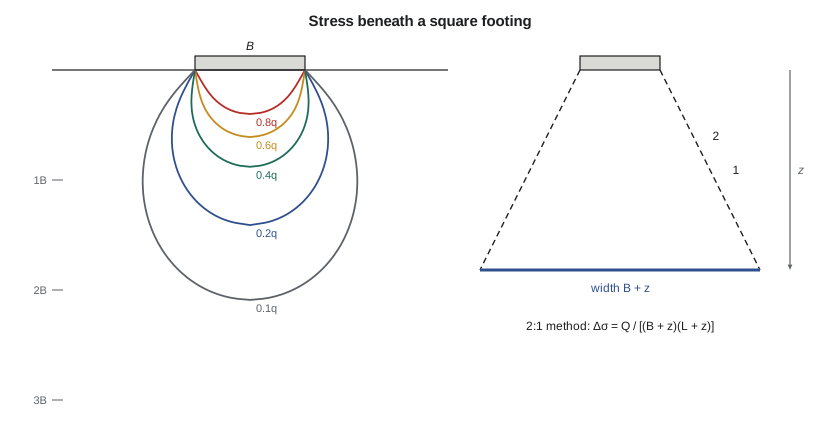
The pressure bulb
Plotting contours of equal stress increase beneath a footing gives the familiar pressure bulbs. Beneath a square footing, the stress falls to about half the applied pressure at a depth of one footing width and to about 10 % at two widths. Beneath a strip footing, the bulbs extend about twice as deep, because the load is spread over a long line. This is the basis of the rule in lesson 1 that boreholes should reach at least one and a half to two footing widths below a footing, and deeper where footings are close together or for a raft, whose width is the width of the whole building.
The 2:1 method
For quick estimates, the load can be assumed to spread with depth at a slope of one horizontal to two vertical. A rectangular footing \(B \times L\) carrying a total load \(Q\) then produces at depth \(z\) an average stress increase
This is the average over the spread area, so it underestimates the stress below the centre at shallow depth and overestimates it at large depth. Between about one and four footing widths it agrees with the elastic centre value within about 30 %, which is adequate for preliminary work and for checking a computer result.
The garage footings
The CIV-330 footings are 3.0 m square with their bases 2.0 m below grade. For consolidation, the load that matters is the sustained load: the dead load plus the part of the live load present for long periods, here 1,900 kN per column. The footing itself weighs about 159 kN and the backfill over it about 203 kN. The net pressure on the soil is the gross pressure minus the weight of the soil removed:
Only the net pressure adds effective stress below the footing, because the soil excavated for the footing had already been carrying its own weight. A basement or a deeply embedded footing can reduce the net pressure almost to zero; this is the principle of a floating, or compensated, foundation.
Worked problem
Stress at the top of the clay
Find the vertical stress increase at the top of the clay, 2.0 m below the footing base, under the centre of an isolated footing, by the elastic solution and by the 2:1 method.
Show solution
- Divide the footing into four 1.5 × 1.5 m squares meeting at the centre. For each, \(m = n = 1.5/2.0 = 0.75\):
- \[I = \frac{1}{4\pi}\Big[\frac{2(0.5625)\sqrt{2.125}}{2.125 + 0.316}\cdot\frac{3.125}{2.125} + \tan^{-1}\frac{2(0.5625)\sqrt{2.125}}{2.125 - 0.316}\Big] = 0.1374\]
- \[\Delta\sigma_z = 4(0.1374)(215) = 118\ \text{kPa}\]
- By the 2:1 method, with \(Q = 215(9.0) = 1935\) kN:
- \[\Delta\sigma_z = \frac{1935}{(3.0 + 2.0)^2} = 77\ \text{kPa}\]
Answer: At this shallow depth, two thirds of the footing width, the 2:1 average is a third lower than the elastic centre value. Lesson 10 uses the elastic values.
Sofia's script computes the stress increase beneath the centre and the corner of a footing at several depths through the clay, compares it with the 2:1 method and adds the effect of the four nearest neighbouring footings on the column grid.
# Vertical stress increase under the garage footings (Boussinesq, elastic half-space)
from math import pi, sqrt, atan2, copysign

def corner(a, b, z):
    """Influence factor at depth z below the corner of a uniformly loaded a x b rectangle."""
    if a == 0 or b == 0: return 0.0
    m, n = abs(a) / z, abs(b) / z
    s = m * m + n * n + 1
    I = (2 * m * n * sqrt(s) / (s + m * m * n * n) * (s + 1) / s + atan2(2 * m * n * sqrt(s), s - m * m * n * n)) / (4 * pi)
    return copysign(1, a) * copysign(1, b) * I

def rect(q, x1, x2, y1, y2, x, y, z):
    """Stress increase at (x, y, z) from load q on the rectangle x1..x2, y1..y2 (superposition of corners)."""
    return q * (corner(x2 - x, y2 - y, z) - corner(x1 - x, y2 - y, z) - corner(x2 - x, y1 - y, z) + corner(x1 - x, y1 - y, z))

B = 3.0                                   # square footing (m), base 2.0 m below grade
P, W_ftg, W_fill = 1900.0, 159.0, 203.0   # sustained column load, footing and backfill weights (kN)
q_net = (P + W_ftg + W_fill) / B**2 - 18.0 * 2.0
print(f"Net bearing pressure q_net = {q_net:.0f} kPa")
spacing = 7.5                             # column grid (m)
print(" z below base   centre   corner   2:1     centre with 4 neighbours")
for z in (0.5, 1.0, 2.0, 3.0, 4.0, 5.5, 7.5, 9.0):
    c = rect(q_net, -B/2, B/2, -B/2, B/2, 0, 0, z)
    k = rect(q_net, -B/2, B/2, -B/2, B/2, B/2, B/2, z)
    two = q_net * B * B / (B + z) ** 2
    nb = c + sum(rect(q_net, dx - B/2, dx + B/2, dy - B/2, dy + B/2, 0, 0, z)
                 for dx, dy in ((spacing, 0), (-spacing, 0), (0, spacing), (0, -spacing)))
    print(f"{z:8.1f} m  {c:8.1f} {k:8.1f} {two:7.1f} {nb:12.1f}   kPa")

# Point load check: the whole footing load as a point at depth 6 m
z = 6.0
print(f"\nPoint load approximation at z = {z} m: {3 * q_net * B * B / (2 * pi * z * z):.1f} kPa")Net bearing pressure q_net = 215 kPa
z below base centre corner 2:1 centre with 4 neighbours
0.5 m 210.1 53.7 158.2 210.1 kPa
1.0 m 185.8 52.5 121.1 185.9 kPa
2.0 m 118.2 46.4 77.5 119.4 kPa
3.0 m 72.4 37.7 53.8 75.6 kPa
4.0 m 46.8 29.5 39.6 52.6 kPa
5.5 m 27.2 20.4 26.8 36.5 kPa
7.5 m 15.4 13.0 17.6 27.3 kPa
9.0 m 10.9 9.6 13.5 23.3 kPa
Point load approximation at z = 6.0 m: 25.7 kPaReading the results
Under the centre of an isolated footing, the stress increase falls from 210 kPa just below the base to 118 kPa at the top of the clay, 27 kPa at mid-clay (5.5 m below the base) and 11 kPa at the bottom of the clay. The 2:1 method gives similar values in the middle of the layer and higher values near its base. Under the corner, the stress is only a quarter of the centre value near the surface but nearly the same at depth, as the bulbs merge.
The neighbouring footings, at 7.5 m centres, add almost nothing near the top of the clay but contribute 9 kPa at mid-depth and 12 kPa at the base, more than doubling the stress increase at the base. Deep below a group of footings, the stress approaches the average pressure of the whole building spread over its plan area. This is why interior footings settle more than corner footings, and why a building on a thick clay settles in a dish shape.
Large loaded areas
An area fill or a raft that is wide compared with the depth of the compressible layer produces a stress increase that hardly decreases with depth: the pressure bulb is wider than the layer is deep. For a fill many times wider than the clay is thick, the stress increase is simply the fill pressure, \(\Delta\sigma_z = \gamma_{fill} H_{fill}\), at every depth. This one-dimensional condition is exactly the condition of the laboratory consolidation test, which is why settlements under wide fills are predicted more reliably than under small footings.
The yard at the operations centre will be raised by 1.2 m of granular fill over an area about 80 m square, a load of about 1.2 × 20 = 24 kPa. Because the area is so much wider than the clay is deep, Owen takes the full 24 kPa through the clay.
Limits of the elastic solutions
The Boussinesq solutions assume a uniform half-space, a flexible load and small stresses. Real ground is layered. A stiff layer over a soft one spreads the load more widely, reducing stresses in the soft layer; a soft layer over a rigid base concentrates them. Elastic solutions for two- and three-layer systems, developed by Burmister for pavements, and finite element analyses capture these effects. A rigid footing, which settles uniformly, has a contact pressure that is higher at the edges than the centre on clay and higher at the centre on sand, but at depths greater than about half the footing width the stress distribution is the same as for a flexible footing with the same total load. For most foundation settlement work, the Boussinesq solution applied to the net pressure is the accepted standard.
Practical points
- Use the net pressure, not the gross pressure, for settlement calculations.
- Use the sustained load for consolidation of clay and the full service load for immediate settlement.
- Include neighbouring footings when the stress is needed at depths greater than about the footing spacing.
- Remember that the stresses from wide fills hardly decrease with depth.
- Check computer results against a hand calculation at one depth.
Common mistakes
MistakeApplying the corner influence factor directly at the centre of a footing.
InsteadDivide the footing into four rectangles meeting at the centre and add their contributions.
MistakeUsing the 2:1 method for precise calculations at shallow depth.
InsteadUse the elastic solution; the 2:1 method gives an average and underestimates the centre value near the surface.
MistakeIgnoring the load from neighbouring footings deep in the clay.
InsteadSuperpose the contributions of nearby footings and area loads.
MistakeUsing the gross bearing pressure as the stress increase.
InsteadSubtract the weight of the soil removed to get the net pressure.
Summary and key terms
- Boussinesq's point load: \(\Delta\sigma_z = (3P/2\pi z^2)[1 + (r/z)^2]^{-5/2}\), independent of the elastic constants.
- Uniformly loaded rectangles: \(\Delta\sigma_z = qI(m, n)\) under a corner; superposition gives any point.
- Pressure bulbs under a square footing reach about 10 % of q at a depth of 2B.
- The 2:1 method gives \(Q/[(B + z)(L + z)]\), a useful average.
- Under the garage footing centre, \(q_{net} = 215\) kPa gives 118 kPa at the top of the clay and 27 kPa at mid-clay; neighbours add about 9 kPa there.
- Wide fills impose nearly the full fill pressure throughout the clay.
- Boussinesq solution
- The elastic solution for the stresses in a half-space under a surface point load.
- Influence factor
- The ratio of stress increase to applied pressure at a point below a loaded area.
- Superposition
- Adding the effects of separate loads, valid for linear elastic solutions.
- Pressure bulb
- A contour of equal vertical stress increase below a loaded area.
- 2:1 method
- An approximation in which load spreads at one horizontal to two vertical with depth.
- Net pressure
- The pressure added to the soil at founding level, gross pressure minus the overburden removed.
- Compensated foundation
- A foundation whose excavated soil weight offsets much of the building load.
- Sustained load
- The part of the load present long enough to cause consolidation.
Practice problems
Work each problem on paper first, then reveal the answer to check.
A 500 kN point load acts on the surface. Find Δσz at 2 m depth directly below and at r = 2 m.
Show answer
Below: \(0.477(500)/4 = 59.7\) kPa; at r = z: \(59.7(0.5)^{2.5} = 10.5\) kPa.
A 2 m by 3 m footing carries a net pressure of 150 kPa. Estimate Δσz at 3 m below its base by the 2:1 method.
Show answer
\(150(6)/[(5)(6)] = 30\) kPa.
Why do interior footings of a building on deep clay settle more than corner footings with the same load?
Show answer
Their stress bulbs overlap with more neighbours, so the stress increase deep in the clay is larger.
A storage tank 12 m in diameter applies 100 kPa. Find Δσz at 6 m below its centre.
Show answer
\(a/z = 1\): \(100[1 - (0.5)^{1.5}] = 64.6\) kPa.
Lesson quiz · 5 questions
Score 60% or more to complete this lesson.
Create a free account to save your progress, take quizzes and earn a certificate.