
CIV-340 · Lesson 6 of 12 · 22 min
Effective stress and capillarity
Karl Terzaghi, the founder of soil mechanics, called the principle of effective stress the most important idea in the subject. It says that what deforms soil and gives it strength is not the total stress applied to it, but the part of that stress carried by the grains: the total stress minus the pressure of the water in the pores. Every calculation of settlement, every check of stability and every interpretation of a strength test rests on it. This lesson computes the effective stress profile under the operations centre, examines the artesian water in the till and the capillary water above the water table, and shows why lowering the groundwater for the pump station will settle the clay.
Total stress
At a depth \(z\) below a level ground surface, the total vertical stress \(\sigma_v\) is the weight of everything above a unit area: soil grains, the water in the pores and any surface load. For layered soil it is the sum of unit weight times thickness:
using the moist unit weight above the water table and the saturated unit weight below it. If a lake or river covers the ground, the weight of the free water above the surface is added too.
Pore water pressure
Water in the pores is connected through the soil, so under static conditions its pressure is hydrostatic: it increases linearly with depth below the water table, the level at which the pore pressure is zero (atmospheric).
where \(h_w\) is the depth below the water table, or more generally the height of water that would rise in a standpipe above the point, the pressure head. When water is flowing, as it is upward through the site clay, the pore pressure departs from hydrostatic, and the piezometers of lesson 1 measure it directly.
The principle of effective stress
Terzaghi defined the effective stress as
The idea is easiest to see with a thought experiment. A box of saturated sand is submerged in a tank and the water level is raised by a metre. The total stress on the sand rises, because there is more water above it, but the pore pressure rises by exactly the same amount, so the effective stress does not change, and the sand does not compress or get stronger. If instead a weight is laid on the sand, the total stress rises and, once the water has drained, the pore pressure is unchanged, so the effective stress rises and the sand compresses. Only changes in effective stress cause soil to deform or to change its strength.
Physically, the effective stress is the average contact force between grains per unit of total area. It is not the true stress at the tiny grain contacts, which is very much larger, and it is not a stress that can be measured with a gauge. It is a bookkeeping quantity that turns out to control behaviour. Soil cannot carry tension through its grains, so the effective stress of an uncemented soil cannot be negative; when the pore pressure rises to equal the total stress, the grains float apart and the soil loses its strength. That is the condition behind quicksand, piping and liquefaction.
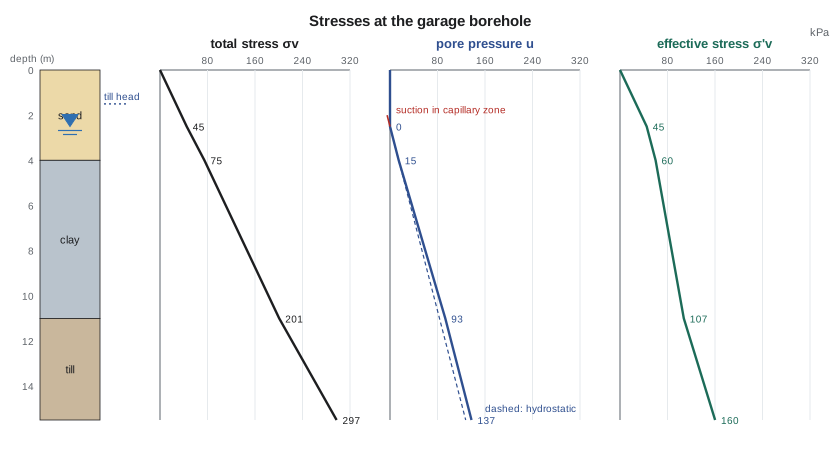
The stress profile at the garage
The BH-3 profile gives the layers: compact sand to 4.0 m, weighing 18.0 kN/m³ above the water table at 2.5 m and 19.8 kN/m³ below; clay to 11.0 m at 18.0 kN/m³; and till to bedrock at 15.5 m, at 21.5 kN/m³. A piezometer sealed in the till shows a water level 1.5 m below ground, a metre above the water table in the sand. The till is under artesian pressure, fed from higher ground to the north.
Worked problem
Effective stress at mid-depth of the clay
Find \(\sigma_v\), \(u\) and \(\sigma'_v\) at 7.5 m, the middle of the clay, at BH-3.
Show solution
- Total stress:
- \[\sigma_v = 18.0(2.5) + 19.8(1.5) + 18.0(3.5) = 45.0 + 29.7 + 63.0 = 137.7\ \text{kPa}\]
- Pore pressure. At the top of the clay it is hydrostatic from the sand, \(9.81(1.5) = 14.7\) kPa; at the base it follows the till head, \(9.81(11.0 - 1.5) = 93.2\) kPa. With steady upward flow through a uniform clay, it varies linearly between them:
- \[u = 14.7 + (93.2 - 14.7)\,\frac{3.5}{7.0} = 54.0\ \text{kPa}\]
- \[\sigma'_v = 137.7 - 54.0 = 83.7\ \text{kPa}\]
Answer: If the till were not artesian and the pore pressure were hydrostatic from the water table, \(u\) would be \(9.81(5.0) = 49.1\) kPa and \(\sigma'_v\) would be 88.6 kPa. The upward seepage reduces the effective stress by about 5 kPa at mid-depth and by 9.8 kPa at the base of the clay.
Sofia's script computes the whole profile, the upward gradient through the clay, the height of capillary rise in the sand and the effect of dewatering.
# Total stress, pore pressure and effective stress at BH-3
gw = 9.81
# (top, bottom, unit weight above water table, unit weight below water table) in m and kN/m3
layers = [(0.0, 4.0, 18.0, 19.8, "sand"), (4.0, 11.0, 18.0, 18.0, "clay"), (11.0, 15.5, 21.5, 21.5, "till")]
wt = 2.5                 # water table in the sand (m)
h_till = 1.5             # piezometric level of the till, as a depth below ground (m)

def total_stress(z, wt):
    s = 0.0
    for top, bot, g_moist, g_sat, _ in layers:
        if z <= top:
            break
        dz_top, dz_bot = top, min(z, bot)
        above = max(0.0, min(dz_bot, wt) - dz_top)
        below = max(0.0, dz_bot - max(dz_top, wt))
        s += g_moist * above + g_sat * below
    return s

def pore_pressure(z, wt, h_till):
    if z <= 4.0:                                    # sand: hydrostatic below the water table
        return gw * max(0.0, z - wt)
    u_top = gw * (4.0 - wt)                         # top of clay, hydrostatic from the sand
    u_bot = gw * (11.0 - h_till)                    # bottom of clay, from the till piezometer
    if z <= 11.0:                                   # steady seepage through the clay: linear
        return u_top + (u_bot - u_top) * (z - 4.0) / 7.0
    return gw * (z - h_till)                        # till: hydrostatic about its own head

print("  z (m)   sigma   u      sigma'   (kPa)")
for z in (0.0, 2.5, 4.0, 7.5, 11.0, 15.5):
    s, u = total_stress(z, wt), pore_pressure(z, wt, h_till)
    print(f"{z:6.1f} {s:7.1f} {u:6.1f} {s - u:8.1f}")

# Upward gradient through the clay from the artesian head in the till
i = ((11.0 - h_till) - (11.0 - wt) ) / 7.0
print(f"\nExcess head at the base of the clay = {wt - h_till:.1f} m, upward gradient i = {i:.3f}")

# Capillary rise in the sand: h_c = C / (e D10), with C about 0.1 to 0.5 cm2
e, D10_cm = 0.62, 0.0097
for C in (0.1, 0.3, 0.5):
    print(f"C = {C:.1f} cm2: capillary rise h_c = {C / (e * D10_cm) / 100:.2f} m")
hc = 0.5
z = wt - hc
print(f"Top of the capillary zone at {z:.1f} m: u = {-gw*hc:.1f} kPa, sigma' rises by {gw*hc:.1f} kPa above the dry estimate")

# Dewatering for the pump station lowers the water table in the sand to the top of the clay
s0, u0 = total_stress(4.0, wt), pore_pressure(4.0, wt, h_till)
s1 = total_stress(4.0, 4.0)             # sand between 2.5 and 4.0 m now drained, at its moist unit weight
u1 = 0.0
print(f"\nTop of clay before: sigma' = {s0 - u0:.1f} kPa; after dewatering: sigma' = {s1 - u1:.1f} kPa; "
f"increase {s1 - u1 - (s0 - u0):.1f} kPa")z (m) sigma u sigma' (kPa) 0.0 0.0 0.0 0.0 2.5 45.0 0.0 45.0 4.0 74.7 14.7 60.0 7.5 137.7 54.0 83.7 11.0 200.7 93.2 107.5 15.5 297.4 137.3 160.1 Excess head at the base of the clay = 1.0 m, upward gradient i = 0.143 C = 0.1 cm2: capillary rise h_c = 0.17 m C = 0.3 cm2: capillary rise h_c = 0.50 m C = 0.5 cm2: capillary rise h_c = 0.83 m Top of the capillary zone at 2.0 m: u = -4.9 kPa, sigma' rises by 4.9 kPa above the dry estimate Top of clay before: sigma' = 60.0 kPa; after dewatering: sigma' = 72.0 kPa; increase 12.0 kPa
Seepage and effective stress
Flowing water drags on the grains it passes. Where water flows downward, the drag adds to the weight of the grains and the effective stress is higher than hydrostatic conditions would give; where it flows upward, the drag lifts the grains and the effective stress is lower. The excess head across the clay here is small, and the upward hydraulic gradient, the head lost per unit length of flow, is
Lesson 7 shows that upward flow reduces the effective stress by \(i\gamma_w\) per unit depth, and that the effective stress falls to zero when the gradient reaches about 1.0. The site is far from that, but the pump station excavation, which will cut down toward the clay, changes the picture: removing the sand above the clay removes the weight that holds the clay down against the artesian pressure in the till. Lesson 8 checks the base of that excavation against heave.
Capillarity
Above the water table, water is drawn up into the narrow pores by surface tension, just as it rises in a thin glass tube. In a tube of diameter \(d\), water rises to a height
where \(T\) is the surface tension of water, about 0.073 N/m at room temperature, and \(\alpha\) is the contact angle, near zero for clean glass and mineral surfaces. The water in the tube hangs from the meniscus, so its pressure is below atmospheric: negative pore pressure, or suction, equal to \(-\gamma_w h\) at a height \(h\) above the water table. Soil pores are not tubes, but the same physics applies, and an empirical form due to Hazen relates the height of capillary rise to the effective size:
with \(C\) between about 0.1 and 0.5 cm² and \(D_{10}\) in centimetres. Rise is a few centimetres in gravel, tens of centimetres in sand, metres in silt and many metres in clay, although in clay it takes a very long time to develop.
For the site sand, \(D_{10} = 0.097\) mm and \(e = 0.62\) give a capillary rise between about 0.2 and 0.8 m; Owen takes 0.5 m. In that zone, from 2.0 to 2.5 m, the sand is close to saturated and the pore pressure is negative, as low as \(-4.9\) kPa at the top. The suction adds to the effective stress: it is what lets a child build a sandcastle from damp sand, and it disappears when the sand dries out or is submerged.
Engineers rarely count on suction in design, because it can vanish after heavy rain, a burst pipe or a rise in the water table. Its loss is the reason a trench cut in damp sand can stand vertically for a few hours and then collapse as it dries. Capillarity also feeds the ice lenses of frost heave described in lesson 3, which is why a layer of clean coarse gravel, a capillary break, is placed under floor slabs and road bases in cold regions.
Partly saturated soils
In soils that are partly saturated, such as compacted fills and the sand above the capillary zone, the pores contain both air and water, and the simple form of the effective stress principle no longer holds exactly. Bishop proposed a modified expression that weights the suction by a factor between 0 and 1 depending on the degree of saturation, and modern unsaturated soil mechanics treats the net stress and the suction as separate variables. For most foundation work, engineers assume either zero pore pressure above the water table or a conservative capillary zone, as Owen has done.
Changing the water table
Because effective stress depends on the pore pressure, lowering the groundwater increases the effective stress in every layer below. In sand the effect is immediate and causes little settlement, because sand is stiff. In clay it causes consolidation settlement that develops over months or years, the subject of lessons 10 and 11. Groundwater pumping has caused large regional subsidence in many cities built on clay, including Mexico City and Bangkok.
Worked problem
Effect of dewatering for the pump station
During construction of the pump station, wells will lower the water table in the sand from 2.5 m to the top of the clay at 4.0 m. Assume the drained sand weighs 18.0 kN/m³. Find the increase in effective stress at the top of the clay.
Show solution
- Before: \(\sigma_v = 74.7\) kPa, \(u = 14.7\) kPa, \(\sigma'_v = 60.0\) kPa.
- After: the 1.5 m of sand above the clay drains, so its unit weight falls from 19.8 to 18.0 kN/m³ and the pore pressure at the clay surface falls to zero:
- \[\sigma_v = 18.0(4.0) = 72.0\ \text{kPa} \qquad \sigma'_v = 72.0 - 0 = 72.0\ \text{kPa}\]
- \[\Delta\sigma'_v = 72.0 - 60.0 = 12.0\ \text{kPa}\]
Answer: An increase of 12 kPa is equivalent to adding about two thirds of a metre of fill over the whole dewatered area. Lesson 10 checks whether it will settle the nearby garage footings.
Owen points out that the excavation itself will remove soil and reduce the total stress inside the pump station, so the clay there will unload. Outside the excavation, however, the dewatering effect spreads as far as the drawdown cone reaches, and that is where the garage footings sit. Dr. Kowalczyk adds a requirement for settlement monitoring points on the garage during the pump station work and suggests recharge wells if the measured drawdown spreads too far.
Horizontal stress
The effective stress principle applies in every direction, but the horizontal effective stress is not simply equal to the vertical one. For a soil that was deposited and loaded only vertically, the ratio of horizontal to vertical effective stress at rest is the coefficient \(K_0\), about \(1 - \sin\phi'\) for normally consolidated soils, roughly 0.4 to 0.6. In overconsolidated soils, from which overburden has been removed by erosion or melting ice, \(K_0\) is higher and can exceed 1 near the surface. The horizontal stress matters for retaining walls, piles and the stress paths of lesson 12, and it is covered in the foundation and geotechnical design courses.
Practical points
- Always draw the profile: layers, unit weights, water table and any piezometric levels in deeper layers.
- Use measured piezometric levels, not an assumed hydrostatic profile, when layers are separated by clay.
- Do not rely on capillary suction for long-term stability.
- Check the effect of any dewatering on nearby structures founded over compressible soil.
Common mistakes
MistakeComputing settlement or strength from the total stress.
InsteadUse the effective stress, σ' = σ − u.
MistakeUsing the buoyant unit weight above the water table.
InsteadAbove the water table use the moist unit weight and u = 0 (or negative in the capillary zone).
MistakeAssuming the pore pressure is hydrostatic through a clay between aquifers at different heads.
InsteadInterpolate between the measured heads for steady seepage.
MistakeForgetting that a rising flood level does not change the effective stress in a submerged soil.
InsteadFree water above the ground raises σ and u equally.
Summary and key terms
- Effective stress \(\sigma' = \sigma - u\) controls the deformation and strength of soil.
- Total stress is \(\sum\gamma_i h_i\); pore pressure is \(\gamma_w h_w\) under hydrostatic conditions.
- Upward seepage lowers the effective stress; downward seepage raises it.
- At mid-clay at the garage, \(\sigma'_v = 83.7\) kPa, about 5 kPa lower than hydrostatic because of the artesian till.
- Capillary rise \(h_c \approx C/(eD_{10})\) creates suction above the water table, which is not relied on in design.
- Dewatering to the top of the clay raises its effective stress by 12 kPa, which can settle nearby footings.
- Effective stress
- The total stress minus the pore water pressure; the stress carried through the soil skeleton.
- Pore water pressure
- The pressure of the water in the soil pores.
- Water table
- The level in the ground at which the pore water pressure equals atmospheric pressure.
- Artesian pressure
- A pore pressure in a confined layer higher than the hydrostatic pressure from the local water table.
- Capillary rise
- The height to which water is drawn above the water table by surface tension.
- Suction
- A negative pore water pressure, below atmospheric.
- Hydraulic gradient
- The loss of total head per unit length of flow path.
- Coefficient of earth pressure at rest
- K0, the ratio of horizontal to vertical effective stress in soil that has not moved laterally.
Practice problems
Work each problem on paper first, then reveal the answer to check.
Find σ'v at 4.0 m at BH-3 if the water table rose to the ground surface in a spring flood.
Show answer
\(\sigma_v = 19.8(4.0) = 79.2\) kPa; \(u = 39.2\) kPa; \(\sigma'_v = 40.0\) kPa.
A lake 3 m (10 ft) deep covers a clay. How does the effective stress in the clay compare with the case of no lake?
Show answer
It is the same; the lake raises the total stress and pore pressure equally.
A silt has D10 = 0.01 mm and e = 0.8. Estimate the capillary rise with C = 0.3 cm².
Show answer
\(h_c = 0.3/(0.8 \times 0.001) = 375\) cm, about 3.8 m.
Why do the garage footings not settle immediately when the water table is lowered?
Show answer
The clay must expel water to consolidate under the higher effective stress, which takes time.
Lesson quiz · 5 questions
Score 60% or more to complete this lesson.
Create a free account to save your progress, take quizzes and earn a certificate.