
CIV-340 · Lesson 4 of 12 · 19 min
Soil classification
A classification system turns the index tests of lesson 3 into a short label that every engineer understands. Calling the site clay a CL tells a reader at once that it is a fine-grained soil of low to intermediate plasticity, likely to be compressible, of low permeability and strength sensitive to water. Classification does not replace testing, but it organizes experience: soils in the same group tend to behave alike, so a label carries decades of lessons from other projects. This lesson applies the Unified Soil Classification System to the soils from the operations centre and explains how classification fits with field description.
Why classify
Classification serves three purposes. It is a common language for logs, reports and specifications. It groups soils for correlations, so that a reader can look up typical permeabilities, strengths and compaction behaviour for each group. And it flags problems early: a symbol such as OH or Pt, or a high-plasticity CH, warns of difficult ground before any detailed test is run. Most systems use only the grain size distribution and the Atterberg limits, which are cheap and quick, and deliberately ignore properties such as density and structure, which depend on the state of the soil in the ground rather than on what it is made of.
The Unified Soil Classification System
The USCS was developed by Arthur Casagrande for airfield construction during the Second World War and later adopted by the US Army Corps of Engineers and the Bureau of Reclamation. It is standardized as ASTM D2487 for laboratory classification and ASTM D2488 for visual-manual field description. In Canada it is the standard engineering classification; the CFEM presents it with minor modifications and pairs it with a descriptive system for logs.
Each group has a two-letter symbol. The first letter is the main soil type: G for gravel, S for sand, M for silt (from the Swedish mo), C for clay, O for organic and Pt for peat. The second letter is a modifier: W for well graded, P for poorly graded, M for silty fines, C for clayey fines, L for low plasticity and H for high plasticity. Each group also has a name, such as poorly graded sand with silt or lean clay, which the standard builds from the symbol and the percentages of secondary components.
Coarse-grained soils
A soil is coarse grained if more than half of it by mass is retained on the 0.075 mm sieve. It is a gravel if more of the coarse fraction is gravel than sand, and a sand otherwise. The fines content then decides the next step:
- Less than 5 % fines: the soil is clean and is classified by its grading, GW or GP, SW or SP, using \(C_u\) and \(C_c\) from lesson 3.
- More than 12 % fines: the fines control the behaviour and the soil is GM or GC, SM or SC, depending on whether the fines plot as silt or clay on the plasticity chart.
- From 5 to 12 % fines: the soil is a borderline case and gets a dual symbol that combines the grading and the fines, such as SP-SM or GW-GC.
Fine-grained soils and the plasticity chart
A soil is fine grained if half or more passes the finest sieve. It is classified by plotting its plasticity index against its liquid limit on Casagrande's plasticity chart.
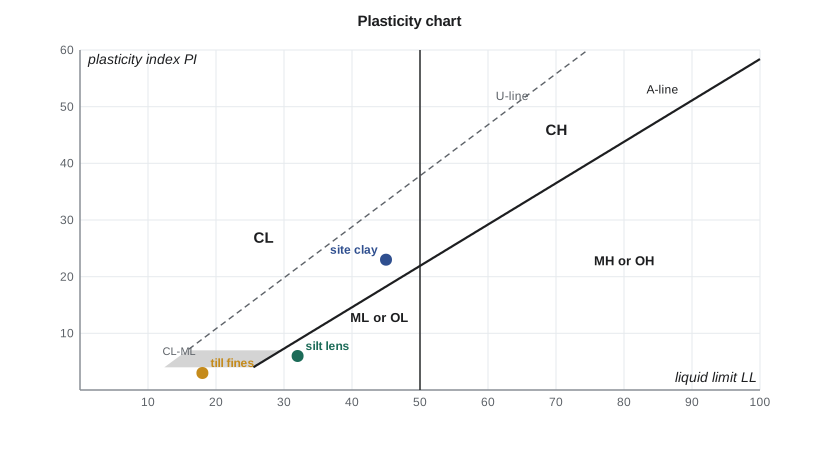
Two lines divide the chart. The A-line, \(PI = 0.73(LL - 20)\), separates clays above from silts and organic soils below. The vertical line at \(LL = 50\) separates low plasticity (L) from high plasticity (H). The U-line, \(PI = 0.9(LL - 8)\), is an upper limit found empirically for natural soils; a point above it suggests a testing error. A small hatched zone between \(PI = 4\) and 7 above the A-line gives the dual symbol CL-ML.
Organic soils are identified by a drop in the liquid limit after oven drying: if the liquid limit of the oven-dried soil is less than three quarters of that of the undried soil, the soil is organic (OL or OH). They are also recognized by their dark colour, odour and spongy feel. Peat, Pt, is mostly plant matter and is identified by eye. Organic soils and peat are very compressible and usually removed from beneath structures.
Classifying the site soils
Owen classifies the soils tested in lesson 3, together with a silt lens found in BH-2 and the crushed stone proposed as granular base for the yard. Sofia codes a simplified version of the ASTM D2487 flowchart for inorganic soils. It ignores the group names and the rules for cobbles and organic soils, but it reproduces the symbols.
Worked problem
Classifying the till
The till has 31 % gravel, 37 % sand and 32 % fines. The fines have LL = 18 and PI = 3. Classify it.
Show solution
- Less than half is fines, so the soil is coarse grained. The sand fraction (37 %) exceeds the gravel fraction (31 %), so it is a sand.
- The fines exceed 12 %, so the second letter comes from the fines.
- On the plasticity chart, PI = 3 is below 4, so the fines are silt:
- \[\text{A-line at}\ LL = 18: \quad PI = 0.73(18 - 20) < 0 \qquad PI = 3 < 4 \quad\Longrightarrow\quad \text{M}\]
- The symbol is SM. With 31 % gravel, more than 15 %, the group name is silty sand with gravel.
Answer: The till is SM, silty sand with gravel. Its behaviour, low permeability, frost susceptibility and sensitivity to water during placement, comes from the silty fines, not from the gravel that dominates its appearance in the borehole.
# A simplified Unified Soil Classification System (after ASTM D2487) for inorganic soils
def a_line(LL):
    return 0.73 * (LL - 20)

def fine_symbol(LL, PI):
    """Group symbol for fines from the plasticity chart; PI None means nonplastic."""
    if PI is None:
        return "ML"
    if 4 <= PI <= 7 and PI >= a_line(LL):
        return "CL-ML"
    if PI < 4 or PI < a_line(LL):
        return "MH" if LL >= 50 else "ML"
    return "CH" if LL >= 50 else "CL"

def uscs(gravel, sand, fines, Cu=None, Cc=None, LL=None, PI=None):
    if fines >= 50:
        return fine_symbol(LL, PI)
    G = gravel > sand
    first = "G" if G else "S"
    well = Cu is not None and Cc is not None and 1 <= Cc <= 3 and Cu >= (4 if G else 6)
    grade = first + ("W" if well else "P")
    if fines < 5:
        return grade
    fsym = fine_symbol(LL, PI)
    plastic = first + ("C" if fsym in ("CL", "CH") else "M")
    if fsym == "CL-ML":
        plastic = first + "C-" + first + "M"
    if fines <= 12:
        return grade + "-" + plastic[:2]
    return plastic

samples = [
    ("Brown sand, BH-3 1.5 m",          dict(gravel=2, sand=91, fines=7, Cu=5.0, Cc=1.32)),
    ("Grey varved clay, BH-3 6 m",      dict(gravel=0, sand=1, fines=99, LL=45, PI=23)),
    ("Grey till, BH-3 12 m",            dict(gravel=31, sand=37, fines=32, LL=18, PI=3)),
    ("Silt lens, BH-2 7.5 m",           dict(gravel=0, sand=15, fines=85, LL=32, PI=6)),
    ("Crushed stone base, stockpile",   dict(gravel=55, sand=41, fines=4, Cu=30, Cc=1.4)),
]
for name, d in samples:
    sym = uscs(**d)
    extra = ""
    if d.get("LL") is not None:
        extra = f"  (LL {d['LL']}, PI {d['PI']}, A-line PI {a_line(d['LL']):.1f})"
print(f"{name:32s} {sym:7s}{extra}")Brown sand, BH-3 1.5 m SP-SM Grey varved clay, BH-3 6 m CL (LL 45, PI 23, A-line PI 18.2) Grey till, BH-3 12 m SM (LL 18, PI 3, A-line PI -1.5) Silt lens, BH-2 7.5 m ML (LL 32, PI 6, A-line PI 8.8) Crushed stone base, stockpile GW
The sand, with 7 % nonplastic fines and \(C_u\) below 6, is SP-SM, poorly graded sand with silt. The clay is CL, lean clay: its point lies above the A-line and to the left of \(LL = 50\). The silt lens has a PI of 6, which would put it in the CL-ML zone if it lay above the A-line, but at \(LL = 32\) the A-line is at a PI of 8.8, so it is ML, silt. The crushed stone, well graded with only 4 % fines, is GW.
The silt lens deserves attention even though it is thin. It is more permeable than the clay around it, so it drains the clay and speeds consolidation, and in an excavation it can bring water and fines in through the sides. Dr. Kowalczyk asks for the CPT records to be checked for other lenses between the boreholes.
Classification and description in Canadian practice
Canadian logs combine the USCS symbol with a descriptive name in a standard order. The CFEM descriptive system uses proportion terms for secondary components: trace (1 to 10 %), some (10 to 20 %), adjective form such as silty or gravelly (20 to 35 %), and and (35 to 50 %). The till would be logged as silty sand, some gravel to gravelly, trace clay, grey, moist, very dense (till), SM. Provincial agencies follow similar conventions; the Ontario Ministry of Transportation, for example, uses a modified USCS on highway projects. The proportion terms differ slightly from the group names of ASTM D2487, so a report should state which system its descriptions follow.
Pavement designers in Canada, including the City of Thunder Bay and the Ontario Ministry of Transportation, rate subgrades by their frost susceptibility, drainage and resilient modulus rather than by an index number. The clay's plasticity and the till's silt content both point to a poor subgrade that will need a thick granular section and good drainage. The AASHTO system, common in the United States, is seldom used on Canadian projects.
| Group | Typical soils | Permeability | Compressibility | As subgrade or fill |
|---|---|---|---|---|
| GW, SW | Well-graded gravels and sands | High | Negligible | Excellent |
| GP, SP | Uniform gravels and sands | High | Negligible | Good; hard to compact if uniform |
| GM, SM | Silty gravels and sands, many tills | Low to moderate | Low | Good to fair; frost-susceptible |
| GC, SC | Clayey gravels and sands | Low | Low | Good to fair |
| ML | Silts, rock flour | Low | Low to medium | Poor; frost-susceptible |
| CL | Lean clays, lake clays | Very low | Medium | Fair to poor |
| CH, MH | Fat clays, elastic silts | Very low | High | Poor; swelling and shrinkage |
| OL, OH, Pt | Organic soils and peat | Variable | Very high | Unsuitable |
Field identification
In the field, without a laboratory, an engineer or technician can classify soil well enough for logging by simple tests. Coarse and fine soils are separated by eye: individual sand grains are visible, silt and clay particles are not. Fine soils are distinguished by four manual tests from ASTM D2488:
- Dry strength: a dried lump of clay is hard to crush between the fingers; silt crumbles easily.
- Dilatancy: a pat of wet silt shaken in the palm turns glossy as water comes to the surface and dull when squeezed; clay shows little or no reaction.
- Toughness: a thread of clay rolled near the plastic limit is stiff and tough; a silt thread is weak and crumbles.
- Plasticity: the ease of rolling a thread and the water content range over which it can be rolled.
A trained eye and these tests usually place a soil within one group of its laboratory classification. The laboratory then confirms the classification on representative samples, and the logs are corrected where needed.
What classification cannot tell you
Two soils in the same group can behave very differently. A loose SP sand and a dense SP sand share a symbol but differ in strength, stiffness and liquefaction potential. A soft, normally consolidated CL and a stiff, overconsolidated CL share a symbol but differ several times over in compressibility and strength. Classification describes what a soil is made of; its state, density, stress history and structure must be measured separately, by the in situ tests of lesson 1 and the consolidation and strength tests of lessons 10 and 12. Sensitive clays, such as the Leda clay of the Ottawa and St. Lawrence valleys studied in CIV-241, are a striking example: they classify as ordinary CL or CH soils but can turn to liquid when disturbed.
Practical points
- Report the group name and the percentages, not just the symbol; the name carries the secondary components.
- Use dual symbols for borderline gradings (5 to 12 % fines) and the CL-ML zone, as the standard requires.
- Classify every sample used in design, and correlate field descriptions with laboratory results.
- Treat thin lenses and seams as their own soil type in design if they control drainage or stability.
Common mistakes
MistakeClassifying a coarse soil by its appearance when the fines exceed 12 %.
InsteadUse the plasticity of the fines for the second letter; the fines govern behaviour.
MistakePlacing a point on the plasticity chart by its PI alone.
InsteadCompare PI with the A-line value at the soil's liquid limit.
MistakeUsing the AASHTO gravel-sand boundary in the USCS.
InsteadThe USCS boundary is 4.75 mm; AASHTO uses 2.0 mm.
MistakeAssuming soils in the same group have the same strength.
InsteadClassification reflects composition, not density or stress history.
Summary and key terms
- The USCS uses two-letter symbols: G, S, M, C, O and Pt with modifiers W, P, M, C, L and H.
- Coarse soils with less than 5 % fines are classified by grading, with more than 12 % by the fines, and with 5 to 12 % by a dual symbol.
- Fine soils are classified on the plasticity chart using the A-line \(PI = 0.73(LL - 20)\) and \(LL = 50\).
- The site sand is SP-SM, the clay CL, the till SM, the silt lens ML and the crushed stone GW.
- Classification reflects composition; density, stress history and structure must be measured separately.
- Group symbol
- The two-letter USCS label for a soil, such as SP-SM or CL.
- Dual symbol
- A combined symbol for borderline soils, such as SW-SM or CL-ML.
- A-line
- The line PI = 0.73(LL − 20) on the plasticity chart that separates clays from silts.
- Lean clay
- An inorganic clay of low plasticity, USCS group CL.
- Fat clay
- An inorganic clay of high plasticity, USCS group CH.
- Dilatancy
- The appearance of water on the surface of a silt pat when it is shaken.
- Plasticity chart
- A plot of plasticity index against liquid limit used to classify fine soils.
- Proportion terms
- Descriptive words such as trace, some and and that indicate the amounts of secondary components.
Practice problems
Work each problem on paper first, then reveal the answer to check.
A soil has 60 % sand, 30 % gravel and 10 % fines; Cu = 8 and Cc = 1.8; the fines plot below the A-line. Classify it.
Show answer
Sand, well graded, 5 to 12 % silty fines: SW-SM, well-graded sand with silt and gravel.
A fine soil has LL = 68 and PI = 40. Classify it.
Show answer
A-line PI = 35.0; 40 is above it and LL ≥ 50: CH, fat clay.
A fine soil has LL = 55 and PI = 20. Classify it.
Show answer
A-line PI = 25.6; 20 is below it and LL ≥ 50: MH, elastic silt (if not organic).
Why does classification not distinguish a soft clay from a stiff one?
Show answer
It uses only grain size and limits, which reflect composition, not the stress history or density.
Lesson quiz · 5 questions
Score 60% or more to complete this lesson.
Create a free account to save your progress, take quizzes and earn a certificate.