
CIV-340 · Lesson 10 of 12 · 21 min
Consolidation and settlement
When a load is placed on a saturated clay, the clay cannot compress at once, because its pores are full of water that must first flow out. At first the water carries the added load as excess pore pressure. As the water drains, the pressure dissipates, the load passes to the soil skeleton, the effective stress rises and the clay compresses. This slow process is consolidation, and it is responsible for most of the settlement of structures on clay. This lesson covers how much a clay settles; lesson 11 covers how fast. Both are applied to the garage footings and the yard fill at the operations centre.
The spring analogy
Terzaghi explained consolidation with a simple model: a piston resting on a spring in a cylinder full of water, with a small valve in the piston. The spring represents the soil skeleton, the water the pore water and the valve the permeability of the soil. When a load is placed on the piston with the valve closed, the water, which is nearly incompressible, carries all of it and the spring does not compress. When the valve is opened, water escapes slowly, the piston moves down, the spring takes up more and more of the load and the water pressure falls. Eventually the spring carries the whole load, the water pressure returns to its initial value and movement stops. The total compression depends only on the spring's stiffness; how long it takes depends on the size of the valve.
The oedometer test
The compressibility of clay is measured in the oedometer, or one-dimensional consolidation test. An undisturbed specimen, typically 63.5 mm (2.5 in.) in diameter and 19 to 25 mm (0.75 to 1 in.) thick, is trimmed into a rigid ring that prevents lateral strain, with porous stones above and below to let water drain. A vertical load is applied in increments, usually each double the last, and each is held for 24 hours or until primary consolidation ends. The specimen's thickness is read against time during each increment, and the void ratio at the end of each increment is computed from the thickness change. After the largest load, the specimen is unloaded in steps to measure its swelling.
Because the ring prevents lateral movement, the test reproduces the conditions under a wide fill or deep in a clay layer below a footing, where the soil compresses mainly vertically. The change in void ratio is related to the change in thickness by
which follows from the phase diagram of lesson 2: the volume of solids is constant, so the thickness is proportional to \(1 + e\).
The compression curve
Plotting void ratio against the logarithm of effective stress gives the compression curve. For most clays it has two nearly straight parts. At stresses below a certain value the curve is flat: the clay is stiff and compresses little. Above it, the curve turns down steeply. The stress at the bend is the preconsolidation stress \(\sigma'_p\), the largest effective stress the clay has carried in its history. Below \(\sigma'_p\) the clay is being reloaded along a path it has travelled before; above it, it is being compressed to new, denser states for the first time, along the virgin compression line.
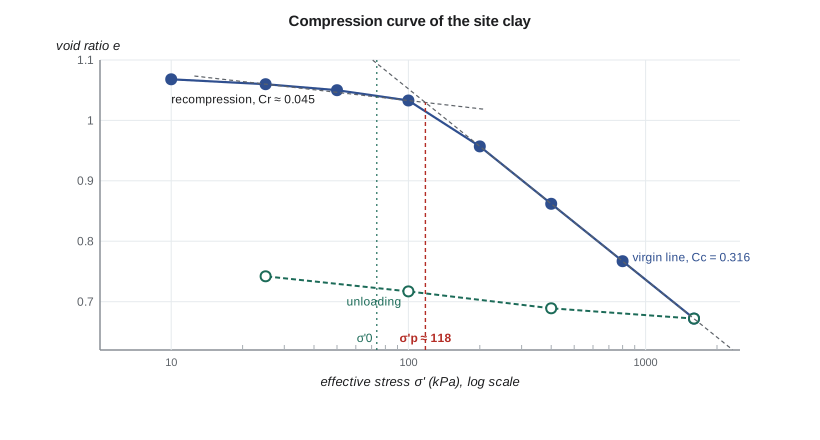
The slopes of the two parts are the compression index \(C_c\) and the recompression index \(C_r\), sometimes called the swelling index \(C_s\) when it is measured on unloading:
For inorganic clays, \(C_c\) ranges from about 0.1 for stiff, low-plasticity clays to over 1 for soft, sensitive or organic clays. \(C_r\) is usually a fifth to a tenth of \(C_c\). Skempton's correlation for remoulded clays, often applied to undisturbed clays of low sensitivity as a check, is \(C_c \approx 0.009(LL - 10)\).
Stress history
A clay is normally consolidated if its present effective stress is its preconsolidation stress: it has never carried more. It is overconsolidated if it once carried more and has since been unloaded. The overconsolidation ratio expresses the difference:
Clays become overconsolidated in many ways: erosion of overlying soil, melting of glacial ice, a lowered and then restored water table, drying near the surface, and slow chemical bonding and creep, called ageing. A clay whose preconsolidation stress exceeds the present stress by a roughly constant amount at all depths, as is common in lake clays with a desiccated crust, is described by its pre-overburden pressure, \(POP = \sigma'_p - \sigma'_0\). Stress history matters enormously: a load that stays below \(\sigma'_p\) produces small settlements on the recompression line, while one that exceeds it produces large settlements on the virgin line.
Finding the preconsolidation stress
Casagrande's construction is the classic way to find \(\sigma'_p\): at the point of maximum curvature of the compression curve, draw a horizontal line and a tangent, bisect the angle between them and find where the bisector meets the extension of the virgin line. A simpler method, adequate for curves with a clear break, takes the intersection of the extended recompression and virgin lines. Sample disturbance rounds the curve and lowers the apparent \(\sigma'_p\), so good sampling matters; Schmertmann's procedure corrects the field curve for disturbance.
An oedometer test on the Shelby tube sample from 6.0 m in BH-3 was loaded from 10 to 1,600 kPa and unloaded to 25 kPa. Sofia's script fits the two lines and computes their intersection.
# Oedometer test on the BH-3 clay (6.0 m) and consolidation settlement of the garage footing
from math import log10, pi, sqrt, atan2, copysign

load = [(10, 1.068), (25, 1.060), (50, 1.050), (100, 1.033), (200, 0.957), (400, 0.862), (800, 0.767), (1600, 0.672)]
unload = [(1600, 0.672), (400, 0.689), (100, 0.717), (25, 0.742)]
slope = lambda a, b: (a[1] - b[1]) / log10(b[0] / a[0])
Cc = slope(load[5], load[7])              # virgin line, 400 to 1600 kPa
Cr = slope(unload[2], unload[1])          # unloading, 100 to 400 kPa
Crl = slope(load[1], load[3])             # reloading slope, 25 to 100 kPa
# preconsolidation stress: intersection of the reloading line and the virgin line
x = (load[1][1] - load[5][1] + Crl * log10(load[1][0]) - Cc * log10(load[5][0])) / (Crl - Cc)
print(f"Cc = {Cc:.3f}, Cr = {Cr:.3f} (reloading {Crl:.3f}), sigma'p = {10**x:.0f} kPa")
print(f"Empirical Cc = 0.009(LL - 10) = {0.009 * (45 - 10):.3f}")

def corner(a, b, z):
    m, n = abs(a) / z, abs(b) / z; s = m * m + n * n + 1
    return copysign(1, a) * copysign(1, b) * (2*m*n*sqrt(s)/(s + m*m*n*n)*(s + 1)/s + atan2(2*m*n*sqrt(s), s - m*m*n*n)) / (4*pi)
def rect(q, x1, x2, y1, y2, z):
    return q * (corner(x2, y2, z) - corner(x1, y2, z) - corner(x2, y1, z) + corner(x1, y1, z))
def footing_stress(z, B=3.0, q=215.0, s=7.5):
    return sum(rect(q, dx - B/2, dx + B/2, dy - B/2, dy + B/2, z)
               for dx, dy in ((0, 0), (s, 0), (-s, 0), (0, s), (0, -s)))

def sigma0(z):                             # effective stress in the clay from lesson 6 (artesian till)
    s = 18.0 * 2.5 + 19.8 * 1.5 + 18.0 * (z - 4.0)
    u = 14.7 + (93.2 - 14.7) * (z - 4.0) / 7.0
    return s - u
POP, e0, Df = 45.0, 1.06, 2.0              # preconsolidation margin sigma'p - sigma'0 (kPa), footing depth (m)

def settlement(dsig, label):
    total = 0.0; rows = []
    for k in range(7):                     # seven 1 m sublayers from 4.0 to 11.0 m
        z = 4.5 + k; s0 = sigma0(z); sp = s0 + POP; ds = dsig(z); sf = s0 + ds
        if sf <= sp:
            dH = 1.0 * Cr / (1 + e0) * log10(sf / s0)
        else:
            dH = 1.0 / (1 + e0) * (Cr * log10(sp / s0) + Cc * log10(sf / sp))
        total += dH; rows.append((z, s0, sp, ds, dH))
    print(f"\n{label}: total consolidation settlement = {1000*total:.0f} mm")
    return rows, total

rows, s_ftg = settlement(lambda z: footing_stress(z - Df), "Interior garage footing")
print("   z     s'0     s'p    d_sigma   settlement")
for z, s0, sp, ds, dH in rows:
    print(f"{z:5.1f} {s0:7.1f} {sp:7.1f} {ds:8.1f} {1000*dH:8.1f} mm")
settlement(lambda z: rect(215.0, -1.5, 1.5, -1.5, 1.5, z - Df), "Isolated footing (no neighbours)")
settlement(lambda z: 24.0, "Yard fill, 24 kPa over a wide area")
settlement(lambda z: 12.0 - 14.7 * (z - 4.0) / 7.0 if 12.0 - 14.7 * (z - 4.0) / 7.0 > 0 else 0.001, "Pump station dewatering (long term)")Cc = 0.316, Cr = 0.047 (reloading 0.045), sigma'p = 118 kPa Empirical Cc = 0.009(LL - 10) = 0.315 Interior garage footing: total consolidation settlement = 60 mm z s'0 s'p d_sigma settlement 4.5 63.4 108.4 94.0 30.1 mm 5.5 70.2 115.2 62.2 14.1 mm 6.5 77.0 122.0 45.6 4.8 mm 7.5 83.7 128.8 36.5 3.5 mm 8.5 90.5 135.5 31.0 2.9 mm 9.5 97.3 142.3 27.3 2.4 mm 10.5 104.1 149.1 24.5 2.1 mm Isolated footing (no neighbours): total consolidation settlement = 52 mm Yard fill, 24 kPa over a wide area: total consolidation settlement = 18 mm Pump station dewatering (long term): total consolidation settlement = 4 mm
The test gives \(C_c = 0.316\), close to the empirical 0.315, \(C_r = 0.047\) and \(\sigma'_p = 118\) kPa. At 6.0 m the in situ effective stress, from lesson 6, is 73.6 kPa, so the OCR is 1.6 and the POP is about 45 kPa. Two other tests, at 4.8 and 9.2 m, gave similar POP values, so Dr. Kowalczyk adopts \(\sigma'_p = \sigma'_0 + 45\) kPa throughout the clay.
Settlement equations
For a clay layer of thickness \(H\), initial void ratio \(e_0\) and initial effective stress \(\sigma'_0\) at its middle, loaded by \(\Delta\sigma\) to a final effective stress \(\sigma'_f = \sigma'_0 + \Delta\sigma\), the consolidation settlement follows from the compression curve:
For a normally consolidated clay, \(\sigma'_p = \sigma'_0\) and only the \(C_c\) term remains. Because both \(\sigma'_0\) and \(\Delta\sigma\) vary with depth, a thick layer is divided into sublayers, each calculated at its mid-depth, and the settlements are added. An alternative uses the coefficient of volume compressibility \(m_v = \Delta\varepsilon/\Delta\sigma'\), so that \(s_c = m_v\,\Delta\sigma'\,H\); it is convenient but \(m_v\) depends on the stress range, so it must be chosen for the actual stresses.
The garage footing
Worked problem
Settlement of the top sublayer
The top metre of clay, 4.0 to 5.0 m, lies 2.0 to 3.0 m below the base of an interior footing. At its middle, \(\sigma'_0 = 63.4\) kPa, \(\sigma'_p = 108.4\) kPa and the stress increase from the footing and its four neighbours is 94.0 kPa (lesson 9). With \(e_0 = 1.06\), find its settlement.
Show solution
- \[\sigma'_f = 63.4 + 94.0 = 157.4\ \text{kPa} > \sigma'_p\]
- \[s = \frac{1.0}{2.06}\Big[0.047\log\frac{108.4}{63.4} + 0.316\log\frac{157.4}{108.4}\Big]\]
- \[s = 0.485\,[0.0110 + 0.0512] = 0.0302\ \text{m} = 30\ \text{mm}\]
Answer: Half of the footing's whole settlement comes from this one metre, where the stress increase is largest and pushes the clay past its preconsolidation stress.
Summed over seven sublayers, the interior footing settles about 60 mm by consolidation; an isolated footing with no neighbours would settle 52 mm. Only the top three sublayers pass their preconsolidation stress, the third only just; below 7 m the clay stays on its recompression line and contributes only 2 to 4 mm per metre. The 45 kPa margin of preconsolidation is doing most of the work: if the clay were normally consolidated, the same loads would settle it about 210 mm, three and a half times as much.
Other loads on the clay
The script also computes the settlement under the yard fill, 24 kPa over a wide area, about 18 mm, and the long-term settlement from dewatering for the pump station, about 4 mm where the full drawdown occurs. The fill load is spread so widely that it acts on the whole clay layer; if it is placed next to the garage, its settlement adds to the footings' along that side. Dr. Kowalczyk recommends placing the yard fill early, so that most of its settlement happens before the garage is built.
Immediate and secondary settlement
Consolidation is only one part of the total settlement. Immediate, or elastic, settlement occurs as soon as load is applied, from distortion of the soil without volume change in saturated clay and from compression of the sand above, which drains at once. It is usually estimated with elastic theory or, in sands, with correlations to SPT and CPT results such as Schmertmann's method, covered in CIV-341. Secondary compression, or creep, continues after the excess pore pressure has dissipated, at a rate that decreases with the logarithm of time. Lesson 11 estimates it for the site clay. For the garage, the compact sand between the footing and the clay adds perhaps 5 to 10 mm (0.2 to 0.4 in.) of immediate settlement.
How much settlement is acceptable
Structures are damaged less by total settlement than by differential settlement, the difference between nearby footings, and specifically by the angular distortion, the differential settlement divided by the distance between the footings. Skempton and MacDonald, and later Bjerrum, studied damaged buildings and proposed limits: an angular distortion of about 1/500 is a common safe limit for framed buildings to avoid cracking of finishes, 1/300 is the onset of visible damage to panels and partitions, and 1/150 risks structural damage. Total settlements of 25 mm (1 in.) for isolated footings on sand and 50 to 75 mm (2 to 3 in.) for footings on clay are often quoted as consistent with these distortions, because differential settlements are usually some fraction of the total.
For the garage, the difference between an interior footing (60 mm) and an isolated corner footing (closer to 52 mm, less with fewer neighbours) is of the order of 10 mm over the 7.5 m bay, an angular distortion of about 1/750. Variability in the clay could make it larger. The steel frame of the maintenance bay, with simple connections, tolerates this easily. The slab-on-grade, however, will settle with the yard fill and the clay under it, and must be detailed to move independently of the columns.
Reducing settlement
When predicted settlements are too large, the engineer has several options. Spreading the load over a larger footing or a raft reduces the stress at shallow depth. Removing soil in a basement compensates for the building load. Preloading the site with a temporary fill heavier than the building, possibly with vertical drains to speed consolidation, takes the clay past its working stress before the building is built, so that it later stays on its recompression line. Deep foundations, piles to the till, bypass the clay altogether. Lesson 11 examines preloading and drains, and CIV-341 covers piles.
Practical points
- Obtain good undisturbed samples; disturbance lowers \(\sigma'_p\) and raises \(C_r\), giving wrong predictions in both directions.
- Divide thick layers into sublayers, especially near the footing where the stress changes fastest.
- Always compare the final stress with the preconsolidation stress; it decides which index applies.
- Check \(C_c\) against correlations and against the settlement of similar structures nearby.
- Think in terms of differential settlement and angular distortion, not only total settlement.
Common mistakes
MistakeUsing Cc for the whole stress range in an overconsolidated clay.
InsteadUse Cr up to σ'p and Cc only beyond it.
MistakeComputing settlement from the stress at the top of a thick clay layer.
InsteadDivide the layer into sublayers and use the stresses at their mid-depths.
MistakeUsing the total stress instead of the effective stress in the logarithms.
InsteadConsolidation depends on effective stress; use σ'0 and σ'f.
MistakeJudging a foundation by its total settlement alone.
InsteadCheck the differential settlement and angular distortion against the structure's tolerance.
Summary and key terms
- Consolidation is the slow compression of saturated clay as excess pore water pressure dissipates.
- The oedometer test gives the compression curve of void ratio against log effective stress.
- The preconsolidation stress \(\sigma'_p\) separates the flat recompression line (\(C_r\)) from the steep virgin line (\(C_c\)).
- Settlement: \(s_c = H/(1 + e_0)[C_r\log(\sigma'_p/\sigma'_0) + C_c\log(\sigma'_f/\sigma'_p)]\) when \(\sigma'_f > \sigma'_p\).
- The site clay has Cc = 0.316, Cr = 0.047 and POP of about 45 kPa; an interior garage footing settles about 60 mm.
- Angular distortions below about 1/500 are generally safe for framed buildings.
- Consolidation
- Compression of saturated soil over time as pore water drains and excess pore pressure dissipates.
- Oedometer
- A laboratory apparatus that compresses a laterally confined soil specimen in one dimension.
- Preconsolidation stress
- The largest vertical effective stress a soil has experienced.
- Compression index
- Cc, the slope of the virgin compression line on an e–log σ' plot.
- Recompression index
- Cr, the slope of the reloading or unloading line on an e–log σ' plot.
- Overconsolidation ratio
- OCR, the preconsolidation stress divided by the present effective stress.
- Pre-overburden pressure
- POP, the preconsolidation stress minus the present effective stress.
- Angular distortion
- The differential settlement between two points divided by the distance between them.
Practice problems
Work each problem on paper first, then reveal the answer to check.
A normally consolidated clay 4 m thick has e0 = 1.20, Cc = 0.45 and σ'0 = 50 kPa at mid-depth. A wide fill adds 30 kPa. Find the settlement.
Show answer
\(s = 4/2.2 \times 0.45\log(80/50) = 0.167\) m = 167 mm.
Repeat with σ'p = 90 kPa and Cr = 0.06.
Show answer
\(\sigma'_f = 80 < 90\): \(s = 4/2.2 \times 0.06\log 1.6 = 0.022\) m = 22 mm.
Why does sample disturbance make a clay appear less overconsolidated?
Show answer
Disturbance destroys structure and rounds the compression curve, lowering the apparent σ'p.
Two footings 6 m apart settle 45 and 30 mm. Find the angular distortion and comment.
Show answer
\(15/6000 = 1/400\), between the 1/500 safe limit and the 1/300 onset of damage; finishes may crack.
Lesson quiz · 5 questions
Score 60% or more to complete this lesson.
Create a free account to save your progress, take quizzes and earn a certificate.