
CISSP-116 · Lesson 8 of 12 · 27 min
Incident reporting: legal, regulatory and law enforcement obligations
When an incident involves personal information, regulated data, a public company or critical infrastructure, the organization will usually have legal duties to report it: to a regulator, to affected individuals, to investors, to customers under contract, or to a national cyber agency. These duties have their own definitions, thresholds and deadlines, and missing them can turn a manageable incident into an enforcement action. Reporting is therefore a core part of incident management, and the incident response plan must build the legal assessment into the process from the first hours.
This lesson maps the main obligations in Canada and the United States as of October 2026 and explains how to run the reporting decision as a process. CISSP-113 covered the broader legal and regulatory landscape, privacy principles and the governance of compliance; this lesson focuses on what happens to those obligations when an incident occurs.
Running the reporting decision as a process
Reporting duties typically turn on three questions: what happened (for example, unauthorized access to or disclosure of personal information), how serious it is (a harm threshold or materiality test), and when the clock started (often at discovery or at a determination that the threshold is met). Because these are legal judgments made on incomplete facts, the plan should assign a named person, usually the privacy officer working with counsel, to run a documented assessment as soon as an incident might involve regulated data. Every decision, including a decision not to report, should be recorded with the facts known at the time and the reasoning.
| Step | Question | Who leads |
|---|---|---|
| 1. Identify | Does the incident involve personal information, regulated data, a listed company or a regulated sector? | Incident manager flags; privacy officer confirms |
| 2. Scope | Whose data, how many people, which jurisdictions, what types of data? | Security analysts with data owners |
| 3. Assess threshold | Does it meet each applicable test (harm, materiality, reportable incident)? | Privacy officer and counsel |
| 4. Determine clocks | When did each clock start, and what is each deadline? | Counsel |
| 5. Notify | Prepare required content for each regulator, individual or agency | Privacy, legal and communications |
| 6. Record | Document the assessment, decisions and notices, and update as facts change | Privacy officer |
Multi-jurisdiction incidents are common: a Canadian company with US customers, or a US company with employees in Quebec, may face several sets of rules at once, each with different triggers and deadlines. A jurisdiction table prepared in advance, listing the rules that apply to the organization's data and the information each notice requires, saves time when the clock is running.
Privacy breach reporting
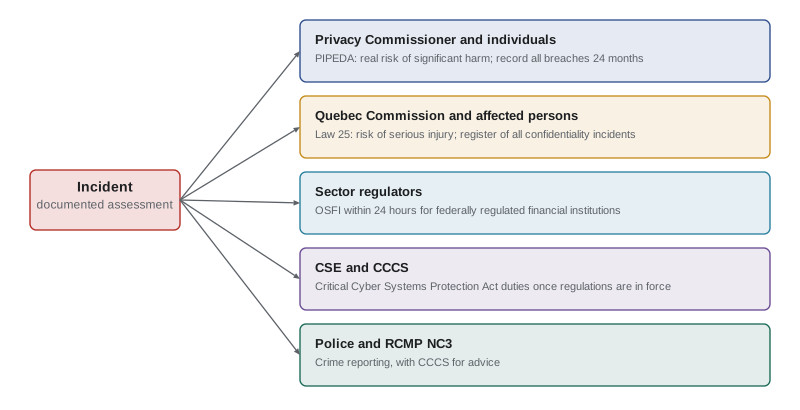
In Canada, the Personal Information Protection and Electronic Documents Act (PIPEDA) has required breach reporting since 1 November 2018. An organization must report to the Office of the Privacy Commissioner of Canada (OPC) any breach of security safeguards involving personal information under its control if it is reasonable to believe that the breach creates a real risk of significant harm (RROSH) to an individual. It must also notify affected individuals, and notify any other organization or government institution that may be able to reduce the risk of harm, as soon as feasible after determining that a breach has occurred. Significant harm is defined broadly and includes bodily harm, humiliation, damage to reputation or relationships, financial loss, identity theft, negative effects on credit records and loss of employment or business opportunities. The two factors for assessing real risk are the sensitivity of the information and the probability that it has been, is being or will be misused.
PIPEDA also requires organizations to keep a record of every breach of security safeguards, whether or not it meets the RROSH threshold, for 24 months after the day the organization determined that the breach occurred, and to provide those records to the OPC on request. The Breach of Security Safeguards Regulations set the content of the report to the OPC and of notices to individuals, such as a description of the circumstances, the date or period, the information involved, the steps taken to reduce harm and a contact point. Alberta's Personal Information Protection Act has a similar requirement to notify the Alberta commissioner where there is a real risk of significant harm.
In Quebec, the Act respecting the protection of personal information in the private sector, as amended by Law 25, uses the term confidentiality incident. Since 22 September 2022, an organization must promptly notify the Commission d'accès à l'information and affected persons when an incident presents a risk of serious injury, and must keep a register of all confidentiality incidents, which the Commission can request. The assessment considers the sensitivity of the information, the anticipated consequences of its use and the likelihood that it will be used for harmful purposes. Organizations operating in Quebec should keep the PIPEDA record and the Law 25 register aligned, since one incident often needs to appear in both.
Health and financial sector reporting
Several Canadian sectors have their own incident reporting rules. Federally regulated financial institutions must report technology and cyber security incidents to the Office of the Superintendent of Financial Institutions (OSFI) under its Technology and Cyber Security Incident Reporting advisory, within 24 hours or sooner where possible, with regular updates. Provincial health information laws, such as Ontario's Personal Health Information Protection Act, require custodians to notify individuals and, in defined cases, the provincial commissioner when health information is stolen, lost or used or disclosed without authority. Securities regulators expect reporting issuers to disclose material information, including the effects of a significant cyber incident, under continuous disclosure rules.
For publicly listed Canadian companies, cyber incidents also raise disclosure questions under provincial securities law. The Canadian Securities Administrators have issued guidance that issuers should consider whether a cyber attack is a material change requiring prompt news release and filing, and should describe cyber security risks in their disclosure documents. Many Canadian issuers are also listed in the United States and must follow the SEC rules as well.
Critical infrastructure reporting
Bill C-8, which received royal assent on 16 June 2026, enacts the Critical Cyber Systems Protection Act. Once its regulations are in force, designated operators in federally regulated sectors such as finance, telecommunications, energy and transportation will have to establish cyber security programs and report cyber security incidents to the Communications Security Establishment, which operates the Canadian Centre for Cyber Security, within a period to be set by regulation (checked October 2026). CISSP-113 covers the Act in more detail. Until then, operators are encouraged to report voluntarily to the Cyber Centre.
Law enforcement and national agencies
Cybercrime in Canada can be reported to the local police service and through the national online reporting system operated by the RCMP's National Cybercrime Coordination Centre (NC3) with the Canadian Anti-Fraud Centre. The Canadian Centre for Cyber Security (CCCS) accepts incident reports from organizations and provides advice and, for significant incidents, coordination. Reporting to the Cyber Centre is a separate step from reporting to the OPC; the Cyber Centre is not a privacy regulator. Before sharing evidence with police, organizations should agree with counsel what is provided and how chain of custody will be maintained, as Lesson 2 described.
Engaging law enforcement early has benefits: investigators may already know the adversary, may be able to help recover funds in fraud cases if contacted within hours, and may provide threat information. Involving them does not mean surrendering control of the response, and law enforcement in both countries generally works to minimize disruption to victims. In some cases investigators may ask an organization to delay public notification to protect an investigation; most notification laws allow for that delay when requested by law enforcement, but the request should be documented.
Calculating deadlines
Deadlines expressed in hours, calendar days or business days, starting from different trigger points, are easy to miscalculate under pressure. A simple calculator, maintained by counsel and included in the plan, helps the incident manager see all the clocks on one page.
from datetime import date, datetime, timedelta
# Notification clocks for one synthetic incident; triggers and deadlines vary by rule and need legal advice
holidays = {date(2026, 11, 11), date(2026, 11, 26)}
def add_business_days(d, n):
    while n:
        d += timedelta(days=1)
        if d.weekday() < 5 and d not in holidays:
            n -= 1
    return d
discovered = date(2026, 11, 6)                       # Friday
significant_determined = datetime(2026, 11, 6, 15, 0)
materiality_determined = date(2026, 11, 10)          # Tuesday
clocks = [
    ('Banking regulator, 36 hours from determination (US)', (significant_determined + timedelta(hours=36)).strftime('%Y-%m-%d %H:%M')),
    ('SEC 8-K Item 1.05, 4 business days after materiality (US)', add_business_days(materiality_determined, 4).isoformat()),
    ('GLBA Safeguards, FTC notice within 30 days (US)', (discovered + timedelta(days=30)).isoformat()),
    ('HIPAA outer limit, 60 calendar days (US)', (discovered + timedelta(days=60)).isoformat()),
    ('PIPEDA, as soon as feasible (Canada)', 'no fixed day: act promptly'),
]
for name, due in clocks:
print(f'{name:58s} {due}')Banking regulator, 36 hours from determination (US) 2026-11-08 03:00 SEC 8-K Item 1.05, 4 business days after materiality (US) 2026-11-17 GLBA Safeguards, FTC notice within 30 days (US) 2026-12-06 HIPAA outer limit, 60 calendar days (US) 2027-01-05 PIPEDA, as soon as feasible (Canada) no fixed day: act promptly
Note that the SEC deadline skips the weekend and a US federal holiday, and that rules phrased as as soon as feasible or without unreasonable delay have no safe harbour date: regulators expect organizations to move as fast as the facts allow, and outer limits are maximums, not targets.
# A structured real-risk-of-significant-harm style assessment (illustrative scoring, not a legal test)
sensitivity = {'contact details': 1, 'account number': 2, 'government ID': 3, 'health information': 3, 'credentials': 3}
probability = {'encrypted, key safe': 0, 'lost device, no evidence of access': 1, 'sent to wrong trusted recipient, confirmed deleted': 0,
               'accessed by unknown party': 2, 'posted publicly or ransomed': 3}
cases = [
    ('Laptop lost, full disk encryption on', 'government ID', 'encrypted, key safe'),
    ('Email with health details sent to wrong clinic, deleted', 'health information', 'sent to wrong trusted recipient, confirmed deleted'),
    ('Customer portal accessed with stolen passwords', 'account number', 'accessed by unknown party'),
    ('HR files posted on extortion site', 'government ID', 'posted publicly or ransomed'),
]
for desc, data, prob in cases:
    s, p = sensitivity[data], probability[prob]
    verdict = 'likely notifiable: consult counsel' if s * p >= 4 else ('borderline: document and consult counsel' if s * p >= 2 else 'likely not notifiable: record it')
print(f'{desc:55s} sensitivity {s} x probability {p} = {s*p} {verdict}')Laptop lost, full disk encryption on sensitivity 3 x probability 0 = 0 likely not notifiable: record it Email with health details sent to wrong clinic, deleted sensitivity 3 x probability 0 = 0 likely not notifiable: record it Customer portal accessed with stolen passwords sensitivity 2 x probability 2 = 4 likely notifiable: consult counsel HR files posted on extortion site sensitivity 3 x probability 3 = 9 likely notifiable: consult counsel
The scoring is a way of documenting thinking, not a legal test, and counsel should review any borderline case. Even incidents assessed as not notifiable must be recorded: in Canada under the PIPEDA 24-month record-keeping rule and the Law 25 register, and in the United States in an internal register that regulators may request.
Worked problem
One incident, several duties
A company listed on both the Toronto Stock Exchange and Nasdaq discovers that an attacker accessed a database holding names and health insurance numbers of 3,200 employees in Ontario, Quebec and Texas.
Show solution
- Privacy officer and counsel open a documented assessment on the day of discovery.
- Canada: assess real risk of significant harm under PIPEDA (or the applicable provincial law for employee data) and risk of serious injury under Quebec Law 25; health and government identifiers are sensitive and access by an unknown party makes misuse probable, so report and notify as soon as feasible and add the incident to the PIPEDA record and Law 25 register.
- United States: check the Texas breach law, which sets a 60-day outer limit for individual notice and requires notice to the attorney general when 250 or more Texans are affected.
- Disclosure committee assesses materiality for the SEC and Canadian securities rules; if material, file Form 8-K Item 1.05 within four business days of the determination.
- Report the crime to police and the RCMP NC3, the FBI or IC3, and inform CCCS and CISA, agreeing with counsel on evidence sharing.
Answer: Run a single documented assessment that tracks each jurisdiction's test and clock, then send each required notice with consistent facts.
Common mistakes
MistakeWaiting until the investigation is complete before considering reporting duties.
InsteadStart a documented legal assessment as soon as regulated data might be involved, because clocks may already be running.
MistakeRecording only the breaches that are reported.
InsteadRecord every breach of security safeguards with the reasoning, as PIPEDA, Law 25 and US regulators expect.
MistakeApplying only the home jurisdiction's rules.
InsteadApply the rules where affected individuals live and where the organization is regulated.
MistakeTreating an outer limit such as 60 days as the target.
InsteadNotify as soon as the facts allow; outer limits are maximums.
MistakeAssuming a report to a national cyber agency satisfies privacy or securities duties.
InsteadTreat each regulator's duty separately.
MistakeSending inconsistent facts to different regulators and the public.
InsteadMaintain one fact base, reviewed by counsel, for all notices.
Summary and key terms
- Reporting duties depend on what happened, a seriousness threshold and when the clock started; assess them from the first hours.
- Canada: PIPEDA requires reporting to the OPC and notice to individuals when there is a real risk of significant harm, and records of all breaches for 24 months.
- Quebec Law 25 requires notice for incidents presenting a risk of serious injury and a register of all confidentiality incidents.
- United States: every state has a breach law; HIPAA allows no more than 60 days; SEC Form 8-K Item 1.05 requires disclosure within four business days of a materiality determination.
- Canada's Critical Cyber Systems Protection Act (Bill C-8) and the US CIRCIA will add critical infrastructure reporting once their regulations or final rule take effect.
- Law enforcement contacts include police and the RCMP NC3 with CCCS in Canada, and the FBI, IC3 and CISA in the United States.
- Document every decision and keep facts consistent across all notices.
- RROSH
- Real risk of significant harm: the PIPEDA threshold for reporting a breach of security safeguards.
- Breach of security safeguards
- Under PIPEDA, loss of, unauthorized access to or unauthorized disclosure of personal information resulting from a breach of safeguards or a failure to establish them.
- Confidentiality incident
- The Quebec Law 25 term for unauthorized access, use, communication or loss of personal information.
- Breach record
- The record of every breach of security safeguards that PIPEDA requires organizations to keep for 24 months.
- Materiality
- Whether information would be important to a reasonable investor; the test for SEC incident disclosure.
- Form 8-K Item 1.05
- The SEC disclosure item for material cybersecurity incidents, due within four business days of determining materiality.
- Unsecured PHI
- Protected health information not rendered unusable to unauthorized persons, for example by encryption, under HIPAA.
- CIRCIA
- The US Cyber Incident Reporting for Critical Infrastructure Act of 2022.
- Critical Cyber Systems Protection Act
- The Canadian law enacted by Bill C-8 that imposes cyber security program and reporting duties on designated operators.
- NC3
- The RCMP national cybercrime coordination unit, which runs Canada's online cybercrime reporting system.
Practice problems
Work each problem on paper first, then reveal the answer to check.
What three questions do most reporting duties turn on?
Show answer
What happened, whether it meets a seriousness threshold and when the clock started.
What is the PIPEDA threshold for reporting a breach?
Show answer
A real risk of significant harm to an individual.
What two factors does PIPEDA use to assess real risk?
Show answer
Sensitivity of the information and probability of misuse.
How long must PIPEDA breach records be kept?
Show answer
24 months after the day the breach was determined to have occurred.
What must Quebec organizations keep under Law 25?
Show answer
A register of all confidentiality incidents.
What is the outer limit for HIPAA individual notice?
Show answer
60 calendar days after discovery.
When must a material incident be disclosed on Form 8-K?
Show answer
Within four business days of determining that it is material.
What is the status of CIRCIA reporting as of October 2026?
Show answer
The final rule was sent to OMB on 1 October 2026 and had not taken effect; reporting under CIRCIA was voluntary.
Name the Canadian and US agencies for reporting cybercrime.
Show answer
Canada: police and the RCMP NC3 with CCCS; United States: the FBI, IC3 and CISA.
Why should incidents assessed as not notifiable still be recorded?
Show answer
Laws and regulators expect a record of all breaches with the reasoning, and may ask to see it.
Lesson quiz · 5 questions
Score 60% or more to complete this lesson.
Create a free account to save your progress, take quizzes and earn a certificate.