
CISSP-116 · Lesson 3 of 12 · 29 min
Logging, monitoring and detection
Most security incidents are discovered through monitoring: a rule fires, an analyst notices a pattern, or a system reports an anomaly. Some are discovered much later, by a customer, a journalist, a regulator or a ransom note. The difference between those two outcomes is largely the quality of an organization's logging and monitoring program. Sub-domain 7.2 of the CISSP outline, conduct logging and monitoring activities, covers the tools and processes that turn raw events into timely detection: security information and event management, continuous monitoring, egress monitoring, log management, threat intelligence, user and entity behaviour analytics and security orchestration.
CISSP-115 dealt with log review as a control test: deciding what to log, protecting log integrity, clipping levels and organizing periodic reviews. This lesson takes the operational view. It looks at how a monitoring program is built and run day to day, how much it costs to collect and keep data, how alerts are triaged, how analysts' capacity limits what can be monitored, and how intelligence and automation help a small team keep up.
From events to incidents
Monitoring deals with a funnel. At the top are events: any observable occurrence, such as a log-in, a file access or a network connection. Large organizations generate billions a day. Detection rules and analytics select a small fraction of those as alerts, which are events or combinations of events that may indicate a problem and deserve human or automated attention. Triage examines each alert and decides whether it is a false positive, a benign true positive (real activity that is allowed), or a true positive that warrants investigation. Some investigations confirm an incident: an event that actually or potentially jeopardizes the confidentiality, integrity or availability of information or systems, or violates security policy.
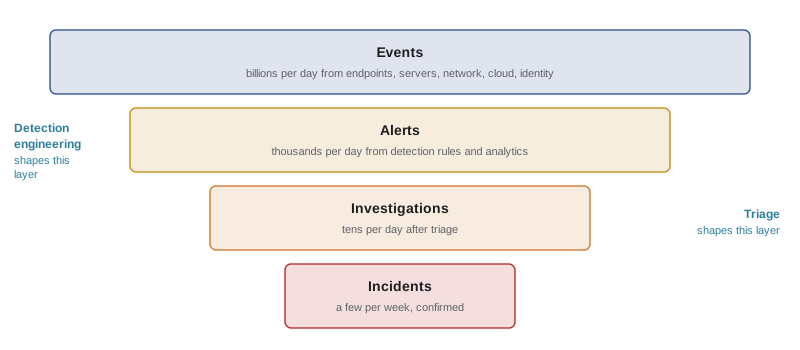
Each step in the funnel is a design choice with trade-offs. Too few rules and real attacks pass unnoticed; too many and analysts drown in alerts, start closing them without proper review, and miss the one that mattered. The craft of security operations is tuning the funnel so that analysts spend their limited time on alerts with a reasonable chance of being real.
SIEM, log management and data pipelines
A security information and event management (SIEM) system collects logs and events from many sources, normalizes them into a common format, correlates related events, applies detection rules and presents alerts, dashboards and search tools to analysts. It also supports compliance reporting and retention. A log management platform may handle collection, storage and search more cheaply for high-volume sources, forwarding only security-relevant data to the SIEM. Many organizations now use a data pipeline layer that filters, enriches and routes logs before they reach expensive storage.
Coverage matters more than tool choice. A SIEM that receives logs from only half the environment gives false comfort. Security operations should keep an inventory of log sources mapped to assets and to the detection use cases they support, and should monitor the monitoring: alert when an important source stops sending data, because silence from a firewall can mean failure or tampering.
| Source | Detection value | Typical volume | Common gap |
|---|---|---|---|
| Identity provider and directory | Account misuse, impossible travel, privilege changes | Moderate | Cloud sign-ins not collected |
| Endpoint detection and response | Malicious processes, persistence, lateral movement | High | Unmanaged or legacy devices |
| Firewalls, proxies and DNS | Command-and-control, data exfiltration, policy violations | Very high | DNS logs not retained |
| Cloud control plane | Configuration changes, new keys, exposed storage | Moderate | Some accounts or regions not enabled |
| Email security | Phishing, business email compromise | High | Mailbox rule changes not logged |
| Business applications | Fraud, unusual data access | Variable | Application logs never designed for security |
How much data, kept for how long?
Retention requirements come from several directions. Legal and regulatory rules set minimums for some records; investigations need enough history to establish when an intrusion began, and studies of real incidents regularly find dwell times of weeks or months; and storage costs push in the other direction. A common pattern is tiered retention: recent data, perhaps 30 to 90 days, is kept in fast, searchable storage for daily detection, while older data is kept for a year or more in cheaper archive storage that can be restored for investigations.
Capacity planning starts with simple arithmetic: events per day multiplied by average size multiplied by retention days, adjusted for compression and replication. The numbers grow quickly, and they drive both licence costs (many SIEMs charge by volume ingested) and storage costs.
# Log retention sizing for tiered storage (illustrative volumes)
sources = {           # events per day, average bytes per event
    'endpoint EDR': (180_000_000, 600),
    'firewall':     (250_000_000, 350),
    'DNS':          (400_000_000, 200),
    'identity':     (12_000_000, 900),
    'cloud audit':  (20_000_000, 1_200),
}
hot_days, archive_days = 90, 365
compression = 8          # archive compresses about 8:1
replicas = 2             # hot tier stored twice for resilience
raw_day = sum(n * b for n, b in sources.values())
print(f'Raw data per day: {raw_day / 1e9:,.1f} GB')
hot = raw_day * hot_days * replicas
archive = raw_day * archive_days / compression
print(f'Hot tier ({hot_days} days, x{replicas}): {hot / 1e12:,.1f} TB')
print(f'Archive ({archive_days} days, {compression}:1): {archive / 1e12:,.1f} TB')
for name, (n, b) in sorted(sources.items(), key=lambda kv: -kv[1][0] * kv[1][1]):
print(f' {name:12s} {n * b / raw_day:5.1%} of daily volume')Raw data per day: 310.3 GB Hot tier (90 days, x2): 55.9 TB Archive (365 days, 8:1): 14.2 TB endpoint EDR 34.8% of daily volume firewall 28.2% of daily volume DNS 25.8% of daily volume cloud audit 7.7% of daily volume identity 3.5% of daily volume
The result shows why data pipelines matter. Endpoint, firewall and DNS logs make up almost 90 % of the daily volume, yet many of their records are routine. Filtering duplicate or low-value records before ingestion, or keeping high-volume sources in cheaper storage and sending only summaries to the SIEM, can cut costs substantially without losing detection value, provided the full data remains available for investigations.
Alert triage and analyst capacity
Analysts are the scarcest resource in monitoring. If each alert takes on average 15 minutes to triage and an analyst has six productive hours per shift, one analyst can properly handle about 24 alerts per shift. A SOC that generates 500 alerts a day therefore needs many analysts, or better rules, or automation. Two metrics guide tuning: the precision of each rule (the share of its alerts that turn out to be true positives) and the alert volume it produces.
import random
random.seed(7)
# Alert volume and precision by detection rule over one month (synthetic)
rules = {
    'impossible travel':         (420, 0.04),
    'new admin account':         (35,  0.40),
    'mass file download':        (160, 0.12),
    'malware hash match':        (60,  0.85),
    'login from Tor exit node':  (900, 0.01),
}
minutes_per_alert = 15
print(f"{'rule':26s} {'alerts':>6s} {'true':>5s} {'precision':>9s} {'analyst h':>9s}")
total_h = 0
for name, (n, p) in rules.items():
    tp = sum(random.random() < p for _ in range(n))
    hours = n * minutes_per_alert / 60
    total_h += hours
    print(f'{name:26s} {n:6d} {tp:5d} {tp / n:9.1%} {hours:9.0f}')
print(f'Total analyst hours this month: {total_h:.0f} (about {total_h / 6 / 21:.1f} analysts at 6 h x 21 days)')rule alerts true precision analyst h impossible travel 420 18 4.3% 105 new admin account 35 18 51.4% 9 mass file download 160 19 11.9% 40 malware hash match 60 49 81.7% 15 login from Tor exit node 900 11 1.2% 225 Total analyst hours this month: 394 (about 3.1 analysts at 6 h x 21 days)
Two rules in this synthetic month consume most of the workload while finding almost nothing. The right response is not simply to disable them but to tune them: for example, suppress known corporate VPN egress points from the travel rule, or route the low-precision Tor rule to an automated enrichment step that only escalates when combined with a second indicator. The high-precision malware rule deserves fast, perhaps automatic, response. Tuning decisions should be documented, reviewed and tested, because a careless suppression can hide a real attack.
Worked problem
Deciding whether the SOC can take on a new log source
The business wants payroll application logs monitored for fraud. Detection engineering expects the new rules to produce about 40 alerts a day at 20 minutes each. The SOC currently handles 220 alerts a day with eight analysts working six productive hours each.
Show solution
- Current capacity: 8 analysts x 6 hours x 60 minutes = 2,880 minutes a day; current load at an average of 12 minutes is 220 x 12 = 2,640 minutes, leaving 240 minutes.
- New load: 40 alerts x 20 minutes = 800 minutes a day, which the spare 240 minutes cannot absorb.
- Options: tune the payroll rules before go-live to raise precision and lower volume, automate enrichment so triage takes less time, retire low-value existing rules, or add staff.
- Recommend piloting the rules in a reporting mode for a month, tuning them, and agreeing with the business which alerts need same-day handling.
Answer: The SOC lacks capacity for the new alerts as designed; tune and pilot before going live, and fund staff or automation if volume remains high.
Continuous monitoring and egress monitoring
Continuous monitoring, in the sense used by NIST SP 800-137 and many regulators, means maintaining ongoing awareness of security posture, vulnerabilities and threats to support risk decisions. It covers more than alerts: it includes configuration drift, patch status, asset inventory accuracy and control effectiveness, reported at a frequency matched to risk. The operations team provides much of this data.
Egress monitoring watches what leaves the network: outbound connections, uploads, email attachments and data moving to cloud services. It supports detection of data exfiltration and of compromised systems contacting external control servers. Data loss prevention (DLP) tools inspect content for sensitive information such as card numbers or health identifiers and can alert, block or encrypt. Egress monitoring must respect privacy and employment law and the organization's own monitoring notices, and encryption increasingly limits what network tools can see, which shifts monitoring toward endpoints and cloud service logs.
Threat intelligence and user behaviour analytics
Threat intelligence is information about threats that has been collected, analysed and put in context so that it supports decisions. Strategic intelligence informs executives about trends and adversary motives; operational intelligence describes campaigns and adversary behaviour; tactical and technical intelligence includes indicators of compromise such as malicious domains and file hashes, and descriptions of techniques. Many SOCs map their detection coverage to a framework of adversary behaviours, such as MITRE ATT&CK, to find gaps. Intelligence comes from commercial feeds, government sources such as CCCS, Canada's national cyber security agency, and the US Cybersecurity and Infrastructure Security Agency, industry information sharing and analysis centres, and the organization's own incidents. Intelligence is only useful if it is relevant, timely and acted on; a feed of a million indicators that nobody tunes can create more noise than value.
User and entity behaviour analytics (UEBA) builds baselines of normal behaviour for users, devices and services and flags deviations, such as an account that suddenly reads thousands of files it has never touched. UEBA helps detect insider threats and compromised accounts that use valid credentials, which rule-based detection often misses. Its outputs are probabilistic risk scores, so they need human judgement and, because they profile individuals, privacy review and clear policy.
Security orchestration, automation and response
Security orchestration, automation and response (SOAR) tools connect security systems and execute playbooks: when an alert of a certain type arrives, automatically gather context from threat intelligence and asset systems, open a ticket, notify the right analyst and, for well-understood cases, take a containment action such as disabling an account or isolating an endpoint. Automation reduces triage time and makes responses consistent. It also carries risk: an automated action that is wrong at scale can disrupt the business. Good practice is to automate enrichment freely, automate low-impact containment with clear criteria, and keep high-impact actions behind human approval, with every automated action logged and periodically reviewed.
Worked problem
Automating a phishing response playbook
Staff report about 150 suspected phishing emails a week. Each takes an analyst 20 minutes to check and clean up. Management asks what can be automated safely.
Show solution
- Automate enrichment: extract links and attachments, check them against reputation services and sandbox verdicts, and look up how many mailboxes received the same message.
- Automate low-risk actions: when a message is confirmed malicious by two independent sources, remove copies from all mailboxes and notify recipients.
- Keep human approval for higher-impact actions, such as blocking a sending domain used by a business partner or resetting an executive's credentials.
- Measure the result: time per report, accuracy of automated verdicts and any wrongly removed legitimate messages, reviewed monthly.
Answer: Automate enrichment and clearly defined low-impact remediation, keep humans in the loop for high-impact decisions, and measure accuracy.
Common mistakes
MistakeCollecting every log possible and assuming coverage equals detection.
InsteadMap log sources to assets and detection use cases, and monitor for sources that go silent.
MistakeDisabling noisy rules without analysis.
InsteadTune rules using precision and volume data, document changes and test that real attacks still alert.
MistakeKeeping only 30 days of logs to save money.
InsteadSet tiered retention based on legal requirements and realistic investigation look-back periods.
MistakeBuying threat intelligence feeds without a plan to use them.
InsteadSelect relevant intelligence and integrate it into detection and triage.
MistakeAutomating high-impact containment actions with no human review.
InsteadAutomate enrichment and low-impact actions; keep approval for actions that can disrupt the business.
MistakeDeploying behaviour analytics without privacy review.
InsteadAssess privacy impact, align with monitoring notices and treat scores as leads, not conclusions.
Summary and key terms
- Monitoring narrows billions of events into alerts, investigations and a few confirmed incidents; each step is a design choice.
- A SIEM collects, normalizes, correlates and alerts; coverage of log sources matters more than the product.
- Retention is tiered to balance legal duties, investigation needs and cost, and storage grows with events, size and days.
- Analyst time limits what can be monitored, so rules are tuned using precision and volume.
- Continuous monitoring tracks posture and controls, and egress monitoring and DLP watch what leaves the organization.
- Threat intelligence and UEBA add context and detect misuse of valid credentials, but need tuning, judgement and privacy review.
- SOAR automates enrichment and routine response; high-impact actions should keep human approval.
- Event
- Any observable occurrence in a system or network.
- Alert
- An event or set of events selected by detection logic for attention.
- SIEM
- A system that collects, normalizes, correlates and analyses security events and produces alerts.
- Precision
- The share of a rule's alerts that are true positives.
- Egress monitoring
- Monitoring of data and connections leaving the organization.
- Data loss prevention
- Tools that detect and control movement of sensitive data.
- Threat intelligence
- Analysed information about threats that supports decisions.
- Indicator of compromise
- An observable artefact, such as a hash or domain, associated with malicious activity.
- UEBA
- Analytics that baseline normal behaviour of users and entities and flag deviations.
- SOAR
- Tools that orchestrate security systems and automate response playbooks.
Practice problems
Work each problem on paper first, then reveal the answer to check.
What is the difference between an event and an alert?
Show answer
An event is any observable occurrence; an alert is an event or combination selected by detection logic for attention.
Why should a SOC alert when a log source stops sending data?
Show answer
Silence can mean failure or tampering, leaving a blind spot.
What three factors drive raw log storage?
Show answer
Events per day, average event size and retention days.
What is tiered retention?
Show answer
Keeping recent data in fast searchable storage and older data in cheaper archive storage.
How is a rule's precision calculated?
Show answer
True positives divided by total alerts from that rule.
What should be done with a high-volume, low-precision rule?
Show answer
Tune it, enrich it automatically or require a second indicator, rather than simply disabling it.
What does NIST SP 800-137 address?
Show answer
Information security continuous monitoring.
Why is UEBA useful against insiders?
Show answer
It detects unusual behaviour by accounts using valid credentials, which rules often miss.
Name two government sources of threat intelligence.
Show answer
CCCS in Canada and the US Cybersecurity and Infrastructure Security Agency.
Which SOAR actions are safest to automate fully?
Show answer
Enrichment and clearly defined low-impact containment.
Lesson quiz · 5 questions
Score 60% or more to complete this lesson.
Create a free account to save your progress, take quizzes and earn a certificate.