
CINE-221 · Lesson 7 of 12 · 25 min
Night interiors
At night, interiors are lit by the sources people choose: lamps, ceiling fixtures, candles, screens, the glow of a refrigerator, streetlight through a window. This gives cinematographers enormous expressive freedom, because darkness can be shaped as deliberately as light, but it also brings the challenge of making a scene feel dark while keeping faces readable and images clean. This lesson covers the character of night interiors, source logic at night, exposing for darkness, practical-led lighting, overhead and top light, light from outside through windows, single-source and low-key approaches, candle and firelight interiors, colour at night, and lighting moving actors through dark spaces.
The character of night interiors
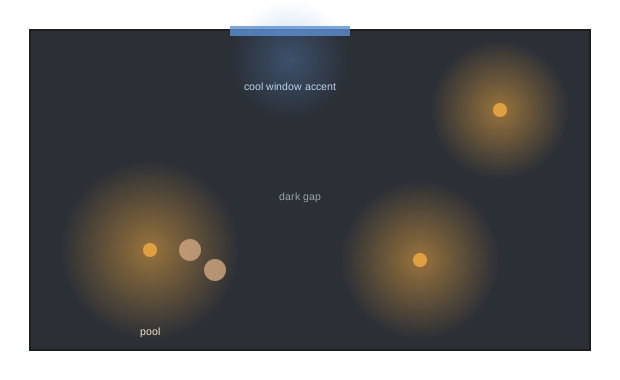
Night interiors differ from day interiors in several ways. Sources are small and local, so light falls off quickly and creates pools and dark areas rather than even ambience. Windows become dark or reflect the room, unless streetlight or moonlight enters. Colour comes from artificial sources: warm incandescent, cooler LED and fluorescent, coloured screens and signs. Contrast is usually higher, with deep shadows. These characteristics are the signature of night, and lighting that ignores them, for example filling a room evenly with soft light, makes a night scene look like day with the curtains closed.
Source logic at night
At night, the sources in the set should explain the light. A living room might be lit by two table lamps and a floor lamp; a kitchen by an overhead pendant and under-cabinet lights; a bedroom by a bedside lamp and moonlight through curtains; an office by desk lamps and the glow of monitors. As in day scenes, the cinematographer maps sources on a floor plan and decides which will key each actor at each position, which provide background interest, and where darkness will fall. Sources can be cheated for faces, but the overall impression of small, local, practical light should remain.
Exposing for darkness
A night scene must feel dark yet show what matters. Strategies include:
- Exposing faces near or slightly below their usual level, for example light skin around middle grey to half a stop over rather than a stop over, while letting backgrounds fall 2 to 4 stops below the faces.
- Including some true blacks and deep shadows in the frame, which tells the eye that it is night.
- Keeping some highlights, such as practicals, reflections and edge light, which give the darkness reference and sparkle.
- Exposing a little brighter than the final look and grading down, which keeps shadows cleaner (CINE-202).
- Avoiding pushing the camera to very high EI and underexposing, which brings noise.
Darkness is relative: a scene can feel very dark with faces at a normal exposure if the surroundings fall away to black and the sources are small. Monitoring on a calibrated display in a dim environment is essential, since a bright monitor on a sunny set makes night scenes look darker than they are.
| Element | Typical exposure relative to middle grey |
|---|---|
| Practical shades and bulbs | +2 to +5 stops (bulbs may clip) |
| Key side of faces | −0.5 to +1 stop depending on skin and mood |
| Shadow side of faces | −2 to −4 stops |
| Background walls | −2 to −5 stops |
| Deep corners | Below −5 stops (near black) |
Practical-led lighting
Many contemporary night interiors are lit largely by practicals, supplemented with small hidden sources. This approach, enabled by sensitive cameras and LED film bulbs, gives a natural look and lets actors move freely, since the light is part of the set. It requires careful control of each practical's brightness and colour (Lesson 6), additional practicals placed to light key areas, and small soft sources hidden to extend practical light to faces. A tip from many gaffers is to add more practicals than seem necessary, then dim them; a room with five dimmed lamps feels warmer and more natural than one with a single bright lamp.
Overhead and top light
Ceiling fixtures, pendants and overhead bulbs are common night sources. Pure top light is unflattering, creating dark eye sockets, but it can be powerful for mood, isolation or menace, as in Gordon Willis's work. To soften it, cinematographers use larger, more diffused overhead sources, such as a soft box or lantern above the frame line, positioned slightly in front of actors so that light reaches the eyes, and add a little bounce from tables, papers or laps. A pendant over a dining table is a classic night setup: the table bounces light up into faces, giving a warm, intimate look, while the room falls away into darkness.
Light from outside
Windows at night can bring light into a room from streetlights, neighbouring buildings, passing cars, moonlight or signs. These sources add depth, colour contrast and a sense of the world outside. Streetlight might come in as a cool or orange shaft through blinds; moonlight as a soft, cool wash; car headlights as moving beams across walls. Lights placed outside the window, often on stands or lifts, create these effects, with patterns from blinds or foliage. The level is usually low, a background accent rather than a key, though it can key a character for a dramatic beat, for example a face lit only by the light from a window.
Single-source and low-key approaches
Some of the most striking night interiors are lit by a single source: one lamp, one window, one screen. Single-source lighting creates strong shape and mood and directs attention, but it demands careful positioning of actors and camera, since anything outside the light disappears. Low-key lighting more generally keeps most of the frame dark, with selective highlights. It is common in thrillers, noir and drama. Fill, if any, is minimal and often comes from bounce off the set rather than added lights. Negative fill can deepen shadows further. In low-key scenes, edge light and practical highlights are especially important to separate dark subjects from dark backgrounds.
Worked problem
Lighting a confession scene
Two characters sit across a kitchen table at night, lit by a pendant lamp above the table. The director wants intimacy and tension, with the rest of the room falling into darkness. How might the cinematographer approach it?
Show solution
- Keep the pendant as the visible source, dimmed so its shade is about 3 stops above faces.
- Hide a soft source, such as a small LED lantern or soft box, just above frame on the same position as the pendant, slightly toward each actor, to light faces softly from above.
- Use a white tablecloth or papers to bounce light up into faces, filling the eye sockets.
- Flag the overhead light off the walls so the room falls 3 to 4 stops below faces, and add a dim practical in the background for depth.
- Add a faint cool edge from a window behind one actor for separation.
Answer: Motivate the key from the pendant with a hidden soft source above, fill from table bounce, flag the walls dark, and add a background practical and faint cool edge for depth.
Candlelight and firelight interiors
Candles and fireplaces were the main night sources before electricity and remain powerful for romance, period scenes and atmosphere. A single candle provides very little light, about one candela, so real candlelight scenes need fast lenses, high sensitivity and many candles, as famously in Stanley Kubrick's Barry Lyndon (1975), shot with extremely fast lenses. More commonly, candlelight is supplemented with small, warm sources at about 1,800 to 2,000 K placed near the candles, sometimes with flicker programmed to match the flames. Firelight from a fireplace is reproduced with warm sources low in the frame, flickered by dimmer effects, moving flags or dedicated fire-effect LEDs (Lesson 11). The flicker should be subtle and irregular; regular, obvious flicker looks artificial.
Colour at night
Night interiors offer rich colour choices. Warm practicals against cool window light create a classic contrast; matched warm sources create a sense of comfort; cool, desaturated light creates loneliness or clinical spaces; coloured sources, such as a red neon sign or blue screen, create stylized moods. The camera's white balance determines how warm practicals appear: balanced at 3,200 K, tungsten practicals look neutral and moonlight very blue; balanced at 4,300 K or higher, practicals look warm and moonlight more neutral. Many cinematographers choose a balance that keeps practicals slightly warm, which reads as night. Colour should support the story and remain consistent within scenes.
Moving actors through dark spaces
When actors walk through a dark house at night, the light on them should change as they pass sources: brighter near a lamp, dimmer between rooms, perhaps silhouetted against a lit doorway. This requires planning the path, placing sources or practicals along it, and controlling the light on actors as they move, through dimmer cues, flags operated by grips, or handheld sources moving with the camera. Very dark passages risk losing the actor entirely; a faint edge or a low ambient level can keep them readable. Moving through darkness is one of the most effective ways to build suspense, and lighting it well requires rehearsal with camera and electricians together.
Bedrooms, bathrooms and small rooms at night
Small rooms present particular challenges at night. There is little space to hide lights, ceilings are low, and every surface bounces light, raising ambience and reducing contrast. Common approaches include using practicals as the main sources, replacing bulbs with controllable film bulbs, hiding small LEDs behind furniture, above door frames or inside lampshades, and using negative fill such as black cloth on walls out of frame to keep contrast. In bathrooms, mirrors reflect everything, so lights must be placed carefully; the mirror itself can be used to bounce light onto faces. Removing walls on built sets, or shooting from doorways on location, gives space for the camera and lights.
Hospital, office and institutional nights
Institutional spaces at night, such as hospitals, offices, police stations and schools, are often lit by overhead fluorescent or LED panels left on at reduced levels, emergency lighting, exit signs and screens. Their light is typically cool, greenish or bluish, flat from above, and uncomfortable, which can be exactly the mood a scene needs. Reproducing it involves overhead soft sources with a slightly green or cool setting, perhaps with some fixtures dimmed or off to create pools, and screens or desk lamps as accents. For faces, a little fill from desks or papers prevents dark eye sockets. The coldness of these spaces contrasts strongly with warm domestic interiors, a contrast often used in drama.
Night interiors and windows from the inside
At night, windows from inside a lit room appear black or reflect the interior, unless something outside is lit. A completely black window can feel claustrophobic or ominous; a window showing distant city lights, a moonlit garden or a streetlight adds context and depth. Lighting the exterior for this purpose may involve placing a few lights outside to illuminate trees or a facade, using a translight or LED backing on stage, or choosing a location with an attractive view. Reflections of the interior in the glass must be controlled.
Testing night looks
Night interiors are especially sensitive to monitoring conditions, so testing them during prep is valuable. Shooting a short test with the production camera, LUT and stand-ins in a representative set, then viewing it in a dark room on a calibrated display, shows how dark the scene really is and whether faces hold detail. Tests also reveal noise levels at the chosen EI, the colour of practicals and the effect of the camera's white balance, allowing the cinematographer to refine the approach before the shoot and to show the director what the night scenes will feel like.
Common mistakes
MistakeFilling night interiors evenly.
InsteadLight in pools from local sources and keep darkness.
MistakeUnderexposing heavily at high EI.
InsteadExpose cleanly and grade down.
MistakeHarsh top light with black eye sockets by accident.
InsteadUse larger soft overhead sources and table bounce.
MistakeObvious regular candle flicker.
InsteadUse subtle, irregular flicker.
MistakeLosing actors in dark backgrounds.
InsteadAdd edge light or practical highlights.
Summary and key terms
- Night interiors are lit in pools from small local sources.
- Map night sources and decide where darkness will fall.
- Expose faces near normal and let surroundings fall 2–5 stops below.
- Practical-led lighting with hidden supplements looks natural.
- Soften overhead sources and use table bounce for faces.
- Window light from outside adds depth and colour contrast.
- Candles, firelight, colour and movement need subtle control.
- Pool of light
- Localized area lit by a small source.
- Low-key
- Lighting with mostly dark tones and selective highlights.
- Single-source lighting
- A scene lit by one apparent source.
- Top light
- Light from directly above.
- Table bounce
- Light reflected upward from a table surface.
- Practical-led lighting
- Lighting based mainly on visible practicals.
- Edge light
- Light outlining a subject from behind.
- Dimmer cue
- Planned change in a light's level during a shot.
- Firelight effect
- Warm flickering light imitating fire.
- Colour contrast
- Difference in colour between sources.
Practice problems
Work each problem on paper first, then reveal the answer to check.
How does night interior light differ from day?
Show answer
Small local sources, pools, higher contrast.
Where might faces sit relative to middle grey at night?
Show answer
About −0.5 to +1 stop.
How dark might background walls fall?
Show answer
2–5 stops below grey.
Why add extra practicals and dim them?
Show answer
A warmer, more natural feel.
How do you soften pendant top light?
Show answer
A larger soft source above, slightly forward, with table bounce.
Name two outside sources through windows at night.
Show answer
Streetlights, moonlight, car headlights, signs.
Why is edge light important in low key?
Show answer
It separates dark subjects from dark backgrounds.
Colour temperature of candlelight?
Show answer
About 1,800–2,000 K.
Which film used extremely fast lenses for candlelight?
Show answer
Barry Lyndon.
How do you light actors moving through darkness?
Show answer
Sources along the path, dimmer cues, moving flags or handheld lights.
Lesson quiz · 5 questions
Score 60% or more to complete this lesson.
Create a free account to save your progress, take quizzes and earn a certificate.